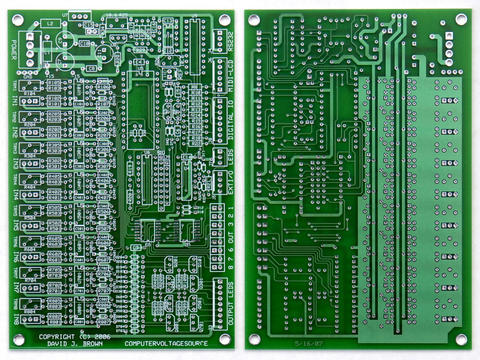
ComputerVoltageSources group photo

Yahoo Groups archive

ComputerVoltageSources

Archive for ComputerVoltageSources.

Index last updated: 2026-03-30 01:00 UTC

Thread

programming languages

programming languages

2006-03-09 by john mahoney

----- Original Message -----
From: "drmabuce" <drmabuce@...>
Subject: Re: Microprocessors in analog modules
[snip]
>
> i think it's worthwhile to ask how many folks would prefer graphic
> development to low-level MBASIC or C or Forth coding.***
> The number might justify the effort of a (ie) graphic-to-MBASIC
> compiler .... to someone!
> ...
> ***and then just to be a smartass we should ask how many people would
> prefer to develop direcly in assembler .... or.... OR THE PROCESSOR
> CODE.... WOW!!!!!! that stuff's REALLY FAST!!!!!
> uh....
> MBASIC still gets my vote BTW
> ;'>


As one wag put it, lower level languages give you the answer quicker, but
later. ;-)

MBASIC on the Atom Pro is fast enough for most of our purposes here. If a
need arises for particular routines to written in a lower level language,
I'd be willing to give it a go. Coding "to the bare metal" can be fun in
limited amounts.

Forth was brought up on the Synth-DIY list, as I recall. It's pretty obscure
to most folks but quite popular for embedded systems. A CVS* is an embedded
system, no? The cool thing about Forth is that hardcore programmers can
create a set of custom commands which can then be used by everyone else. So,
the pioneers have a steep slope to climb, but they are able to build a lift
for everyone else -- in theory, anyway. (Note: I am not suggesting that
Forth be the language of choice, especially since I don't know it! Heh...
MBASIC works, and it's pretty darn fast on the Atom Pro.)

Not to get all off-topic and nostalgic, but... my first languages were the
Apple ][ BASICs (Integer and Applesoft) and 6502 machine code and assembler,
more or less at the same time, way back in 19mumblemumble...
--
john


* CVS = Computer Voltage Source

Re: programming languages [forth]

2006-03-09 by data2action

ummm, forth... hadn't thot about it for a while, but there was
polansky & burk's HMSL (hierachical music specification language)
written in forth, and i think a java version that followed... as
dr.m. described, a bunch of routines that were compositionally
useful as building blocks... seems like eons ago. a whole different
universe than what we're talking about here. but those frog peak
guys did some nice stuff.

but not to stray... MBasic, just the ticket, yass yass... onward!

bbob


--- In ComputerVoltageSources@yahoogroups.com, "john mahoney"
<jmahoney@...> wrote:
>
> ----- Original Message -----
> From: "drmabuce" <drmabuce@...>
> Subject: Re: Microprocessors in analog modules
> [snip]
> >
> > i think it's worthwhile to ask how many folks would prefer
graphic
> > development to low-level MBASIC or C or Forth coding.***
> > The number might justify the effort of a (ie) graphic-to-MBASIC
> > compiler .... to someone!
> > ...
> > ***and then just to be a smartass we should ask how many people
would
> > prefer to develop direcly in assembler .... or.... OR THE
PROCESSOR
> > CODE.... WOW!!!!!! that stuff's REALLY FAST!!!!!
> > uh....
> > MBASIC still gets my vote BTW
> > ;'>
>
>
> As one wag put it, lower level languages give you the answer
quicker, but
> later. ;-)
>
> MBASIC on the Atom Pro is fast enough for most of our purposes
here. If a
> need arises for particular routines to written in a lower level
language,
> I'd be willing to give it a go. Coding "to the bare metal" can be
fun in
> limited amounts.
>
> Forth was brought up on the Synth-DIY list, as I recall. It's
pretty obscure
> to most folks but quite popular for embedded systems. A CVS* is an
embedded
> system, no? The cool thing about Forth is that hardcore
programmers can
> create a set of custom commands which can then be used by everyone
else. So,
> the pioneers have a steep slope to climb, but they are able to
build a lift
> for everyone else -- in theory, anyway. (Note: I am not suggesting
that
> Forth be the language of choice, especially since I don't know it!
Heh...
> MBASIC works, and it's pretty darn fast on the Atom Pro.)
>
> Not to get all off-topic and nostalgic, but... my first languages
were the
> Apple ][ BASICs (Integer and Applesoft) and 6502 machine code and
assembler,
> more or less at the same time, way back in 19mumblemumble...
> --
> john
>
>
> * CVS = Computer Voltage Source
>

Re: programming languages [forth]

2006-03-09 by drmabuce

hi bbob
--- In ComputerVoltageSources@yahoogroups.com, "data2action"
<rdrake@...> wrote:
>
> ummm, forth... hadn't thot about it for a while,

LOL
me neither!!! i had Forth CARTRIDGE for my C64's ...in fact i don't
think my headache subsided until about 1992!!!! (and then my kid was
born....OY!) (back to headaches!)
;'>


> a whole different
> universe than what we're talking about here. but those frog peak
> guys did some nice stuff.
>
> but not to stray... MBasic, just the ticket, yass yass... onward!
>

i agree
and the more i read on this group (BTW this HAS been especially
instructive folks! kudos & thanks!)
the more i'm convinced that if we want to see actual copper on a
PCB...and give the folks with soldering irons a fightin' chance...
then BasicMicro is the path.
...and that renders discussions of languages other than MBASIC (at the
moment) academic.... interesting perhaps.... but still academic!

(he says, hoping no one will notice that HE was one of the voices that
raised other languages...)

i want to see a PCB .... i want to write a check....
i want to code more eccentric MBASIC and impose my silliness on shiny
new DACS.

Avanti! BasicAtomPro!

-doc

Re: programming languages

2006-03-09 by drmabuce

Hi John

--- In ComputerVoltageSources@yahoogroups.com, "john mahoney"
<jmahoney@...> wrote:

>
> As one wag put it, lower level languages give you the answer
quicker, but
> later. ;-)
>
LOL!!!!!
LOL!!!! again!
that's a good one! i can't believe i missed that one!
-doc

Re: programming languages

2006-03-09 by Mike Marsh

Ah, Forth, the write-only language :p I once wrote a drum machine in
Forth on a VIC-20 (still have it) but went back to add triplets a
couple of months later and couldn't read my own code!

Mike

> Forth be the language of choice, especially since I don't know it!
Heh...

Re: programming languages

2006-03-09 by drmabuce

Hi Mike

--- In ComputerVoltageSources@yahoogroups.com, "Mike Marsh"
<michaelmarsh@...> wrote:
>
> Ah, Forth, the write-only language :p I once wrote a drum machine in
> Forth on a VIC-20 (still have it) but went back to add triplets a
> couple of months later and couldn't read my own code!

(uff da! YA!*)

me too

but without going TOO far OT...(i hope)....
in all fairness to the few and the proud....
i have seen some 'miracles of rare device' written in Forth ... i
guess it all comes down the compatibility of the tool and the hand
that must wield it....

but here and now....

i ain't a gonna worry about it until BasicMicro migrates the whole
BasicAtomPro product line to it!!!!!
;'>

-doc

(* just got off the phone with Digi-Key.... youuuuuu betcha!)

Re: programming languages

2006-03-09 by Grant Richter

There are two versions of the Basic Micro development software. One says something
about a C compiler. Anybody know what is up with that?

If we can use both MBasic and C together, then bonus.


--- In ComputerVoltageSources@yahoogroups.com, "drmabuce" <drmabuce@...> wrote:
>
> Hi Mike
>
> --- In ComputerVoltageSources@yahoogroups.com, "Mike Marsh"
> <michaelmarsh@> wrote:
> >
> > Ah, Forth, the write-only language :p I once wrote a drum machine in
> > Forth on a VIC-20 (still have it) but went back to add triplets a
> > couple of months later and couldn't read my own code!
>
> (uff da! YA!*)
>
> me too
>
> but without going TOO far OT...(i hope)....
> in all fairness to the few and the proud....
> i have seen some 'miracles of rare device' written in Forth ... i
> guess it all comes down the compatibility of the tool and the hand
> that must wield it....
>
> but here and now....
>
> i ain't a gonna worry about it until BasicMicro migrates the whole
> BasicAtomPro product line to it!!!!!
> ;'>
>
> -doc
>
> (* just got off the phone with Digi-Key.... youuuuuu betcha!)
>

Re: programming languages

2006-03-10 by djbrow54

I probably spent a day trying to get the C environment working. I
don't remember all the issues but I got nothing working. I posted a
note on the BasicMicro forum asking if anyone had success with C and
never got a reply. Months later someone else posted the same question
and didn't get any replies either. Haven't checked lately but I doubt
it. Assembly should also be a possibility but there is no
documentation on this nor passing variables.

Dave

--- In ComputerVoltageSources@yahoogroups.com, "Grant Richter"
<grichter@...> wrote:
>
> There are two versions of the Basic Micro development software. One
says something
> about a C compiler. Anybody know what is up with that?
>
> If we can use both MBasic and C together, then bonus.

Re: programming languages

2006-03-10 by djbrow54

I'm waiting for someone to suggest FOCAL. Anyone here that old?
Probably could still write it.

Dave

--- In ComputerVoltageSources@yahoogroups.com, "Mike Marsh"
<michaelmarsh@...> wrote:
>
> Ah, Forth, the write-only language :p I once wrote a drum machine in
> Forth on a VIC-20 (still have it) but went back to add triplets a
> couple of months later and couldn't read my own code!
>
> Mike
>
> > Forth be the language of choice, especially since I don't know it!
> Heh...

Re: [ComputerVoltageSources] Re: programming languages

2006-03-10 by john mahoney

I like the way this is shaping up:
BasicATOMPRO, naturally! (Been there, done that.)
Optional display, yes!
Optional MIDI, yes!
Input attenuators, yes!
Careful consideration given to voltage references and I/O levels and
scaling, yes!
Allowing for future expansion, yes!
MBASIC, sure!
A SpeakJet option would be fabulous.

Any display will be better than none at all, so I'd be happy with a 2x8.

Dave, I assume that you mean MOTM horizontal units when you refer to 1U and
2U. (BTW, the 0.5U MOTM format was recently born on the MOTM list. It's
still just a concept but it seems likely to become real.) We can't forget
the Frac Rack folks, though.


Caution: OT comments, ahead.

Speaking of MOTM, y'all may know that Paul Schrieber's manufacturing
partner, Paul Haneberg, has suffered a stroke. The prognosis seems pretty
good (it was presumably a mild stroke), but please send your good energy,
prayers, magic spells, etc., his way -- whatever works for you.


> Just spent some time on the phone with John Loffink discussing ...

What's a "phone"? ;-)


> I'm waiting for someone to suggest FOCAL. Anyone here that old?
> Probably could still write it.

Don't know that one. We had a FOCUS programmer in our department once, but I
assume that it's something else (was mainly for report generation, AFAIK).
--
john

Re: programming languages

2006-03-10 by djbrow54

--- In ComputerVoltageSources@yahoogroups.com, "john mahoney"
<jmahoney@...> wrote:
> I like the way this is shaping up:
> Input attenuators, yes!

Mine are not input attenuators. They are 0 - 10 volt controls sourced
from a regulator and normalled to the inputs. With no input plug the
controls provide 0 to 10 volts. With an input plug, the controls are
disconnected and there is no attenuation

> A SpeakJet option would be fabulous

I haven't really done much with my SpeakJet. I did just buy the
TTS256 to play with. I do use a general pin to interface to the
SpeakJet. Interrupts have to be disabled to send data using the
serial commands. I also used the buffer half full flag instead of
speaking flag to speed things up by using the buffer. However, you
can't effectively put pauses in with program delays since you don't
know when the chip is speaking. You have to program in the pauses. In
retrospect I might have used the speaking flag but this all changes
when using the TTS256.

> Dave, I assume that you mean MOTM horizontal units when you refer to
1U and 2U. (BTW, the 0.5U MOTM format was recently born on the MOTM
list.

Yes

> > Just spent some time on the phone with John Loffink discussing ...
> What's a "phone"? ;-)

It took me a bit to remember how to dial long distance :)

> > I'm waiting for someone to suggest FOCAL. Anyone here that old?
> > Probably could still write it.
> Don't know that one. We had a FOCUS programmer in our department
> once, but I assume that it's something else.

Focal was a PDP-8 high level programming language where commands were
single character. Pretty efficient. ALso did PL/M for any old-timers
out there. See http://en.wikipedia.org/wiki/FOCAL

Dave

Re: programming languages

2006-03-10 by Grant Richter

That is how I have my PSIM setup now. It works fine for the most part.

Since we are spinning a new board, I think it would be useful to have full synthesizer style
inputs. That is algebraic summing with offset and span for each channel. Plus calibratable
voltage inputs, so you can compute in real floating point voltages and interface 1 volt per
octave keyboards.

It is just one TL072 per channel, or two TL074s instead of one. The cost impact is minimal
compared to the DAC cost.

I have a 36 dB per ocatave reconstruction filter for the Speakjet 1, it sounds better than
the one given in the app notes. I was hoping the Speakjet 2 would be out by now, it was
supposed to have ADSRs in it.

--- In ComputerVoltageSources@yahoogroups.com, "djbrow54" <davebr@...> wrote:
>
> --- In ComputerVoltageSources@yahoogroups.com, "john mahoney"
> <jmahoney@> wrote:
> > I like the way this is shaping up:
> > Input attenuators, yes!
>
> Mine are not input attenuators. They are 0 - 10 volt controls sourced
> from a regulator and normalled to the inputs. With no input plug the
> controls provide 0 to 10 volts. With an input plug, the controls are
> disconnected and there is no attenuation
>
> > A SpeakJet option would be fabulous
>
> I haven't really done much with my SpeakJet. I did just buy the
> TTS256 to play with. I do use a general pin to interface to the
> SpeakJet. Interrupts have to be disabled to send data using the
> serial commands. I also used the buffer half full flag instead of
> speaking flag to speed things up by using the buffer. However, you
> can't effectively put pauses in with program delays since you don't
> know when the chip is speaking. You have to program in the pauses. In
> retrospect I might have used the speaking flag but this all changes
> when using the TTS256.
>
> > Dave, I assume that you mean MOTM horizontal units when you refer to
> 1U and 2U. (BTW, the 0.5U MOTM format was recently born on the MOTM
> list.
>
> Yes
>
> > > Just spent some time on the phone with John Loffink discussing ...
> > What's a "phone"? ;-)
>
> It took me a bit to remember how to dial long distance :)
>
> > > I'm waiting for someone to suggest FOCAL. Anyone here that old?
> > > Probably could still write it.
> > Don't know that one. We had a FOCUS programmer in our department
> > once, but I assume that it's something else.
>
> Focal was a PDP-8 high level programming language where commands were
> single character. Pretty efficient. ALso did PL/M for any old-timers
> out there. See http://en.wikipedia.org/wiki/FOCAL
>
> Dave
>

useful input structures and not so useful input structures

2006-03-10 by drmabuce

Hi All

--- In ComputerVoltageSources@yahoogroups.com, "Grant Richter"
<grichter@...> wrote:
>
> Since we are spinning a new board, I think it would be useful to
have full synthesizer style
> inputs. That is algebraic summing with offset and span for each
channel. Plus calibratable
> voltage inputs, so you can compute in real floating point voltages
and interface 1 volt per
> octave keyboards.
>
I built this type of input structure for my PSIM and found it to be
REALLY useful so i endorse this feature strongly.

The added cost and footprint of the input summing amps (and the extra
knoibs & pots) can be easily bypassed if the user/kit builder does not
require them.

While i'm on the subject...
('oh boy' the list groans , 'we KNEW he couldn't stick to just ONE
topic in a message!')
let me describe a 'feature' that i added to my PSIM that i'm NOT
endorsing for the theoretical CVS gadget.
(but that might tickle the fancy of other bomb-throwing musical
bolsheviks out there)

i normalled a transistor-type analog noise (scaled 0-10V) to input
one. The inernal random function was 'repeating' a little too much for
my persnickety tastes in randomness. when i need a little
unpredictability left over from the big bang i just sample input one,
(assuming that nothing external is plugged into it) and voila! All i
have to do is scale the result, using simple division, to whatever
range is required by the software.
Rest assured the software i release does not exploit this
idiosyncratic mod.

to infinity! and beyond!
-doc

Re: [ComputerVoltageSources] useful input structures and not so useful input structures

2006-03-10 by Andrew Scheidler

There are 3 modules I use regularly on the Input side of my PSIM:

Blacet VC LFO - running at high speed, the 0~10v waves are great as a random voltage source.

Wiard Joystick - for easy 0~10v or a gate, nothing is easier; nice visual feedback too.

Blacet Mixer/Processor - perfect for mixing & shifting voltages; being able to easily invert and adjust bias comes in very handy.

Andrew

BO PEEP:
Whadda ya say I get someone else to watch the sheep tonight?


>>> drmabuce@... 03/10/06 9:55 AM >>>
I built this type of input structure for my PSIM and found it to be
REALLY useful so i endorse this feature strongly.

The added cost and footprint of the input summing amps (and the extra
knoibs & pots) can be easily bypassed if the user/kit builder does not
require them.

While i'm on the subject...
('oh boy' the list groans , 'we KNEW he couldn't stick to just ONE
topic in a message!')
let me describe a 'feature' that i added to my PSIM that i'm NOT
endorsing for the theoretical CVS gadget.
(but that might tickle the fancy of other bomb-throwing musical
bolsheviks out there)

i normalled a transistor-type analog noise (scaled 0-10V) to input
one. The inernal random function was 'repeating' a little too much for
my persnickety tastes in randomness. when i need a little
unpredictability left over from the big bang i just sample input one,
(assuming that nothing external is plugged into it) and voila! All i
have to do is scale the result, using simple division, to whatever
range is required by the software.
Rest assured the software i release does not exploit this
idiosyncratic mod.

to infinity! and beyond!
-doc

Re: [ComputerVoltageSources] Re: programming languages

2006-03-10 by xamboldt

This may be drifting a little OT, but I'm wondering why you couldn't
just wire the 10V source to the normalling lug of the input jack, and
then wire the tip lug to the attenuating pot, so that it would act as
an attenuator for the 10V source or any signal you plugged in...

Am I missing something? It would be far from the first time :)

-Chris


On Mar 10, 2006, at 12:30 AM, djbrow54 wrote:

> --- In ComputerVoltageSources@yahoogroups.com, "john mahoney"
> <jmahoney@...> wrote:
> > I like the way this is shaping up:
> > Input attenuators, yes!
>
> Mine are not input attenuators. They are 0 - 10 volt controls sourced
> from a regulator and normalled to the inputs. With no input plug the
> controls provide 0 to 10 volts. With an input plug, the controls are
> disconnected and there is no attenuation
>
> > A SpeakJet option would be fabulous
>
> I haven't really done much with my SpeakJet. I did just buy the
> TTS256 to play with. I do use a general pin to interface to the
> SpeakJet. Interrupts have to be disabled to send data using the
> serial commands. I also used the buffer half full flag instead of
> speaking flag to speed things up by using the buffer. However, you
> can't effectively put pauses in with program delays since you don't
> know when the chip is speaking. You have to program in the pauses. In
> retrospect I might have used the speaking flag but this all changes
> when using the TTS256.
>
> > Dave, I assume that you mean MOTM horizontal units when you refer to
> 1U and 2U. (BTW, the 0.5U MOTM format was recently born on the MOTM
> list.
>
> Yes
>
> > > Just spent some time on the phone with John Loffink discussing ...
> > What's a "phone"? ;-)
>
> It took me a bit to remember how to dial long distance :)
>
> > > I'm waiting for someone to suggest FOCAL. Anyone here that old?
> > > Probably could still write it.
> > Don't know that one. We had a FOCUS programmer in our department
> > once, but I assume that it's something else.
>
> Focal was a PDP-8 high level programming language where commands were
> single character. Pretty efficient. ALso did PL/M for any old-timers
> out there. See http://en.wikipedia.org/wiki/FOCAL
>
> Dave
>
>
>
>
>
> SPONSORED LINKS
> Music instrument stores Electronic Instruments
> Module
>
> YAHOO! GROUPS LINKS
>
> Visit your group "ComputerVoltageSources" on the web.
>
> To unsubscribe from this group, send an email to:
> ComputerVoltageSources-unsubscribe@yahoogroups.com
>
> Your use of Yahoo! Groups is subject to the Yahoo! Terms of Service.
>
>

Re: programming languages

2006-03-10 by drmabuce

Hi Chris

--- In ComputerVoltageSources@yahoogroups.com, xamboldt <xamboldt@...>
wrote:
>
> This may be drifting a little OT,

not at all!
in fact, one of the reaons i'm riding these threads so hard is that
NOW is the time to brainstorm these issues , and get on with it
so.... fire away!

> but I'm wondering why you couldn't
> just wire the 10V source to the normalling lug of the input jack, and
> then wire the tip lug to the attenuating pot, so that it would act as
> an attenuator for the 10V source or any signal you plugged in...
>
> Am I missing something? It would be far from the first time :)

that'd work fine (ya might want a resistor in series to limit the
current in the quick zap that happens while the plug passes thru....
but it would work fine

(but what Grant proposes below)

> Since we are spinning a new board, I think it would be useful to
have full synthesizer style
> inputs. That is algebraic summing with offset and span for each
channel. Plus calibratable
> voltage inputs, so you can compute in real floating point voltages
and interface 1 volt per
> octave keyboards.
>

yields OFFSET
and (speaking strictly for myself) i've found offset to be invaluable
when interfacing to a wide range of external gadgets.

that's why i'm behind this one!

best,
-doc

Re: programming languages

2006-03-10 by Mike Marsh

This was my experience, too :( though I only spent about half a day
trying it. I'm not sure in this environment whether C would create
code that was any faster than BASIC. That's what I wanted to test...

Mike

--- In ComputerVoltageSources@yahoogroups.com, "djbrow54" <davebr@...>
wrote:
>
> I probably spent a day trying to get the C environment working. I
> don't remember all the issues but I got nothing working. I posted a
> note on the BasicMicro forum asking if anyone had success with C and
> never got a reply. Months later someone else posted the same question
> and didn't get any replies either. Haven't checked lately but I doubt
> it. Assembly should also be a possibility but there is no
> documentation on this nor passing variables.
>
> Dave
>
> --- In ComputerVoltageSources@yahoogroups.com, "Grant Richter"
> <grichter@> wrote:
> >
> > There are two versions of the Basic Micro development software. One
> says something
> > about a C compiler. Anybody know what is up with that?
> >
> > If we can use both MBasic and C together, then bonus.
>

Re: programming languages

2006-03-10 by Gary Chang

"drmabuce" <drmabuce@...> wrote:
>

> in fact, one of the reaons i'm riding these threads so hard is that
> NOW is the time to brainstorm these issues , and get on with it
> so.... fire away!
>

Well, then, I am constantly patching a SLEW to smooth the output of
the PSIM - I get a faint zippering when it is an LFO, controlling
JAG-VCAs for location...

gary

Trial Faceplate Layout

2006-03-10 by Grant Richter

I guess we could add the option of a slew limiter for each ouput. If you want, populate the
board and wire you jacks to a differnt set of ouputs. That will add 4 more pots and
possibly 4 more jacks if you want both.

At this point we are up to 12 knobs, 19 jacks, 6 LEDs, three 5 pin DIN connectors and a
DB9 connector.

With 1/4" connectors, that is like half a 19 "rack. Same with Frac-Rac, a very big faceplate.
Then if you add a LCD display somewhere...

Any more stuff and the faceplate will be so expensive it will be too expensive for students
and beginning hobbiests.

For those who want to begin laying out faceplates, the faceplate component list is:

Jacks:
1 v/oct in 1-4
Variable CV in 1-4
CV out 1-4
Run Pulse in
Stop Pulse in
Speech out jack
Gate out jack
Trig out jack
Gate in jack
Trig in jack = 19

Pushbuttons:

Run / Stop = 2

Knobs:

CV offset 1-4
CV attenuator 1-4
Ouput slew 1-4 = 12

5 pin DIN:
MIDI in
MIDI out
DIN in or out = 3

DB9 for programing interface

LEDs:

CV indicators 1-4
Run / Stop LEDs = 6 total

Who is going to volunteer to do layouts in .fpd fromat?

One for MOTM and one for Frac-Rac. That will give us some idea of PC board dimensions
to work with.

I think we can use the Metalbox style 1900H knobs and Alpha pots for Frac-Rac.
The jack spacing should accept either Switchcraft (Blacet) or 16PJ135 (Wiard) jacks.
The 16PJ135 jacks wire up very neatly because of the ground tangs being in-line.
The knurled nuts are designed to be assembled with fingernails, so that is one less tool
you need.

--- In ComputerVoltageSources@yahoogroups.com, "Gary Chang" <gchang@...> wrote:
>
> "drmabuce" <drmabuce@> wrote:
> >
>
> > in fact, one of the reaons i'm riding these threads so hard is that
> > NOW is the time to brainstorm these issues , and get on with it
> > so.... fire away!
> >
>
> Well, then, I am constantly patching a SLEW to smooth the output of
> the PSIM - I get a faint zippering when it is an LFO, controlling
> JAG-VCAs for location...
>
> gary
>

Re: [ComputerVoltageSources] Trial Faceplate Layout

2006-03-10 by xamboldt

Can of worms warning!

Should the PCB be laid out so as to allow PCB-mounted pots for
perhaps 4 or 6 of the controls? Different front panel formats could
be allowed for by simply doing point-to-point wiring instead of PCB
mounting the pots. The difficulty comes in deciding which format
would be used to dictate the spacing of holes for the PCB-mounted
pots. Both Blacet and MOTM have standards we could appropriate for
PCB-mounted pots. The CVS' pots (as spelled out by Grant) are grouped
in functional units of 4, and that is the typical max vertical
allowance of pots on an MOTM panel. Blacet has up to 6 maximum, but
plenty of designs have fewer pots.

I guess someone had to bring it up.... :)

-Chris


>
> I think we can use the Metalbox style 1900H knobs and Alpha pots
> for Frac-Rac.
> The jack spacing should accept either Switchcraft (Blacet) or
> 16PJ135 (Wiard) jacks.
> The 16PJ135 jacks wire up very neatly because of the ground tangs
> being in-line.
> The knurled nuts are designed to be assembled with fingernails, so
> that is one less tool
> you need.

Re: Trial Faceplate Layout

2006-03-10 by data2action

ummm... user interface... finally something i might be able to
contribute to... UI should really come last, but sometimes it helps
to visualize what it might look like even while we're still
brainstorming...

i think you're right, grant, the full feature set would take up a lot
of panel real estate, in both frac and motm. i'd suggest starting
with a "kitchen sink" version implementing all options, but to
eventually have some alternate versions scaled down for specific
users...
i'm not much of a midi guy, so i might want one without DIN; someone
else might want to use the PCB to implement a dedicated quantizer or
arpegiattor, they might sacrafice almost everthing, even the serial
port...

consequences of that plan might be: to limit one diminsion of the PCB
to some lowest-common-denominator width (3" wide for frac, horizontal
mount); and flying wires for jacks to accomidate the various
layouts...

b


--- In ComputerVoltageSources@yahoogroups.com, "Grant Richter"
<grichter@...> wrote:
>
> I guess we could add the option of a slew limiter for each ouput.
If you want, populate the
> board and wire you jacks to a differnt set of ouputs. That will add
4 more pots and
> possibly 4 more jacks if you want both.
>
> At this point we are up to 12 knobs, 19 jacks, 6 LEDs, three 5 pin
DIN connectors and a
> DB9 connector.
>
> With 1/4" connectors, that is like half a 19 "rack. Same with Frac-
Rac, a very big faceplate.
> Then if you add a LCD display somewhere...
>
> Any more stuff and the faceplate will be so expensive it will be
too expensive for students
> and beginning hobbiests.
>
> For those who want to begin laying out faceplates, the faceplate
component list is:
>
> Jacks:
> 1 v/oct in 1-4
> Variable CV in 1-4
> CV out 1-4
> Run Pulse in
> Stop Pulse in
> Speech out jack
> Gate out jack
> Trig out jack
> Gate in jack
> Trig in jack = 19
>
> Pushbuttons:
>
> Run / Stop = 2
>
> Knobs:
>
> CV offset 1-4
> CV attenuator 1-4
> Ouput slew 1-4 = 12
>
> 5 pin DIN:
> MIDI in
> MIDI out
> DIN in or out = 3
>
> DB9 for programing interface
>
> LEDs:
>
> CV indicators 1-4
> Run / Stop LEDs = 6 total
>
> Who is going to volunteer to do layouts in .fpd fromat?
>
> One for MOTM and one for Frac-Rac. That will give us some idea of
PC board dimensions
> to work with.
>
> I think we can use the Metalbox style 1900H knobs and Alpha pots
for Frac-Rac.
> The jack spacing should accept either Switchcraft (Blacet) or
16PJ135 (Wiard) jacks.
> The 16PJ135 jacks wire up very neatly because of the ground tangs
being in-line.
> The knurled nuts are designed to be assembled with fingernails, so
that is one less tool
> you need.
>
> --- In ComputerVoltageSources@yahoogroups.com, "Gary Chang"
<gchang@> wrote:
> >
> > "drmabuce" <drmabuce@> wrote:
> > >
> >
> > > in fact, one of the reaons i'm riding these threads so hard is
that
> > > NOW is the time to brainstorm these issues , and get on with it
> > > so.... fire away!
> > >
> >
> > Well, then, I am constantly patching a SLEW to smooth the output
of
> > the PSIM - I get a faint zippering when it is an LFO, controlling
> > JAG-VCAs for location...
> >
> > gary
> >
>

Re: [ComputerVoltageSources] Trial Faceplate Layout

2006-03-10 by xamboldt

Or... if pots aren't PCB-mounted, what panel components should be?
MIDI Jacks? DIN? LEDs? We've already heard that DIN might not be
something everyone would want...

Would there be room for 4 pots and MIDI I/O?

-Chris

On Mar 10, 2006, at 3:10 PM, xamboldt wrote:

> Can of worms warning!
>
> Should the PCB be laid out so as to allow PCB-mounted pots for
> perhaps 4 or 6 of the controls? Different front panel formats could
> be allowed for by simply doing point-to-point wiring instead of PCB
> mounting the pots. The difficulty comes in deciding which format
> would be used to dictate the spacing of holes for the PCB-mounted
> pots. Both Blacet and MOTM have standards we could appropriate for
> PCB-mounted pots. The CVS' pots (as spelled out by Grant) are grouped
> in functional units of 4, and that is the typical max vertical
> allowance of pots on an MOTM panel. Blacet has up to 6 maximum, but
> plenty of designs have fewer pots.
>
> I guess someone had to bring it up.... :)
>
> -Chris
>
>
> >
> > I think we can use the Metalbox style 1900H knobs and Alpha pots
> > for Frac-Rac.
> > The jack spacing should accept either Switchcraft (Blacet) or
> > 16PJ135 (Wiard) jacks.
> > The 16PJ135 jacks wire up very neatly because of the ground tangs
> > being in-line.
> > The knurled nuts are designed to be assembled with fingernails, so
> > that is one less tool
> > you need.
>

Re: Trial Faceplate Layout

2006-03-10 by Grant Richter

First, no offense to Chris for an excellent question.

Don't talk to me about "no screw holes in the faceplate" that is why you don't see Wiard
modules in MOTM format. That idea is insulting to any designer.

Spend your time thinking about MUSIC, forget the g*dd*mn screwholes, get some therapy
for your out of control OCD behavior, how many times do you wash your hands a
day?????????????????? (loud hissing of steam escaping from ears).

I apologize for the rant, silly limitations really annoy me.

There is no advantage to ANY panel mounted components being in hard copper on the PC
board.

What if someone wants to use it for controlling dimmer packs for a hobby theater?
Then the board would be bench top mounted horizontally and the pots would be slide
pots. It could support both 0-10 volt packs and the MIDI controlled ones.

What about using it to control servo laser scanners for a laserium light show? (those are
voltage outputs to current drivers)

What if all the pots are force sensing resistors built into a dancers suit?

What about if it is used for squib control to light the "Burning Man" on fire when
Interstellar Overdrive reaches the climax?

OK, those are meant to be humorous examples, but also practical applications.

I don't see an anvantage favoring any mounting position or potentiometer type, spacing or
placement. I would just use the Wiard pigtail pot assembly method. That is each pot,
switch or whatever has a dedicated 0.100 KK connector. You can always solder directly to
the PC pads and skip the connectors.

I would use the extra space for as much perf board area as possible for hanging more
experimenters chips, sensors, high current servo drivers etc.

We will have holes in the right spots for that MOTM metal bracket thingy. Can sombody
tell me what that spacing and hole size is?

A 4 x 6 board will fit in a Frac-Rac. Is 6-7 inches too deep for MOTM and Doepfer racks?


--- In ComputerVoltageSources@yahoogroups.com, xamboldt <xamboldt@...> wrote:
>
> Or... if pots aren't PCB-mounted, what panel components should be?
> MIDI Jacks? DIN? LEDs? We've already heard that DIN might not be
> something everyone would want...
>
> Would there be room for 4 pots and MIDI I/O?
>
> -Chris
>
> On Mar 10, 2006, at 3:10 PM, xamboldt wrote:
>
> > Can of worms warning!
> >
> > Should the PCB be laid out so as to allow PCB-mounted pots for
> > perhaps 4 or 6 of the controls? Different front panel formats could
> > be allowed for by simply doing point-to-point wiring instead of PCB
> > mounting the pots. The difficulty comes in deciding which format
> > would be used to dictate the spacing of holes for the PCB-mounted
> > pots. Both Blacet and MOTM have standards we could appropriate for
> > PCB-mounted pots. The CVS' pots (as spelled out by Grant) are grouped
> > in functional units of 4, and that is the typical max vertical
> > allowance of pots on an MOTM panel. Blacet has up to 6 maximum, but
> > plenty of designs have fewer pots.
> >
> > I guess someone had to bring it up.... :)
> >
> > -Chris
> >
> >
> > >
> > > I think we can use the Metalbox style 1900H knobs and Alpha pots
> > > for Frac-Rac.
> > > The jack spacing should accept either Switchcraft (Blacet) or
> > > 16PJ135 (Wiard) jacks.
> > > The 16PJ135 jacks wire up very neatly because of the ground tangs
> > > being in-line.
> > > The knurled nuts are designed to be assembled with fingernails, so
> > > that is one less tool
> > > you need.
> >
>

Re: [ComputerVoltageSources] Re: Trial Faceplate Layout

2006-03-10 by David Kronemyer

If I could just chime in here, it¹s crazy to mount anything to the PCB
except for wires. A few good twists (as in knobs) or push-pulls (as in
plugs) and they¹re history. For lack of a better expression, they ³torque
out² (an old surfing term). This is why e.g. Whirlwind stage boxes (with
which I have too much familiarity) tend to fall apart quickly ­ all the
connectors are PCB mounted. DAVID


On 3/10/06 1:49 PM, "Grant Richter" <grichter@...> wrote:

> First, no offense to Chris for an excellent question.
>
> Don't talk to me about "no screw holes in the faceplate" that is why you don't
> see Wiard
> modules in MOTM format. That idea is insulting to any designer.
>
> Spend your time thinking about MUSIC, forget the g*dd*mn screwholes, get some
> therapy
> for your out of control OCD behavior, how many times do you wash your hands a
> day?????????????????? (loud hissing of steam escaping from ears).
>
> I apologize for the rant, silly limitations really annoy me.
>
> There is no advantage to ANY panel mounted components being in hard copper on
> the PC
> board.
>
> What if someone wants to use it for controlling dimmer packs for a hobby
> theater?
> Then the board would be bench top mounted horizontally and the pots would be
> slide
> pots. It could support both 0-10 volt packs and the MIDI controlled ones.
>
> What about using it to control servo laser scanners for a laserium light show?
> (those are
> voltage outputs to current drivers)
>
> What if all the pots are force sensing resistors built into a dancers suit?
>
> What about if it is used for squib control to light the "Burning Man" on fire
> when
> Interstellar Overdrive reaches the climax?
>
> OK, those are meant to be humorous examples, but also practical applications.
>
> I don't see an anvantage favoring any mounting position or potentiometer type,
> spacing or
> placement. I would just use the Wiard pigtail pot assembly method. That is
> each pot,
> switch or whatever has a dedicated 0.100 KK connector. You can always solder
> directly to
> the PC pads and skip the connectors.
>
> I would use the extra space for as much perf board area as possible for
> hanging more
> experimenters chips, sensors, high current servo drivers etc.
>
> We will have holes in the right spots for that MOTM metal bracket thingy. Can
> sombody
> tell me what that spacing and hole size is?
>
> A 4 x 6 board will fit in a Frac-Rac. Is 6-7 inches too deep for MOTM and
> Doepfer racks?
>
>
>
>
> --- In ComputerVoltageSources@yahoogroups.com, xamboldt <xamboldt@...> wrote:
>> >
>> > Or... if pots aren't PCB-mounted, what panel components should be?
>> > MIDI Jacks? DIN? LEDs? We've already heard that DIN might not be
>> > something everyone would want...
>> >
>> > Would there be room for 4 pots and MIDI I/O?
>> >
>> > -Chris
>> >
>> > On Mar 10, 2006, at 3:10 PM, xamboldt wrote:
>> >
>>> > > Can of worms warning!
>>> > >
>>> > > Should the PCB be laid out so as to allow PCB-mounted pots for
>>> > > perhaps 4 or 6 of the controls? Different front panel formats could
>>> > > be allowed for by simply doing point-to-point wiring instead of PCB
>>> > > mounting the pots. The difficulty comes in deciding which format
>>> > > would be used to dictate the spacing of holes for the PCB-mounted
>>> > > pots. Both Blacet and MOTM have standards we could appropriate for
>>> > > PCB-mounted pots. The CVS' pots (as spelled out by Grant) are grouped
>>> > > in functional units of 4, and that is the typical max vertical
>>> > > allowance of pots on an MOTM panel. Blacet has up to 6 maximum, but
>>> > > plenty of designs have fewer pots.
>>> > >
>>> > > I guess someone had to bring it up.... :)
>>> > >
>>> > > -Chris
>>> > >
>>> > >
>>>> > > >
>>>> > > > I think we can use the Metalbox style 1900H knobs and Alpha pots
>>>> > > > for Frac-Rac.
>>>> > > > The jack spacing should accept either Switchcraft (Blacet) or
>>>> > > > 16PJ135 (Wiard) jacks.
>>>> > > > The 16PJ135 jacks wire up very neatly because of the ground tangs
>>>> > > > being in-line.
>>>> > > > The knurled nuts are designed to be assembled with fingernails, so
>>>> > > > that is one less tool
>>>> > > > you need.
>>> > >
>> >
>
>
>
>
>
>
>
> SPONSORED LINKS
>
> Music instrument stores
> <http://groups.yahoo.com/gads?t=ms&k=Music+instrument+stores&w1=Music+instrume
> nt+stores&w2=Electronic&w3=Instruments&w4=Module&c=4&s=74&.sig=sl1GY0kdfizgobJ
> LyCnG4g> Electronic
> <http://groups.yahoo.com/gads?t=ms&k=Electronic&w1=Music+instrument+stores&w2=
> Electronic&w3=Instruments&w4=Module&c=4&s=74&.sig=lQYNIdCzB9Es_s-ln81AvQ>
> Instruments
> <http://groups.yahoo.com/gads?t=ms&k=Instruments&w1=Music+instrument+stores&w2
> =Electronic&w3=Instruments&w4=Module&c=4&s=74&.sig=e6Jlo4KGQihWioYCcIZjjQ>
> Module
> <http://groups.yahoo.com/gads?t=ms&k=Module&w1=Music+instrument+stores&w2=Elec
> tronic&w3=Instruments&w4=Module&c=4&s=74&.sig=sPALVFXECM0JfHcmogn8UA>
>
>
>
> YAHOO! GROUPS LINKS
>
> * Visit your group "ComputerVoltageSources
> <http://groups.yahoo.com/group/ComputerVoltageSources> " on the web.
> *
> * To unsubscribe from this group, send an email to:
> * ComputerVoltageSources-unsubscribe@yahoogroups.com
> <mailto:ComputerVoltageSources-unsubscribe@yahoogroups.com?subject=Unsubscribe
> >
> *
> * Your use of Yahoo! Groups is subject to the Yahoo! Terms of Service
> <http://docs.yahoo.com/info/terms/> .
>
>
>
>


[Non-text portions of this message have been removed]

[OT]Re: Trial Faceplate Layout

2006-03-10 by Mike Marsh

[OT] Small rant of my own:

I don't recall seeing ANY screwholes on any MOTM module, and I have a
few. My Wiard Joystick on the other hand...I may have misread this
post, and if I have I apologize. It is entirely possible to put Wiard
modules behind an MOTM faceplate without screwholes, so the reason we
don't see Wiard modules in MOTM format must be something else.

Mike

--- In ComputerVoltageSources@yahoogroups.com, "Grant Richter"
<grichter@...> wrote:
>
> First, no offense to Chris for an excellent question.
>
> Don't talk to me about "no screw holes in the faceplate" that is why
you don't see Wiard
> modules in MOTM format. That idea is insulting to any designer.
>
> Spend your time thinking about MUSIC, forget the g*dd*mn screwholes,
get some therapy
> for your out of control OCD behavior, how many times do you wash
your hands a
> day?????????????????? (loud hissing of steam escaping from ears).
>
> I apologize for the rant, silly limitations really annoy me.
>
> There is no advantage to ANY panel mounted components being in hard
copper on the PC
> board.
>
> What if someone wants to use it for controlling dimmer packs for a
hobby theater?
> Then the board would be bench top mounted horizontally and the pots
would be slide
> pots. It could support both 0-10 volt packs and the MIDI controlled
ones.
>
> What about using it to control servo laser scanners for a laserium
light show? (those are
> voltage outputs to current drivers)
>
> What if all the pots are force sensing resistors built into a
dancers suit?
>
> What about if it is used for squib control to light the "Burning
Man" on fire when
> Interstellar Overdrive reaches the climax?
>
> OK, those are meant to be humorous examples, but also practical
applications.
>
> I don't see an anvantage favoring any mounting position or
potentiometer type, spacing or
> placement. I would just use the Wiard pigtail pot assembly method.
That is each pot,
> switch or whatever has a dedicated 0.100 KK connector. You can
always solder directly to
> the PC pads and skip the connectors.
>
> I would use the extra space for as much perf board area as possible
for hanging more
> experimenters chips, sensors, high current servo drivers etc.
>
> We will have holes in the right spots for that MOTM metal bracket
thingy. Can sombody
> tell me what that spacing and hole size is?
>
> A 4 x 6 board will fit in a Frac-Rac. Is 6-7 inches too deep for
MOTM and Doepfer racks?
>
>
>
>
> --- In ComputerVoltageSources@yahoogroups.com, xamboldt <xamboldt@>
wrote:
> >
> > Or... if pots aren't PCB-mounted, what panel components should be?
> > MIDI Jacks? DIN? LEDs? We've already heard that DIN might not be
> > something everyone would want...
> >
> > Would there be room for 4 pots and MIDI I/O?
> >
> > -Chris
> >
> > On Mar 10, 2006, at 3:10 PM, xamboldt wrote:
> >
> > > Can of worms warning!
> > >
> > > Should the PCB be laid out so as to allow PCB-mounted pots for
> > > perhaps 4 or 6 of the controls? Different front panel formats could
> > > be allowed for by simply doing point-to-point wiring instead of PCB
> > > mounting the pots. The difficulty comes in deciding which format
> > > would be used to dictate the spacing of holes for the PCB-mounted
> > > pots. Both Blacet and MOTM have standards we could appropriate for
> > > PCB-mounted pots. The CVS' pots (as spelled out by Grant) are
grouped
> > > in functional units of 4, and that is the typical max vertical
> > > allowance of pots on an MOTM panel. Blacet has up to 6 maximum, but
> > > plenty of designs have fewer pots.
> > >
> > > I guess someone had to bring it up.... :)
> > >
> > > -Chris
> > >
> > >
> > > >
> > > > I think we can use the Metalbox style 1900H knobs and Alpha pots
> > > > for Frac-Rac.
> > > > The jack spacing should accept either Switchcraft (Blacet) or
> > > > 16PJ135 (Wiard) jacks.
> > > > The 16PJ135 jacks wire up very neatly because of the ground tangs
> > > > being in-line.
> > > > The knurled nuts are designed to be assembled with fingernails, so
> > > > that is one less tool
> > > > you need.
> > >
> >
>

Re: Trial Faceplate Layout

2006-03-10 by drmabuce

Hi All
--- In ComputerVoltageSources@yahoogroups.com, "Grant Richter"
<grichter@...> wrote:
>
> First, no offense to Chris for an excellent question.
>

agreed!
my views on discussions of form factor are already too well exercised
;'>

in all cases, it's important to ask the questions and raise the issue


>
> I would use the extra space for as much perf board area as possible
for hanging more
> experimenters chips, sensors, high current servo drivers etc.
>

and that criterion is the most cogent one to me. If this is to be DIY
oriented , flexibility is a high priority. The 'proto-areas' on some
of Ken Stone's PCBs have been a godsend to me on many occasions.

best,
-doc

Re: Trial Faceplate Layout

2006-03-10 by Mike Marsh

All of my Blacet modules have panel-mounted pots and they work fine...?

--- In ComputerVoltageSources@yahoogroups.com, David Kronemyer
<dkronemyer@...> wrote:
>
> If I could just chime in here, it¹s crazy to mount anything to the PCB
> except for wires. A few good twists (as in knobs) or push-pulls (as in
> plugs) and they¹re history. For lack of a better expression, they
³torque
> out² (an old surfing term). This is why e.g. Whirlwind stage boxes
(with
> which I have too much familiarity) tend to fall apart quickly ­ all the
> connectors are PCB mounted. DAVID
>
>
> On 3/10/06 1:49 PM, "Grant Richter" <grichter@...> wrote:
>
> > First, no offense to Chris for an excellent question.
> >
> > Don't talk to me about "no screw holes in the faceplate" that is
why you don't
> > see Wiard
> > modules in MOTM format. That idea is insulting to any designer.
> >
> > Spend your time thinking about MUSIC, forget the g*dd*mn
screwholes, get some
> > therapy
> > for your out of control OCD behavior, how many times do you wash
your hands a
> > day?????????????????? (loud hissing of steam escaping from ears).
> >
> > I apologize for the rant, silly limitations really annoy me.
> >
> > There is no advantage to ANY panel mounted components being in
hard copper on
> > the PC
> > board.
> >
> > What if someone wants to use it for controlling dimmer packs for a
hobby
> > theater?
> > Then the board would be bench top mounted horizontally and the
pots would be
> > slide
> > pots. It could support both 0-10 volt packs and the MIDI
controlled ones.
> >
> > What about using it to control servo laser scanners for a laserium
light show?
> > (those are
> > voltage outputs to current drivers)
> >
> > What if all the pots are force sensing resistors built into a
dancers suit?
> >
> > What about if it is used for squib control to light the "Burning
Man" on fire
> > when
> > Interstellar Overdrive reaches the climax?
> >
> > OK, those are meant to be humorous examples, but also practical
applications.
> >
> > I don't see an anvantage favoring any mounting position or
potentiometer type,
> > spacing or
> > placement. I would just use the Wiard pigtail pot assembly method.
That is
> > each pot,
> > switch or whatever has a dedicated 0.100 KK connector. You can
always solder
> > directly to
> > the PC pads and skip the connectors.
> >
> > I would use the extra space for as much perf board area as
possible for
> > hanging more
> > experimenters chips, sensors, high current servo drivers etc.
> >
> > We will have holes in the right spots for that MOTM metal bracket
thingy. Can
> > sombody
> > tell me what that spacing and hole size is?
> >
> > A 4 x 6 board will fit in a Frac-Rac. Is 6-7 inches too deep for
MOTM and
> > Doepfer racks?
> >
> >
> >
> >
> > --- In ComputerVoltageSources@yahoogroups.com, xamboldt
<xamboldt@> wrote:
> >> >
> >> > Or... if pots aren't PCB-mounted, what panel components should be?
> >> > MIDI Jacks? DIN? LEDs? We've already heard that DIN might not be
> >> > something everyone would want...
> >> >
> >> > Would there be room for 4 pots and MIDI I/O?
> >> >
> >> > -Chris
> >> >
> >> > On Mar 10, 2006, at 3:10 PM, xamboldt wrote:
> >> >
> >>> > > Can of worms warning!
> >>> > >
> >>> > > Should the PCB be laid out so as to allow PCB-mounted pots for
> >>> > > perhaps 4 or 6 of the controls? Different front panel
formats could
> >>> > > be allowed for by simply doing point-to-point wiring instead
of PCB
> >>> > > mounting the pots. The difficulty comes in deciding which format
> >>> > > would be used to dictate the spacing of holes for the
PCB-mounted
> >>> > > pots. Both Blacet and MOTM have standards we could
appropriate for
> >>> > > PCB-mounted pots. The CVS' pots (as spelled out by Grant)
are grouped
> >>> > > in functional units of 4, and that is the typical max vertical
> >>> > > allowance of pots on an MOTM panel. Blacet has up to 6
maximum, but
> >>> > > plenty of designs have fewer pots.
> >>> > >
> >>> > > I guess someone had to bring it up.... :)
> >>> > >
> >>> > > -Chris
> >>> > >
> >>> > >
> >>>> > > >
> >>>> > > > I think we can use the Metalbox style 1900H knobs and
Alpha pots
> >>>> > > > for Frac-Rac.
> >>>> > > > The jack spacing should accept either Switchcraft (Blacet) or
> >>>> > > > 16PJ135 (Wiard) jacks.
> >>>> > > > The 16PJ135 jacks wire up very neatly because of the
ground tangs
> >>>> > > > being in-line.
> >>>> > > > The knurled nuts are designed to be assembled with
fingernails, so
> >>>> > > > that is one less tool
> >>>> > > > you need.
> >>> > >
> >> >
> >
> >
> >
> >
> >
> >
> >
> > SPONSORED LINKS
> >
> > Music instrument stores
> >
<http://groups.yahoo.com/gads?t=ms&k=Music+instrument+stores&w1=Music+instrume
> >
nt+stores&w2=Electronic&w3=Instruments&w4=Module&c=4&s=74&.sig=sl1GY0kdfizgobJ
> > LyCnG4g> Electronic
> >
<http://groups.yahoo.com/gads?t=ms&k=Electronic&w1=Music+instrument+stores&w2=
> >
Electronic&w3=Instruments&w4=Module&c=4&s=74&.sig=lQYNIdCzB9Es_s-ln81AvQ>
> > Instruments
> >
<http://groups.yahoo.com/gads?t=ms&k=Instruments&w1=Music+instrument+stores&w2
> >
=Electronic&w3=Instruments&w4=Module&c=4&s=74&.sig=e6Jlo4KGQihWioYCcIZjjQ>
> > Module
> >
<http://groups.yahoo.com/gads?t=ms&k=Module&w1=Music+instrument+stores&w2=Elec
> > tronic&w3=Instruments&w4=Module&c=4&s=74&.sig=sPALVFXECM0JfHcmogn8UA>
> >
> >
> >
> > YAHOO! GROUPS LINKS
> >
> > * Visit your group "ComputerVoltageSources
> > <http://groups.yahoo.com/group/ComputerVoltageSources> " on the web.
> > *
> > * To unsubscribe from this group, send an email to:
> > * ComputerVoltageSources-unsubscribe@yahoogroups.com
> >
<mailto:ComputerVoltageSources-unsubscribe@yahoogroups.com?subject=Unsubscribe
> > >
> > *
> > * Your use of Yahoo! Groups is subject to the Yahoo! Terms of Service
> > <http://docs.yahoo.com/info/terms/> .
> >
> >
> >
> >
>
>
>
>
> [Non-text portions of this message have been removed]
>

Re: Trial Faceplate Layout

2006-03-10 by drmabuce

--- In ComputerVoltageSources@yahoogroups.com, David Kronemyer
<dkronemyer@...> wrote:

> out² (an old surfing term). This is why e.g. Whirlwind stage boxes
(with
> which I have too much familiarity) tend to fall apart quickly ­ all the
> connectors are PCB mounted.
>

the lowly wire as Shock Absorber!
=)

(chuckle)
maybe that's why more of my DIY gewgaws are in recycled whirlwind
boxes than in old electroharmonix boxes!!!

-doc

Re: Trial Faceplate Layout..., but seriously folks...

2006-03-10 by drmabuce

just a suggestion...
( another feather in the pillow fight , as it were!)

Separate "Panel boards' could be fabricated by various parties with
expertise and allegiances to the various formats.

These would be configured to conform to the size, shape and quality
grade of panel components that each camp specifies..... and connected
to the main board by (perhaps) individual wires , point to point, or
perhaps, a ribbon cable with an AMP(-type) header

this may well be superfluous (i prefer plain ol' point-to-point wiring
myself***) (but then i started with heathkits and TUBES!!!!) but i
thought i'd suggest it to see if this functions as a compromise .

FWIW,
-doc

****
it's been said of me (not unfairly) That my love of art was forged in
the kitchen! The sound of bacon frying is my idea of music and for
visual beauty nothing beats a plate of spaghetti!
=)

[OT]Re: Trial Faceplate Layout

2006-03-10 by Grant Richter

OK, I'll bite.

I was told by Larry Hendry (RIP) that people would NOT buy a MOTM module if there were
screws that went through the faceplate. Even though the mounting screws go through the
faceplate.

That is why there are only 10 MOTMized Noise Rings.

How do I attach a joystick to a MOTM faceplate without screws going through the
faceplate? I don't trust glue and positioning would be a bitch, even if glue were strong
enough.

There is no way I can afford to have screw stubs spot welded to the back. That would be
like 100 times the price of 4 simple screws.

--- In ComputerVoltageSources@yahoogroups.com, "Mike Marsh" <michaelmarsh@...>
wrote:
>
> [OT] Small rant of my own:
>
> I don't recall seeing ANY screwholes on any MOTM module, and I have a
> few. My Wiard Joystick on the other hand...I may have misread this
> post, and if I have I apologize. It is entirely possible to put Wiard
> modules behind an MOTM faceplate without screwholes, so the reason we
> don't see Wiard modules in MOTM format must be something else.
>
> Mike
>
> --- In ComputerVoltageSources@yahoogroups.com, "Grant Richter"
> <grichter@> wrote:
> >
> > First, no offense to Chris for an excellent question.
> >
> > Don't talk to me about "no screw holes in the faceplate" that is why
> you don't see Wiard
> > modules in MOTM format. That idea is insulting to any designer.
> >
> > Spend your time thinking about MUSIC, forget the g*dd*mn screwholes,
> get some therapy
> > for your out of control OCD behavior, how many times do you wash
> your hands a
> > day?????????????????? (loud hissing of steam escaping from ears).
> >
> > I apologize for the rant, silly limitations really annoy me.
> >
> > There is no advantage to ANY panel mounted components being in hard
> copper on the PC
> > board.
> >
> > What if someone wants to use it for controlling dimmer packs for a
> hobby theater?
> > Then the board would be bench top mounted horizontally and the pots
> would be slide
> > pots. It could support both 0-10 volt packs and the MIDI controlled
> ones.
> >
> > What about using it to control servo laser scanners for a laserium
> light show? (those are
> > voltage outputs to current drivers)
> >
> > What if all the pots are force sensing resistors built into a
> dancers suit?
> >
> > What about if it is used for squib control to light the "Burning
> Man" on fire when
> > Interstellar Overdrive reaches the climax?
> >
> > OK, those are meant to be humorous examples, but also practical
> applications.
> >
> > I don't see an anvantage favoring any mounting position or
> potentiometer type, spacing or
> > placement. I would just use the Wiard pigtail pot assembly method.
> That is each pot,
> > switch or whatever has a dedicated 0.100 KK connector. You can
> always solder directly to
> > the PC pads and skip the connectors.
> >
> > I would use the extra space for as much perf board area as possible
> for hanging more
> > experimenters chips, sensors, high current servo drivers etc.
> >
> > We will have holes in the right spots for that MOTM metal bracket
> thingy. Can sombody
> > tell me what that spacing and hole size is?
> >
> > A 4 x 6 board will fit in a Frac-Rac. Is 6-7 inches too deep for
> MOTM and Doepfer racks?
> >
> >
> >
> >
> > --- In ComputerVoltageSources@yahoogroups.com, xamboldt <xamboldt@>
> wrote:
> > >
> > > Or... if pots aren't PCB-mounted, what panel components should be?
> > > MIDI Jacks? DIN? LEDs? We've already heard that DIN might not be
> > > something everyone would want...
> > >
> > > Would there be room for 4 pots and MIDI I/O?
> > >
> > > -Chris
> > >
> > > On Mar 10, 2006, at 3:10 PM, xamboldt wrote:
> > >
> > > > Can of worms warning!
> > > >
> > > > Should the PCB be laid out so as to allow PCB-mounted pots for
> > > > perhaps 4 or 6 of the controls? Different front panel formats could
> > > > be allowed for by simply doing point-to-point wiring instead of PCB
> > > > mounting the pots. The difficulty comes in deciding which format
> > > > would be used to dictate the spacing of holes for the PCB-mounted
> > > > pots. Both Blacet and MOTM have standards we could appropriate for
> > > > PCB-mounted pots. The CVS' pots (as spelled out by Grant) are
> grouped
> > > > in functional units of 4, and that is the typical max vertical
> > > > allowance of pots on an MOTM panel. Blacet has up to 6 maximum, but
> > > > plenty of designs have fewer pots.
> > > >
> > > > I guess someone had to bring it up.... :)
> > > >
> > > > -Chris
> > > >
> > > >
> > > > >
> > > > > I think we can use the Metalbox style 1900H knobs and Alpha pots
> > > > > for Frac-Rac.
> > > > > The jack spacing should accept either Switchcraft (Blacet) or
> > > > > 16PJ135 (Wiard) jacks.
> > > > > The 16PJ135 jacks wire up very neatly because of the ground tangs
> > > > > being in-line.
> > > > > The knurled nuts are designed to be assembled with fingernails, so
> > > > > that is one less tool
> > > > > you need.
> > > >
> > >
> >
>

[OT]Re: Trial Faceplate Layout

2006-03-10 by mate_stubb

Larry may have heard that kind of feedback, but I haven't since the
very early days. For almost all applications, the stooge brackets we
came up with are sufficient to avoid screws.

My noise ring has a screw mounting the LED strip, and the two standoff
screws holding the rs connector / board.

Don't worry about it - if certain people are adamant that they don't
want screws, we'll try to work with them to figure out another way.

Moe
http://www.stoogeindustries.com

--- In ComputerVoltageSources@yahoogroups.com, "Grant Richter"
<grichter@...> wrote:
>
> OK, I'll bite.
>
> I was told by Larry Hendry (RIP) that people would NOT buy a MOTM
module if there were
> screws that went through the faceplate. Even though the mounting
screws go through the
> faceplate.
>
> That is why there are only 10 MOTMized Noise Rings.
>
> How do I attach a joystick to a MOTM faceplate without screws going
through the
> faceplate? I don't trust glue and positioning would be a bitch, even
if glue were strong
> enough.
>
> There is no way I can afford to have screw stubs spot welded to the
back. That would be
> like 100 times the price of 4 simple screws.
>
> --- In ComputerVoltageSources@yahoogroups.com, "Mike Marsh"
<michaelmarsh@>
> wrote:
> >
> > [OT] Small rant of my own:
> >
> > I don't recall seeing ANY screwholes on any MOTM module, and I have a
> > few. My Wiard Joystick on the other hand...I may have misread this
> > post, and if I have I apologize. It is entirely possible to put Wiard
> > modules behind an MOTM faceplate without screwholes, so the reason we
> > don't see Wiard modules in MOTM format must be something else.
> >
> > Mike
> >
> > --- In ComputerVoltageSources@yahoogroups.com, "Grant Richter"
> > <grichter@> wrote:
> > >
> > > First, no offense to Chris for an excellent question.
> > >
> > > Don't talk to me about "no screw holes in the faceplate" that is why
> > you don't see Wiard
> > > modules in MOTM format. That idea is insulting to any designer.
> > >
> > > Spend your time thinking about MUSIC, forget the g*dd*mn screwholes,
> > get some therapy
> > > for your out of control OCD behavior, how many times do you wash
> > your hands a
> > > day?????????????????? (loud hissing of steam escaping from ears).
> > >
> > > I apologize for the rant, silly limitations really annoy me.
> > >
> > > There is no advantage to ANY panel mounted components being in hard
> > copper on the PC
> > > board.
> > >
> > > What if someone wants to use it for controlling dimmer packs for a
> > hobby theater?
> > > Then the board would be bench top mounted horizontally and the pots
> > would be slide
> > > pots. It could support both 0-10 volt packs and the MIDI controlled
> > ones.
> > >
> > > What about using it to control servo laser scanners for a laserium
> > light show? (those are
> > > voltage outputs to current drivers)
> > >
> > > What if all the pots are force sensing resistors built into a
> > dancers suit?
> > >
> > > What about if it is used for squib control to light the "Burning
> > Man" on fire when
> > > Interstellar Overdrive reaches the climax?
> > >
> > > OK, those are meant to be humorous examples, but also practical
> > applications.
> > >
> > > I don't see an anvantage favoring any mounting position or
> > potentiometer type, spacing or
> > > placement. I would just use the Wiard pigtail pot assembly method.
> > That is each pot,
> > > switch or whatever has a dedicated 0.100 KK connector. You can
> > always solder directly to
> > > the PC pads and skip the connectors.
> > >
> > > I would use the extra space for as much perf board area as possible
> > for hanging more
> > > experimenters chips, sensors, high current servo drivers etc.
> > >
> > > We will have holes in the right spots for that MOTM metal bracket
> > thingy. Can sombody
> > > tell me what that spacing and hole size is?
> > >
> > > A 4 x 6 board will fit in a Frac-Rac. Is 6-7 inches too deep for
> > MOTM and Doepfer racks?
> > >
> > >
> > >
> > >
> > > --- In ComputerVoltageSources@yahoogroups.com, xamboldt <xamboldt@>
> > wrote:
> > > >
> > > > Or... if pots aren't PCB-mounted, what panel components should
be?
> > > > MIDI Jacks? DIN? LEDs? We've already heard that DIN might not be
> > > > something everyone would want...
> > > >
> > > > Would there be room for 4 pots and MIDI I/O?
> > > >
> > > > -Chris
> > > >
> > > > On Mar 10, 2006, at 3:10 PM, xamboldt wrote:
> > > >
> > > > > Can of worms warning!
> > > > >
> > > > > Should the PCB be laid out so as to allow PCB-mounted pots for
> > > > > perhaps 4 or 6 of the controls? Different front panel
formats could
> > > > > be allowed for by simply doing point-to-point wiring instead
of PCB
> > > > > mounting the pots. The difficulty comes in deciding which format
> > > > > would be used to dictate the spacing of holes for the
PCB-mounted
> > > > > pots. Both Blacet and MOTM have standards we could
appropriate for
> > > > > PCB-mounted pots. The CVS' pots (as spelled out by Grant) are
> > grouped
> > > > > in functional units of 4, and that is the typical max vertical
> > > > > allowance of pots on an MOTM panel. Blacet has up to 6
maximum, but
> > > > > plenty of designs have fewer pots.
> > > > >
> > > > > I guess someone had to bring it up.... :)
> > > > >
> > > > > -Chris
> > > > >
> > > > >
> > > > > >
> > > > > > I think we can use the Metalbox style 1900H knobs and
Alpha pots
> > > > > > for Frac-Rac.
> > > > > > The jack spacing should accept either Switchcraft (Blacet) or
> > > > > > 16PJ135 (Wiard) jacks.
> > > > > > The 16PJ135 jacks wire up very neatly because of the
ground tangs
> > > > > > being in-line.
> > > > > > The knurled nuts are designed to be assembled with
fingernails, so
> > > > > > that is one less tool
> > > > > > you need.
> > > > >
> > > >
> > >
> >
>

[OT]Re: Trial Faceplate Layout

2006-03-10 by djbrow54

I have screws on several of my own designs. Try mounting an LCD to a
front panel without screws. I just always countersink, and use a good
black anodized flat head philips screw. Trying to find them,
however, is another problem. I have gun-blued a few of them to get
the right size in black (oxide).

Dave

--- In ComputerVoltageSources@yahoogroups.com, "Grant Richter"
<grichter@...> wrote:
>
> OK, I'll bite.
>
> I was told by Larry Hendry (RIP) that people would NOT buy a MOTM
> module if there were screws that went through the faceplate. Even
> though the mounting screws go through the faceplate.

[OT]Re: Trial Faceplate Layout

2006-03-11 by Mike Marsh

See? Now I have to apologize because I thought you meant the opposite!
Crap. Irony is soometimes hard to get from a post.

I'm sure Larry had better info than I, since he actually sold the
stuff, but frankly, there are situations where you've got to grab on
to SOMETHING. Metalbox modules have screws and they sell pretty well.

For me, I don't give a darn - I bought the Joystick (and Borg and
Noise Ring) because it is a quality module that does stuff I need.
Bugger the screwholes (oops, sorry again)! Mostly (as you said) it's
the MUSIC that counts...so I think we are in vehement agreement.

Again, sorry for the misread...

Mike

--- In ComputerVoltageSources@yahoogroups.com, "Grant Richter"
<grichter@...> wrote:
>
> OK, I'll bite.
>
> I was told by Larry Hendry (RIP) that people would NOT buy a MOTM
module if there were
> screws that went through the faceplate. Even though the mounting
screws go through the
> faceplate.
>
> That is why there are only 10 MOTMized Noise Rings.
>
> How do I attach a joystick to a MOTM faceplate without screws going
through the
> faceplate? I don't trust glue and positioning would be a bitch, even
if glue were strong
> enough.
>
> There is no way I can afford to have screw stubs spot welded to the
back. That would be
> like 100 times the price of 4 simple screws.
>
> --- In ComputerVoltageSources@yahoogroups.com, "Mike Marsh"
<michaelmarsh@>
> wrote:
> >
> > [OT] Small rant of my own:
> >
> > I don't recall seeing ANY screwholes on any MOTM module, and I have a
> > few. My Wiard Joystick on the other hand...I may have misread this
> > post, and if I have I apologize. It is entirely possible to put Wiard
> > modules behind an MOTM faceplate without screwholes, so the reason we
> > don't see Wiard modules in MOTM format must be something else.
> >
> > Mike
> >
> > --- In ComputerVoltageSources@yahoogroups.com, "Grant Richter"
> > <grichter@> wrote:
> > >
> > > First, no offense to Chris for an excellent question.
> > >
> > > Don't talk to me about "no screw holes in the faceplate" that is why
> > you don't see Wiard
> > > modules in MOTM format. That idea is insulting to any designer.
> > >
> > > Spend your time thinking about MUSIC, forget the g*dd*mn screwholes,
> > get some therapy
> > > for your out of control OCD behavior, how many times do you wash
> > your hands a
> > > day?????????????????? (loud hissing of steam escaping from ears).
> > >
> > > I apologize for the rant, silly limitations really annoy me.
> > >
> > > There is no advantage to ANY panel mounted components being in hard
> > copper on the PC
> > > board.
> > >
> > > What if someone wants to use it for controlling dimmer packs for a
> > hobby theater?
> > > Then the board would be bench top mounted horizontally and the pots
> > would be slide
> > > pots. It could support both 0-10 volt packs and the MIDI controlled
> > ones.
> > >
> > > What about using it to control servo laser scanners for a laserium
> > light show? (those are
> > > voltage outputs to current drivers)
> > >
> > > What if all the pots are force sensing resistors built into a
> > dancers suit?
> > >
> > > What about if it is used for squib control to light the "Burning
> > Man" on fire when
> > > Interstellar Overdrive reaches the climax?
> > >
> > > OK, those are meant to be humorous examples, but also practical
> > applications.
> > >
> > > I don't see an anvantage favoring any mounting position or
> > potentiometer type, spacing or
> > > placement. I would just use the Wiard pigtail pot assembly method.
> > That is each pot,
> > > switch or whatever has a dedicated 0.100 KK connector. You can
> > always solder directly to
> > > the PC pads and skip the connectors.
> > >
> > > I would use the extra space for as much perf board area as possible
> > for hanging more
> > > experimenters chips, sensors, high current servo drivers etc.
> > >
> > > We will have holes in the right spots for that MOTM metal bracket
> > thingy. Can sombody
> > > tell me what that spacing and hole size is?
> > >
> > > A 4 x 6 board will fit in a Frac-Rac. Is 6-7 inches too deep for
> > MOTM and Doepfer racks?
> > >
> > >
> > >
> > >
> > > --- In ComputerVoltageSources@yahoogroups.com, xamboldt <xamboldt@>
> > wrote:
> > > >
> > > > Or... if pots aren't PCB-mounted, what panel components should
be?
> > > > MIDI Jacks? DIN? LEDs? We've already heard that DIN might not be
> > > > something everyone would want...
> > > >
> > > > Would there be room for 4 pots and MIDI I/O?
> > > >
> > > > -Chris
> > > >
> > > > On Mar 10, 2006, at 3:10 PM, xamboldt wrote:
> > > >
> > > > > Can of worms warning!
> > > > >
> > > > > Should the PCB be laid out so as to allow PCB-mounted pots for
> > > > > perhaps 4 or 6 of the controls? Different front panel
formats could
> > > > > be allowed for by simply doing point-to-point wiring instead
of PCB
> > > > > mounting the pots. The difficulty comes in deciding which format
> > > > > would be used to dictate the spacing of holes for the
PCB-mounted
> > > > > pots. Both Blacet and MOTM have standards we could
appropriate for
> > > > > PCB-mounted pots. The CVS' pots (as spelled out by Grant) are
> > grouped
> > > > > in functional units of 4, and that is the typical max vertical
> > > > > allowance of pots on an MOTM panel. Blacet has up to 6
maximum, but
> > > > > plenty of designs have fewer pots.
> > > > >
> > > > > I guess someone had to bring it up.... :)
> > > > >
> > > > > -Chris
> > > > >
> > > > >
> > > > > >
> > > > > > I think we can use the Metalbox style 1900H knobs and
Alpha pots
> > > > > > for Frac-Rac.
> > > > > > The jack spacing should accept either Switchcraft (Blacet) or
> > > > > > 16PJ135 (Wiard) jacks.
> > > > > > The 16PJ135 jacks wire up very neatly because of the
ground tangs
> > > > > > being in-line.
> > > > > > The knurled nuts are designed to be assembled with
fingernails, so
> > > > > > that is one less tool
> > > > > > you need.
> > > > >
> > > >
> > >
> >
>

RE: [ComputerVoltageSources] Trial Faceplate Layout

2006-03-11 by John Loffink

Is it possible to satisfy the input offset and output slew knobs/pots with
programmable offset and slew?

If slew is only used to prevent zippering, then a digitally set programmable
slew per output seems much easier, repeatable, plus saves panel space.

Input offset might be a little more difficult, depending on the usage. If
only used to change from 0-10 volt range to +/- 5V range, then a
programmable function is easy. If used to tweak the nominal value of a
function, let's say four voltage controlled LFOs, then it becomes a
necessity. Opinions appreciated, especially from those who have wired this
function in their PSIM and used it.

I could personally do without MIDI, but it seems that a lot of people want
this feature.

If we were to take a poll, I'd guess that most people would vote for all the
features but want it in a 2U MOTM or standard width Frac Rack panel...

John Loffink
The Microtonal Synthesis Web Site
http://www.microtonal-synthesis.com
The Wavemakers Synthesizer Web Site
http://www.wavemakers-synth.com


> -----Original Message-----
> From: ComputerVoltageSources@yahoogroups.com
> [mailto:ComputerVoltageSources@yahoogroups.com] On Behalf Of Grant Richter
>
> I guess we could add the option of a slew limiter for each ouput. If you
> want, populate the
> board and wire you jacks to a differnt set of ouputs. That will add 4 more
> pots and
> possibly 4 more jacks if you want both.
>
> At this point we are up to 12 knobs, 19 jacks, 6 LEDs, three 5 pin DIN
> connectors and a
> DB9 connector.
>
> With 1/4" connectors, that is like half a 19 "rack. Same with Frac-Rac, a
> very big faceplate.
> Then if you add a LCD display somewhere...
>
> Any more stuff and the faceplate will be so expensive it will be too
> expensive for students
> and beginning hobbiests.
>
> For those who want to begin laying out faceplates, the faceplate component
> list is:
>
> Jacks:
> 1 v/oct in 1-4
> Variable CV in 1-4
> CV out 1-4
> Run Pulse in
> Stop Pulse in
> Speech out jack
> Gate out jack
> Trig out jack
> Gate in jack
> Trig in jack = 19
>
> Pushbuttons:
>
> Run / Stop = 2
>
> Knobs:
>
> CV offset 1-4
> CV attenuator 1-4
> Ouput slew 1-4 = 12
>
> 5 pin DIN:
> MIDI in
> MIDI out
> DIN in or out = 3
>
> DB9 for programing interface
>
> LEDs:
>
> CV indicators 1-4
> Run / Stop LEDs = 6 total
>

Re: Trial Faceplate Layout

2006-03-11 by djbrow54

I'm not trying to 'sell' MIDI. I typically only use it for a
modularized Sound Canvas. You can get interesting sounds by modifying
the program change, not necessarily the notes. There are a couple of
samples on my page:

http://modularsynthesis.com/samples/samples.htm

Circus, Nightmare, and Storm are examples. In one of these it's
basically the same note with a different program change.

Here's my point for MIDI. Consider it to be a simple serial
communciations for expansion. The programming overhead is nil and
there is lots of flexibility.

You need more D/A's? Connect it to a PAiA MIDI2CV. Eight more 7 bit
DAC's instantly available. In running status mode, it only takes 2
bytes for each DAC. You can send an update to all 8 DACs in less than
200 uS of program execution time. The actual serial transmission
will take ~5 mS. Don't think 7 bits is enough? Consider them digital
outputs. I have one program that drives twelve digital and one analog
outputs.

Have two ComputerVoltageSources? MIDI sysex would allow expansion and
intermodule communication. Want to control some external SDI devices?
A $3 Atmel processor can easily convert MIDI sysex messages to SPI.
How about some external relays? My favorite is vactrols to interface
external signal processors. I have a neat Ibanez digital delay that
is only ~4 vactrols away from being interfaced to my PSIM. I can
daisy chain my two displays together via MIDI sysex to have a 2x20 and
a 2x8 display simultaneous. Delays do add up but are in the order of
~1 mS.

Consider the possibilities of MIDI as a future expandability
mechanism.

Dave

--- In ComputerVoltageSources@yahoogroups.com, "data2action" <rdrake@
...> wrote:
> I'm not much of a midi guy, so i might want one without DIN; someone
> else might want to use the PCB to implement a dedicated quantizer or
> arpegiattor, they might sacrafice almost everthing, even the serial
> port...

RE: [ComputerVoltageSources] Trial Faceplate Layout

2006-03-11 by John Loffink

The more I read this, the more I think Grant is pulling our leg. This is a
good example of feature creep. Welcome to marketing 101. :-)

John Loffink
The Microtonal Synthesis Web Site
http://www.microtonal-synthesis.com
The Wavemakers Synthesizer Web Site
http://www.wavemakers-synth.com


> -----Original Message-----
> From: ComputerVoltageSources@yahoogroups.com
> [mailto:ComputerVoltageSources@yahoogroups.com] On Behalf Of Grant Richter
>
> I guess we could add the option of a slew limiter for each ouput. If you
> want, populate the
> board and wire you jacks to a differnt set of ouputs. That will add 4 more
> pots and
> possibly 4 more jacks if you want both.
>
> At this point we are up to 12 knobs, 19 jacks, 6 LEDs, three 5 pin DIN
> connectors and a
> DB9 connector.
>
> With 1/4" connectors, that is like half a 19 "rack. Same with Frac-Rac, a
> very big faceplate.
> Then if you add a LCD display somewhere...
>
> Any more stuff and the faceplate will be so expensive it will be too
> expensive for students
> and beginning hobbiests.
>
> For those who want to begin laying out faceplates, the faceplate component
> list is:
>
> Jacks:
> 1 v/oct in 1-4
> Variable CV in 1-4
> CV out 1-4
> Run Pulse in
> Stop Pulse in
> Speech out jack
> Gate out jack
> Trig out jack
> Gate in jack
> Trig in jack = 19
>
> Pushbuttons:
>
> Run / Stop = 2
>
> Knobs:
>
> CV offset 1-4
> CV attenuator 1-4
> Ouput slew 1-4 = 12
>
> 5 pin DIN:
> MIDI in
> MIDI out
> DIN in or out = 3
>
> DB9 for programing interface
>
> LEDs:
>
> CV indicators 1-4
> Run / Stop LEDs = 6 total
>
> Who is going to volunteer to do layouts in .fpd fromat?
>
> One for MOTM and one for Frac-Rac. That will give us some idea of PC board
> dimensions
> to work with.
>
> I think we can use the Metalbox style 1900H knobs and Alpha pots for Frac-
> Rac.
> The jack spacing should accept either Switchcraft (Blacet) or 16PJ135
> (Wiard) jacks.
> The 16PJ135 jacks wire up very neatly because of the ground tangs being
> in-line.
> The knurled nuts are designed to be assembled with fingernails, so that is
> one less tool
> you need.
>
> --- In ComputerVoltageSources@yahoogroups.com, "Gary Chang" <gchang@...>

RE: [ComputerVoltageSources] Re: Trial Faceplate Layout

2006-03-11 by John Loffink

Dave,

You have some good points for MIDI as an expansion interface. I'm sold.

John Loffink
The Microtonal Synthesis Web Site
http://www.microtonal-synthesis.com
The Wavemakers Synthesizer Web Site
http://www.wavemakers-synth.com


> -----Original Message-----
> From: ComputerVoltageSources@yahoogroups.com
> [mailto:ComputerVoltageSources@yahoogroups.com] On Behalf Of djbrow54
>
> Here's my point for MIDI. Consider it to be a simple serial
> communciations for expansion. The programming overhead is nil and
> there is lots of flexibility.
>
> You need more D/A's? Connect it to a PAiA MIDI2CV. Eight more 7 bit
> DAC's instantly available. In running status mode, it only takes 2
> bytes for each DAC. You can send an update to all 8 DACs in less than
> 200 uS of program execution time. The actual serial transmission
> will take ~5 mS. Don't think 7 bits is enough? Consider them digital
> outputs. I have one program that drives twelve digital and one analog
> outputs.
>
> Have two ComputerVoltageSources? MIDI sysex would allow expansion and
> intermodule communication. Want to control some external SDI devices?
> A $3 Atmel processor can easily convert MIDI sysex messages to SPI.
> How about some external relays? My favorite is vactrols to interface
> external signal processors. I have a neat Ibanez digital delay that
> is only ~4 vactrols away from being interfaced to my PSIM. I can
> daisy chain my two displays together via MIDI sysex to have a 2x20 and
> a 2x8 display simultaneous. Delays do add up but are in the order of
> ~1 mS.
>
> Consider the possibilities of MIDI as a future expandability
> mechanism.
>

MIDI (Was Re: Trial Faceplate Layout)

2006-03-11 by paradigmshiftbeats

--- In ComputerVoltageSources@yahoogroups.com, "John Loffink"
<jloffink@...> wrote:
>
> Dave,
>
> You have some good points for MIDI as an expansion interface. I'm
sold.

One of the applications I'd use quite often would be the CV-to-midi
capability. I had the opportunity to use an Analogue Systems RS-300
once, which opened my mind to all sorts of uses, using CV modules as
sources to modulate midi devices, whether hardware or software
(think about DAW mixing or Kyma); recording analog joystick/JAG
movements to midi CCs for playback later; using midi-compatible
software to process CV information and spit the result back out to
the modular; and so on.

Chris Sawyer

Re: [ComputerVoltageSources] Re: Trial Faceplate Layout

2006-03-11 by Henry Till

On Mar 10, 2006, at 4:49 PM, Grant Richter wrote:
> A 4 x 6 board will fit in a Frac-Rac. Is 6-7 inches too deep for
> MOTM and Doepfer racks?

Some MOTM racks only accommodate 5 or so inches (SKB pop-up racks in
particular), and I believe many of Paul's modules are only about 5"
deep.

Perhaps if you go with the 4 x 6 board, it could be mounted in
shallower MOTM systems with the 4" on top using the two/three-piece
special pot and jack brackets from Stooge Industries, rather than the
stock single piece Stooge brackets.

-Henry

MIDI (Was Re: Trial Faceplate Layout)

2006-03-11 by djbrow54

I use CV to MIDI quite often. I will run my CV keyboard into the
PSIM. Since I can't capture triggers, I look for gate to be valid and
then sample the CV. I use this CV as a reference point and track
changes from it. When the change is greater than a semitone, I must
have a new note as long as the gate is still valid and will send a
midi note off and then send the new midi note on and reset my
reference CV.

What's interesting is if you set portamento on the CV keyboard. This
creates fast MIDI glissindos. You can hear these in some of my
samples.

I'll also use CVs to re-define program change, note velocity, and
offsets for a MIDI note stream.

The other thing I do with MIDI is to use it for general user input.
If I want to select a parameter for a program and don't have an analog
input left, I'll just use MIDI keys as parameters. These could be to
select one of 10 (or 88) preset arpeggiation sequences. I just need a
spare MIDI keyboard nearby to patch in. Since I built my bass pedals
I always have 13 keys nearby for parameter selection. You can also
use the mod and pitch wheels for general input. I have one program
where I use the pitch wheel simply as a toggle switch to apply
mappings to MIDI notes.

Dave

--- In ComputerVoltageSources@yahoogroups.com, "paradigmshiftbeats"
<paradigmshiftbeats@...> wrote:
> One of the applications I'd use quite often would be the CV-to-midi
> capability.

RE: [ComputerVoltageSources] MIDI (Was Re: Trial Faceplate Layout)

2006-03-11 by John Loffink

I was thinking more of a unique controller I'd like to interface to my
modular, where a digital IO would be the best means for interfacing.

But it sounds like the MIDI option has lots of favorable applications.

John Loffink
The Microtonal Synthesis Web Site
http://www.microtonal-synthesis.com
The Wavemakers Synthesizer Web Site
http://www.wavemakers-synth.com


> -----Original Message-----
> From: ComputerVoltageSources@yahoogroups.com
> [mailto:ComputerVoltageSources@yahoogroups.com] On Behalf Of
> paradigmshiftbeats
>
> --- In ComputerVoltageSources@yahoogroups.com, "John Loffink"
> <jloffink@...> wrote:
> >
> > Dave,
> >
> > You have some good points for MIDI as an expansion interface. I'm
> sold.
>
> One of the applications I'd use quite often would be the CV-to-midi
> capability. I had the opportunity to use an Analogue Systems RS-300
> once, which opened my mind to all sorts of uses, using CV modules as
> sources to modulate midi devices, whether hardware or software
> (think about DAW mixing or Kyma); recording analog joystick/JAG
> movements to midi CCs for playback later; using midi-compatible
> software to process CV information and spit the result back out to
> the modular; and so on.
>
> Chris Sawyer
>

RE: [ComputerVoltageSources] Re: Trial Faceplate Layout

2006-03-11 by John Loffink

I wouldn't assume that MOTM format PCBs must be 4-5 inches in depth. A
majority of the Blacet and CGS conversions to MOTM format won't fit in that
depth, and users have designed their cabinets to accommodate depths to 8
inches or so (MiniWave, Time Machine, etc.).

John Loffink
The Microtonal Synthesis Web Site
http://www.microtonal-synthesis.com
The Wavemakers Synthesizer Web Site
http://www.wavemakers-synth.com


> -----Original Message-----
> From: ComputerVoltageSources@yahoogroups.com
> [mailto:ComputerVoltageSources@yahoogroups.com] On Behalf Of Henry Till
>
> On Mar 10, 2006, at 4:49 PM, Grant Richter wrote:
> > A 4 x 6 board will fit in a Frac-Rac. Is 6-7 inches too deep for
> > MOTM and Doepfer racks?
>
> Some MOTM racks only accommodate 5 or so inches (SKB pop-up racks in
> particular), and I believe many of Paul's modules are only about 5"
> deep.
>
> Perhaps if you go with the 4 x 6 board, it could be mounted in
> shallower MOTM systems with the 4" on top using the two/three-piece
> special pot and jack brackets from Stooge Industries, rather than the
> stock single piece Stooge brackets.
>
> -Henry
>

Re: Trial Faceplate Layout

2006-03-11 by Grant Richter

I think we just plan to rotate the board.

For Frac-Rac, the 4 inch is the vertcal dimension, for MOTM, the six inch is the vertical
dimension. This why no board mounted pots or jacks.

Maybe we could have one large master connector that all faceplate harness variations plug
into? I am sure that is a bad idea, but just can't think of why right a this moment.

I am just trying to make the point that the target goal is a $50 experimenters PC board
done as a group buy. You can stick it in any mechanical package you like including any
modules type, as a desktop standalone, inside your Ron Tree / Nik Turner space helmet,
whatever. Just post a picture in the photos section, OK?

There will need to be some sacrifices in cosmetic and aesthetic niceities in order to make
the board adaptable to the widest possible number of packaging options.

Also, I have only seen one factory MOTM system in my whole life (Larry Hendry's) , and I
didn't get to see behind the panels at that.

Could you explain the different mounting brackets you mentioned or give a link to
mechanical drawings?

This is not a dig at anybody. The MOTM system is quite new to me and I have not yet had
a chance to learn about the mechanical design aspects (which I am sure are both well
thought out and professionally implemented).

So as Dr. Evil would say "Toss me a bone here people"

I also need the distance between the front mounting rails for a Euro-rack system and the
depth to the power buss or however Dieter does it.

Frac-Rac and Euro-rack = horizontal board mount.
MOTM, Modcan and synth.com = vertical board mount.
Serge or Buchla panel = lay flat in boat (I doubt Rex would give a crap, but I will ask him
anyway) A 4 x 6 board will fit flat inside a single width Buchla boat.

We just need to make the PC board dimensions correct and have mounting holes in the
right spots.

The fpd. files for differnt type faceplates can follow as people volunteer to do them.


--- In ComputerVoltageSources@yahoogroups.com, Henry Till <htill@...> wrote:
>
> On Mar 10, 2006, at 4:49 PM, Grant Richter wrote:
> > A 4 x 6 board will fit in a Frac-Rac. Is 6-7 inches too deep for
> > MOTM and Doepfer racks?
>
> Some MOTM racks only accommodate 5 or so inches (SKB pop-up racks in
> particular), and I believe many of Paul's modules are only about 5"
> deep.
>
> Perhaps if you go with the 4 x 6 board, it could be mounted in
> shallower MOTM systems with the 4" on top using the two/three-piece
> special pot and jack brackets from Stooge Industries, rather than the
> stock single piece Stooge brackets.
>
> -Henry
>

MIDI (Was Re: Trial Faceplate Layout)

2006-03-11 by Grant Richter

We are going to hang a digital port expander on there.

See 74hc595.pdf in the files section


--- In ComputerVoltageSources@yahoogroups.com, "John Loffink" <jloffink@...> wrote:
>
> I was thinking more of a unique controller I'd like to interface to my
> modular, where a digital IO would be the best means for interfacing.
>
> But it sounds like the MIDI option has lots of favorable applications.
>
> John Loffink
> The Microtonal Synthesis Web Site
> http://www.microtonal-synthesis.com
> The Wavemakers Synthesizer Web Site
> http://www.wavemakers-synth.com
>
>
> > -----Original Message-----
> > From: ComputerVoltageSources@yahoogroups.com
> > [mailto:ComputerVoltageSources@yahoogroups.com] On Behalf Of
> > paradigmshiftbeats
> >
> > --- In ComputerVoltageSources@yahoogroups.com, "John Loffink"
> > <jloffink@> wrote:
> > >
> > > Dave,
> > >
> > > You have some good points for MIDI as an expansion interface. I'm
> > sold.
> >
> > One of the applications I'd use quite often would be the CV-to-midi
> > capability. I had the opportunity to use an Analogue Systems RS-300
> > once, which opened my mind to all sorts of uses, using CV modules as
> > sources to modulate midi devices, whether hardware or software
> > (think about DAW mixing or Kyma); recording analog joystick/JAG
> > movements to midi CCs for playback later; using midi-compatible
> > software to process CV information and spit the result back out to
> > the modular; and so on.
> >
> > Chris Sawyer
> >
>

Re: Trial Faceplate Layout

2006-03-11 by mate_stubb

Grant, I'm planning to bring my big MOTM system to AHMW. Are you
coming to that this year?

Moe

--- In ComputerVoltageSources@yahoogroups.com, "Grant Richter"
<grichter@...> wrote:

> Also, I have only seen one factory MOTM system in my whole life
(Larry > Hendry's) , and I
> didn't get to see behind the panels at that.
>

Re: [ComputerVoltageSources] Re: Trial Faceplate Layout

2006-03-11 by harrybissell

Grant Richter wrote:
>
> I think we just plan to rotate the board.


I have the MOTM brackets, so no problem making the board fit those.

It would be nice to have a header for all connections... but that might
depend on what the board density looks like.

Any SMT parts in the design ???

H^) harry

Re: [ComputerVoltageSources] Re: Trial Faceplate Layout

2006-03-11 by Henry Till

On Mar 11, 2006, at 10:28 AM, Grant Richter wrote:

> I think we just plan to rotate the board.
>
> For Frac-Rac, the 4 inch is the vertcal dimension, for MOTM, the
> six inch is the vertical
> dimension. This why no board mounted pots or jacks.
>

Sounds good.


> Could you explain the different mounting brackets you mentioned or
> give a link to
> mechanical drawings?

Here are some pictures of the MOTM Stooge Brackets:

Modular Brackets:
http://www.wiseguysynth.com/larry/brackets/modular_brackets.htm
Perhaps Stooge Moe could give us mechanical drawings for these, as I
don't have any.

The Regular Stooge Brackets (short and long, 3 and four pot):
http://www.wiseguysynth.com/larry/brackets/4brackets.jpg (picture)
http://www.wiseguysynth.com/larry/brackets/bracket-draw2.jpg (mech.
drawing)

(both of these brackets are now sold through http://
www.stoogeindustries.com, above link just for reference)

So as you can see, using the modular brackets, you can put the
mounting hole anywhere you please on the main plate, or on the jack/
pot bracket. I think the plate is about 4 x 6" from the looks of,
but I haven't purchased any yet, so maybe someone who has one can
verify this? Moe?

-Henry

Re: Trial Faceplate Layout

2006-03-11 by Mike Marsh

That's right, and anybody that has a Time Machine in MOTM format has a
deepish cabinet...

--- In ComputerVoltageSources@yahoogroups.com, "John Loffink"
<jloffink@...> wrote:
>
> I wouldn't assume that MOTM format PCBs must be 4-5 inches in depth. A
> majority of the Blacet and CGS conversions to MOTM format won't fit
in that
> depth, and users have designed their cabinets to accommodate depths to 8
> inches or so (MiniWave, Time Machine, etc.).
>
> John Loffink
> The Microtonal Synthesis Web Site
> http://www.microtonal-synthesis.com
> The Wavemakers Synthesizer Web Site
> http://www.wavemakers-synth.com
>
>
> > -----Original Message-----
> > From: ComputerVoltageSources@yahoogroups.com
> > [mailto:ComputerVoltageSources@yahoogroups.com] On Behalf Of Henry
Till
> >
> > On Mar 10, 2006, at 4:49 PM, Grant Richter wrote:
> > > A 4 x 6 board will fit in a Frac-Rac. Is 6-7 inches too deep for
> > > MOTM and Doepfer racks?
> >
> > Some MOTM racks only accommodate 5 or so inches (SKB pop-up racks in
> > particular), and I believe many of Paul's modules are only about 5"
> > deep.
> >
> > Perhaps if you go with the 4 x 6 board, it could be mounted in
> > shallower MOTM systems with the 4" on top using the two/three-piece
> > special pot and jack brackets from Stooge Industries, rather than the
> > stock single piece Stooge brackets.
> >
> > -Henry
> >
>

Re: Trial Faceplate Layout

2006-03-11 by Gary Chang

"Grant Richter" <grichter@...> wrote:
>
> I think we just plan to rotate the board.
>
> For Frac-Rac, the 4 inch is the vertcal dimension, for MOTM, the six
inch is the vertical
> dimension. This why no board mounted pots or jacks.
>

Grant,

Regarding the pcb design and application, are you planning for a
perpendicularly oriented pc (ala Blacet), or a parallel oriented pcb,
(ala Wiard)?

gary

Re: Trial Faceplate Layout

2006-03-12 by Grant Richter

OK, consider it done. There will be mounting holes on the long vertical edge of PCB for the
MOTM bracket.

--- In ComputerVoltageSources@yahoogroups.com, Henry Till <htill@...> wrote:
>
> On Mar 11, 2006, at 10:28 AM, Grant Richter wrote:
>
> > I think we just plan to rotate the board.
> >
> > For Frac-Rac, the 4 inch is the vertcal dimension, for MOTM, the
> > six inch is the vertical
> > dimension. This why no board mounted pots or jacks.
> >
>
> Sounds good.
>
>
> > Could you explain the different mounting brackets you mentioned or
> > give a link to
> > mechanical drawings?
>
> Here are some pictures of the MOTM Stooge Brackets:
>
> Modular Brackets:
> http://www.wiseguysynth.com/larry/brackets/modular_brackets.htm
> Perhaps Stooge Moe could give us mechanical drawings for these, as I
> don't have any.
>
> The Regular Stooge Brackets (short and long, 3 and four pot):
> http://www.wiseguysynth.com/larry/brackets/4brackets.jpg (picture)
> http://www.wiseguysynth.com/larry/brackets/bracket-draw2.jpg (mech.
> drawing)
>
> (both of these brackets are now sold through http://
> www.stoogeindustries.com, above link just for reference)
>
> So as you can see, using the modular brackets, you can put the
> mounting hole anywhere you please on the main plate, or on the jack/
> pot bracket. I think the plate is about 4 x 6" from the looks of,
> but I haven't purchased any yet, so maybe someone who has one can
> verify this? Moe?
>
> -Henry
>

Re: Trial Faceplate Layout

2006-03-12 by Grant Richter

The Blacet mechanical scheme will work for the most mechanical formats (PC board 90
degrees from panel).

You can always mount the board parallel to the faceplate in a desktop design using longer
standoffs to the faceplate.

All packaging will be by the end user. I only see a PC board coming out of this. Hopefully a
group buy will make them available to the public for under $50. With publicly published
parts sources. You supply the solder.

If people do layouts for Schaefer panels, it will be nice if they share them with the group.

I'm still thinking "high school science fair project" (maybe with Dad's help?). It is a general
purpose processor board with voltage I/O, you could use it to control Christmas tree lights
around the house. We are just adding the tweaks so it fits perfectly with analog modulars.

The fact that it will be very fun for ALL modular guys is a bonus.

For a didactic object, the more immediate the reward, the better the learning potential.
What better "reward" for learning than to hear music you caused with your own
programming? And the worst punishment for failure is the music sounds strange, nothing
students would need therapy for.

I wish there was still an "all in one" synth chip so we could put a synth voice right on the
PC board. The Speakjet is an OK substitute (pitches are not very accurate).

--- In ComputerVoltageSources@yahoogroups.com, "Gary Chang" <gchang@...> wrote:
>
> "Grant Richter" <grichter@> wrote:
> >
> > I think we just plan to rotate the board.
> >
> > For Frac-Rac, the 4 inch is the vertcal dimension, for MOTM, the six
> inch is the vertical
> > dimension. This why no board mounted pots or jacks.
> >
>
> Grant,
>
> Regarding the pcb design and application, are you planning for a
> perpendicularly oriented pc (ala Blacet), or a parallel oriented pcb,
> (ala Wiard)?
>
> gary
>

RE: [ComputerVoltageSources] Re: Trial Faceplate Layout

2006-03-12 by John Loffink

So would the LCD microcontroller and drivers be placed on this PCB, or
expected to be attached externally?

John Loffink
The Microtonal Synthesis Web Site
http://www.microtonal-synthesis.com
The Wavemakers Synthesizer Web Site
http://www.wavemakers-synth.com


> -----Original Message-----
> From: ComputerVoltageSources@yahoogroups.com
> [mailto:ComputerVoltageSources@yahoogroups.com] On Behalf Of Grant Richter
>
> All packaging will be by the end user. I only see a PC board coming out of
> this. Hopefully a
> group buy will make them available to the public for under $50. With
> publicly published
> parts sources. You supply the solder.
>
> I'm still thinking "high school science fair project" (maybe with Dad's
> help?). It is a general
> purpose processor board with voltage I/O, you could use it to control
> Christmas tree lights
> around the house. We are just adding the tweaks so it fits perfectly with
> analog modulars.
>

Re: [ComputerVoltageSources] Re: Trial Faceplate Layout

2006-03-12 by harrybissell

A 4" x 6" PCB should come in at way under $50 unless its necessary
to use a four-layer board.

It would be best to avoid that from a hobbyist standpoint, they are hard
to hack and modify... and if you have to unsolder anything, the PTH
holes
can be damaged easily.

I'm planning on beefy pads and about a 15 mil trace, minimum. I do
boards
like someone will repair them in the future. No 'throw-away' for me :^P

Instead of the 'magic eye' tubes on the front panel... we should put
phase controlled AC outputs of 120V or 240V so that you can do a whole
light show.

(if you are extra-nice... I'll put isolation on them so the whole synth
chassis is not at line potential :^)

y'don't think the dv/dt will cause any noise issues ??? Probably no
harder to
deal with than the heat from the tubes :^P

H^) harry

Grant Richter wrote:
>
> The Blacet mechanical scheme will work for the most mechanical formats
> (PC board 90
> degrees from panel).
>
> You can always mount the board parallel to the faceplate in a desktop
> design using longer
> standoffs to the faceplate.
>
> All packaging will be by the end user. I only see a PC board coming
> out of this. Hopefully a
> group buy will make them available to the public for under $50. With
> publicly published
> parts sources. You supply the solder.
>
> If people do layouts for Schaefer panels, it will be nice if they
> share them with the group.
>
> I'm still thinking "high school science fair project" (maybe with
> Dad's help?). It is a general
> purpose processor board with voltage I/O, you could use it to control
> Christmas tree lights
> around the house. We are just adding the tweaks so it fits perfectly
> with analog modulars.
>
> The fact that it will be very fun for ALL modular guys is a bonus.
>
> For a didactic object, the more immediate the reward, the better the
> learning potential.
> What better "reward" for learning than to hear music you caused with
> your own
> programming? And the worst punishment for failure is the music sounds
> strange, nothing
> students would need therapy for.
>
> I wish there was still an "all in one" synth chip so we could put a
> synth voice right on the
> PC board. The Speakjet is an OK substitute (pitches are not very
> accurate).
>
> --- In ComputerVoltageSources@yahoogroups.com, "Gary Chang"
> <gchang@...> wrote:
> >
> > "Grant Richter" <grichter@> wrote:
> > >
> > > I think we just plan to rotate the board.
> > >
> > > For Frac-Rac, the 4 inch is the vertcal dimension, for MOTM, the
> six
> > inch is the vertical
> > > dimension. This why no board mounted pots or jacks.
> > >
> >
> > Grant,
> >
> > Regarding the pcb design and application, are you planning for a
> > perpendicularly oriented pc (ala Blacet), or a parallel oriented
> pcb,
> > (ala Wiard)?
> >
> > gary
> >
>
> SPONSORED LINKS
>
> Music instrument stores Electronic Instruments
>
> Module
>
> ----------------------------------------------------------------------
> YAHOO! GROUPS LINKS
>
> + Visit your group "ComputerVoltageSources" on the web.
>
> + To unsubscribe from this group, send an email to:
> ComputerVoltageSources-unsubscribe@yahoogroups.com
>
> + Your use of Yahoo! Groups is subject to the Yahoo! Terms of
> Service.
>
> ----------------------------------------------------------------------

Re: [ComputerVoltageSources] Re: Trial Faceplate Layout

2006-03-12 by harrybissell

Hmmm... The LCD display chosen should probably have its own
micro and drivers on board. The only downside is that ties you to
a smaller number of displays.

I'd suggest choosing one that is multiple sourced and has a simple
interface so that obsolescence does not occur too early

The number of lines to drive the dispay of the LCD would be pretty high
if all
the electronics are offboard (ie on the main PCB).

H^) harry

John Loffink wrote:
>
> So would the LCD microcontroller and drivers be placed on this PCB, or
> expected to be attached externally?
>
> John Loffink
> The Microtonal Synthesis Web Site
> http://www.microtonal-synthesis.com
> The Wavemakers Synthesizer Web Site
> http://www.wavemakers-synth.com
>
> > -----Original Message-----
> > From: ComputerVoltageSources@yahoogroups.com
> > [mailto:ComputerVoltageSources@yahoogroups.com] On Behalf Of Grant
> Richter
> >
> > All packaging will be by the end user. I only see a PC board coming
> out of
> > this. Hopefully a
> > group buy will make them available to the public for under $50. With
> > publicly published
> > parts sources. You supply the solder.
> >
> > I'm still thinking "high school science fair project" (maybe with
> Dad's
> > help?). It is a general
> > purpose processor board with voltage I/O, you could use it to
> control
> > Christmas tree lights
> > around the house. We are just adding the tweaks so it fits perfectly
> with
> > analog modulars.
> >
>
> SPONSORED LINKS
>
> Music instrument stores Electronic Instruments
>
> Module
>
> ----------------------------------------------------------------------
> YAHOO! GROUPS LINKS
>
> + Visit your group "ComputerVoltageSources" on the web.
>
> + To unsubscribe from this group, send an email to:
> ComputerVoltageSources-unsubscribe@yahoogroups.com
>
> + Your use of Yahoo! Groups is subject to the Yahoo! Terms of
> Service.
>
> ----------------------------------------------------------------------

[ComputerVoltageSources] LCD support

2006-03-13 by John Loffink

Trying to synchronize some LCD comments, copied below, and replying inline:

> From Grant Richter:

> RE: LCD display

> 4 pins would be Ground, TXD, Reset amd +5 volts, is that correct?
> The voltage regulator is only a TO-92, don't plan on powering the LCD if
> it draws more than 25 ma.

Backlight is 160 mA. Sounds like the 4 pin interface means the LCD
microcontroller is on another board.

From Dave Brown:

> Two comments. First, I'd go with a 4 pin interface. I think there
> should be a ground and it would be nice to tie the resets together.
> You can do them independent but you have timing issues on power-up not
> knowing which processor is active first (although the displays take
> some time to initialize.

Dave's proposal assumes a simple 2 wire serial interface between the BASIC
ATOM PRO, a secondary microcontroller on a secondary board that converts the
serial 2 wire to the common LCD 8 bit data and 3 control signal logic, that
goes to the LCD's onboard LSI controller that drives the LCD segments and
commons.

From John Loffink:

> Doing a little research, I found the following Lumex LCD.

> LCM-S01602DSF/C
> LCD 16x2 STN Y/G LED backlit
> $13.36 available from stock from either Mouser or Digi-Key
> Board size: 3.346 x 1.181 inches

> Width just fits within a MOTM 2U panel. Height is as little as can be
> expected for a 2 line LCD.

I'll dump the LCD data sheets in the files area. The only difference
between this LCD and the dozens of others from Mouser and Digi-Key is the
smaller height.

John Loffink
The Microtonal Synthesis Web Site
http://www.microtonal-synthesis.com
The Wavemakers Synthesizer Web Site
http://www.wavemakers-synth.com


> -----Original Message-----
> From: ComputerVoltageSources@yahoogroups.com
> [mailto:ComputerVoltageSources@yahoogroups.com] On Behalf Of harrybissell
>
> Hmmm... The LCD display chosen should probably have its own
> micro and drivers on board. The only downside is that ties you to
> a smaller number of displays.
>
> I'd suggest choosing one that is multiple sourced and has a simple
> interface so that obsolescence does not occur too early
>
> The number of lines to drive the dispay of the LCD would be pretty high
> if all
> the electronics are offboard (ie on the main PCB).
>
> H^) harry
>

The LCD has on onboard LSI controller, but not suitable for direct
interfacing to the BASIC ATOM PRO. It steals too many of the digital IO
pins. The microcontroller I'm talking about sits between the BASIC ATOM PRO
and the LCD's onboard LSI controller.

Dave Brown and I discussed this one the phone extensively. The eight data
and three control signal interface is on everything sourced from Mouser or
Digi-Key. That should be the way to go.

Number of lines is controlled by a two wire interface from the BASIC ATOM
PRO to the secondary microcontroller. LCD commands are MIDI Sysex, then
MIDI is passed on to the MIDI port. Secondary microcontroller then drives
the LCD LSI controller parallel interface.

Dave already has most of the code needed to do this (see previous threads).
I could do the secondary LCD microcontroller board, unless Dave prefers to
do it himself.

RE: [ComputerVoltageSources] LCD support

2006-03-13 by John Loffink

One more thing, some mounting holes halfway across the main board would be
nice for stacking half sized accessory boards, like an LCD microcontroller.

John Loffink
The Microtonal Synthesis Web Site
http://www.microtonal-synthesis.com
The Wavemakers Synthesizer Web Site
http://www.wavemakers-synth.com


> -----Original Message-----
> From: ComputerVoltageSources@yahoogroups.com
> [mailto:ComputerVoltageSources@yahoogroups.com] On Behalf Of John Loffink
>
> Dave already has most of the code needed to do this (see previous
> threads).
> I could do the secondary LCD microcontroller board, unless Dave prefers to
> do it himself.
>

Re: LCD support

2006-03-13 by djbrow54

--- In ComputerVoltageSources@yahoogroups.com
> Backlight is 160 mA. Sounds like the 4 pin interface means the LCD
> microcontroller is on another board.

The backlights for these LCD controllers do take a lot of power. My
first display was a VFD which took 400 mA of +5!!! My 8x2 takes about
70 mA of +5. I would suspect that we wouldn't use this display at
full 160 mA backlight. Generally, they are very bright! Some
experimentation would be needed to determine an appropriate
brightness. The A and K for the backlight are on separate pins which
means we could power these from either a +5 or a +15 supply if
desired.

The LCD logic is only a couple of mA. The controller is the same.
The MIDI spec is 5 mA. Total display/MIDI power without the backlight
is probably around 10 mA. I think you will find, however, that the
AtomPro28 might consume more than 25 mA. My PSIM consumes 70 mA with
all the LEDs on. I've not measured it with the LEDs off.

> > Doing a little research, I found the following Lumex LCD.
> > LCM-S01602DSF/C
> > LCD 16x2 STN Y/G LED backlit
> > $13.36 available from stock from either Mouser or Digi-Key
> > Board size: 3.346 x 1.181 inches

This looks like a nice display. Crummy data sheets, though. I assume
the Samsung controller is compatible with the Hitachi. There are some
features built into the controller that it would be nice to know if
are implemented in the display module. For example, what is the
character font (I can't find it), how many programmable characters,
etc. I assume this is a 5x7 with an 8th row for cursor. I'll keep
looking for a complete data sheet.

Dave

RE: [ComputerVoltageSources] Re: LCD support

2006-03-13 by John Loffink

Lumex Samsung controller LCD spec:

http://www.lumex.com/technotes.aspx

John Loffink
The Microtonal Synthesis Web Site
http://www.microtonal-synthesis.com
The Wavemakers Synthesizer Web Site
http://www.wavemakers-synth.com


> -----Original Message-----
> From: ComputerVoltageSources@yahoogroups.com
> [mailto:ComputerVoltageSources@yahoogroups.com] On Behalf Of djbrow54
> Sent: Sunday, March 12, 2006 6:38 PM
> To: ComputerVoltageSources@yahoogroups.com
> Subject: [ComputerVoltageSources] Re: LCD support
>
> --- In ComputerVoltageSources@yahoogroups.com
> > Backlight is 160 mA. Sounds like the 4 pin interface means the LCD
> > microcontroller is on another board.
>
> The backlights for these LCD controllers do take a lot of power. My
> first display was a VFD which took 400 mA of +5!!! My 8x2 takes about
> 70 mA of +5. I would suspect that we wouldn't use this display at
> full 160 mA backlight. Generally, they are very bright! Some
> experimentation would be needed to determine an appropriate
> brightness. The A and K for the backlight are on separate pins which
> means we could power these from either a +5 or a +15 supply if
> desired.
>
> The LCD logic is only a couple of mA. The controller is the same.
> The MIDI spec is 5 mA. Total display/MIDI power without the backlight
> is probably around 10 mA. I think you will find, however, that the
> AtomPro28 might consume more than 25 mA. My PSIM consumes 70 mA with
> all the LEDs on. I've not measured it with the LEDs off.
>
> > > Doing a little research, I found the following Lumex LCD.
> > > LCM-S01602DSF/C
> > > LCD 16x2 STN Y/G LED backlit
> > > $13.36 available from stock from either Mouser or Digi-Key
> > > Board size: 3.346 x 1.181 inches
>
> This looks like a nice display. Crummy data sheets, though. I assume
> the Samsung controller is compatible with the Hitachi. There are some
> features built into the controller that it would be nice to know if
> are implemented in the display module. For example, what is the
> character font (I can't find it), how many programmable characters,
> etc. I assume this is a 5x7 with an 8th row for cursor. I'll keep
> looking for a complete data sheet.
>
> Dave
>
>
>
>
>
>
>
> Yahoo! Groups Links
>
>
>
>

Re: LCD support

2006-03-13 by djbrow54

Thanks for the link. I had found the Samsung controller chip but
missed the character font summary. The short answer is 5x7, 8
programmable character cells, and a standard default font.

I put a preliminary display microcontroller spec in the files section
under hardware. I offer this as a starting point. Protocol needs to
be decided at some point.

Based on the controller used in the LCD module, it is difficult to
implement contiguous two line scrolling. However, it is easier to do
two line horizontal windowing (e.g. looking into a larger buffer). I
chose to implement contiguous scrolling in a simple TTY mode.

The LCD allows direct character addressing (e.g. place this character
at this postion). I didn't bother with this for my 8x2 since the
lines are so short. I just implemented commands to set the character
position at the beginning of either line and move forward and backward
commands.

I also didn't implement a cursor since I'm never really doing
character input. However, anything is possible. It's just code so
fire away.

Dave

--- In ComputerVoltageSources@yahoogroups.com, "John Loffink"
<jloffink@...> wrote:
>
> Lumex Samsung controller LCD spec:
>
> http://www.lumex.com/technotes.aspx
>
>> There are some features built into the controller that it would
>> be nice to know if are implemented in the display module. For
>> example, what is the character font (I can't find it), how many
>> programmable characters, etc. I assume this is a 5x7 with an 8th
>> row for cursor.

Re: LCD support

2006-03-13 by Grant Richter

A complete MIDI interface will be on the main board.
As I understand it, the LCD display microcontroller monitors the
MIDI data stream looking for a SYSEX string.

My thought was to simply send the 5 volt level TXD pin to the external LCD board.
Not the current loop signal.

That would eliminate any need for level shifting or an opto isolator on the display sub
assembly.

It would also allow the display to mounted in many more mechanical positions if seperate
from the main board, and with it's own power supply.

It would also be possible to have different size displays, or multiple displays each with a
unique SYSEX code.

That seems like the easiest solution. Rough in a connector for a smart display in the main
board, then the display sub-assembly can change and evolve as needed.


--- In ComputerVoltageSources@yahoogroups.com, "djbrow54" <davebr@...> wrote:
>
> --- In ComputerVoltageSources@yahoogroups.com
> > Backlight is 160 mA. Sounds like the 4 pin interface means the LCD
> > microcontroller is on another board.
>
> The backlights for these LCD controllers do take a lot of power. My
> first display was a VFD which took 400 mA of +5!!! My 8x2 takes about
> 70 mA of +5. I would suspect that we wouldn't use this display at
> full 160 mA backlight. Generally, they are very bright! Some
> experimentation would be needed to determine an appropriate
> brightness. The A and K for the backlight are on separate pins which
> means we could power these from either a +5 or a +15 supply if
> desired.
>
> The LCD logic is only a couple of mA. The controller is the same.
> The MIDI spec is 5 mA. Total display/MIDI power without the backlight
> is probably around 10 mA. I think you will find, however, that the
> AtomPro28 might consume more than 25 mA. My PSIM consumes 70 mA with
> all the LEDs on. I've not measured it with the LEDs off.
>
> > > Doing a little research, I found the following Lumex LCD.
> > > LCM-S01602DSF/C
> > > LCD 16x2 STN Y/G LED backlit
> > > $13.36 available from stock from either Mouser or Digi-Key
> > > Board size: 3.346 x 1.181 inches
>
> This looks like a nice display. Crummy data sheets, though. I assume
> the Samsung controller is compatible with the Hitachi. There are some
> features built into the controller that it would be nice to know if
> are implemented in the display module. For example, what is the
> character font (I can't find it), how many programmable characters,
> etc. I assume this is a 5x7 with an 8th row for cursor. I'll keep
> looking for a complete data sheet.
>
> Dave
>

Re: LCD support

2006-03-13 by djbrow54

A couple of thoughts. First, the LCD microcontroller should be on
the same PCB as the display. This allows changes to support a
variety of displays and interfaces.

The MIDI out signal is generated via two resistors so there's not a
lot of circuitry involved. Monitoring the TTL signal is appropriate.

There are two options here: simply monitor the MIDI out signal or
loop it through the microcontroller.

Advantages of looping it through the microcontroller is that you can
actually filter out the display sysex messages and not send them
out. Since they are sysex messages it shouldn't matter but you
always have the opportunity to add or expand the protocol since you
can filter the messages out. Right now I'm using the educational
ID. I suppose that is OK since this is a non-commercial
application. It doesn't really matter, though since the messages
are never passed through to MIDI out.

Disadvantages are that it adds a 1 or 2 byte delay to the message.
Pretty minimal.

One possibility would be to loop through the TTL signal at the
connector (e.g. put a jumper on the connector). This allows MIDI to
work without a display but when a display is connected, it filters
out the display messages. It can still be done with a 4 pin
connector.

6 of one, half dozen of the other ...

Dave

--- In ComputerVoltageSources@yahoogroups.com, "Grant Richter"
<grichter@...> wrote:
>
> A complete MIDI interface will be on the main board.
> As I understand it, the LCD display microcontroller monitors the
> MIDI data stream looking for a SYSEX string.
>
> My thought was to simply send the 5 volt level TXD pin to the
> external LCD board. Not the current loop signal.
>
> That would eliminate any need for level shifting or an opto
> isolator on the display sub assembly.
>
> It would also allow the display to mounted in many more mechanical
> positions if seperate from the main board, and with it's own power
> supply.
>
> It would also be possible to have different size displays, or
> multiple displays each with a unique SYSEX code.
>

RE: [ComputerVoltageSources offlist] Re: LCD support

2006-03-13 by John Loffink

Dave,

Just to be clear as to how I see this:

CVS custom PCB contains the BASIC ATOM PRO
LCD custom PCB contains the ATMEGA microcontroller with your code
LCD prefab device contains Samsung LSI LCD controller

You appear to be talking about the ATMEGA controller PCB below (?).

The difficulty in mounting the LCD custom PCB to the LCD prefab assembly is
that every LCD prefab aseembly has its own mounting hole dimensions. An LCD
custom PCB that fits a 2U MOTM format will be too small to fit any LCD
prefab devices larger than 16 characters. It also won't be able to fit many
of the larger 16x2 LCDs. Most of the holes won't line up or will be off the
board dimensions.

John Loffink
The Microtonal Synthesis Web Site
http://www.microtonal-synthesis.com
The Wavemakers Synthesizer Web Site
http://www.wavemakers-synth.com


> -----Original Message-----
> From: ComputerVoltageSources@yahoogroups.com
> [mailto:ComputerVoltageSources@yahoogroups.com] On Behalf Of djbrow54
>
> A couple of thoughts. First, the LCD microcontroller should be on
> the same PCB as the display. This allows changes to support a
> variety of displays and interfaces.
>

RE: [ComputerVoltageSources] Re: LCD support

2006-03-13 by John Loffink

Oop! Not offlist after all.

No matter. If we named these things we'd be able to keep them straight. My
suggestions, these can just be placeholders:

CVS PCB = New custom PCB designed by Harry to populate the BASIC ATOM PRO
and associated circuitry
LCD Support PCB = New custom PCB to contain intermediary microcontroller
(ATMEGA proposed by Dave) to translate serial/MIDI from CVS PCB to LCD
Assembly parallel format.
LCD Assembly = Piece as bought from Lumex/Mouser/Digi-Key. Includes the
Samsung LSI controller.

Everytime someone mentioned "LCD controller," I wonder whether they are
referring to the ATMEGA or Samsung part. Let's juust call them out by
manufacturer for clarity.

John Loffink
The Microtonal Synthesis Web Site
http://www.microtonal-synthesis.com
The Wavemakers Synthesizer Web Site
http://www.wavemakers-synth.com


> -----Original Message-----
> From: ComputerVoltageSources@yahoogroups.com
> [mailto:ComputerVoltageSources@yahoogroups.com] On Behalf Of John Loffink
> Subject: [ComputerVoltageSources] RE: [ComputerVoltageSources offlist] Re:
> LCD support
>

Re: LCD support

2006-03-14 by djbrow54

Fine. A couple of notes. The Samsung controller is compatible with
the Hitachi controller so this means all of these parallel LCD
Assemblies will be compatible.

I would propose an ATTINY2313 for the LCD support PCB. Note that this
PCB would contain only the following parts:

ATTINY2313 20 pin DIP
14 pin header to connect to LCD Assembly
3 or 4 pin header to connect to CVS PC
(Tx, Reset, Ground, and possibly +5)
Input power connector for the LCD Assembly backlight
Current limit resistor for the LCD Assembly backlight
8 MHz crystal and two 22 pF capacitors
Optional 6 pin header to program the ATTINY2313 in-circuit
Optional contrast potentiometer (my experience is to run the LCD
at full contrast with no potentiometer)

Alternatives for the +5 volt power are:
1) Use the CVS PCB. Power for the ATTINY2313 is 6 mA. The LCD
Assembly selected has a separate 2 pin connector for the backlight.
This could be powered from +15 volts with a current limit resistor or
from +5 volts with a current limit resistor if available from the
power supply.

2) Local +5 volt regulation for the ATTINY2313 and power the backlight
from +15 volts with a current limit resistor.

3) Power both the ATTINY2313 and backlight from +5 volts with a
current limit resistor if available from the power supply.

Dave

--- In ComputerVoltageSources@yahoogroups.com, "John Loffink"
<jloffink@...> wrote:
>
> Oop! Not offlist after all.
>
> No matter. If we named these things we'd be able to keep them
> straight. My suggestions, these can just be placeholders:
>
> CVS PCB = New custom PCB designed by Harry to populate the BASIC
> ATOM PRO and associated circuitry
>
> LCD Support PCB = New custom PCB to contain intermediary
> microcontroller (ATMEGA proposed by Dave) to translate
> serial/MIDI from CVS PCB to LCD Assembly parallel format.
>
> LCD Assembly = Piece as bought from Lumex/Mouser/Digi-Key.
> Includes the Samsung LSI controller.

Re: LCD support (vapid cheerleading)

2006-03-14 by drmabuce

nomenclature conventions!
YAY!!!!!
keeps those pesky angels from dancing on the head of our pin (and the
resultant circular discussions)
Hear hear! John,
Good Show!

-doc


--- In ComputerVoltageSources@yahoogroups.com, "John Loffink"
<jloffink@...> wrote:
>
> Oop! Not offlist after all.
>
> No matter. If we named these things we'd be able to keep them
straight. My
> suggestions, these can just be placeholders:
>
> CVS PCB = New custom PCB designed by Harry to populate the BASIC
ATOM PRO
> and associated circuitry
> LCD Support PCB = New custom PCB to contain intermediary microcontroller
> (ATMEGA proposed by Dave) to translate serial/MIDI from CVS PCB to LCD
> Assembly parallel format.
> LCD Assembly = Piece as bought from Lumex/Mouser/Digi-Key. Includes the
> Samsung LSI controller.
>
> Everytime someone mentioned "LCD controller," I wonder whether they are
> referring to the ATMEGA or Samsung part. Let's juust call them out by
> manufacturer for clarity.
>
> John Loffink
> The Microtonal Synthesis Web Site
> http://www.microtonal-synthesis.com
> The Wavemakers Synthesizer Web Site
> http://www.wavemakers-synth.com
>
>
> > -----Original Message-----
> > From: ComputerVoltageSources@yahoogroups.com
> > [mailto:ComputerVoltageSources@yahoogroups.com] On Behalf Of John
Loffink
> > Subject: [ComputerVoltageSources] RE: [ComputerVoltageSources
offlist] Re:
> > LCD support
> >
>

RE: [ComputerVoltageSources] Re: LCD support

2006-03-14 by John Loffink

Attiny2313 availability is limited, only Arrow and All American at the
moment. Should we go to a more common 28 pin part? Cost wouldn't be much
more, maybe 60 cents or so.

John Loffink
The Microtonal Synthesis Web Site
http://www.microtonal-synthesis.com
The Wavemakers Synthesizer Web Site
http://www.wavemakers-synth.com


> -----Original Message-----
> From: ComputerVoltageSources@yahoogroups.com
> [mailto:ComputerVoltageSources@yahoogroups.com] On Behalf Of djbrow54
>
> Fine. A couple of notes. The Samsung controller is compatible with
> the Hitachi controller so this means all of these parallel LCD
> Assemblies will be compatible.
>
> I would propose an ATTINY2313 for the LCD support PCB. Note that this
> PCB would contain only the following parts:
>
> ATTINY2313 20 pin DIP
> 14 pin header to connect to LCD Assembly
> 3 or 4 pin header to connect to CVS PC
> (Tx, Reset, Ground, and possibly +5)
> Input power connector for the LCD Assembly backlight
> Current limit resistor for the LCD Assembly backlight
> 8 MHz crystal and two 22 pF capacitors
> Optional 6 pin header to program the ATTINY2313 in-circuit
> Optional contrast potentiometer (my experience is to run the LCD
> at full contrast with no potentiometer)
>

RE: [ComputerVoltageSources] Re: LCD support

2006-03-14 by John Loffink

Forward voltage on the backlight is 4.2 volts. It must have LEDs in series.
Forward current is 160 mA.

Power dissipation for backlight from +15V is (15 V - 4.2 V) * 160 mA = 1.73
Watts. Ouch! We could put a big clunky 5 Watt power resistor down, just
don't put this next to a VCO. :-)

Power dissipation for backlight from +5V is (5 V - 4.2 V) * 160 mA = .128
Watts. Suggest we use a half watt resistor minimum. Resistor is 0.8 V /
160 mA = 5 ohms.

We need to account for systems without 5 volt power, so we'll need a jumper
or stuffing option for a 1/2 watt or so regulator and multiple power
connector options.

Seems like we should just power everything from the LCD support PCB local 5
volts.

John Loffink
The Microtonal Synthesis Web Site
http://www.microtonal-synthesis.com
The Wavemakers Synthesizer Web Site
http://www.wavemakers-synth.com


> -----Original Message-----
> From: ComputerVoltageSources@yahoogroups.com
> [mailto:ComputerVoltageSources@yahoogroups.com] On Behalf Of djbrow54
>

> Alternatives for the +5 volt power are:
> 1) Use the CVS PCB. Power for the ATTINY2313 is 6 mA. The LCD
> Assembly selected has a separate 2 pin connector for the backlight.
> This could be powered from +15 volts with a current limit resistor or
> from +5 volts with a current limit resistor if available from the
> power supply.
>
> 2) Local +5 volt regulation for the ATTINY2313 and power the backlight
> from +15 volts with a current limit resistor.
>
> 3) Power both the ATTINY2313 and backlight from +5 volts with a
> current limit resistor if available from the power supply.
>

Re: LCD support

2006-03-14 by djbrow54

The ATMEGA8 would be my second choice. I've used it for other
projects.

I'll have to look into availability for the ATTINY2313. It's my
favorite part. I'll send an email to the aps engineer. This could be
simply a phase out of the leaded part and a replacement of the RoHS
part.

Dave


--- In ComputerVoltageSources@yahoogroups.com, "John Loffink"
<jloffink@...> wrote:
>
> Attiny2313 availability is limited, only Arrow and All American at
the
> moment. Should we go to a more common 28 pin part? Cost wouldn't
be much
> more, maybe 60 cents or so.
>
> John Loffink
> The Microtonal Synthesis Web Site
> http://www.microtonal-synthesis.com
> The Wavemakers Synthesizer Web Site
> http://www.wavemakers-synth.com

Re: LCD support

2006-03-14 by djbrow54

We need to get an LCD module and see what a reasonable backlight
current is. I've not used one yet at the full current spec. I can buy
one from Mouser. I wonder what Paul did on the MOTM-650?

Dave


--- In ComputerVoltageSources@yahoogroups.com, "John Loffink"
<jloffink@...> wrote:
>
> Forward voltage on the backlight is 4.2 volts. It must have LEDs in
series.
> Forward current is 160 mA.
>
> Power dissipation for backlight from +15V is (15 V - 4.2 V) * 160 mA
= 1.73
> Watts. Ouch! We could put a big clunky 5 Watt power resistor down,
just
> don't put this next to a VCO. :-)
>
> Power dissipation for backlight from +5V is (5 V - 4.2 V) * 160 mA =
.128
> Watts. Suggest we use a half watt resistor minimum. Resistor is 0.
8 V /
> 160 mA = 5 ohms.
>
> We need to account for systems without 5 volt power, so we'll need a
jumper
> or stuffing option for a 1/2 watt or so regulator and multiple power
> connector options.
>
> Seems like we should just power everything from the LCD support PCB
local 5
> volts.
>
> John Loffink
> The Microtonal Synthesis Web Site
> http://www.microtonal-synthesis.com
> The Wavemakers Synthesizer Web Site
> http://www.wavemakers-synth.com
>
>
> > -----Original Message-----
> > From: ComputerVoltageSources@yahoogroups.com
> > [mailto:ComputerVoltageSources@yahoogroups.com] On Behalf Of
djbrow54
> >
>
> > Alternatives for the +5 volt power are:
> > 1) Use the CVS PCB. Power for the ATTINY2313 is 6 mA. The LCD
> > Assembly selected has a separate 2 pin connector for the
backlight.
> > This could be powered from +15 volts with a current limit resistor
or
> > from +5 volts with a current limit resistor if available from the
> > power supply.
> >
> > 2) Local +5 volt regulation for the ATTINY2313 and power the
backlight
> > from +15 volts with a current limit resistor.
> >
> > 3) Power both the ATTINY2313 and backlight from +5 volts with a
> > current limit resistor if available from the power supply.
> >
>

RE: [ComputerVoltageSources] Re: LCD support

2006-03-14 by John Loffink

Correction. We need about 160 mA at 5 V, or 800 mW, and regulator should be
specified well above that. LM341 is $0.60 from Digi-Key. TO-220 package,
up to 500 mA.

John Loffink
The Microtonal Synthesis Web Site
http://www.microtonal-synthesis.com
The Wavemakers Synthesizer Web Site
http://www.wavemakers-synth.com


> -----Original Message-----
> From: ComputerVoltageSources@yahoogroups.com
> [mailto:ComputerVoltageSources@yahoogroups.com] On Behalf Of John Loffink
>
> We need to account for systems without 5 volt power, so we'll need a
> jumper
> or stuffing option for a 1/2 watt or so regulator and multiple power
> connector options.
>

Re: LCD support

2006-03-14 by djbrow54

My 2x20 LCD is spec'd at 4.1 volts at a max of 260 mA. I run it with
a 68 ohm series resistor. Assuming a constant 4.1 volts, that's only
13 mA. It's plenty bright. I think we need to get one and experiment
with what is reasonable. You don't need to read it from across the
room.

Dave

--- In ComputerVoltageSources@yahoogroups.com, "John Loffink"
<jloffink@...> wrote:
>
> Correction. We need about 160 mA at 5 V, or 800 mW, and regulator
should be
> specified well above that. LM341 is $0.60 from Digi-Key. TO-220
package,
> up to 500 mA.
>
> John Loffink
> The Microtonal Synthesis Web Site
> http://www.microtonal-synthesis.com
> The Wavemakers Synthesizer Web Site
> http://www.wavemakers-synth.com

Re: LCD support

2006-03-14 by djbrow54

The Atmel web site shows it as current production.

Digikey has 3500 in stock.

Dave


--- In ComputerVoltageSources@yahoogroups.com, "John Loffink"
<jloffink@...> wrote:
>
> Attiny2313 availability is limited, only Arrow and All American at
the
> moment. Should we go to a more common 28 pin part? Cost wouldn't
be much
> more, maybe 60 cents or so.
>
> John Loffink
> The Microtonal Synthesis Web Site
> http://www.microtonal-synthesis.com
> The Wavemakers Synthesizer Web Site
> http://www.wavemakers-synth.com

RE: [ComputerVoltageSources] Re: LCD support

2006-03-15 by John Loffink

Dave,

You're right. I was basing availability on Atmel's "Find Distributors" link
for the Attiny2313, which erroneously shows only Arrow and All American.

John Loffink
The Microtonal Synthesis Web Site
http://www.microtonal-synthesis.com
The Wavemakers Synthesizer Web Site
http://www.wavemakers-synth.com


> -----Original Message-----
> From: ComputerVoltageSources@yahoogroups.com
> [mailto:ComputerVoltageSources@yahoogroups.com] On Behalf Of djbrow54
>
> The Atmel web site shows it as current production.
>
> Digikey has 3500 in stock.
>
> Dave
>

LCD support - feature creature WARNING

2006-03-15 by drmabuce

Hi All (especially John, Dave, Eric & any other LCD enthusiasts)
first off,

please feel free to tell me to [insert favorite euphemism for consume
feces and cease to exist here] because i lack the expertise and the
time to pitch in on this suggestion in any substantive way....

it's a fair cop...

but here goes

i've been trying to digest all the discussion about the LCD
implementation and my (so-called) mind wandered into the question of
using this gadget not only as a display but as part of an INPUT scheme
for user interaction as well.
(yes! i know i've always been sort of indifferent to the LCD before
and so i have to wear the 'hypocrite hat' for 24 hours too!)


------------
but considering the following two design ideas:

a separate (Samsung? Hitachi?) microcontroller residing on a separate
PCB with the LCD

and

a fairly flexible and open-ended interface, specifically: piggybacking
display data traffic on MIDI sysex
(which strikes me as cleverer every time i think about it... kudos Dave!)
-------

Is it feasible and practical to consider the addition of a few (maybe
5) buttons to interact with the display via cursor? (up down left
right enter)
and THUS transmit some data to the main CSV processor (ie program
selection parameter select etc.) via sysex
Now as i have already expressed my readiness to be openly ridiculed
for broaching such a can of worms. Let me say that i have a little
experience with the software side of interpreting 'Keyhole' interfaces
and i realize that as a user interface, they are far from luxurious
(ala the DX7 or the Mirage)

i also realize that we'd have to "OR" into the RXD pin on the Main
processor but that doesn't 'SEEM' to intrusive to my unschooled eye.

so i'll shut up about this now
and leave this notion to those better able to judge it's merits than
myself

a tip of the hat to all for keeping this barn-raising in motion,
-doc


--- In ComputerVoltageSources@yahoogroups.com, "djbrow54" <davebr@...>
wrote:
>
> A couple of thoughts. First, the LCD microcontroller should be on
> the same PCB as the display. This allows changes to support a
> variety of displays and interfaces.
>
> The MIDI out signal is generated via two resistors so there's not a
> lot of circuitry involved. Monitoring the TTL signal is appropriate.
>
> There are two options here: simply monitor the MIDI out signal or
> loop it through the microcontroller.
>
> Advantages of looping it through the microcontroller is that you can
> actually filter out the display sysex messages and not send them
> out. Since they are sysex messages it shouldn't matter but you
> always have the opportunity to add or expand the protocol since you
> can filter the messages out. Right now I'm using the educational
> ID. I suppose that is OK since this is a non-commercial
> application. It doesn't really matter, though since the messages
> are never passed through to MIDI out.
>
> Disadvantages are that it adds a 1 or 2 byte delay to the message.
> Pretty minimal.
>
> One possibility would be to loop through the TTL signal at the
> connector (e.g. put a jumper on the connector). This allows MIDI to
> work without a display but when a display is connected, it filters
> out the display messages. It can still be done with a 4 pin
> connector.


>
> 6 of one, half dozen of the other ...
>
> Dave
>
> --- In ComputerVoltageSources@yahoogroups.com, "Grant Richter"
> <grichter@> wrote:
> >
> > A complete MIDI interface will be on the main board.
> > As I understand it, the LCD display microcontroller monitors the
> > MIDI data stream looking for a SYSEX string.
> >
> > My thought was to simply send the 5 volt level TXD pin to the
> > external LCD board. Not the current loop signal.
> >
> > That would eliminate any need for level shifting or an opto
> > isolator on the display sub assembly.
> >
> > It would also allow the display to mounted in many more mechanical
> > positions if seperate from the main board, and with it's own power
> > supply.
> >
> > It would also be possible to have different size displays, or
> > multiple displays each with a unique SYSEX code.
> >
>

RE: [ComputerVoltageSources] LCD support - feature creature WARNING

2006-03-16 by John Loffink

Doc,

No problem making the suggestion. A free flow of ideas is good. Here are a
couple of considerations that I see:

1. Dave has already allocated all pins of the ATtiny2313. We'd need a
larger ATMEGA device for the button inputs.
2. MIDI RX at the CVS board can't be easily shared, or OR'd as suggested,
unless you have a toggle to turn external MIDI on/off or insure MIDI IN is
not used. So MIDI from the LCD Support PCB to the CVS PCB requires another
dedicated pin on the BASIC ATOM PRO.
3. Need a cursor character for button data entry, which consumes one of the
programmable LCD characters.
4. Program or parameter selection can also be done from the CVS knobs, if
so desired. Maybe one knob scrolls through functions, another changes the
values. This makes buttons redundant, but dedicates the knobs to that
function.
5. Data entry is really valuable if we have runtime Flash storage, which we
apparently get with the ATOM PRO 28M.

John Loffink
The Microtonal Synthesis Web Site
http://www.microtonal-synthesis.com
The Wavemakers Synthesizer Web Site
http://www.wavemakers-synth.com


> -----Original Message-----
> From: ComputerVoltageSources@yahoogroups.com
> [mailto:ComputerVoltageSources@yahoogroups.com] On Behalf Of drmabuce
>
> Hi All (especially John, Dave, Eric & any other LCD enthusiasts)
> first off,
>
> please feel free to tell me to [insert favorite euphemism for consume
> feces and cease to exist here] because i lack the expertise and the
> time to pitch in on this suggestion in any substantive way....
>
> it's a fair cop...
>
> but here goes
>
> i've been trying to digest all the discussion about the LCD
> implementation and my (so-called) mind wandered into the question of
> using this gadget not only as a display but as part of an INPUT scheme
> for user interaction as well.
> (yes! i know i've always been sort of indifferent to the LCD before
> and so i have to wear the 'hypocrite hat' for 24 hours too!)
>
>
>
> ------------
> but considering the following two design ideas:
>
> a separate (Samsung? Hitachi?) microcontroller residing on a separate
> PCB with the LCD
>
> and
>
> a fairly flexible and open-ended interface, specifically: piggybacking
> display data traffic on MIDI sysex
> (which strikes me as cleverer every time i think about it... kudos Dave!)
> -------
>
> Is it feasible and practical to consider the addition of a few (maybe
> 5) buttons to interact with the display via cursor? (up down left
> right enter)
> and THUS transmit some data to the main CSV processor (ie program
> selection parameter select etc.) via sysex
> Now as i have already expressed my readiness to be openly ridiculed
> for broaching such a can of worms. Let me say that i have a little
> experience with the software side of interpreting 'Keyhole' interfaces
> and i realize that as a user interface, they are far from luxurious
> (ala the DX7 or the Mirage)
>
> i also realize that we'd have to "OR" into the RXD pin on the Main
> processor but that doesn't 'SEEM' to intrusive to my unschooled eye.
>
> so i'll shut up about this now
> and leave this notion to those better able to judge it's merits than
> myself
>
> a tip of the hat to all for keeping this barn-raising in motion,
> -doc
>

Re: LCD support - feature creature WARNING

2006-03-16 by djbrow54

As John has mentioned, you can't 'or' MIDI input data. You have to
parse it to commands, convert running status back to full commands,
and interleave new MIDI data. It requires another pair of hardware
serial ports. The smaller AVR processors only have 1 pair. You could
go to a larger part with 2 pairs of serial hardware or you could
simply add another AT2313. The parts are cheap and there is no
'logical' connection between the LCD/MIDI out data and MIDI in.

I have actually used an AtomPro24 to do this very function (my MIDI
bass pedals scans 13 keys and merges them with MIDI data). I just
implemented the key switches as notes on and off instead of sysex
commands. I have also written most of this code for an AVR so it
would be easy to add.

Several thoughts.

First, anyone could add an off-board MIDI processor. I can probably
be talked into writing the code. It's just two wires, power, and
reset so it could easily be added.

However, some other thoughts (wild and crazy). I have a MIDI command
parser written for the AtomPro24 already. I have used it to implement
specific hardware commands. For example, if you have an 88 note MIDI
keyboard, you never use the high and low notes (at least I don't).
Use them as input keys.

Another option is to use a pitch-bend with no keys depressed. This can
turn your entire keyboard into an input device. Pitch-bend again
with no notes depressed to 'return' to normal MIDI mode.

I actually use MIDI keyboards as input to PSIM programs that don't use
MIDI. It's just a way of getting many more digital inputs. You can
use a low note on + pitch wheel as another analog input to select or
scroll through selections. So much is possible once you have the
ability to parse the MIDI data stream. It may not be the most
friendly user interface but it works.

Dave


--- In ComputerVoltageSources@yahoogroups.com, "John Loffink"
<jloffink@...> wrote:
>
> Doc,
>
> No problem making the suggestion. A free flow of ideas is good.
Here are a
> couple of considerations that I see:
>
> 1. Dave has already allocated all pins of the ATtiny2313. We'd
need a
> larger ATMEGA device for the button inputs.
> 2. MIDI RX at the CVS board can't be easily shared, or OR'd as
suggested,
> unless you have a toggle to turn external MIDI on/off or insure MIDI
IN is
> not used. So MIDI from the LCD Support PCB to the CVS PCB requires
another
> dedicated pin on the BASIC ATOM PRO.
> 3. Need a cursor character for button data entry, which consumes
one of the
> programmable LCD characters.
> 4. Program or parameter selection can also be done from the CVS
knobs, if
> so desired. Maybe one knob scrolls through functions, another
changes the
> values. This makes buttons redundant, but dedicates the knobs to
that
> function.
> 5. Data entry is really valuable if we have runtime Flash storage,
which we
> apparently get with the ATOM PRO 28M.
>
> John Loffink
> The Microtonal Synthesis Web Site
> http://www.microtonal-synthesis.com
> The Wavemakers Synthesizer Web Site
> http://www.wavemakers-synth.com
>
>
> > -----Original Message-----
> > From: ComputerVoltageSources@yahoogroups.com
> > [mailto:ComputerVoltageSources@yahoogroups.com] On Behalf Of
drmabuce
> >
> > Hi All (especially John, Dave, Eric & any other LCD enthusiasts)
> > first off,
> >
> > please feel free to tell me to [insert favorite euphemism for
consume
> > feces and cease to exist here] because i lack the expertise and
the
> > time to pitch in on this suggestion in any substantive way....
> >
> > it's a fair cop...
> >
> > but here goes
> >
> > i've been trying to digest all the discussion about the LCD
> > implementation and my (so-called) mind wandered into the question
of
> > using this gadget not only as a display but as part of an INPUT
scheme
> > for user interaction as well.
> > (yes! i know i've always been sort of indifferent to the LCD
before
> > and so i have to wear the 'hypocrite hat' for 24 hours too!)
> >
> >
> >
> > ------------
> > but considering the following two design ideas:
> >
> > a separate (Samsung? Hitachi?) microcontroller residing on a
separate
> > PCB with the LCD
> >
> > and
> >
> > a fairly flexible and open-ended interface, specifically:
piggybacking
> > display data traffic on MIDI sysex
> > (which strikes me as cleverer every time i think about it... kudos
Dave!)
> > -------
> >
> > Is it feasible and practical to consider the addition of a few
(maybe
> > 5) buttons to interact with the display via cursor? (up down left
> > right enter)
> > and THUS transmit some data to the main CSV processor (ie program
> > selection parameter select etc.) via sysex
> > Now as i have already expressed my readiness to be openly
ridiculed
> > for broaching such a can of worms. Let me say that i have a little
> > experience with the software side of interpreting 'Keyhole'
interfaces
> > and i realize that as a user interface, they are far from
luxurious
> > (ala the DX7 or the Mirage)
> >
> > i also realize that we'd have to "OR" into the RXD pin on the Main
> > processor but that doesn't 'SEEM' to intrusive to my unschooled
eye.
> >
> > so i'll shut up about this now
> > and leave this notion to those better able to judge it's merits
than
> > myself
> >
> > a tip of the hat to all for keeping this barn-raising in motion,
> > -doc
> >
>

Re: LCD support - feature creature WARNING

2006-03-16 by data2action

feeling very much like the good dr. (in terms of following the
threads as best i can, lacking expertise, etc), and with similar
caveats (just ignore me if i'm not making sense)...

in terms of core functionality, a full featured LCD display seems
like icing on the cake rather than critical feature, at least to me.
frankly, i'd be completly satisfied with a few LEDs to display a
program number in binary, a la the miniwave... perhaps that's a
spartan extreme, but there ya are. there might be middle ground,
too, like a couple of 7segment readouts. but i think we should keep
in mind the matrix of critical features vs enhancements on one axis,
and low impact vs high (in terms of difficulty, as well as cost) on
the other.

a second consideration is programming complexity & compatibilty. one
of the beauties of the PSIM model is that even someone like me can
get into the code and at least tweak programs, if not create my
own... adding routines to manage the displays might make this less
accessible. and, assuming that folks may build implementations that
don't include a display (it would be optional, no?), hopefully most
programs would still need to be able to run with or without?

i guess behind this all is, the display thing seems to be presenting
difficulties. if these are resolvable and low-impact, that'd be
great; if it becomes a stumbling block, i'd just want to keep in
mind: is it a critical feature, or just a nice-to-have?

my $.02

bbob


--- In ComputerVoltageSources@yahoogroups.com, "drmabuce"
<drmabuce@...> wrote:
>
> Hi All (especially John, Dave, Eric & any other LCD enthusiasts)
> first off,
>
> please feel free to tell me to [insert favorite euphemism for
consume
> feces and cease to exist here] because i lack the expertise and the
> time to pitch in on this suggestion in any substantive way....
>
> it's a fair cop...
>
> but here goes
>
> i've been trying to digest all the discussion about the LCD
> implementation and my (so-called) mind wandered into the question of
> using this gadget not only as a display but as part of an INPUT
scheme
> for user interaction as well.
> (yes! i know i've always been sort of indifferent to the LCD before
> and so i have to wear the 'hypocrite hat' for 24 hours too!)
>
>
>
> ------------
> but considering the following two design ideas:
>
> a separate (Samsung? Hitachi?) microcontroller residing on a
separate
> PCB with the LCD
>
> and
>
> a fairly flexible and open-ended interface, specifically:
piggybacking
> display data traffic on MIDI sysex
> (which strikes me as cleverer every time i think about it... kudos
Dave!)
> -------
>
> Is it feasible and practical to consider the addition of a few
(maybe
> 5) buttons to interact with the display via cursor? (up down left
> right enter)
> and THUS transmit some data to the main CSV processor (ie program
> selection parameter select etc.) via sysex
> Now as i have already expressed my readiness to be openly ridiculed
> for broaching such a can of worms. Let me say that i have a little
> experience with the software side of interpreting 'Keyhole'
interfaces
> and i realize that as a user interface, they are far from luxurious
> (ala the DX7 or the Mirage)
>
> i also realize that we'd have to "OR" into the RXD pin on the Main
> processor but that doesn't 'SEEM' to intrusive to my unschooled eye.
>
> so i'll shut up about this now
> and leave this notion to those better able to judge it's merits than
> myself
>
> a tip of the hat to all for keeping this barn-raising in motion,
> -doc
>
>
>

Re: [ComputerVoltageSources] Re: LCD support - feature creature WARNING

2006-03-16 by Andrew Scheidler

I'll volunteer to write a subroutine that will translate messages to Morse code and transmit them via an LED =o)

I'm with Bob on the spartan end. Hopefully the module will be fully functional in it's basic form, with the ability to accept the "accessories" the user chooses.

.- -. -.. .-. . .--

>>> rdrake@... 03/16/06 10:57 AM >>>
[snip]
frankly, i'd be completly satisfied with a few LEDs to display a
program number in binary, a la the miniwave... perhaps that's a
spartan extreme, but there ya are. there might be middle ground,
too, like a couple of 7segment readouts. but i think we should keep
in mind the matrix of critical features vs enhancements on one axis,
and low impact vs high (in terms of difficulty, as well as cost) on
the other.

a second consideration is programming complexity & compatibilty. one
of the beauties of the PSIM model is that even someone like me can
get into the code and at least tweak programs, if not create my
own... adding routines to manage the displays might make this less
accessible. and, assuming that folks may build implementations that
don't include a display (it would be optional, no?), hopefully most
programs would still need to be able to run with or without?

i guess behind this all is, the display thing seems to be presenting
difficulties. if these are resolvable and low-impact, that'd be
great; if it becomes a stumbling block, i'd just want to keep in
mind: is it a critical feature, or just a nice-to-have?

my $.02

Re: LCD support - feature creature WARNING

2006-03-16 by djbrow54

--- In ComputerVoltageSources@yahoogroups.com, "data2action" <rdrake@
...> wrote:
> in terms of core functionality, a full featured LCD display seems
> like icing on the cake rather than critical feature, at least to me.

I believe it will be fully optional.

> frankly, i'd be completly satisfied with a few LEDs to display a
> program number in binary, a la the miniwave... perhaps that's a
> spartan extreme, but there ya are.

That's how I started. Where a display really helps is setting input
controls. For example, one program uses a control to offset a
waveform and another control to set duty cycle. I ran this program
without a display but it is much nicer to now know what these controls
are actually set to. Also, I could never remember what program was
loaded. Every time I turned on my synth, I'd have to load the program
I wanted into the module since I couldn't remember what was there.
Sounds simple but it is a nice feature to display the program name.

> a second consideration is programming complexity & compatibilty.

Couldn't be simpler. The hserial system allows strings. The
following command sends a message to the display:

hserout [$f0,$7d,"Your message goes here",$f7]

Using MIDI sysex to communicate with the display, programs written for
a display will function without modification on systems without
displays.

Dave

Re: LCD support - feature creature WARNING

2006-03-16 by drmabuce

Hi All
i'm responding to several of you LCD boffins at once here. I'll try to
keep it all straight

In general thanx for the consideration. i'm not deeply commited to the
cursor control idea (if i get desperate to build a ship-in-a-bottle i
can always write a patch on my DX7!) i just wanted keep the issue of
user interface active. I think some very good ideas are stirred up
here all around!

--- In ComputerVoltageSources@yahoogroups.com, "John Loffink"
<jloffink@...> wrote:

> 1. Dave has already allocated all pins of the ATtiny2313. We'd need a
> larger ATMEGA device for the button inputs.

yer right! not worth it!
in view of yours , and other methods taht Dave suggested, i agree that
this would be pretty superfuous


> 2. MIDI RX at the CVS board can't be easily shared, or OR'd as
suggested,

DOH!
i re-read my email, and realized that i was confusing two issues in my
rapidly decaying mind. I DO realize that a whole infrastructure of
hardware and software would have to be esablished to MERGE -in the data
my bad! sorry!


> 4. Program or parameter selection can also be done from the CVS
knobs, if
> so desired. Maybe one knob scrolls through functions, another
changes the
> values. This makes buttons redundant, but dedicates the knobs to that
> function.

true!!!, and , when i imagine it, i like it better than buttons!

coupled with Dave's clever suggestion of exploiting the SOFTWARE Realm to:

switch the MIDI input stream into a program mode

use the keyboard to select functions or data

use a wheel as an "enter' key (and other functions too)

augment all of the above with a little bit of user feedback on the LCD

....and we got us a pretty decent user interface without dedicated buttons

and to bbob & Andrew's Spartan prinicples, it appears to me (correct
me if i'm wrong guys) that the LCD functionality is already assumed to
be OPTIONAL. It will, of couse, behoove programmers to specify whether
their software App. will REQUIRE the use of the MIDI stream or the LCD
but i always to write for the minimum config and leave it to the
users to add bells whistles & blinkylights.

That there is a lot of disccusion about it doesn't imply (to me
anyway) that it is a nascent requirement.
Hell! Grant may have the thing in the mail to Harry for all i know.
(oooooooo now THAT'LL start a thread ;'>)
but my favorite vision is a very generic 'engine' on the main PCB
bristling with 'hooks' to accomodate a wide range personal custom
versions.

avanti!
-doc

Re: LCD support - feature creature WARNING

2006-03-16 by Gary Chang

"drmabuce" <drmabuce@...> wrote:

i'm not deeply commited to the
> cursor control idea (if i get desperate to build a ship-in-a-bottle i
> can always write a patch on my DX7!) i just wanted keep the issue of
> user interface active. I think some very good ideas are stirred up
> here all around!
>

FWIW,

I have to agree with those who have expressed the opinion about the
relative insignificance of the LCD - essentially you are converting
the module from an infant (parent computer code is good - blinking
green leds; parent computer code is bad - blinking red leds) to a
toddler (parent computer code is good - text "I like that;" parent
computer code bad - text "I crapped in my pants!").

I personally think that Andrew's quest for on board memory, and
whatever ancillary hardware is necessary to do so is more important
that to contribute real estate to provide cursor control.

If it were one thing or the other, I would choose the on board memory
over the lcd display....

gary

Re: LCD support - feature creature WARNING

2006-03-16 by Grant Richter

I have to say again Dave, that MIDI SYSEX trick for the display is just brilliant.

--- In ComputerVoltageSources@yahoogroups.com, "djbrow54" <davebr@...> wrote:
>
> --- In ComputerVoltageSources@yahoogroups.com, "data2action" <rdrake@
> ...> wrote:
> > in terms of core functionality, a full featured LCD display seems
> > like icing on the cake rather than critical feature, at least to me.
>
> I believe it will be fully optional.
>
> > frankly, i'd be completly satisfied with a few LEDs to display a
> > program number in binary, a la the miniwave... perhaps that's a
> > spartan extreme, but there ya are.
>
> That's how I started. Where a display really helps is setting input
> controls. For example, one program uses a control to offset a
> waveform and another control to set duty cycle. I ran this program
> without a display but it is much nicer to now know what these controls
> are actually set to. Also, I could never remember what program was
> loaded. Every time I turned on my synth, I'd have to load the program
> I wanted into the module since I couldn't remember what was there.
> Sounds simple but it is a nice feature to display the program name.
>
> > a second consideration is programming complexity & compatibilty.
>
> Couldn't be simpler. The hserial system allows strings. The
> following command sends a message to the display:
>
> hserout [$f0,$7d,"Your message goes here",$f7]
>
> Using MIDI sysex to communicate with the display, programs written for
> a display will function without modification on systems without
> displays.
>
> Dave
>

real estate , the story so far

2006-03-16 by drmabuce

Hi All
design by comittee is always a mess , and frankly we're doing
pretty well compared to some so-called professional committees i've
seen...
but...

the question of feature priority and location keeps churning up

ie:

--- In ComputerVoltageSources@yahoogroups.com, "Gary Chang"
<gchang@...> wrote:

>
> I personally think that Andrew's quest for on board memory, and
> whatever ancillary hardware is necessary to do so is more important
> that to contribute real estate to provide cursor control.
>
> If it were one thing or the other, I would choose the on board memory
> over the lcd display....
>

so....
in service of the engineers natural instinct to distinguish and
organize, John did us all the favor of suggesting some basic nomenclature.
to wit:

CVS PCB = New custom PCB designed by Harry to populate the BASIC ATOM
PROand associated circuitry

LCD Support PCB = New custom PCB to contain intermediary crocontroller
(ATMEGA proposed by Dave) to translate serial/MIDI from CVS PCB to LCD
Assembly parallel format.

LCD Assembly = Piece as bought from Lumex/Mouser/Digi-Key. Includes
theSamsung LSI controller.

now here's the latest status of these critters (somebody PLEASE
correct me if i'm off track here)

----------------------------------------------------------------
Real estate on the CVS PCB will be given to:
The BasicAtomPro
The DACs
The ADCs and supporting circuitry for
the following panel features

Jacks:
1 v/oct in 1-4
Variable CV in 1-4
CV out 1-4
Run Pulse in
Stop Pulse in
Gate out jack
Trig out jack
Gate in jack
Trig in jack

Pushbuttons:
Run / Stop

Knobs:
CV offset 1-4
CV attenuator 1-4

5 pin DIN:
MIDI in
MIDI out
DIN in or out

DB9 for programing interface

thus hardware support for MIDI & DIN sync will be on the CVS PCB
My reading of the posts indicates that these features were included
because they require very little hardware to support

everything else is 'peripheral'


------------------------------------------------------

real estate on the LCD Support PCB will be used to support the LCD and
it's associated controller
This will be an OPTIONAL addition to the CVS PCB

------------------------------------------------------

the features that appear to me to be in the catgory of:
"Discussed but not have not yet found an acknowledged home" (on the
CVS PCB or an external "option booard" are:

-SpeakJet support

-Memory (External to the BasicAtomPro 28's)

There is also some issues regarding the configuration of the power
connections that are still unresolved

That's what I've been able to digest so far.
If i've missed stuff, (and that's likely - there's a LOT of data
here!) PLEASE update this tally

onward! thru the fog!
-doc

RE: [ComputerVoltageSources] Re: LCD support - feature creature WARNING

2006-03-17 by John Loffink

I wouldn't mistake a healthy exchange of ideas as difficulties. It should
be no problem to support the LCD as an addon accessory, or not, depending on
your preference.

John Loffink
The Microtonal Synthesis Web Site
http://www.microtonal-synthesis.com
The Wavemakers Synthesizer Web Site
http://www.wavemakers-synth.com


> -----Original Message-----
> From: ComputerVoltageSources@yahoogroups.com
> [mailto:ComputerVoltageSources@yahoogroups.com] On Behalf Of data2action
>
>
> i guess behind this all is, the display thing seems to be presenting
> difficulties. if these are resolvable and low-impact, that'd be
> great; if it becomes a stumbling block, i'd just want to keep in
> mind: is it a critical feature, or just a nice-to-have?
>
> my $.02

RE: [ComputerVoltageSources] Re: LCD support - feature creature WARNING

2006-03-17 by John Loffink

Agreed that Dave's MIDI input idea is ingenious and saves data entry
interfaces on the panel.

John Loffink
The Microtonal Synthesis Web Site
http://www.microtonal-synthesis.com
The Wavemakers Synthesizer Web Site
http://www.wavemakers-synth.com


> -----Original Message-----
> From: ComputerVoltageSources@yahoogroups.com
> [mailto:ComputerVoltageSources@yahoogroups.com] On Behalf Of drmabuce
> Sent: Thursday, March 16, 2006 11:26 AM
> To: ComputerVoltageSources@yahoogroups.com
>
> coupled with Dave's clever suggestion of exploiting the SOFTWARE Realm to:
>
> switch the MIDI input stream into a program mode
>
> use the keyboard to select functions or data
>
> use a wheel as an "enter' key (and other functions too)
>
> augment all of the above with a little bit of user feedback on the LCD
>
> ....and we got us a pretty decent user interface without dedicated buttons
>

RE: [ComputerVoltageSources] Re: LCD support - feature creature WARNING

2006-03-17 by John Loffink

I see no impediment to supporting both.

John Loffink
The Microtonal Synthesis Web Site
http://www.microtonal-synthesis.com
The Wavemakers Synthesizer Web Site
http://www.wavemakers-synth.com


> -----Original Message-----
> From: ComputerVoltageSources@yahoogroups.com
> [mailto:ComputerVoltageSources@yahoogroups.com] On Behalf Of Gary Chang
>
>
> If it were one thing or the other, I would choose the on board memory
> over the lcd display....
>

Re: LCD support - feature creature WARNING

2006-03-17 by Mike Marsh

I agree, and I think that the LCD would be very helpful when INPUTing
data, as has been mentioned...it's an option that I would add.

I also like the idea of useable storage - what good is inputing data
if you can't store it, eh?

Mike

--- In ComputerVoltageSources@yahoogroups.com, "Grant Richter"
<grichter@...> wrote:
>
> I have to say again Dave, that MIDI SYSEX trick for the display is
just brilliant.
>

RE: [ComputerVoltageSources] real estate , the story so far

2006-03-18 by John Loffink

Doc,

That looks comprehensive up until recent discussions where Grant mentioned 8
Analog Ins and 8 Analog Outs. It's great if the board can support that
many. Of course builders can populate those portions with circuits, jacks
and knobs, or not, depending on the size and configuration of their module.

I would like just one more digital input to be used as a "Menu" pushbutton.
With eight inputs and outputs, this would be very handy to toggle through
reminder screens for the programmed inputs and outputs. First screen shows
mnemonics for Inputs 1-4, press menu to show mnemonics for Inputs 5-8, press
again for Outputs 1-4 and again for Outputs 5-8.

If we can't add digital inputs, then I believe it might be possible to just
use the "Run" pushbutton. First press starts the program and shows first
set of inputs, then each press toggles to the next set of mnemonics. This
seems possible, but not having a PSIM I haven't delved into the programming
details of the ATOM PRO yet.

I'll tell you one thing, if this module supports eight Ins and Outs then the
LCD screen suddenly becomes REALLY useful for remembering the IO mapping of
the program.

John Loffink
The Microtonal Synthesis Web Site
http://www.microtonal-synthesis.com
The Wavemakers Synthesizer Web Site
http://www.wavemakers-synth.com


> -----Original Message-----
> From: ComputerVoltageSources@yahoogroups.com
> [mailto:ComputerVoltageSources@yahoogroups.com] On Behalf Of drmabuce
>
> so....
> in service of the engineers natural instinct to distinguish and
> organize, John did us all the favor of suggesting some basic nomenclature.
> to wit:
>
> CVS PCB = New custom PCB designed by Harry to populate the BASIC ATOM
> PROand associated circuitry
>
> LCD Support PCB = New custom PCB to contain intermediary crocontroller
> (ATMEGA proposed by Dave) to translate serial/MIDI from CVS PCB to LCD
> Assembly parallel format.
>
> LCD Assembly = Piece as bought from Lumex/Mouser/Digi-Key. Includes
> theSamsung LSI controller.
>
> now here's the latest status of these critters (somebody PLEASE
> correct me if i'm off track here)
>
> ----------------------------------------------------------------
> Real estate on the CVS PCB will be given to:
> The BasicAtomPro
> The DACs
> The ADCs and supporting circuitry for
> the following panel features
>
> Jacks:
> 1 v/oct in 1-4
> Variable CV in 1-4
> CV out 1-4
> Run Pulse in
> Stop Pulse in
> Gate out jack
> Trig out jack
> Gate in jack
> Trig in jack
>
> Pushbuttons:
> Run / Stop
>
> Knobs:
> CV offset 1-4
> CV attenuator 1-4
>
> 5 pin DIN:
> MIDI in
> MIDI out
> DIN in or out
>
> DB9 for programing interface
>
> thus hardware support for MIDI & DIN sync will be on the CVS PCB
> My reading of the posts indicates that these features were included
> because they require very little hardware to support
>
> everything else is 'peripheral'
>
>
> ------------------------------------------------------
>
> real estate on the LCD Support PCB will be used to support the LCD and
> it's associated controller
> This will be an OPTIONAL addition to the CVS PCB
>
> ------------------------------------------------------

Re: LCD support - feature creature WARNING

2006-03-23 by Grant Richter

Works for me.

When the unit is stopped, the knobs can be mapped differently than when in the "Run"
mode.

--- In ComputerVoltageSources@yahoogroups.com, "John Loffink" <jloffink@...> wrote:
>
> Doc,
>
> No problem making the suggestion. A free flow of ideas is good. Here are a
> couple of considerations that I see:
>
> 1. Dave has already allocated all pins of the ATtiny2313. We'd need a
> larger ATMEGA device for the button inputs.
> 2. MIDI RX at the CVS board can't be easily shared, or OR'd as suggested,
> unless you have a toggle to turn external MIDI on/off or insure MIDI IN is
> not used. So MIDI from the LCD Support PCB to the CVS PCB requires another
> dedicated pin on the BASIC ATOM PRO.
> 3. Need a cursor character for button data entry, which consumes one of the
> programmable LCD characters.
> 4. Program or parameter selection can also be done from the CVS knobs, if
> so desired. Maybe one knob scrolls through functions, another changes the
> values. This makes buttons redundant, but dedicates the knobs to that
> function.
> 5. Data entry is really valuable if we have runtime Flash storage, which we
> apparently get with the ATOM PRO 28M.
>
> John Loffink
> The Microtonal Synthesis Web Site
> http://www.microtonal-synthesis.com
> The Wavemakers Synthesizer Web Site
> http://www.wavemakers-synth.com
>
>
> > -----Original Message-----
> > From: ComputerVoltageSources@yahoogroups.com
> > [mailto:ComputerVoltageSources@yahoogroups.com] On Behalf Of drmabuce
> >
> > Hi All (especially John, Dave, Eric & any other LCD enthusiasts)
> > first off,
> >
> > please feel free to tell me to [insert favorite euphemism for consume
> > feces and cease to exist here] because i lack the expertise and the
> > time to pitch in on this suggestion in any substantive way....
> >
> > it's a fair cop...
> >
> > but here goes
> >
> > i've been trying to digest all the discussion about the LCD
> > implementation and my (so-called) mind wandered into the question of
> > using this gadget not only as a display but as part of an INPUT scheme
> > for user interaction as well.
> > (yes! i know i've always been sort of indifferent to the LCD before
> > and so i have to wear the 'hypocrite hat' for 24 hours too!)
> >
> >
> >
> > ------------
> > but considering the following two design ideas:
> >
> > a separate (Samsung? Hitachi?) microcontroller residing on a separate
> > PCB with the LCD
> >
> > and
> >
> > a fairly flexible and open-ended interface, specifically: piggybacking
> > display data traffic on MIDI sysex
> > (which strikes me as cleverer every time i think about it... kudos Dave!)
> > -------
> >
> > Is it feasible and practical to consider the addition of a few (maybe
> > 5) buttons to interact with the display via cursor? (up down left
> > right enter)
> > and THUS transmit some data to the main CSV processor (ie program
> > selection parameter select etc.) via sysex
> > Now as i have already expressed my readiness to be openly ridiculed
> > for broaching such a can of worms. Let me say that i have a little
> > experience with the software side of interpreting 'Keyhole' interfaces
> > and i realize that as a user interface, they are far from luxurious
> > (ala the DX7 or the Mirage)
> >
> > i also realize that we'd have to "OR" into the RXD pin on the Main
> > processor but that doesn't 'SEEM' to intrusive to my unschooled eye.
> >
> > so i'll shut up about this now
> > and leave this notion to those better able to judge it's merits than
> > myself
> >
> > a tip of the hat to all for keeping this barn-raising in motion,
> > -doc
> >
>

Re: LCD support - feature creature WARNING

2006-03-23 by djbrow54

Absolutely. I would not dedicate any buttons to the LCD. In fact,
Run, Stop, and Aux are kind of meaningless. I can think of only 1
program I've written where I actually used the Stop for a Stop.
Typically I use these switches for modes. This time around I would
probably add a switch to Aux as well. Nomenclature could be modified
as well to a more generic purpose: Enter, Mode, S1, etc. Same with
the LEDs. I have found that two switches can provide a pretty
reasonable user interface. I tend to use one for a mode and one for
an enter. That's why the display is so important to provide feedback
as to the current state. It is also important to be able to use the
CV controls for general purpose user input (e.g. waveform, duty cycle,
mode selection, etc.) A display is critical to provide feedback for
this as well.

Just to confuse topics, it might be interesting to see if I can do a
small AVR processor to use the I2C bus. I think they support it. If
so then we could do an AVR-based process for expansion.

Dave

--- In ComputerVoltageSources@yahoogroups.com, "Grant Richter"
<grichter@...> wrote:
>
> Works for me.
>
> When the unit is stopped, the knobs can be mapped differently than
when in the "Run"
> mode.
>