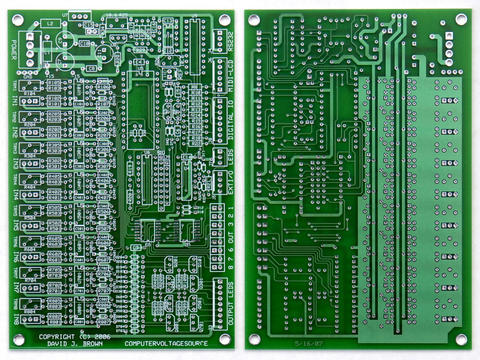
ComputerVoltageSources group photo

Yahoo Groups archive

ComputerVoltageSources

Archive for ComputerVoltageSources.

Index last updated: 2026-03-30 01:00 UTC

Thread

Storage

Storage

2006-03-15 by Andrew Scheidler

I've written several sequencers for my PSIM, and for a time spent a lot of hours trying to find a way to allow the program to store information onboard. For example, to take the 64 note values that I had recorded (into an array) and push them into the PSIM's memory so that they would stay there even after power was removed. Then when powered up, the program would grab those 64 stored values and plug them back into the array.

I dinked around with PEEK and POKE but never got anywhere. Is this possible to do with the PSIM? If not, is it something that the new module might be capable of?

Andrew

RE: [ComputerVoltageSources] Storage

2006-03-16 by John Loffink

The BASIC ATOM PRO's Renasas 3664 processor has 32K of Flash, but it is only
rated at 1000 write cycles. Storing user data there isn't recommended.

We'd have to add some external Flash memory. SPI based Flash reduces pin
count. Do we even have a chip select pin left? An Atmel SPI 64K x 8 Flash
is only $1.40, but it only comes in SOIC-8 packages. Therre are no through
hole versions.

John Loffink
The Microtonal Synthesis Web Site
http://www.microtonal-synthesis.com
The Wavemakers Synthesizer Web Site
http://www.wavemakers-synth.com


> -----Original Message-----
> From: ComputerVoltageSources@yahoogroups.com
> [mailto:ComputerVoltageSources@yahoogroups.com] On Behalf Of Andrew
> Scheidler
>
> I've written several sequencers for my PSIM, and for a time spent a lot of
> hours trying to find a way to allow the program to store information
> onboard. For example, to take the 64 note values that I had recorded
> (into an array) and push them into the PSIM's memory so that they would
> stay there even after power was removed. Then when powered up, the
> program would grab those 64 stored values and plug them back into the
> array.
>
> I dinked around with PEEK and POKE but never got anywhere. Is this
> possible to do with the PSIM? If not, is it something that the new module
> might be capable of?
>
> Andrew
>
>

RE: [ComputerVoltageSources] Storage

2006-03-16 by John Loffink

Looking at the 3664 Spec more closely, use of the BASIC Atom Pro Flash in a
run time environment requires use of the User Program Mode. This requires
running your code out of RAM while the Flash is programmed. Since the BASIC
ATOM compiler does not appear to support this, it looks like you could never
use the internal Flash memory for run time storage. This applies to PSIM or
any new design.

John Loffink
The Microtonal Synthesis Web Site
http://www.microtonal-synthesis.com
The Wavemakers Synthesizer Web Site
http://www.wavemakers-synth.com


> -----Original Message-----
> From: ComputerVoltageSources@yahoogroups.com
> [mailto:ComputerVoltageSources@yahoogroups.com] On Behalf Of John Loffink
>
> The BASIC ATOM PRO's Renasas 3664 processor has 32K of Flash, but it is
> only
> rated at 1000 write cycles. Storing user data there isn't recommended.
>
> We'd have to add some external Flash memory. SPI based Flash reduces pin
> count. Do we even have a chip select pin left? An Atmel SPI 64K x 8 Flash
> is only $1.40, but it only comes in SOIC-8 packages. Therre are no
> through
> hole versions.
>
>
>
> > -----Original Message-----
> > From: ComputerVoltageSources@yahoogroups.com
> > [mailto:ComputerVoltageSources@yahoogroups.com] On Behalf Of Andrew
> > Scheidler
> >
> > I've written several sequencers for my PSIM, and for a time spent a lot
> of
> > hours trying to find a way to allow the program to store information
> > onboard. For example, to take the 64 note values that I had recorded
> > (into an array) and push them into the PSIM's memory so that they would
> > stay there even after power was removed. Then when powered up, the
> > program would grab those 64 stored values and plug them back into the
> > array.
> >
> > I dinked around with PEEK and POKE but never got anywhere. Is this
> > possible to do with the PSIM? If not, is it something that the new
> module
> > might be capable of?
> >
> > Andrew
> >
> >

Re: Storage

2006-03-16 by Grant Richter

If you look at the Basic Atom Pro 28M description, it mentions adding 32K of EEPROM on
the carrier board, included in the price.

--- In ComputerVoltageSources@yahoogroups.com, "John Loffink" <jloffink@...> wrote:
>
> The BASIC ATOM PRO's Renasas 3664 processor has 32K of Flash, but it is only
> rated at 1000 write cycles. Storing user data there isn't recommended.
>
> We'd have to add some external Flash memory. SPI based Flash reduces pin
> count. Do we even have a chip select pin left? An Atmel SPI 64K x 8 Flash
> is only $1.40, but it only comes in SOIC-8 packages. Therre are no through
> hole versions.
>
> John Loffink
> The Microtonal Synthesis Web Site
> http://www.microtonal-synthesis.com
> The Wavemakers Synthesizer Web Site
> http://www.wavemakers-synth.com
>
>
> > -----Original Message-----
> > From: ComputerVoltageSources@yahoogroups.com
> > [mailto:ComputerVoltageSources@yahoogroups.com] On Behalf Of Andrew
> > Scheidler
> >
> > I've written several sequencers for my PSIM, and for a time spent a lot of
> > hours trying to find a way to allow the program to store information
> > onboard. For example, to take the 64 note values that I had recorded
> > (into an array) and push them into the PSIM's memory so that they would
> > stay there even after power was removed. Then when powered up, the
> > program would grab those 64 stored values and plug them back into the
> > array.
> >
> > I dinked around with PEEK and POKE but never got anywhere. Is this
> > possible to do with the PSIM? If not, is it something that the new module
> > might be capable of?
> >
> > Andrew
> >
> >
>

RE: [ComputerVoltageSources] Re: Storage

2006-03-16 by John Loffink

Hmmm, I missed that since it is only on the web page description. It would
be nice if they published the spec for the 28M device, since they are
selling it. That needs to be considered for the CVS designs, because you
need to know which pins are allocated for memory access.

John Loffink
The Microtonal Synthesis Web Site
http://www.microtonal-synthesis.com
The Wavemakers Synthesizer Web Site
http://www.wavemakers-synth.com


> -----Original Message-----
> From: ComputerVoltageSources@yahoogroups.com
> [mailto:ComputerVoltageSources@yahoogroups.com] On Behalf Of Grant Richter
> Sent: Wednesday, March 15, 2006 7:58 PM
> To: ComputerVoltageSources@yahoogroups.com
> Subject: [ComputerVoltageSources] Re: Storage
>
> If you look at the Basic Atom Pro 28M description, it mentions adding 32K
> of EEPROM on
> the carrier board, included in the price.
>
> --- In ComputerVoltageSources@yahoogroups.com, "John Loffink"

Update from Nathan at Basic Micro

2006-03-16 by Grant Richter

Hit "unwrap lines" above so this doesn't look jumbled.

OK, to clarify the difference between Basic Atom Pro 24M and 28M.

The pinouts are the same as far as power pins etc. So a socket can accept either 24 or 28
version without needing jumpers. Just more I/O pins are added at then end.

The 32K of EEPROM is 32K BITS, which is only 4096 BYTES. Still very handy. See the "Read"
and "Write" commands in the software manual (quote from Nathan).

The additional 4 pins added on the bottom are 4 more A/D inputs, so the device could
support 8 analog voltage inputs with no multiplexors. Whoo HA! One option is to decicate
some of the 4 analog inputs to fixed functions like cursor control or some kind of user
interface?

Like using a knob with 10 hardware detents to select 10 software options?
It might be possible to support some kind of performance interface using a force sensing
resitor? The processor is there to od the math to extract the X,Y and Z data.

That makes me want to put two sockets for quad DACs with a chip select to give 8 voltage
outputs.

This may come at the expense of some digital funtions. I may have to sacrifice a pin for
chip select. Are we FOR SURE dedicated to having a Speakjet socket on the main CVS PC
board? Or would we rather have 8 analog inputs and 8 analog outputs?

The Speakjet is cute, no doubt about it. A voice synthesizer is a bunch of fun, even if the
highest frequency out is 8 KHz. I wish that new MOOG in a chip was further along. I really
like the idea of having some kind of synth right on the PCB for the circuit bending. build it
into a manakins head crowd, They make me smile.

ALSO:

He is hand building prototypes of the 40 pin version of the Basic Atom Pro 40M now. This
is upgraded to a 20 Mhz clock (from 18) and uses the bigger 3687 part rather than current
3664. He says at least 6 months to a years till it is available but recommends using a 40
pin footprint for any new board. The Basic Micro (PIC based) 40m can be bought now.

Slower, but maybe with a enough I/O pins to read a MIni-Wave Prom for complex envelope
storage.

--- In ComputerVoltageSources@yahoogroups.com, "John Loffink" <jloffink@...> wrote:
>
> Hmmm, I missed that since it is only on the web page description. It would
> be nice if they published the spec for the 28M device, since they are
> selling it. That needs to be considered for the CVS designs, because you
> need to know which pins are allocated for memory access.
>
> John Loffink
> The Microtonal Synthesis Web Site
> http://www.microtonal-synthesis.com
> The Wavemakers Synthesizer Web Site
> http://www.wavemakers-synth.com
>
>

Re: Update from Nathan at Basic Micro

2006-03-16 by djbrow54

--- In ComputerVoltageSources@yahoogroups.com, "Grant Richter"

Nice update on the AtomPro24.

> The Speakjet is cute, no doubt about it. A voice synthesizer is a
> bunch of fun, even if the highest frequency out is 8 KHz.

I have a SpeakJet on my PSIM and I have failed to ever find a real use
for it. It's fun but a pain to program. Also, interfacing to it via
software serial is a pain because interrupts have to be disabled. The
programming would be easier if we were to include a TTS256 along with
it. Perhaps this is an opportunity to make the SpeakJet an optional
PCB. It also requires filtering and gain which takes up real estate.
One possibility is to continue to extend the MIDI sysex. We could
pick a different ID and use this to wrap the text for the TTS256.
This would be much easier to program since you can send nice string
text to it. A microcontroller to interface to the TTS256 would be a
bit more difficult since we'd be dealing with different baud rates.
Perhaps this would be the time to use the larger AVR controllers with
increase ram size. Just a thought. I personally don't think the
Speakjet is worth the real estate on the main PCB.


> I wish that new MOOG in a chip was further along. I really like
> the idea of having some kind of synth right on the PCB for the
> circuit bending. build it into a manakins head crowd, They make
> me smile.

The AVR synth is a possibility. It's a single chip + external DAC
that would interface directly to the MIDI. I have one. The filter is
a bit lame. One would have to rewrite portions of the code to encode
all of the potentiometer values and switches (I assume we don't want 8
more pots and 15 switches) into a sysex message. Maybe it's time we
buy our own MIDI ID :)

Dave

Re: [ComputerVoltageSources] Update from Nathan at Basic Micro

2006-03-16 by Henry Till

On Mar 16, 2006, at 3:04 PM, Grant Richter wrote:
This may come at the expense of some digital funtions. I may have to
sacrifice a pin for
chip select. Are we FOR SURE dedicated to having a Speakjet socket on
the main CVS PC
board? Or would we rather have 8 analog inputs and 8 analog outputs?

My vote is for not having a dedicated Speakjet socket in favor of
more inputs + outputs. In my opinion, the chip isn't useful enough
to warrant having it's own dedicated socket on the main board. It
should definitely be an add-on.

-Henry


[Non-text portions of this message have been removed]

Re: [ComputerVoltageSources] Update from Nathan at Basic Micro

2006-03-16 by john mahoney

> ...
> Are we FOR SURE dedicated to having a Speakjet socket on the main CVS PC
> board? Or would we rather have 8 analog inputs and 8 analog outputs?

I'd much rather have 8 ins and outs. (Forget that I ever mentioned the
SpeakJet. ;-)

A writeable store would be fabulous, too. Optional would be even better.

A display would be most useful, especially for a general purpose
(non-dedicated) device. Allowing the display to be an option is the bee's
knees. And, as Grant said, using MIDI Sysex was a brilliant hack by Dave.

A bare bones CVS will find its way into dedicated modules, so we really want
that to be our baseline, IMHO. (And I really mean "in my HUMBLE opinion," as
I am happily humbled by this ersatz committee.)
--
john

Re: [ComputerVoltageSources] Update from Nathan at Basic Micro

2006-03-16 by Harry Bissell Jr

YOU mentioned the SpeakJet ???

Please have it ridicule you, on my behalf... :^P

"Talk to the chip, the hand is tired..."

H^) harry (yes to more I/O, no to speakjet :^)

john mahoney <jmahoney@...> wrote: > ...
> Are we FOR SURE dedicated to having a Speakjet socket on the main CVS PC
> board? Or would we rather have 8 analog inputs and 8 analog outputs?

I'd much rather have 8 ins and outs. (Forget that I ever mentioned the
SpeakJet. ;-)

A writeable store would be fabulous, too. Optional would be even better.

A display would be most useful, especially for a general purpose
(non-dedicated) device. Allowing the display to be an option is the bee's
knees. And, as Grant said, using MIDI Sysex was a brilliant hack by Dave.

A bare bones CVS will find its way into dedicated modules, so we really want
that to be our baseline, IMHO. (And I really mean "in my HUMBLE opinion," as
I am happily humbled by this ersatz committee.)
--
john


SPONSORED LINKS
Music instrument stores Electronic Instruments Module

---------------------------------
YAHOO! GROUPS LINKS


Visit your group "ComputerVoltageSources" on the web.

To unsubscribe from this group, send an email to:
ComputerVoltageSources-unsubscribe@yahoogroups.com

Your use of Yahoo! Groups is subject to the Yahoo! Terms of Service.


---------------------------------


[Non-text portions of this message have been removed]

Re: [ComputerVoltageSources] Update from Nathan at Basic Micro

2006-03-16 by xamboldt

I humbly defer to Dave & Grant's opinions, speaking as people who
already have SpeakJets hooked up to their PSIMs, that the additional
I/O would be more useful.

One thing to consider is the additional front panel space this might
take up if you build up these additional inputs with the full
complement of pots/jacks....

-Chris

On Mar 16, 2006, at 3:04 PM, Grant Richter wrote:

> Hit "unwrap lines" above so this doesn't look jumbled.
>
> OK, to clarify the difference between Basic Atom Pro 24M and 28M.
>
> The pinouts are the same as far as power pins etc. So a socket can
> accept either 24 or 28
> version without needing jumpers. Just more I/O pins are added at
> then end.
>
> The 32K of EEPROM is 32K BITS, which is only 4096 BYTES. Still very
> handy. See the "Read"
> and "Write" commands in the software manual (quote from Nathan).
>
> The additional 4 pins added on the bottom are 4 more A/D inputs, so
> the device could
> support 8 analog voltage inputs with no multiplexors. Whoo HA! One
> option is to decicate
> some of the 4 analog inputs to fixed functions like cursor control
> or some kind of user
> interface?
>
> Like using a knob with 10 hardware detents to select 10 software
> options?
> It might be possible to support some kind of performance interface
> using a force sensing
> resitor? The processor is there to od the math to extract the X,Y
> and Z data.
>
> That makes me want to put two sockets for quad DACs with a chip
> select to give 8 voltage
> outputs.
>
> This may come at the expense of some digital funtions. I may have
> to sacrifice a pin for
> chip select. Are we FOR SURE dedicated to having a Speakjet socket
> on the main CVS PC
> board? Or would we rather have 8 analog inputs and 8 analog outputs?
>
> The Speakjet is cute, no doubt about it. A voice synthesizer is a
> bunch of fun, even if the
> highest frequency out is 8 KHz. I wish that new MOOG in a chip was
> further along. I really
> like the idea of having some kind of synth right on the PCB for the
> circuit bending. build it
> into a manakins head crowd, They make me smile.
>
> ALSO:
>
> He is hand building prototypes of the 40 pin version of the Basic
> Atom Pro 40M now. This
> is upgraded to a 20 Mhz clock (from 18) and uses the bigger 3687
> part rather than current
> 3664. He says at least 6 months to a years till it is available but
> recommends using a 40
> pin footprint for any new board. The Basic Micro (PIC based) 40m
> can be bought now.
>
> Slower, but maybe with a enough I/O pins to read a MIni-Wave Prom
> for complex envelope
> storage.
>
> --- In ComputerVoltageSources@yahoogroups.com, "John Loffink"
> <jloffink@...> wrote:
> >
> > Hmmm, I missed that since it is only on the web page
> description. It would
> > be nice if they published the spec for the 28M device, since they
> are
> > selling it. That needs to be considered for the CVS designs,
> because you
> > need to know which pins are allocated for memory access.
> >
> > John Loffink
> > The Microtonal Synthesis Web Site
> > http://www.microtonal-synthesis.com
> > The Wavemakers Synthesizer Web Site
> > http://www.wavemakers-synth.com
> >
> >
>
>
>
>
>
>
>
> SPONSORED LINKS
> Music instrument stores Electronic Instruments
> Module
>
> YAHOO! GROUPS LINKS
>
> Visit your group "ComputerVoltageSources" on the web.
>
> To unsubscribe from this group, send an email to:
> ComputerVoltageSources-unsubscribe@yahoogroups.com
>
> Your use of Yahoo! Groups is subject to the Yahoo! Terms of Service.
>
>

Re: [ComputerVoltageSources] Update from Nathan at Basic Micro

2006-03-16 by john mahoney

----- Original Message -----
From: "Harry Bissell Jr"

> YOU mentioned the SpeakJet ???
>
> Please have it ridicule you, on my behalf... :^P
>
> "Talk to the chip, the hand is tired..."
>
> H^) harry (yes to more I/O, no to speakjet :^)


To paraphrase Maxwell Smart, "I told you not to mention that."

Talk to the chip, via the shoe phone. ;-)
--
john (missed it by *that* much!)

Noise Maker

2006-03-17 by Grant Richter

Works for me.

Next question, each CV input takes two op-amps. Do we use 8 dual op-amps, or 4 quad
op-amps?

The will need to be two differnt BOMs for 10 volts systems and 5 volt systems.
Just a few resistor changes.

I still wish we could put a little noise chip on the CVS board so it could be a truely stand
alone electronium. Are we sure there isn't a cheap I2C or SPI noise maker chip or
something?
How about a cell phone ring tone chip? Or a video game noise chip? Maybe a frequency
synthesizer with an SPI programming port?

Any ideas?

--- In ComputerVoltageSources@yahoogroups.com, Harry Bissell Jr <harrybissell@...>
wrote:
>
> YOU mentioned the SpeakJet ???
>
> Please have it ridicule you, on my behalf... :^P
>
> "Talk to the chip, the hand is tired..."
>
> H^) harry (yes to more I/O, no to speakjet :^)
>
> john mahoney <jmahoney@...> wrote: > ...
> > Are we FOR SURE dedicated to having a Speakjet socket on the main CVS PC
> > board? Or would we rather have 8 analog inputs and 8 analog outputs?
>
> I'd much rather have 8 ins and outs. (Forget that I ever mentioned the
> SpeakJet. ;-)
>
> A writeable store would be fabulous, too. Optional would be even better.
>
> A display would be most useful, especially for a general purpose
> (non-dedicated) device. Allowing the display to be an option is the bee's
> knees. And, as Grant said, using MIDI Sysex was a brilliant hack by Dave.
>
> A bare bones CVS will find its way into dedicated modules, so we really want
> that to be our baseline, IMHO. (And I really mean "in my HUMBLE opinion," as
> I am happily humbled by this ersatz committee.)
> --
> john
>
>
>
> SPONSORED LINKS
> Music instrument stores
Electronic Instruments
Module
>
> ---------------------------------
> YAHOO! GROUPS LINKS
>
>
> Visit your group "ComputerVoltageSources" on the web.
>
> To unsubscribe from this group, send an email to:
> ComputerVoltageSources-unsubscribe@yahoogroups.com
>
> Your use of Yahoo! Groups is subject to the Yahoo! Terms of Service.
>
>
> ---------------------------------
>
>
>
>
>
> [Non-text portions of this message have been removed]
>

RE: [ComputerVoltageSources] Update from Nathan at Basic Micro

2006-03-17 by John Loffink

One more vote for more I/O, and no Speakjet. I had my fling with speech
synthesis 25 years ago with an addon to the TI 99/4A computer. Ultimately
the pitch resolution and bandwidth limitations of the speech synthesizer
were frustrating and proved this exploration to be a dead end.

John Loffink
The Microtonal Synthesis Web Site
http://www.microtonal-synthesis.com
The Wavemakers Synthesizer Web Site
http://www.wavemakers-synth.com


> -----Original Message-----
> From: ComputerVoltageSources@yahoogroups.com
> [mailto:ComputerVoltageSources@yahoogroups.com] On Behalf Of Grant Richter
>
> The additional 4 pins added on the bottom are 4 more A/D inputs, so the
> device could
> support 8 analog voltage inputs with no multiplexors. Whoo HA! One option
> is to decicate
> some of the 4 analog inputs to fixed functions like cursor control or some
> kind of user
> interface?
>
> Like using a knob with 10 hardware detents to select 10 software options?
> It might be possible to support some kind of performance interface using a
> force sensing
> resitor? The processor is there to od the math to extract the X,Y and Z
> data.
>
> That makes me want to put two sockets for quad DACs with a chip select to
> give 8 voltage
> outputs.
>
> This may come at the expense of some digital funtions. I may have to
> sacrifice a pin for
> chip select. Are we FOR SURE dedicated to having a Speakjet socket on the
> main CVS PC
> board? Or would we rather have 8 analog inputs and 8 analog outputs?
>
> The Speakjet is cute, no doubt about it. A voice synthesizer is a bunch of
> fun, even if the
> highest frequency out is 8 KHz. I wish that new MOOG in a chip was further
> along. I really
> like the idea of having some kind of synth right on the PCB for the
> circuit bending. build it
> into a manakins head crowd, They make me smile.
>
> ALSO:

Re: Update from Nathan at Basic Micro

2006-03-17 by Gary Chang

Henry Till <htill@...> wrote:
>
Or would we rather have 8 analog inputs and 8 analog outputs?
>
> My vote is for not having a dedicated Speakjet socket in favor of
> more inputs + outputs. In my opinion, the chip isn't useful enough
> to warrant having it's own dedicated socket on the main board. It
> should definitely be an add-on.
>
> -Henry
>

i agree with Henry....

gc

Re: [ComputerVoltageSources] Noise Maker

2006-03-17 by Eric Brombaugh

You mean something like these:

http://www.okisemi.com/english/ml2870.htm
http://www.necel.com/mobile/melody/en/product/pd9971.html

and many others. The trouble is that they're all
surface-mount, usually BGA and probably only available
in qty 10000+. Neat idea though...

Eric

--- Grant Richter <grichter@...> wrote:


> I still wish we could put a little noise chip on the
> CVS board so it could be a truely stand
> alone electronium. Are we sure there isn't a cheap
> I2C or SPI noise maker chip or
> something?
> How about a cell phone ring tone chip? Or a video
> game noise chip? Maybe a frequency
> synthesizer with an SPI programming port?


__________________________________________________
Do You Yahoo!?
Tired of spam? Yahoo! Mail has the best spam protection around
http://mail.yahoo.com

Re: [ComputerVoltageSources] Noise Maker

2006-03-17 by Eric Brombaugh

Whoops - missed the last thought on serially
programmable frequency generators. That's a good one.

I have used an Analog Devices AD9851 DDS in a
PIC-based frequency source. The 180MHz output range is
probably overkill, and it only has a sine output.

There is the following chip though:

http://www.analog.com/en/prod/0,,770_843_AD9833%2C00.html

which has sine/tri/sq outputs and is serially
programmable. Fairly inexpensive and while
surface-mount it does have exposed leads so it would
be hand-solderable. ADI is pretty good people and they
have been known to be generous with the free
samples...

Eric

--- Grant Richter <grichter@...> wrote:

> I still wish we could put a little noise chip on the
> CVS board
<snip>
> Maybe a frequency
> synthesizer with an SPI programming port?


__________________________________________________
Do You Yahoo!?
Tired of spam? Yahoo! Mail has the best spam protection around
http://mail.yahoo.com

Re: Update from Nathan at Basic Micro

2006-03-17 by Mike Marsh

Personally, I'd rather have the 8 I/O than Speakjet on board. I can
hook my Speakjet to my PSIM if I really needed it...

Mike

--- In ComputerVoltageSources@yahoogroups.com, "Grant Richter"
<grichter@...> wrote:
>
> Hit "unwrap lines" above so this doesn't look jumbled.
>
> OK, to clarify the difference between Basic Atom Pro 24M and 28M.
>
> The pinouts are the same as far as power pins etc. So a socket can
accept either 24 or 28
> version without needing jumpers. Just more I/O pins are added at
then end.
>
> The 32K of EEPROM is 32K BITS, which is only 4096 BYTES. Still very
handy. See the "Read"
> and "Write" commands in the software manual (quote from Nathan).
>
> The additional 4 pins added on the bottom are 4 more A/D inputs, so
the device could
> support 8 analog voltage inputs with no multiplexors. Whoo HA! One
option is to decicate
> some of the 4 analog inputs to fixed functions like cursor control
or some kind of user
> interface?
>
> Like using a knob with 10 hardware detents to select 10 software
options?
> It might be possible to support some kind of performance interface
using a force sensing
> resitor? The processor is there to od the math to extract the X,Y
and Z data.
>
> That makes me want to put two sockets for quad DACs with a chip
select to give 8 voltage
> outputs.
>
> This may come at the expense of some digital funtions. I may have to
sacrifice a pin for
> chip select. Are we FOR SURE dedicated to having a Speakjet socket
on the main CVS PC
> board? Or would we rather have 8 analog inputs and 8 analog outputs?
>
> The Speakjet is cute, no doubt about it. A voice synthesizer is a
bunch of fun, even if the
> highest frequency out is 8 KHz. I wish that new MOOG in a chip was
further along. I really
> like the idea of having some kind of synth right on the PCB for the
circuit bending. build it
> into a manakins head crowd, They make me smile.
>
> ALSO:
>
> He is hand building prototypes of the 40 pin version of the Basic
Atom Pro 40M now. This
> is upgraded to a 20 Mhz clock (from 18) and uses the bigger 3687
part rather than current
> 3664. He says at least 6 months to a years till it is available but
recommends using a 40
> pin footprint for any new board. The Basic Micro (PIC based) 40m can
be bought now.
>
> Slower, but maybe with a enough I/O pins to read a MIni-Wave Prom
for complex envelope
> storage.
>
> --- In ComputerVoltageSources@yahoogroups.com, "John Loffink"
<jloffink@> wrote:
> >
> > Hmmm, I missed that since it is only on the web page description.
It would
> > be nice if they published the spec for the 28M device, since they are
> > selling it. That needs to be considered for the CVS designs,
because you
> > need to know which pins are allocated for memory access.
> >
> > John Loffink
> > The Microtonal Synthesis Web Site
> > http://www.microtonal-synthesis.com
> > The Wavemakers Synthesizer Web Site
> > http://www.wavemakers-synth.com
> >
> >
>

Re: Noise Maker

2006-03-17 by Mike Marsh

Actually, the Speakjet has noise and you can get primitive synthesis
out of it, too.

--- In ComputerVoltageSources@yahoogroups.com, "Grant Richter"
<grichter@...> wrote:
>
>
> I still wish we could put a little noise chip on the CVS board so it
could be a truely stand
> alone electronium. Are we sure there isn't a cheap I2C or SPI noise
maker chip or
> something?
> How about a cell phone ring tone chip? Or a video game noise chip?
Maybe a frequency
> synthesizer with an SPI programming port?
>
> Any ideas?
>

Where we are at now.

2006-03-18 by Grant Richter

All of this is determined by the workload the heroic Harry Bissel will bear, without turning
into a bear.

Right now we have:

Power connector
2 x poly fuses
2 x 1N4001
2 x Filter caps
TL431 shunt regulator (for DAC reference)
LM78L05ACZ
some 0.1 ceramics
4 x TL074 or 8 x TL072 or whatever you like to put there
16 x 3 pin pot connectors
9 trim pots (optional that every input channel be calibrated).
2 x 16 pin DAC chips
40 some resistors .
40 pin processor socket
32 x 1N4148 protection diodes (inputs an outputs)
Various connector pads and perfboard areas

I would guess that is about 4 hours for schematic capture, 4 hours to place and another 4
hours to route.

So about a weekend of Harry's very valuable time.

We might be able to wedge a connector to some kind of evaluation board in this glorious
mess. Like if there was an eval board for that programmable analog chip they keep talking
about making Moogs out of... http://www.anadigm.com/Sol_10_d.asp

--- In ComputerVoltageSources@yahoogroups.com, Eric Brombaugh <ebrombaugh@...>
wrote:
>
>
> You mean something like these:
>
> http://www.okisemi.com/english/ml2870.htm
> http://www.necel.com/mobile/melody/en/product/pd9971.html
>
> and many others. The trouble is that they're all
> surface-mount, usually BGA and probably only available
> in qty 10000+. Neat idea though...
>
> Eric
>
> --- Grant Richter <grichter@...> wrote:
>
>
> > I still wish we could put a little noise chip on the
> > CVS board so it could be a truely stand
> > alone electronium. Are we sure there isn't a cheap
> > I2C or SPI noise maker chip or
> > something?
> > How about a cell phone ring tone chip? Or a video
> > game noise chip? Maybe a frequency
> > synthesizer with an SPI programming port?
>
>
> __________________________________________________
> Do You Yahoo!?
> Tired of spam? Yahoo! Mail has the best spam protection around
> http://mail.yahoo.com
>