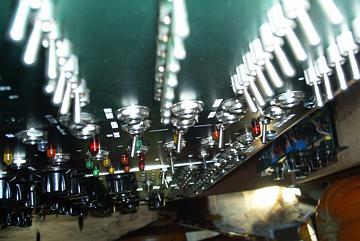
Of course you're right about that, Scott.  We'd forgotten that entirely - so kind-of focused on our recently acquired Hammond C1 tone generator and looking at its rotary "scanner" thing.  Yup - you're right linear makes much more sense for this.  <shrug>  Bill and Will


--- In ModularSynthPanels@yahoogroups.com, Scott Juskiw <scott@...> wrote:
>
> I'm not sure a circular (or elliptical) pattern would be applicable to
> this circuit because it does not scan in a circle, it scans up and
> down. I think something more like Dave Brown's design would be better,
> although it does necessitate small knobs for the 9 inputs. However,
> the remainder of the panel could spread the controls out a bit more.
>
> I haven't built my scanner/vibrato yet, but I have worked out a list
> of elements that the panel will require. Anybody want to take this on
> and try to design something?
>
> Required:
>
> 1. Audio In/Out: 2 jacks (IN and OUT)
> 2. Interpolating Scanner Controls: 9 jacks (IN), 9 pots (LEVEL), 9 LEDs
> 3. LFO Rate Control: 1 jack (RATE CV IN), 2 pots (RATE, RATE CV)
> 4. LFO Depth Control: 1 jack (DEPTH CV IN), 2 pots (DEPTH, DEPTH CV)
> 5. Scan Control: 1 jack (SCAN CV IN), 2 pots (MANUAL, SCAN CV)
> 6. Lag Control: 1 switch
> 7. Chorus/Vibrato control: 1 switch (see *note 1)
> 8. Function control: 9 pin 4 pole rotary switch
>
> Optional:
>
> 1. Input attenuator (for Vibrato/Chorus): 1 pot
> 2. Lowpass filter (for Vibrato/Chorus): 1 pot
> 3. Celeste control (for Vibrato/Chorus): 1 switch (see *note 2)
>
> *Note 1
> There are several possibilities for the Chorus/Vibrato control:
> a. 1 switch (as shown in the schematics)
> b. 1 pot (as Dave Brown did)
> c. 1 switch and 1 pot (as JH did)
>
> *Note 2
> Here's what JH had to say about the Celeste switch:
>
> "Celeste is an option for which no on-board connector is provided,
> namely removing the termination resistor of the delay line, R104, from
> the circuit and thus causing reflections of the delayed signal back
> towards the input of the delay line. If you want to implement this,
> lift one side of R104 from the PCB, and re-connect it via a switch."
>
> Here's what Dave Brown had to say about the Celeste switch:
>
> "The Celeste switch adds a 0.01 uF and 2K resistor in series with R104
> to mis-terminate the delay line causing reflections.  I selected these
> values empirically."
>
> Sounds like there is some room for experimenting with the Celeste
> option. It's possible that a pot could be used to control the level of
> mis-termination, but someone would need to verify whether or not this
> is worthy of taking up panel space. Having a Celeste switch is
> probably worthwhile.
>
>
> >
> > Will and I were discussing this just last night and have decided to
> > do a combined unit.  A 3U panel would be fine - or four.  I occurred
> > to us that a panel similar to the elliptical Klee could probably be
> > implemented in four units.  And we'd be fine with that too.  In
> > fact, there are particular advantages to that implementation... one
> > being that it would graphically represent the rotary nature of the
> > original Hammond scanner.  FWIW.  Bill (and Will)
>
Message
Re: JH tremolo
2009-03-21 by wjhall11
Attachments
- No local attachments were found for this message.