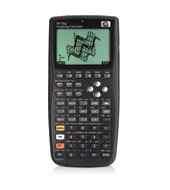
That is good to know about the compiled binary version. My interim solution was to enter verbose info like variable names, etc. into an ASCII text file copied onto the SD card. I haven't figured out a way to use directories on the SD card. That is a pain with a large number of formulas. It would be useful to be able to separate them into directories. Name length is painful as well. When I copy mid-sized named files from the SD card, everything is truncated at a few characters with a ~ (?) appended. This does not happen when copying from a directory to the SD card in the calculator. Renaming programs after a memory clear and restore from SD card can be time consuming. I have had problems with the connect program downloaded from various sources. I'm not sure where my CD that came with the calculator is presently.
Thanks for all of the help!
Thanks for all of the help!
--- In 50g@yahoogroups.com, Don Hart <ddhart1@...> wrote:
>
> Just be sure I didn't confuse you, you'll have to use the compiled binary version if you want to copy it to the SD card, the 50g won't know what to do with the ASCII version of the file. Also, I THINK you may have to put it in the root directory of the SD card, I'm not sure the 50g can navigate into DOS directories, but I could be wrong. Just be aware of that.
>
> ~~~
> ASCII shall receive, Hollerith and get it quicker
>
>
> --- On Mon, 1/11/10, garyokada@... <moviefan@...> wrote:
>
> > From: garyokada@... <moviefan@...>
> > Subject: [50g] Re: Character map for translation to ASCII
> > To: 50g@yahoogroups.com
> > Date: Monday, January 11, 2010, 4:59 PM
> > Thanks. I'll try it. I
> > was becoming resigned to writing an ASCII text file with
> > most of the major gist of the program to the SD card for
> > copying to a directory on the HP 50g, where I would then
> > edit the file adding the proper symbols.
> >
> >
> >
> > --- In 50g@yahoogroups.com,
> > Don Hart <ddhart1@> wrote:
> > >
> > > Debug4x can toggle the display between showing the
> > actual symbols or showing the digraphs. I can't remember
> > where that option is, maybe under 'View'. With digraphs
> > showing, it should be all ASCII.
> > >
> > > I don't have a 50g so this is just what I heard. The
> > CD that came with your 50g should have a program called
> > Conn4x and drivers that use the USB port, serial RS232 cable
> > not required. Using this program, you can transfer the
> > program created by Debug4x to the calc.
> > >
> > > I don't remember if Debug4x can save your program in
> > plain text. But if it does, you should see the header
> > similar to...
> > > %%HP: T(3)A(D)F(.);
> > > ...and the T(3) tells the 50g how to interpret what
> > Conn4x sends to it. The 3 means the program should have
> > digraphs in it. When sending such a program, make sure the
> > icon at the top of Conn4x is showing "ABC" not "010101".
> > >
> > > If Debug4x can save your program as a compiled binary,
> > then you can send it much faster to the 50g using Conn4x,
> > but this time with "010101" selected.
> > >
> > > If Debug4x can't save your program as a compiled
> > binary, you can tell Debug4x to send it directly to the
> > hp50g emulator that came with the package. Then use the
> > emulator to save it as a binary by putting the program on
> > the stack and using "save object" under the 'View' menu.
> > >
> > > That should help get you going and maybe others will
> > chime in with more tips. Debug4x is really a pretty good
> > tool for User RPL but it's perhaps more useful for Sys RPL
> > & assembler programming. That's why I suggested you may
> > get by using a plain text editor (like Notepad in Windows)
> > on a file with digraphs. Then you only need Conn4x to
> > transfer it to your 50g.
> > >
> > > Have fun.
> > >
> > > ~~~
> > > ASCII shall receive, Hollerith and get it quicker
> > >
> > >
> > > --- On Tue, 1/5/10, garyokada@ <moviefan@>
> > wrote:
> > >
> > > > From: garyokada@ <moviefan@>
> > > > Subject: [50g] Re: Character map for translation
> > to ASCII
> > > > To: 50g@yahoogroups.com
> > > > Date: Tuesday, January 5, 2010, 9:30 PM
> > > >
> > > >
> > > > Well, maybe I'm just way out in left field on
> > this one
> > > > then. Thanks for the help!
> > > >
> > > > When viewing programs from the HP50g, very little
> > looks
> > > > like plain ASCII. Sure, some characters are
> > plain
> > > > ASCII, but there is the matter of what appears to
> > be a
> > > > standard header and footer, although it has not
> > been
> > > > completely ruled out that part of the header and
> > footer are
> > > > some sort of translation of << and >>
> > which must
> > > > be in the simplest (empty) program. When a
> > program
> > > > "<< A >>" is viewed as HEX on a PC in
> > Vista,
> > > > there are an extra 7 bytes, including an ASCII
> > 'A' (41
> > > > HEX). Changing the variable to 'B' does cause a
> > change
> > > > of only that character to 'B' (42 HEX).
> > However, a
> > > > program of "<< -> A << A >>
> > >>"
> > > > comes up completely different, with only the
> > first 'A'
> > > > represented in ASCII. A program of "<<
> > A;B
> > > > >>" has 11 more characters than the program
> > with only
> > > > the variable 'A', and 42 HEX (nor 38 HEX for that
> > matter) is
> > > > not one of them. A program of "<<
> > <<
> > > > >> >>" has 20 more characters than
> > the simplest
> > > > program of "<< >>". BTW, the spaces
> > are
> > > > added for legibility and are not deliberately
> > added into the
> > > > programs described.
> > > >
> > > > Maybe that digraph chart might make sense later,
> > but at the
> > > > most elemental level everything seems way
> > different at this
> > > > stage.
> > > >
> > > > Perhaps there is another level of translation
> > when using
> > > > tools in Debug4x...? There was an issue when
> > > > attempting to install Debug4x... on the Vista
> > setup.
> > > > Without a suitable serial cable (and a missing
> > IR
> > > > accessory), it didn't make much sense to
> > continue.
> > > >
> > > > The nascent plan was to write a simple text
> > editor in Java
> > > > to read and write files on a PC in Vista that
> > could be
> > > > simply copied to and from an SD card.
>