Hello Alan,
I am not familiar with the HP15C but have had several years experience
with the HP35, HP65 and HP41C, CV & CX calculators.
Those calculators had/used the RPN system which I appreciated; however the
'stack' only had four (4) registers plus the 'last x'.
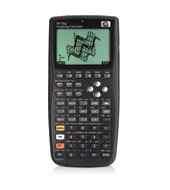
The HP50g also uses RPN system but provides a HUGE stack. I have had mine
up to fourty (40) levels and could have gone higher. Don't know the
limit; I suspect stack is limited only by available memory. Further more
any '50 stack level can contain an 'object' which can be a number, a
letter, a mixed string, a formula, a definition or equation, a list, a
vector, an array, a program and probably other things I haven't yet
learned. It also identifies decimal, integer and complex numbers and
processes each differently. I suspect the HP48 and HP49 calculators had
similiar capability but were more limited because of less memory.
The old '35 thru '41 calculator stack levels did not have all those
capabilities.
The '50g should accomodate practically any length equation you enter; be
aware the '50g permits 'carriage returns' to be inserted during entry of
an equation which provides multiple line display of a lengthy object. The
carriage return is obtained by (RS)(period); that's keys (9,1) then (10,3).
You have probably already noticed that the '50g doesn't 'sto and rcl'
things in the same manner to which you are/were accustomed.
Welcome to the world of computers.
Steve
On Wed, 02 Apr 2008 09:18:42 -0500, alanthegringo
<alanthegringo@...> wrote:
Using Opera's revolutionary e-mail client: http://www.opera.com/mail/
I am not familiar with the HP15C but have had several years experience
with the HP35, HP65 and HP41C, CV & CX calculators.
Those calculators had/used the RPN system which I appreciated; however the
'stack' only had four (4) registers plus the 'last x'.
The HP50g also uses RPN system but provides a HUGE stack. I have had mine
up to fourty (40) levels and could have gone higher. Don't know the
limit; I suspect stack is limited only by available memory. Further more
any '50 stack level can contain an 'object' which can be a number, a
letter, a mixed string, a formula, a definition or equation, a list, a
vector, an array, a program and probably other things I haven't yet
learned. It also identifies decimal, integer and complex numbers and
processes each differently. I suspect the HP48 and HP49 calculators had
similiar capability but were more limited because of less memory.
The old '35 thru '41 calculator stack levels did not have all those
capabilities.
The '50g should accomodate practically any length equation you enter; be
aware the '50g permits 'carriage returns' to be inserted during entry of
an equation which provides multiple line display of a lengthy object. The
carriage return is obtained by (RS)(period); that's keys (9,1) then (10,3).
You have probably already noticed that the '50g doesn't 'sto and rcl'
things in the same manner to which you are/were accustomed.
Welcome to the world of computers.
Steve
On Wed, 02 Apr 2008 09:18:42 -0500, alanthegringo
<alanthegringo@...> wrote:
> On my HP15C, I would enter a long equation, sometimes using store and--
> recall for portions of the equation. I don't see this on the HP50G.
> Can someone help me on this?
> I a totally new to the HP50G calculator.
> Thanks,
> -Alan
>
Using Opera's revolutionary e-mail client: http://www.opera.com/mail/