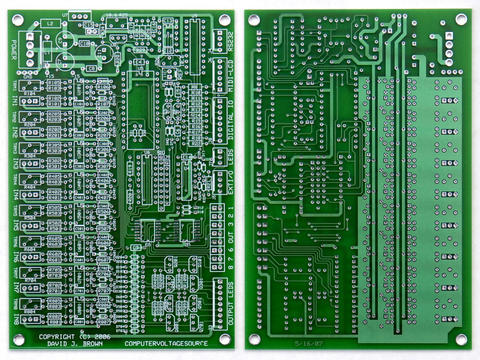
I have no issue with the accuracy of the input sampling. It took me
a while to figure out that the scaling was different. The reference
for the input is 10 volts and 10.66 for the output. This is where I
was getting all my errors. I had to scale inputs prior to outputs.
I use a factor of 15/4 which scales from 10 bits to 12 bits and
compensates for the different reference. This keeps me to integer
arithmetic and is reasonably fast. Not sure if this is what you are
referring to or not.
Dave
--- In
ComputerVoltageSources@yahoogroups.com, "Gary Chang"
<gchang@...> wrote:
>
> "Grant Richter" <grichter@> wrote:
> >
> > >
> > > ∗ 4-channels serially loaded DAC.
> > > What brand of DAC was used on the PSIM?
> > > 2 Dual DACs or one Quad DAC?
> > > Separate or simultaneous load strobe?
> > > How many bits?
> >
> > Lack of port pins keeps it to a serial interface. The AD8420 is
the
> original to the DAC7714
> > and requires no software change. The DAC7714 is only available in
> surface mount where
> > the DAC8420 is available in DIP or SM. The DAC8420 is $44 single
> piece. Probably put a
> > dual footprint on the board for DIP or SM.
> >
> > http://www.analog.com/en/prod/0%2C2877%2CDAC8420%2C00.html
> >
> > All 4 input channels can be read and all 4 output channels
updated
> in 1.2 millisecond.
> > Plenty fast for CV generation.
>
> I want to bring up an issue that was uncovered in early PSIM
usage -
> although the DAC outputs were precise enough for 1 v/oct scaling,
the
> INPUTS were not as precise - for instance, when using Woody Wall's
> Quantized Shift Register, errors were discovered when sampling a
> pre-quantized source (the shift register's output was a different
> pitch than the input). When discussing this with Grant, he
surmised
> that it was the lack of bit resolution on the input side, which
had a
> limited precision - therefore the encoding error. Can we address
this
> hardware issue?
>
> Conxiser this please, oh kind sirs, (bowing as I recceed back into
the
> shaddows) 8-)
>
> gary
>