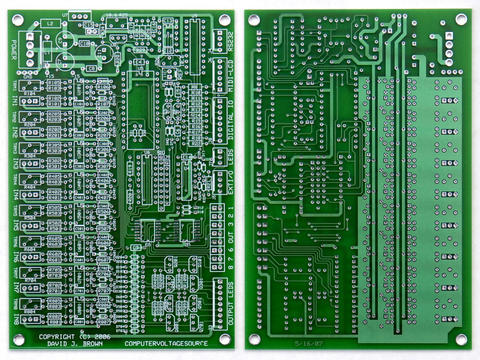
I am sitting on 4 boards waiting for me get time.
On Sat, May 25, 2013 at 7:41 PM, djbrow54 <davebr@...> wrote:
> ∗∗
>
>
>
>
> That's a nice looking breakout board.
>
> The AtomPro still holds it's own for processing CVs. It has plenty of
> flash and ram although the RS-232 port should be upgraded to USB. The IDE
> environment is nice and simple and pretty forgiving. I just wish they
> implemented hardware SPI. A small graphics display instead of 2x20
> characters would be nice but just increases the programming complexity.
>
> The Arduino is a bit more complex to program but has the advantage of a
> multitude of shields and software. My feelings is the programming scared
> users away. Even though BASIC is pretty easy to learn, I think the Arduino
> language would shrink the pool of users even smaller. Maybe not though as
> there might be enough Arduino users who would migrate over to synthesis. I
> think that number is much larger than the number of musicians who would
> migrate over to programming.
>
> I would like a zippy enough processor/dsp to do some audio processing but
> that would make the pool of users miniscule. I'm not sure it needs to be
> the same platform for control voltages and audio so maybe there is room for
> an audio processing module. After all, the name of this group is
> computer-voltage-sources.
>
> Dave
>
>
> --- In ComputerVoltageSources@yahoogroups.com, Eric Brombaugh <ebrombaugh@...>
> wrote:
> >
> > It would be sad if this group really is dead as this seems like a prime
> time for experimentation in Computer Voltage Sources. The Atom processor
> boards may not be the leading edge any longer, but there are plenty of new
> and capable parts to take their place. I'm somewhat surprised it's taken
> this long for Arduino to show up here as it seems to be the obvious heir to
> this role.
> >
> > Another family of parts to consider are the STM32F3xx microcontrollers.
> These are 32-bit ARM Cortex M4F processors (72MHz clock, DSP and Floating
> Point built-in) coupled with a wide variety of capable peripherals and
> available at very reasonable prices (<$10 in small qty). I've been doing a
> bit of work with them lately and find them to be very powerful. The primary
> stumbling block is that they don't have a slick IDE for programming and
> downloading like the one for Arduino, but if you can drive the development
> tools you can leap far beyond what's possible with the AVR processors.
> >
> > Here's a couple of web pages that describe some breakout boards I did
> for these devices:
> >
> > http://ebrombaugh.studionebula.com/embedded/stm32f373breakout/index.html
> >
> >
> > http://ebrombaugh.studionebula.com/embedded/stm32f303breakout/index.html
> >
> >
> > Eric
> >
> >
> > ________________________________
> > From: djbrow54 <davebr@...>
>
> > To: ComputerVoltageSources@yahoogroups.com
> > Sent: Thursday, May 23, 2013 5:25 PM
> > Subject: [ComputerVoltageSources] Arduino ComputerVoltageSource
> >
> >
> >
> > �
> > I know this group is dead but thought I would post here anyways. I
> played around with an Arduino Mega 2560 and replaced the AtomPro28
> processor on a four channel CVS to see what it would do. The SPI update
> rate for the DACs is considerably faster since the Arduino uses native
> hardware support in the AVR. I've only benchmarked one program between the
> Arduino and the AtomPro28 which was a tight loop stepping through 128
> semitone CVs.
> >
> > I don't know that I will go anywhere with this as I have enough
> programmable modules and the speed difference wasn't that compelling but it
> was an interesting exercise. Some details and photos on my Arduino CVS page.
> >
> > http://modularsynthesis.com/arduino/arduino-cvs/arduino-cvs.htm
> >
> > Dave
> >
> >
> >
> >
> > [Non-text portions of this message have been removed]
> >
>
>
>
--
∗
∗
∗Gino Wong Birgelo∗
BSComm, BSEE,
ReRED Recording, ∗Analog Sound Design∗
∗Audio Mastering, Recording & Restoration, Logistics∗
∗Ginowong@...∗
∗
∗
[Non-text portions of this message have been removed]