Archive of the former Yahoo!Groups mailing list: ComputerVoltageSources

previous by date index next by date
previous in topic topic list next in topic

Subject: Re: Power Supply Sequencing

From: "Grant Richter" <grichter@...>
Date: 2006-03-15

The note on power supply sequencing is on page 12 of the DAC8420_a.pdf file.

They say it can take some milliseconds of fault condition, but not how many.

I would rather not gamble.

--- In ComputerVoltageSources@yahoogroups.com, "Grant Richter" <grichter@...> wrote:
>
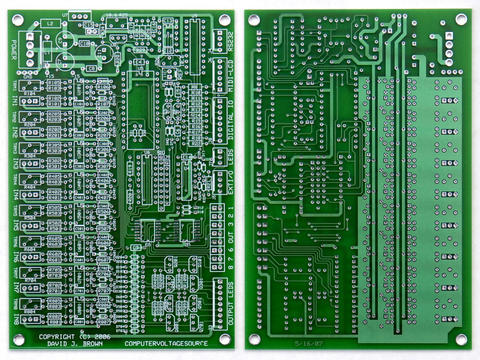
> On the CVS board, we have to have control of power supply sequencing to prevent
blowing
> up the expensive DAC chip (see the datasheet). The +5 and Vref supplies HAVE to come
> up AFTER the +/- 15 volts. And they can NOT stay on if the 15 volts goes away even for
a
> few milliseconds. The only way to assure this is to derive these supplies from +15
supply
> and minimize the energy stored in capacitors after the 5v regulator.
>
> You have to double check your power supply sequencing, otherwise magic smoke will
> appear. On multi supply devices, there are substrate diodes connecting 5 and 15 volts
that
> don't appear on the schematic. If the 15 volts supply fails or is temporarily shorted, but
> not the 5 volt supply, this can reverse bias substrate diodes and blow metal vapor all
over
> the inside of a chip.
>
> For an LCD display board. I sure hope the 200 ma backlight connector is on a seperate
pad
> from the main 5 volt so the wires can be run seperately. A display module probably
> doesn't need 15 volts at all.
>
> But we will have to consider the case where 5 volts is on but either the +15 or -15 volt
> supply is off. We don't want the LCD module supplying destructive currents BACK to the
> CVS in a fault condition.
>
> --- In ComputerVoltageSources@yahoogroups.com, "Larry T." <larry@> wrote:
> >
> > If you only want to supply pads, thats okay, but PLEASE supply the
> > pads, polyswitches and diode locations for all 3 voltages. It should
> > be very easy to make all of the boards switch between using the +15
> > w/a regulator and using +5 direct by choosing between the regulator
> > and parts or the polyswitch and parts. I will point out that more and
> > more +5v components are showing up in our analog systems and probably
> > has a lot to do with MOTM moving to a 6 pin conector and a 3 voltage
> > supply.
> >
> > Larry T.
> >
> > --- In ComputerVoltageSources@yahoogroups.com, Harry Bissell Jr
> > <harrybissell@> wrote:
> > >
> > > Damn good idea.
> > >
> > > The polyswitch fuses can also improve on-card
> > > power supply filtering (by being slightly resistive)
> > > and cause a softer start on the power supply.
> > >
> > > H^) harry
> > >
> > > Grant Richter <grichter@> wrote: Here is a practical idea.
> > >
> > > You have three pads labeled +V, Ground and -V. These go to
> > resetable polyfuses and
> > > 1N4001 diodes to protect the circuitry in case the 12 year old
> > science fair student hooks
> > > something up wrong.
> > >
> > > direct link to schematic:
> > > http://www.blacet.com/techPS.gif
> > >
> > > From John Blacets fine technical page.
> > >
> > > http://www.blacet.com/tech.html
> > >
> > > Then the end user can wire up ANY kind of connector he wants to
> > hook up to those three
> > > pads.
> > >
> > > The 1/3 square inch of board spaced used can substitute for the 2
> > square inches of board
> > > space it would take to support every possible connector type that
> > will probably change or
> > > go obsolete anyway, and who has all the mechanical drawings need
> > to make the custom
> > > PC board connector footprints? And who is going to take
> > responsibility for everything
> > > being correct with each connector type, and what if the
> > manufacturer changes the pinout
> > > or adds something new??????
> > >
> > > Just take an existing "fill in the blank" system power cable, chop
> > one end off and solder
> > > the appropriate three wires to the three pads on the CVS board and
> > be done with it.
> > >
> > > --- In ComputerVoltageSources@yahoogroups.com, "John Loffink"
> > <jloffink@> wrote:
> > > >
> > > > Good point. Here's what could be supported based upon PCB
> > stuffing options:
> > > >
> > > > Synthesizers.com 6 pin 0.100"
> > > > MOTM/Blacet 4 pin 0.156" add 5 V regulator
> > > > MOTM 6 pin 0.156"
> > > > Modcan 3 pin 0.156" add 5 V regulator
> > > >
> > > > Any others?
> > > >
> > > > John Loffink
> > > > The Microtonal Synthesis Web Site
> > > > http://www.microtonal-synthesis.com
> > > > The Wavemakers Synthesizer Web Site
> > > > http://www.wavemakers-synth.com
> > > >
> > > >
> > > > > -----Original Message-----
> > > > > From: ComputerVoltageSources@yahoogroups.com
> > > > > [mailto:ComputerVoltageSources@yahoogroups.com] On Behalf Of
> > Larry T.
> > > > >
> > > > > I would like to suggest that, if at all possible, we include
> > both the
> > > > > Blacet/MOTM 4 pin +/-15v power connector. and the Synthesizers.com
> > > > > +5/+/-15v 6 pin connector. The board could allow for the
> > optional +15
> > > > > to +5 regulators when using the 4 pin connector. Some of us
> > already
> > > > > have +5 in our systems, and generally, no matter how much
> > ANYTHING you
> > > > > come up with will use (short of a room heater), the +5v supply is
> > > > > never anywhere near being used to it's rated output. I note
> > that some
> > > > > of the newer MOTM boards also use a seperate +5v supply.
> > > > >
> > > > > I bring this up in part because of the LED/LCD/VFD
> > discussions, and
> > > > > partly because the MPU in consideration has requirements for
> > +5v, and
> > > > > I really don't want to add more +15 to +5 regulators to my already
> > > > > stressed out +15v supply, when I have 4-6A of un-touched +5 just
> > > > > sitting around asking to be used.
> >
>