Archive of the former Yahoo!Groups mailing list: ComputerVoltageSources

previous by date index next by date
previous in topic topic list next in topic

Subject: Re: LCD

From: "Grant Richter" <grichter@...>
Date: 2006-03-10

Hi Dave,

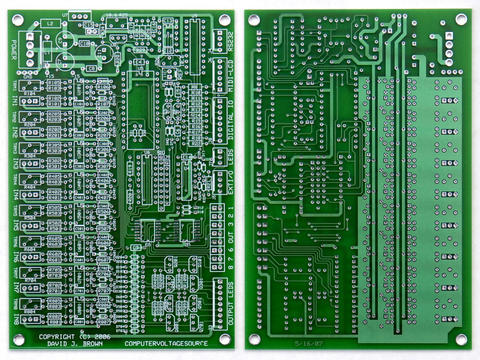
Sounds great. How about if we put a connector on with TXD and ground in paralell to the
MIDI hardware? The you could just hang the display on that connector at 5 volt levels.

I want this all hashed out ASAP so board layout can begin.

Feature creep can kill projects, but not this one.

We will put in as much smart infrastructure for future expansion as possible, but no
stopping for navel gazing (not you of course, your a practical guy).

It doesn't have to BE perfect, it just has to BE.


--- In ComputerVoltageSources@yahoogroups.com, "djbrow54" <davebr@...> wrote:
>
> It depends. This is where I started. I had a really nice serial
> VFD display. I figured out how to use the S_OUT pin for an extra
> output and interfaced this to the display. However, timing is the
> issue. Since I used my hardware serial for MIDI, you have to use
> software serial for any other pins. Software serial timing is
> incompatible with interrupts so you can't reliably talk to the
> display and use either the timer or MIDI interrupts. I do use both
> MIDI and timer interrupts so this was an issue. One way to solve it
> is to always disable interrupts prior to the display but since MIDI
> is at 31250 and the displays typically are at 9600 you will loose
> MIDI notes. Also, your code gets littered with enable and disable
> statements.
>
> A parallel interface is a waste of pins. These LCDs take 11 bits.
> Plus the overhead is tremendous. Each line is non-contiguous with
> the next. There is a 64 byte offset between the first characters of
> each line and horizontally scrolling is a real pain if you want
> the lines contiguous (e.g. line 2 starts at the end of line 1). As
> such, I used a $3 microcontroller to minimize the number of lines
> and manage the overhead of the display. I believe all of these
> RS232 serial displays do the same. However, you still have the
> timing issue with interrupts.
>
> I ended up encoding my serial communications stream to the display
> as a MIDI sysex command. Thus I could use the interrupt mechanism
> to communicate with the display and not have any MIDI or timer
> issues. That was the benefit of the microcontroller. And, once you
> have it, you can use any of the $10 LCDs with a parallel or non-
> RS232 serial interfaces. You could also use SPI but that requires
> more pins. I'd rather save my pins for I/O and not the display.
>
> Just what I found with my experimentation.
>
> Dave
>
>
> --- In ComputerVoltageSources@yahoogroups.com, Eric Brombaugh > None
> of these options would require anything more than
> > a power/data header on the main board.
>