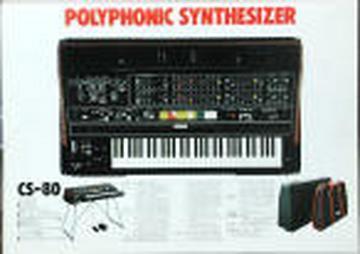
Yamaha CS80 group photo

Yahoo Groups archive

Yamaha CS80

Index last updated: 2026-03-31 22:34 UTC

Thread

Poly-aftertouch question + idea

Poly-aftertouch question + idea

2009-10-22 by stevelenham

Hi,

Please excuse my ignorance, but could anyone give me some examples of how polyphonic aftertouch is actually used in performance? I'm particularly interested in how many notes tend to be modulated at a time - is it just one, or several?

I'm asking because I just learnt about a new range of long resistive sensors (ideal for ribbon controllers, incidentally) and it occurred to me that by adding one of these to a mono-aftertouch keyboard (say, my CS60) one could create what might be called "directed mono aftertouch". Such a system would still only take a single measure of pressure but, by detecting which single key was responsible for it, could apply the resulting modulation to a single voice rather than all active voices.

I completely appreciate that it wouldn't be as good as proper poly aftertouch, but it would be a lot easier to implement. Would it be musically useful? I need to know whether to bother giving the idea more thought!

Best regards,

Steve L.

Re: [yamahacs80] Poly-aftertouch question + idea

2009-10-23 by rj krohn

the magic of poly AT didnt become obvious to me til i played a poly kybd that had mono
AT(matrix 12 et al). simply put, its one note, 6 notes, or anything in between.


Show quoted textHide quoted text
--- On Thu, 10/22/09, stevelenham <yahoo@...> wrote:

From: stevelenham <yahoo@...>
Subject: [yamahacs80] Poly-aftertouch question + idea
To: yamahacs80@yahoogroups.com
Date: Thursday, October 22, 2009, 6:06 PM


Hi,


Please excuse my ignorance, but could anyone give me some examples of how polyphonic aftertouch is actually used in performance? I'm particularly interested in how many notes tend to be modulated at a time - is it just one, or several?


I'm asking because I just learnt about a new range of long resistive sensors (ideal for ribbon controllers, incidentally) and it occurred to me that by adding one of these to a mono-aftertouch keyboard (say, my CS60) one could create what might be called "directed mono aftertouch". Such a system would still only take a single measure of pressure but, by detecting which single key was responsible for it, could apply the resulting modulation to a single voice rather than all active voices.


I completely appreciate that it wouldn't be as good as proper poly aftertouch, but it would be a lot easier to implement. Would it be musically useful? I need to know whether to bother giving the idea more thought!


Best regards,


Steve L.


[Non-text portions of this message have been removed]

Re: [yamahacs80] Poly-aftertouch question + idea

2009-10-23 by Laurie Curry

Gladly.....All that you can hear are capable with more oomph from a
real CS80....

Keep in mind.... my polyAT examples ....the sound source in these
examples are from the Arturia CS80V

and the Ensoniq SQ80 is the PolyAT keyboard........but you should
grasp the Idea

http://audio.xanga.com/slammah/126bb1031243/audio.html

http://audio.xanga.com/slammah/b64a71031225/audio.html

http://audio.xanga.com/slammah/e82a31031186/audio.html


of course I have some CS80 too.....but not much PolyAT action

http://slammah.xanga.com/audio/7bdae2131276/

http://slammah.xanga.com/audio/482b72131176/


http://slammah.xanga.com/audio/d533e1038642/

http://slammah.xanga.com/audio/33e942131171/
-----Original message-----
From: "stevelenham" yahoo@...
Date: Thu, 22 Oct 2009 15:06:49 -0600
To: yamahacs80@yahoogroups.com
Subject: [yamahacs80] Poly-aftertouch question + idea

Hi,

Please excuse my ignorance, but could anyone give me some examples of
how polyphonic aftertouch is actually used in performance? I'm
particularly interested in how many notes tend to be modulated at a
time - is it just one, or several?

I'm asking because I just learnt about a new range of long resistive
sensors (ideal for ribbon controllers, incidentally) and it occurred
to me that by adding one of these to a mono-aftertouch keyboard (say,
my CS60) one could create what might be called "directed
monoaftertouch". Such a system would still only take a single measure
of pressure but, by detecting which single key was responsible for it,
could apply the resulting modulation to a single voice rather than all
active voices.

I completely appreciate that it wouldn't be as good as proper poly
aftertouch, but it would be a lot easier to implement. Would it be
musically useful? I need to know whether to bother giving the idea
more thought!

Best regards,

Steve L.


[Non-text portions of this message have been removed]

Re: Poly-aftertouch question + idea

2009-10-23 by PeterB

Hey Laurie,

interesting. I didn´t know the Ensoniq hat POLY aftertouch... is its keyboard any good? I am still looking for an affordable poly at master keyboard: Kurzweils are hard to get and the VAX77 too expensive. Are the Ensoniqs still available on the vintage market?

Cheers
Worsel

Show quoted textHide quoted text
--- In yamahacs80@yahoogroups.com, "Laurie Curry" <laurie@...> wrote:
>
>
> Gladly.....All that you can hear are capable with more oomph from a
> real CS80....
>
> Keep in mind.... my polyAT examples ....the sound source in these
> examples are from the Arturia CS80V
>
> and the Ensoniq SQ80 is the PolyAT keyboard........but you should
> grasp the Idea
>
> http://audio.xanga.com/slammah/126bb1031243/audio.html
>
> http://audio.xanga.com/slammah/b64a71031225/audio.html
>
> http://audio.xanga.com/slammah/e82a31031186/audio.html
>
>
> of course I have some CS80 too.....but not much PolyAT action
>
> http://slammah.xanga.com/audio/7bdae2131276/
>
> http://slammah.xanga.com/audio/482b72131176/
>
>
> http://slammah.xanga.com/audio/d533e1038642/
>
> http://slammah.xanga.com/audio/33e942131171/
> -----Original message-----
> From: "stevelenham" yahoo@...
> Date: Thu, 22 Oct 2009 15:06:49 -0600
> To: yamahacs80@yahoogroups.com
> Subject: [yamahacs80] Poly-aftertouch question + idea
>
> Hi,
>
> Please excuse my ignorance, but could anyone give me some examples of
> how polyphonic aftertouch is actually used in performance? I'm
> particularly interested in how many notes tend to be modulated at a
> time - is it just one, or several?
>
> I'm asking because I just learnt about a new range of long resistive
> sensors (ideal for ribbon controllers, incidentally) and it occurred
> to me that by adding one of these to a mono-aftertouch keyboard (say,
> my CS60) one could create what might be called "directed
> monoaftertouch". Such a system would still only take a single measure
> of pressure but, by detecting which single key was responsible for it,
> could apply the resulting modulation to a single voice rather than all
> active voices.
>
> I completely appreciate that it wouldn't be as good as proper poly
> aftertouch, but it would be a lot easier to implement. Would it be
> musically useful? I need to know whether to bother giving the idea
> more thought!
>
> Best regards,
>
> Steve L.
>
>
>
>
>
> [Non-text portions of this message have been removed]
>

Re: [yamahacs80] Re: Poly-aftertouch question + idea

2009-10-23 by David Rogoff

PeterB wrote:
> Hey Laurie,
>
> interesting. I didn´t know the Ensoniq hat POLY aftertouch... is its keyboard any good? I am still looking for an affordable poly at master keyboard: Kurzweils are hard to get and the VAX77 too expensive. Are the Ensoniqs still available on the vintage market?


I picked up an old SQ-80 a few years ago just to control cs80v. The
keyboard was horrible. New bushings would have help the noise and
clacking, but the AT was mostly shot. Many keys had no response and
others had max AT with barely any touch.

Anyone have any recent info on the VAX77 keyboard (
http://www.infiniteresponse.com )? They're website is almost a year out
of date and last claimed they'd be shipping months ago.

David

Re: [yamahacs80] Poly-aftertouch question + idea

2009-10-23 by David Rogoff

stevelenham wrote:
> Hi,
>
> Please excuse my ignorance, but could anyone give me some examples of how polyphonic aftertouch is actually used in performance? I'm particularly interested in how many notes tend to be modulated at a time - is it just one, or several?
>
> I'm asking because I just learnt about a new range of long resistive sensors (ideal for ribbon controllers, incidentally) and it occurred to me that by adding one of these to a mono-aftertouch keyboard (say, my CS60) one could create what might be called "directed mono aftertouch". Such a system would still only take a single measure of pressure but, by detecting which single key was responsible for it, could apply the resulting modulation to a single voice rather than all active voices.
>
> I completely appreciate that it wouldn't be as good as proper poly aftertouch, but it would be a lot easier to implement. Would it be musically useful? I need to know whether to bother giving the idea more thought!
>

I can't remember the details (someone help me out), but there was a
master keyboard years ago that could do a pseudo-poly-AT. The keyboard
itself was channel pressure, but it had a mode in which each keypress
went out on a different MIDI channel. It could then fake the Poly-AT by
sending pressure as mod wheel on just the MIDI channel of the highest
(lowest? last?) key pressed.

Something like this would also be great for a real Poly-AT controller
hooked up to a module that didn't understand Poly-AT. It would do the
same thing, as before, sending pressure as mod wheel for each MIDI
channel. Of course, the sound module would have to be able to response
to lots of channels at once - presumably with the same patch.

David

Re: Poly-aftertouch question + idea

2009-10-24 by nicholas kent

Ensoniq came up with patented technology to build poly AT into non-
weighted keyboards at apparently very little extra cost so most of
their unweighted keyboards starting with the EPS family had it (EPS,
VFX, ASR, SQ, TS series as far as I know). They made some weighted
keyboards and none I know had it.

Fatar built all of them for Ensoniq, but since it was Ensoniq's
patent, business ethics or contract probably kept Fatar from
developing rival technology to do it cheaply another way. In other
words poly AT was not under patent but the only low cost way to do it
was. Fatar BTW built the bulk of keyboards for everyone in the 80s
and 90s (other than Roland, Yamaha and some non-synth manufacturers)
and only built it for Ensoniq. So I would guess when the Chinese got
into synth keyboard manufacture big time this decade it was a feature
than no one had used in a while and wasn't on the list of specs they
needed to offer.

Roland had their weighted 88 key A-80 in the late 80s as well as one
of the few unweighted non-ensoniq keys, the 76 key A-50. Their
replacement master keyboard model was the A-90 with the simulated
poly AT that was mentioned on the list. I've not used it but no one
says it's as good as the real thing and Roland didn't offer it again
afaik

Re: Poly-aftertouch question + idea

2009-10-26 by stevelenham

--- In yamahacs80@yahoogroups.com, David Rogoff <david@...> wrote:
Show quoted textHide quoted text
> I can't remember the details (someone help me out), but there was a
> master keyboard years ago that could do a pseudo-poly-AT. The keyboard
> itself was channel pressure, but it had a mode in which each keypress
> went out on a different MIDI channel. It could then fake the Poly-AT by
> sending pressure as mod wheel on just the MIDI channel of the highest
> (lowest? last?) key pressed.

Thanks David, Laurie et al for your replies. It sounds like the pseudo-poly-AT idea might have some merit, so I will probably pick up one of the resistive sensors and have a play with it (for those interested, they are made by Spectrastrip and available from Mouser in the US and - less comprehensively and more expensively - Farnell here in the UK).

Cheers,

Steve L.

RE: [yamahacs80] Re: Poly-aftertouch question + idea

2009-10-26 by John Leimseider

Do you have any part numbers? I looked on Mouser and found cables and
fiber optics only...


John Leimseider

Electronics Technician

Cantos Music Foundation

134-11th Ave. SE

Calgary, Ab. T2G0X5

Canada

403 543-5127

403 543-5129 FAX

www.cantos.ca


Free Workshop! How to Get a Gig with booking agent Pat McGannon: 5:30
p.m. October 26, 2009 preceding Blue Mondays All Ages Blues Jam at 7:00
p.m. Doug Charters co-hosting.


From: yamahacs80@yahoogroups.com [mailto:yamahacs80@yahoogroups.com] On
Behalf Of stevelenham
Sent: Monday, October 26, 2009 8:31 AM
To: yamahacs80@yahoogroups.com
Subject: [yamahacs80] Re: Poly-aftertouch question + idea


--- In yamahacs80@yahoogroups.com <mailto:yamahacs80%40yahoogroups.com>
, David Rogoff <david@...> wrote:
> I can't remember the details (someone help me out), but there was a
> master keyboard years ago that could do a pseudo-poly-AT. The keyboard

> itself was channel pressure, but it had a mode in which each keypress
> went out on a different MIDI channel. It could then fake the Poly-AT
by
Show quoted textHide quoted text
> sending pressure as mod wheel on just the MIDI channel of the highest
> (lowest? last?) key pressed.

Thanks David, Laurie et al for your replies. It sounds like the
pseudo-poly-AT idea might have some merit, so I will probably pick up
one of the resistive sensors and have a play with it (for those
interested, they are made by Spectrastrip and available from Mouser in
the US and - less comprehensively and more expensively - Farnell here in
the UK).

Cheers,

Steve L.


[Non-text portions of this message have been removed]

[yamahacs80] Re: Poly-aftertouch question + idea

2009-10-26 by Laurie Curry

I believe that was the roland A90
-----Original message-----
From: "stevelenham" yahoo@...
Date: Mon, 26 Oct 2009 07:31:07 -0600
To: yamahacs80@yahoogroups.com
Subject: [yamahacs80] Re: Poly-aftertouch question + idea

>
>
> --- In yamahacs80@yahoogroups.com, David Rogoff wrote:
> > I can't remember the details (someone help me out), but there was
a
> > master keyboard years ago that could do a pseudo-poly-AT. The
keyboard
> > itself was channel pressure, but it had a mode in which each
keypress
> > went out on a different MIDI channel. It could then fake the
Poly-AT by
> > sending pressure as mod wheel on just the MIDI channel of the
highest
> > (lowest? last?) key pressed.
>
> Thanks David, Laurie et al for your replies. It sounds like the
pseudo-poly-AT idea might have some merit, so I will probablypick up
one of the resistive sensors and have a play with it (for those
interested, they are made by Spectrastrip and available from Mouser in
the US and - less comprehensively and more expensively - Farnell here
in the UK).
>
> Cheers,
>
> Steve L.
>
>
>

[Non-text portions of this message have been removed]

[yamahacs80] Re: Poly-aftertouch question + idea

2009-10-26 by Laurie Curry

the continuum works in this way as well.... every finger gets assigned
its own midi channel and then is tracked over the 3 d playing surface
until full release....you can set its maximum polyphony for 16
channels or less if you are needing free channels on your receiving
modules....playing more than 4 parts will take many weeks to
master.....the EG shape and level is shaped by your pressure/speed.
...quik finger attacks gives percussive results and gradual pressure
increases gives a slow attack....downwards pressure is the sustain
level therefore sustain can fade and return if wanted...

-----Original message-----
From: "stevelenham" yahoo@...
Date: Mon, 26 Oct 2009 07:31:07 -0600
To: yamahacs80@yahoogroups.com
Subject: [yamahacs80] Re: Poly-aftertouch question + idea

>
>
> --- In yamahacs80@yahoogroups.com, David Rogoff wrote:
> > I can't remember the details (someone helpme out), but there was a

> > master keyboard years ago that could do a pseudo-poly-AT. The
keyboard
> > itself was channel pressure, but it had a mode in which each
keypress
> > went out on a different MIDI channel. It could then fake the
Poly-AT by
> > sending pressure as mod wheel on just the MIDI channel of the
highest
> > (lowest? last?) key pressed.
>
> Thanks David, Laurie et al for your replies. It sounds like the
pseudo-poly-AT idea might have some merit, so I will probably pick up
one of the resistive sensors and have a play with it (for those
interested, they are made by Spectrastrip and available from Mouser in
the US and - less comprehensively and more expensively - Farnell here
in the UK).
>
> Cheers,
>
> Steve L.
>
>
>


[Non-text portions of this message have been removed]

Re: Poly-aftertouch question + idea

2009-10-27 by stevelenham

--- In yamahacs80@yahoogroups.com, "John Leimseider" <leimseiderj@...> wrote:
Show quoted textHide quoted text
>
> Do you have any part numbers? I looked on Mouser and found cables and
> fiber optics only...

Hi John,

For Mouser, search for "soft pot" and the whole range comes up.

Farnell sell them under a different brand, but it looks like the parts are the same; their p/nos are 173-469x where x=0 to 5.

HTH,

Steve L.