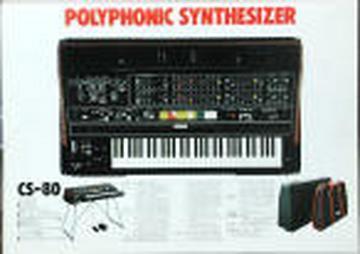
Gladly.....All that you can hear are capable with more oomph from a
real CS80....

Keep in mind.... my polyAT examples ....the sound source in these
examples are from the Arturia CS80V

and the Ensoniq SQ80 is the PolyAT keyboard........but you should
grasp the Idea

http://audio.xanga.com/slammah/126bb1031243/audio.html

http://audio.xanga.com/slammah/b64a71031225/audio.html

http://audio.xanga.com/slammah/e82a31031186/audio.html


of course I have some CS80 too.....but not much PolyAT action

http://slammah.xanga.com/audio/7bdae2131276/

http://slammah.xanga.com/audio/482b72131176/


http://slammah.xanga.com/audio/d533e1038642/

http://slammah.xanga.com/audio/33e942131171/
-----Original message-----
From: "stevelenham" yahoo@lenham.clara.co.uk
Date: Thu, 22 Oct 2009 15:06:49 -0600
To: yamahacs80@yahoogroups.com
Subject: [yamahacs80] Poly-aftertouch question + idea

Hi,

Please excuse my ignorance, but could anyone give me some examples of
how polyphonic aftertouch is actually used in performance? I'm
particularly interested in how many notes tend to be modulated at a
time - is it just one, or several?

I'm asking because I just learnt about a new range of long resistive
sensors (ideal for ribbon controllers, incidentally) and it occurred
to me that by adding one of these to a mono-aftertouch keyboard (say,
my CS60) one could create what might be called "directed
monoaftertouch". Such a system would still only take a single measure
of pressure but, by detecting which single key was responsible for it,
could apply the resulting modulation to a single voice rather than all
active voices.

I completely appreciate that it wouldn't be as good as proper poly
aftertouch, but it would be a lot easier to implement. Would it be
musically useful? I need to know whether to bother giving the idea
more thought!

Best regards,

Steve L.


[Non-text portions of this message have been removed]
Message
Re: [yamahacs80] Poly-aftertouch question + idea
2009-10-23 by Laurie Curry
Attachments
- No local attachments were found for this message.