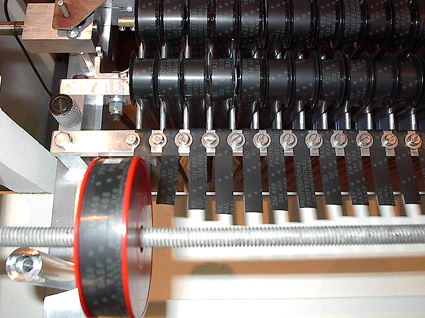
Modern plywood, as an alternative to natural wood, was invented in the 19th
 century, but by the end of the 1940s there was not enough lumber around to
 manufacture plywood affordably. Particleboard was intended to be a
replacement.  German inventor of particle board was _Max  Himmelheber_
(http://en.wikipedia.org/wiki/Max_Himmelheber) . The first commercial piece was produced
during _World War  II_ (http://en.wikipedia.org/wiki/World_War_II)  at a
factory in Bremen, Germany. It used waste material such as  planer shavings,
offcuts or sawdust, _hammer-milled_
(http://en.wikipedia.org/wiki/Hammer_mill)  into chips, and bound together with a _phenolic  resin_
(http://en.wikipedia.org/wiki/Phenolic_resin) . Hammer-milling involves smashing material
into smaller and  smaller pieces until they pass out through a screen. Most
other early  particleboard manufacturers used similar processes, though often
with slightly  different resins.
It was found that better strength, appearance and resin economy could be
achieved by using more uniform, manufactured chips. Manufacturers began
processing solid birch, beech, alder, pine and spruce into consistent chips and
flakes. These finer layers were then placed on the outsides of the board,
with  the central section composed of coarser, cheaper chips. This type of
board is  known as three-layer particleboard.
More recently, graded-density particleboard has also evolved. It contains
particles that gradually become smaller as they get closer to the  surface


In a message dated 3/1/2011 12:50:03 P.M. Eastern Standard Time,
tron400@yahoo.com writes:


I was thinking of plywood as solid wood, but of course, it's not. So, when
did particle board make its debut?

Bernie

--- In _newmellotrongroup@yahoogroups.com_
(mailto:newmellotrongroup@yahoogroups.com) ,  lsf5275@... wrote:
>
> I don't think they were ever made  completely of solid wood. I know that
> most of the Mellotrons I have  seen had plywood lids and front and back
panels,
> but when I owned  1562, it had front and back panels made of phenolic.
>
>
>  In a message dated 3/1/2011 7:47:35 A.M. Eastern Standard Time,
>  tron400@... writes:
>
>
>
>
>
>
> Frank,
>
> Based on the hoard of M400's you've restored,  can you tell at what point
> the cabinets were changed from solid wood  to particle board?
>
> Bernie
>
> --- In __newmellotrongroup@yahoogroups.com_
(mailto:_newmellotrongroup@yahoogroups.com) _
> (mailto:_newmellotrongroup@yahoogroups.com_
(mailto:newmellotrongroup@yahoogroups.com) )  , lsf5275@ wrote:
> >
> > Chris,
> >
> >  Yeah, here are a few more photos. It all comes down to what it would
>  take
> > to make it right. Besides, I want to build a cabinet and  modify the
Tron
> a
> > bit. It all comes down to its  provenance. I won't literally trash the
> > cabinet. I'll just store  it away. If you look at the following photos,
> and if you
>  > know anything about repairing particle board, you'll see how difficult

> the
> > repairs will be and that the cabinet will forever  more be structurally
> > compromised.
> >
> >  Frank
> >
> >
> >
> >
> > I  believe the Tron fell forward on its "chin" and caused this break.
It
>  > goes all the way through.
> >
> > It is worse than you  can see here.
> >
> > Repairing edges and corners is easy.  So is reveneering.
> >
> > As you can see, it is all the  way through. You could dig it out, glue
> it,
> > clamp it  and then fill it with Bondo, but it would never be strong.
> >
> > Notice the crack in the lower left corner of the photo? That  goes all
> the
> > way through as well. You can also see that  the corner blocks in the
> bottom
> > are cracked  through.
> >
> >
> >
> > The question  becomes, "Where do I put my effort?" Can I fix it? Sure,
> and
>  > I can make the breaks invisible. But the cabinet would always be weak
> and
> > easily damaged.
> >
> >
>  >
> >
> >
> > In a message dated 2/28/2011  4:15:42 P.M. Eastern Standard Time,
> > fazeka@ writes:
> >
> >
> >
> >
> > Hi Frank,
> >
> > I'm only referencing pictures, but the current cabinet doesn't  look
> *too*
> > bad. Is there a reason for requiring a new  cab?
> >
> > Chris
> >
> > --- In ___newmellotrongroup@yahoogroups.com_
(mailto:__newmellotrongroup@yahoogroups.com) _
> (mailto:__newmellotrongroup@yahoogroups.com_
(mailto:_newmellotrongroup@yahoogroups.com) )  _
> > (mailto:__newmellotrongroup@yahoogroups.com_
(mailto:_newmellotrongroup@yahoogroups.com) _
> (mailto:_newmellotrongroup@yahoogroups.com_
(mailto:newmellotrongroup@yahoogroups.com) )  ) , lsf5275@ wrote:
> > >
> > <snip>
> >  > I'm going to build it a new cabinet. The plan for now is to build it

> out
> > of
> > > all MDF or a combination of  MDF and Baltic Birch plywood.
> >
>
Message
Re: [newmellotrongroup] Re: Freddy Fender Mellotron
2011-03-01 by lsf5275@aol.com
Attachments
- No local attachments were found for this message.