R.B. Annis makes nice ones... But here's something you might
want to read and then do some follow up research on the subject. This might also
be a good discussion for this forum. I have some insight...
I did not write this, but my research indicates that
there is a lot of support for this....
"First, what I'm about to write will be viewed by many as controversial, by
others as wrong, by still others as hopefully insightful. But I have no doubt
that, because what I'll say flies in the face of "common wisdom", "standard
practices" and even many maintenance manuals, there will be those that just
ignore all of this. That's fine, do what makes you feel good, but there is at
least some science behind my statements below.
Several decades ago I did
some in-depth research into the effectiveness, and necessity of demagnetizing
recorder parts as part of routine maintenance. I won't bore with details, but
part of the research involved renting a lab-grade hall-effect probe gaussmeter
in order to measure DC magnetic fields, analyzing their effect on the recording
process, and their effect on pre-recorded test signals. In addition to the
gaussmeter, a swept spectrum analyzer was used, as was a low distortion sine
generator, and several strong permanent magnets as DC field sources.
In
short, what I found is this:
1. Operating a tape recorder does not cause
anything in the tape path to become magnetized. Not even a tiny bit.
2. All
parts including heads have made from materials with a natural neutral magnetic
state, to which they tend to return even if deliberately magnetized.
3. The
magnetic flux required to affect a recorded tape is much higher than anything
anywhere around the tape recorder, except in the erase and record head gaps. The
effect of a steady-state magnetic field (a DC field) on recorded tape is first
noticed as partial erasure of high frequencies, and that occurred with a field
somewhere above 200 Gauss. Tape has very high coercivity by design, meaning you
need a high field strength to cross the threshold above which the tape will
become magnetized. That's what the bias oscillator does. By being many times
hotter than the actual audio signal on the head, the bias forces the signal over
the coercivity threshold into the more "linear" range of the tape. But that
means it's harder to erase tape than you might think. Typical guide and head
residuals were in the zero to 20 gauss range, far below tape coercivity levels.
4. Erase and record heads are self-demagnetized by the bias oscillator,
which provides an AC field in the gap that is thousands of times higher than
what a de-magnetizer can induce.
5. The field found on recorded tape is
incapable of magnetizing anything. It is minuscule, and when the tape moves, it
becomes an AC field, which would demagnetize if it had any effect.
6. The
effect of a DC field near or in a record head produces two measurable results:
First, a significant elevation of even-order harmonic distortion, and second, an
elevation in low frequency noise (a sort of gravelly sounding noise). But again,
the field has to be fairly high for this to happen. You need a spectrum analyzer
to differentiate even harmonics from the normal odd harmonics created in the
recording process.
7. If tape machine parts become magnetized, there is a
defect in manufacture (the material doesn't have a natural, neutral magnetic
state), or a defect in the tape machine, either due to a failure or design flaw.
Asymmetrical bias waveforms will present a DC component, any DC on a head due to
a circuit defect (bad blocking cap, for example). Demagnetizing may temporarily
remove the residual, but if it creeps back, something is "broken", and needs
repair or replacement.
8. Lastly, casual use of a demagnetizing device,
even if the classic proper techniques are observed (slow removal, switching of
when several feet away), sometimes resulted in an increased magnetic state
rather than a decrease. There's no way to tell if you are demagnetizing, or
magnetizing, without further testing for the effects of magnetism. Once again,
these are HF erasure of a recorded tape, or increase in noise and even-order
harmonic distortion during record. Yes, you need instrumentation to do this.
During the research, I also found that attempts to deliberately
magnetize a tape head with a strong permanent magnet were successful, but over
time, the head returned to a neutral state by itself. It took 24 to 48 hours,
but then all the effects of magnetism vanished. The same was true of guide
parts, though some could not be magnetized being non-ferrous.
In
summary, routine demagnetization is unnecessary, and could actually make things
worse. If you plan to demagnetize, you also need to be able to measure the
effects of residual magnetism to see if you've made it better or worse, or if it
was needed at all.
Have fun,
Jim
In a message dated 3/8/2013 7:09:57 P.M. Eastern Standard Time,
mellotronex@earthlink.net writes:
Frank.
Can you recommend a magnetometer?
This is the only one I can find.
Thank you.
js
M400 #215
Bernie, with a Han-D-Mag you can
de-mag a headblock in a minute or two. But that thing is not to be trifled
with. It will do all kinds of cool things but can really fuck up your shit.
Get your tapes out of the room. Do all the heads at once... Power on...
slowly sweep from head to head... move the HCM away and
unplug.
The magnetometer is the thing. It lets you know for sure if or where
you have problems, and it lets you know if you solved them. No
guessing.
Later you might want to get the Han-D-Mallet... for when nothing else
is working right.
In a message dated 3/8/2013 11:48:33 A.M. Eastern Standard Time,
tron400@yahoo.com writes:
Thanks for those links, Frank.
Bernie
--- In newmellotrongroup@yahoogroups.com,
lsf5275@... wrote:
>
> Han-d-mag
>
> _http://usrecordingmedia.com/handmagdebyr.html_
> (http://usrecordingmedia.com/handmagdebyr.html)
>
> Getting a good magnetometer is a good idea. I find mine
to be indispensable
>
> _http://www.rbannis.com/products/handmags.html_
> (http://www.rbannis.com/products/handmags.html)
>
>
> In a message dated 3/6/2013 12:33:34 P.M.
Eastern Standard Time,
> tron400@... writes:
>
>
>
>
> Hey Frank, when I do a search on Man-D-Mag, I
just get hits on Mad
> Magazine.
>
> Bernie
>
> --- In _newmellotrongroup@yahoogroups.com_
> (mailto:newmellotrongroup@yahoogroups.com)
, lsf5275@ wrote:
> >
> > Buy a Man-D-Mag and a
humidifier.
> >
> >
> > In a message dated
3/6/2013 6:54:32 A.M. Eastern Standard Time,
> > tron400@
writes:
> >
> >
> >
> >
>
> Well, not just M400's.
> >
> > Yesterday, after
turning mine on and letting it warm up, I did the arm
> > across
the keyboard trick to the end of the tapes and 3 of them didn't
>
return.
> > I had to remove the keyboard to release them
(loosening the pinch roller
> > and pad didn't do it).
>
>
> > I played with one of the keys until the tape wouldn't
return, even after
> > removing the keyboard. The tape had
bunched up in front of the capstan.
> When
> > I
unbunched it, I found that a small tape loop had gotten in between the
> > capstan and the long felt pad in front of the capstan. The
tape decided
> to
> > take this route instead of going
into the spill box. Static? The room is
> > pretty dry with
forced air heat.
> >
> > I haven't ever demagged the
heads or capstan. Does that sound like what
> > needs to be
done? I have an old fashioned head demagnetizer (this kind:
> >
__http://www.splicit.com/images/Demagnetizer2.jpg__
> (http://www.splicit.com/images/Demagnetizer2.jpg_)
> > (_http://www.splicit.com/images/Demagnetizer2.jpg_
> (http://www.splicit.com/images/Demagnetizer2.jpg)
) ), but I'm not sure it will work on the
> capstan.
> >
Suggestions?
> >
> > Bernie
>
>
>
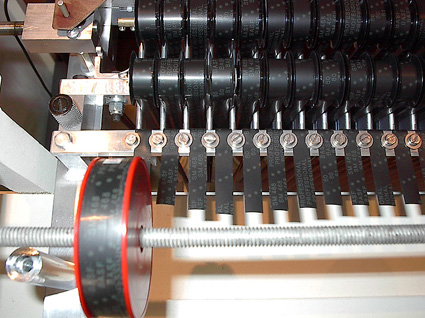
)
