I will respond to these questions to the best of my ability, but I am
happy to be correct if my ageing mind has introduced erroneous
information
At 22:13 15/04/2009, Jim Bailey wrote:
At 22:13 15/04/2009, Jim Bailey wrote:
--- In newmellotrongroup@yahoogroups.com, Chris Dale <unobtainiumkeys@...> wrote:
> I'm not going to add to what appears to be an argument, so I'll just say my
> personal experience and knowledge of the Birotron is this:
Lots of good info; thanks, Chris.
A coulple of things occurred to me while reading this though, and I'm surprised it hasn't come up before in discussions regarding this instrument, unless I managed to miss it. Perhaps you could address them for me.
1/ How long are the loops in a BiroTron cartridge?
This did vary, as we obtained cartridges form different sources but I believe the majority were about 12 minutes - this being the norm for a standard audio cartridge, i.e. 8 tracks, thus 4 stereo tracks and 4 * 12 being adequate for an album of the time. As I recall there were some purchased specifically from manufacturers to Birotronics spec, and I do not know what length they might have been. I will find out.
2/ What happens at the loop point?
I suspect there would have been some audio effect there, but given the length of tape and average use it is not something that would occur very often at all, and I do not know if this was ever commented on, but I doubt it.
Subsidiary question: Is the physical loop point the same as the recorded one?
No, not at all. The recordings made for Birotronics (i can't comment on other later recordings) were recorded on to two loops and manually faded back and forth to avoid the splice - I did read somewhere that this added an 'ethereal' (or "unrealistic", depending on your point of view) feeling to the sound.
Even with a perfect splice there will have to be a noticeable change somewhere.
See above.
The second question relates to what I perceive as a major flaw in the playability of this instrument: If one is playing a sustained note when the recorded loop point passes, is there an audible clunk as though the note were being started from the beginning?
No, the fading of the original recordings made it such that this didn't occur, but consider the comments above.
While this would be bad enough with a single note, I can't even imagine the kind of train-wreck that would occur when playing a chord.
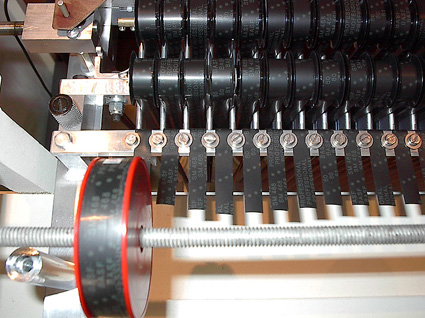
LOL - it would be, but the only issue would be the splice in the cartridge loop, the rest has been taken care of. Now the way the keyboard is associated with the tapes is not 1:1 (or, I suppose, 4:4,). Adjacent notes are spread across different tapes, so for example A is track 1, tape 1, B is track 3 tape 1, C is track 2 tape 2 etc. (these are not the actual spreads, they are give a suggestion of the way the keyboard to tape mapping worked, because I'm too lazy to go and check on my Birotron at this time of night). Now here's the theory, and again I do not claim to be an expert but state what I believe to be the case. Spreading the notes across the tapes this way, when carefully considered, can significantly reduce unwanted harmonics resulting from crosstalk, or bleeding between adjacent tracks. It also avoids your train crash, the chance of any chord being played when all loop splices are in the same position is so remote as to be negligible.
As has been mentioned with regard to the Mellotron, it is the attack at the beginning of a note that defines the "instrument" being played. If this happens part-way through, the result would sound, to put it bluntly, rather stupid I would think.
It would indeed be stupid, but it doesn't happen because of the way the tapes are recorded. This is probably a defining difference in the two machines.
Depending upon the application of the machine though, I cannot agree that the attack is the sole defining factor of an instrument alone. The attack certainly prepares out cognitive senses as to what is to come, if we have had knowledge of that instrument's sound previously, and possibly by losing that attack a sound more akin to early electronic pianos, some organs and early synths will be created. But for many that is, or was, not an issue, the finery of concert quality was not need by Slade, and I don't think Chas and Dave would have looked comfortable around a Steinway.
I must say though that I am merely expressing my opinion, I make no claim other that to have had the experience of building the few Birotrons ever made, and to have an interest in them for that reason. If anything I have stated above is incorrect and any party wishes to correct me, I am, of course happy to receive their constructive criticism.
Please let me know, so that I can sleep peacefully in my bed tonight (or wherever I end up).
Sleep well, you have little or naught to worry about. But if you end up anywhere other than home we will tell your:- partner/cat/dog/neighbour/drinking buddy*
*delete as appropriate.
All the best
Nic