eml synthesizers group photo

Yahoo Groups archive

eml synthesizers

Archive for emlsynth.

Index last updated: 2026-03-30 01:08 UTC

Thread

RE: [emlsynth] Digest Number 120

RE: [emlsynth] Digest Number 120

2004-02-23 by Bob Lee

>I'm curious, now if they actually owned those, after all it's never a
given that stuff used in live shows belongs to the band rather
than being rented, loaned, belonging to the support team), what
strikes me is that as far as I know EML wasn't well known at all
in the UK or Europe. They could have bought those in the U.S.,
but why?

Anyone care to comment on EMLs availability and use in
England (or Europe, Japan etc.) before collectors in the 90s
started to pick them up. After all I know the Keyfax book (UK
1996) has only a short paragraph for the whole company when
usually every model has a listing. I also remember Forrest's
Analogue Synthesizers A-Z first edition had similar scant info
though the current revised edition covers them acceptably.<

I think it was probably a matter of PF's seeking whatever would do the job
satisfactorily. Although the company never reached the prominence that Arp
or Moog enjoyed, they were certainly not unknown in the mid 70s. I was in
high school during those years, and as an avid reader of "Contemporary
Keyboard" magazine I certainly knew of EML. In fact, when my family moved in
1976 to Vernon, Connecticut, from Albany, New York, my consolation was that
I'd be living in the same town as EML. (I tried a couple times to land a job
there but was never successful.) John McLaughlin used a rudimentary guitar
synthesizer made by EML, so the company couldn't have been too hard to find
for Brits who put a little effort into searching. ;^)

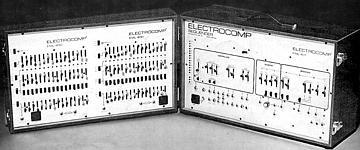
When the ElectroComp 400 sequencer was on the market, I don't know if there
was another sequencer available that was as reasonably portable and
reasonably easy to program.

It was the advanced-technology, low-manufacturing-volume nature of keyboard
and synthesizer instruments that unlike drummers, guitarists, and bassists,
even star keyboardists did not often get instruments for free or as loaners.
(I remember a Keith Emerson interview in CK in which he jokingly lamented
that he was the only band member in ELP who had to actually buy his own
instruments and gear.) And unlike, say, pianos, which may vary subjectively
in timbre and sound quality but still pretty much all work the same, analog
synthesizers of some 30 years ago all had different ranges of capabilities,
different approaches to programming, and such, so it would make sense for a
keyboardist like Richard Wright to actually have his own synthesizer so he
could know it intimately enough to make good use of it.

To my knowledge, EML faded from the scene gradually, without being purchased
by a larger company like Norlin, which otherwise might've helped sustain its
visibility a while longer, or at least maintain its legacy for a bit. That
may explain why documentations done in the 80s and early 90s of the analog
synthesizer industry were often quite sketchy about EML.

Bob Lee
Applications Engineer, Technical Services Group
QSC Audio Products, Inc.
Tel. +1 714.327.4667
1 800 QSC AUDIO (USA only)
Fax. +1 714.754.6173
E-mail: bob_lee@...
www.qscaudio.com (product info and support)
www.qscstore.com (accessory and replacement part sales)
* Chairman, Audio Engineering Society--Los Angeles Section
http://www.aes.org/sections/la/
-------------------------
To order QSC accessories and upgrade options online, visit us at
www.qscstore.com. Thank you!

This electronic message transmission contains information from QSC Audio
Products, Inc., which may be confidential or privileged. This information is
intended for the use of the individual or entity named above. If you are not
the intended recipient, be aware that any disclosure, copying, distribution
or use of the contents of this transmission is strictly prohibited. If you
have received this electronic transmission in error, please notify us
immediately via telephone.

Re: Digest Number 120

2004-03-02 by nicholas_kent

--- In emlsynth@yahoogroups.com, Bob Lee <bob_lee@q...> wrote:
> >I'm curious, now if they actually owned those, after all it's never a
> given that stuff used in live shows belongs to the band rather
> than being rented, loaned, belonging to the support team), what
> strikes me is that as far as I know EML wasn't well known at all
> in the UK or Europe. They could have bought those in the U.S.,
> but why?
>
> Anyone care to comment on EMLs availability and use in
> England (or Europe, Japan etc.) before collectors in the 90s
> started to pick them up. After all I know the Keyfax book (UK
> 1996) has only a short paragraph for the whole company when
> usually every model has a listing. I also remember Forrest's
> Analogue Synthesizers A-Z first edition had similar scant info
> though the current revised edition covers them acceptably.<
>
> I think it was probably a matter of PF's seeking whatever would do the job
> satisfactorily. Although the company never reached the prominence that Arp
> or Moog enjoyed, they were certainly not unknown in the mid 70s. I was in
> high school during those years, and as an avid reader of "Contemporary
> Keyboard" magazine I certainly knew of EML. In fact, when my family moved in
> 1976 to Vernon, Connecticut, from Albany, New York, my consolation was that
> I'd be living in the same town as EML. (I tried a couple times to land a job
> there but was never successful.) John McLaughlin used a rudimentary guitar
> synthesizer made by EML, so the company couldn't have been too hard to find
> for Brits who put a little effort into searching. ;^)

While everything you say is conceivable it just doesn't seem likely. It
made sense that you knew about it, but then you were devouring local
magazines because of your interests.


> When the ElectroComp 400 sequencer was on the market, I don't know if there
> was another sequencer available that was as reasonably portable and
> reasonably easy to program.

Actually what was the release date on the 400? 1978? (from Vintage
Synth Explorer)

They all match up differently and it depends on the exact year but
aside from the one on the Moog modular British acts were often using
Arp's stand alone sequencer. EMS had their 256 step digital sequencer
out real early. You don't have the sliders or knobs but you can play
into the digital ones (Oberheim and the Roland MC-4 & MC-8). Back to
England and knobby ones, Vangelis was very partial to the little one on
the System 100 and the larger System 700 sequencer block, both were
sold separately and are self contained .

Importantly these brands had service reps in England & Europe. It just
seems strange PF, who had money would turn to a brand best known in
education and budget minded experimental musicians solely in the U.S.
market

> To my knowledge, EML faded from the scene gradually, without being purchased
> by a larger company like Norlin, which otherwise might've helped sustain its
> visibility a while longer, or at least maintain its legacy for a bit. That
> may explain why documentations done in the 80s and early 90s of the analog
> synthesizer industry were often quite sketchy about EML.

I see no evidence that these units were any more than vaguely known in
Europe. Forrests' 600+ page volumes on Analogue Synthesisers now has 3
sentances about the 400/401 in it's revised edition. (no info in it's
first edition)

As to the Norlin story - It was pretty much known to have been a sort
of a con job going on in making the company look like they were moving
a lot of product.

On a more straightforward level, the companies that had technologically
advanced product did manage to be sold or have their work purchased and
continued when they folded. EML I don't think had any advanced
technology when they ceased - as Moog did around the same time as EML.
Moog even had computer based product, but they were in serious catch up
mode.

Still curious.

Did any non US acts definitively use any EML before the 1990s (aside
from the PF mystery).