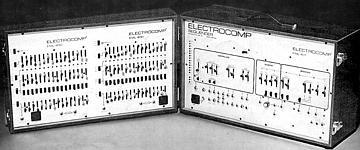
Interesting. I've heard about these things, but this is the first
time
I've ever actually seen any. I'm guessing that the four pots on the
keyboard interface module are perhaps coarse tune, fine tune,
scale, and glide, based on the interface in the EML 101.
Actually, The KB-1 and KB-2 modules and tech sheets I don’t seem to have.
(However, the 101 doesn't have a coarse tune in the keyboard
interface.) If it's the same basic circuit as the 101, then it
interfaces
to an EML duophonic keyboard with Pratt-Read mechanicals.
The circuit is rather trick and you have to know what you're doing
to interface a non-EML keyboard to it. Also, if it's like most EML
stuff,
I have to assume the KB-1 is just you’re typical single Vc output voltage-divider type keyboard, while the KB-2 has the 2nd note computer on board similar to the 101.
the output is scaled normally to 1.2 V/octave.
Actually, according to the tech sheets for the Exponential Amplifiers, it instructs as to how to tune the keyboard module output to 1V/Octave, adjust the linearity so the middle of the keyboard is on-track, and then adjusting the exponential amplifiers to a 2:1 ratio. i.e. the amplifier doubles the voltage coming in. 1V in is 2V out. 2V in is 4 V out, etc.
The VCO is interesting to me because of the two DIP ICs (741s probably).
My 101 was built without any DIP-packaged ICs -- all the ICs in it are
in metal cans. I'm a bit curious as to what all those switches are for
waveform selection? One of those metal can ICs is likely to be a uA726,
which is a very valuable part.
The ICs used in the 101 are mostly metal-can op-amps: They were almost pre DIP packaging.
Oscillator and filter control mixers, Reference voltage source and the second note computer are all 741’s.
The glide circuit uses 741’s, the keyboard sampler uses 748’s.
The exponential amps use 741’s and 1456’s
Oscillators 2 and 3 use 741’s entirely and through the waveform selection pot and as the osc output buffer amp.
Actually, all of the rest of the IC’s in the 101 schematic are either 741’s, 748’s or 1456’s with the lone exception of a 301 used for the noise source.
The ADSR caught my attention too. It must have been a more recent
design, because the 101 doesn't have ADSR envelopes -- only ADS
or ASR, depending on a switch selection. Incidentally, those pots
aren't particularly rare or valuable, nor can they be easily fitted to a
101, because all of the 101's pots are panel mount.
The attack and decay pots on the 101 are just simple AB J-type 1M linear pots. No center-tap on these. The sustain pot is a simple AB J-type 5K linear pot.
The Attack, Decay and Release pots on the circuit module are 1M AB mod pots and the sustain is a 5 K AB mod pot. They have the same mounting hole size as the AB J-type sealed pots and use the same hardware. So, they can be subbed into the 101. You have to solder the leads in either case and EML started panel mounting mod pots when they built the Syntar for me. I’d rather power up the ADSR module and patch the 101 through it. (which I have done)
And finally, my guess is that the mystery boards are VCAs. The one
with the gray caps looks to be a later revision. It would be great if
they were copies of the fancy VCA from the 101, which has both
two-quadrant and four-quadrant inputs, but they don't look "busy"
enough to be that.
Well, I just went through every circuit module tech sheet, the 101, 200, 400-401-416, Poly-box and Syntar schematics and board layouts and didn’t see anything similar to that board nor any part listing of a 3026.
So, it’s still a mystery.
George Mattson