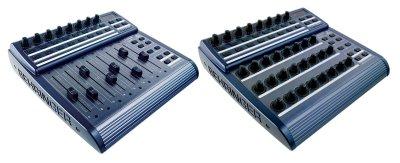
Bc2000 (for the BCF2000 & BCR2000) group photo

Yahoo Groups archive

Bc2000 (for the BCF2000 & BCR2000)

Index last updated: 2026-04-28 23:16 UTC

Thread

Korg Pa600

Korg Pa600

2013-03-17 by jacobsthlm

I realy need someone who programed BCF2000 for a Korg Pa Arranger keyboard. The MicroArranger, Pa800 or Pa3X would more or less work but it would be even greater if I found anyone with the Korg Pa600 who can save it to a template.

I'm a newbie to keyboards. midi channels, Midi data type and so on and realized that this is so beyond my limits and I can't just read manuals to understand this stuff...

Regards
Jacob

Re: Korg Pa600

2013-03-17 by sghookings@...

Hi Jacob

Really lame attitude man ... really lame.

1 - Download the manual
2 - Look at pages 316 .. a SINGLE page
3 - Observe the first column is just CCs ... I am pretty sure the BCR will 'learn' these without any need for Mark or Royce's excellent software
4 - OK so there are some NRPNs ... this _might_ scare the living shit out of really new people ... but it doesnt need to.

NRPN
CC#99
(MSB)
CC#98
(LSB)
CC#06
(Data Entry)
Vibrato Rate 1 8 0
127(a)
(a). 64 = No change to the original parameter's value
Vibrato Depth 1 9 0
127(a)
Vibrato Decay 1 10 0
127(a)
Filter Cutoff 1 32 0
127(a)
Resonance 1 33 0
127(a)
EG Attack Time 1 99 0
127(a)
EG Decay Time 1 100 0
127(a)
EG Release Time 1 102 0
127(a)
Drum Filter Cutoff 20 dd(b)
(b). dd = Drum Instrument No. 0
127 (C0
C8)
0
127(a)
Drum Filter Resonance 21 dd(b) 0
127(a)
Drum EG Attack Time 22 dd(b) 0
127(a)
Drum EG Decay Time 23 dd(b) 0
127(a)
Drum Coarse Tune 24 dd(b) 0
127(a)
Drum Fine Tune 25 dd(b) 0
127(a)
Drum Volume 26 dd(b) 0
127
Drum Panpot 28 dd(b) 0
127(a)
Drum Rev Send (FX 1) 29 dd(b) 0
127(a)
Drum Mod Send (FX 2) 30 dd(b) 0
127(a)

So this is a baby set!!! No really complexity (I know you are possibly irate/incandescent with rage at Steve (me) right now but seriously I work with incompetent folks with an IQ lower than a discarded jizz rag {not my local workmates ... no offence meant if any of you are reading this!} ... and they have a better 'can do' attitude than yours.

PLEASE read how a CC works ... it IS explained in all the manuals (BCR .. you wont need Royce/Mark for this!).

AND the NRPNs are okay too.

NOTE: 
(*) The following NRPN messages are recognized by Pa600 in
Song Play and Sequencer mode only:

So notice they are all 7 bit (0 ... 127).
So again these can be programmed direct from the BCR .. no need for complexity.

No need to freak

Try learn mode in I dont know S3 say?


[[Sorry everyone else who will patiently explain this stuff .. You know I normally do .. but really at least start your mail with 'I tried doing X or Y, like 2 beeplandscape .. see he has pretty much solved it himself .. and I bet he feels $1,000,000 because of it .. He is so MoneySupermarket . and he knows it!]

--- In bc2000@yahoogroups.com, "jacobsthlm" <jacobsthlm@...> wrote:
Show quoted textHide quoted text
>
> I realy need someone who programed BCF2000 for a Korg Pa Arranger keyboard. The MicroArranger, Pa800 or Pa3X would more or less work but it would be even greater if I found anyone with the Korg Pa600 who can save it to a template.
> 
> I'm a newbie to keyboards. midi channels, Midi data type and so on and realized that this is so beyond my limits and I can't just read manuals to understand this stuff...
> 
> Regards
> Jacob
>

Re: Korg Pa600

2013-03-19 by jacobsthlm

I want to thank you for answering me but you realy don't understand where I am in all this. I don't have a low IQ but pretty mutch everything you wrote after 4. and starting with the line "NRPN" is as clear as this will be for you:

"Jag tror du har problem att begripa detta. Till skillnad från dig kan jag inte använda googles för att förstå men jag ar tacksam att du forsokte forklara" 

It's not that I haven't read the manual it's that this is to complicated both in english and also as I don't understand the terms even when I get them translated. I know to very little about playing music and almost nothing about "Resonance, Attack, Decay, Tune, Panpot" and so on...

Regards
Jacob

--- In bc2000@yahoogroups.com, sghookings@... wrote:
>
> Hi Jacob
> 
> Really lame attitude man ... really lame.
> 
> 1 - Download the manual
> 2 - Look at pages 316 .. a SINGLE page
> 3 - Observe the first column is just CCs ... I am pretty sure the BCR will 'learn' these without any need for Mark or Royce's excellent software
> 4 - OK so there are some NRPNs ... this _might_ scare the living shit out of really new people ... but it doesnt need to.
> 
> NRPN
> CC#99
> (MSB)
> CC#98
> (LSB)
> CC#06
> (Data Entry)
> Vibrato Rate 1 8 0
127(a)
> (a). 64 = No change to the original parameter's value
> Vibrato Depth 1 9 0
127(a)
> Vibrato Decay 1 10 0
127(a)
> Filter Cutoff 1 32 0
127(a)
> Resonance 1 33 0
127(a)
> EG Attack Time 1 99 0
127(a)
> EG Decay Time 1 100 0
127(a)
> EG Release Time 1 102 0
127(a)
> Drum Filter Cutoff 20 dd(b)
> (b). dd = Drum Instrument No. 0
127 (C0
C8)
> 0
127(a)
> Drum Filter Resonance 21 dd(b) 0
127(a)
> Drum EG Attack Time 22 dd(b) 0
127(a)
> Drum EG Decay Time 23 dd(b) 0
127(a)
> Drum Coarse Tune 24 dd(b) 0
127(a)
> Drum Fine Tune 25 dd(b) 0
127(a)
> Drum Volume 26 dd(b) 0
127
> Drum Panpot 28 dd(b) 0
127(a)
> Drum Rev Send (FX 1) 29 dd(b) 0
127(a)
> Drum Mod Send (FX 2) 30 dd(b) 0
127(a)
Show quoted textHide quoted text
> 
> So this is a baby set!!! No really complexity (I know you are possibly irate/incandescent with rage at Steve (me) right now but seriously I work with incompetent folks with an IQ lower than a discarded jizz rag {not my local workmates ... no offence meant if any of you are reading this!} ... and they have a better 'can do' attitude than yours.
> 
> PLEASE read how a CC works ... it IS explained in all the manuals (BCR .. you wont need Royce/Mark for this!).
> 
> AND the NRPNs are okay too.
> 
> NOTE: 
> (*) The following NRPN messages are recognized by Pa600 in
> Song Play and Sequencer mode only:
> 
> So notice they are all 7 bit (0 ... 127).
> So again these can be programmed direct from the BCR .. no need for complexity.
> 
> No need to freak
> 
> Try learn mode in I dont know S3 say?
> 
> 
> [[Sorry everyone else who will patiently explain this stuff .. You know I normally do .. but really at least start your mail with 'I tried doing X or Y, like 2 beeplandscape .. see he has pretty much solved it himself .. and I bet he feels $1,000,000 because of it .. He is so MoneySupermarket . and he knows it!]
> 
> --- In bc2000@yahoogroups.com, "jacobsthlm" <jacobsthlm@> wrote:
> >
> > I realy need someone who programed BCF2000 for a Korg Pa Arranger keyboard. The MicroArranger, Pa800 or Pa3X would more or less work but it would be even greater if I found anyone with the Korg Pa600 who can save it to a template.
> > 
> > I'm a newbie to keyboards. midi channels, Midi data type and so on and realized that this is so beyond my limits and I can't just read manuals to understand this stuff...
> > 
> > Regards
> > Jacob
> >
>

Re: Korg Pa600

2013-03-19 by sghookings@...

En av mina bästa vänner är svenska, är en annan finska.

Ich bin in Deutschland für die nächsten 4 Monate.
So kann ich nicht mit meinem BCR2000 testen,

But the starting point is the page I pointed you to.

This tells you the CC (midi CC is a 'continuous controller')
These are nice and simple.

A control message + channel ... a controller number ... a value.

NRPNs are 'two' of these (but on special controller numbers hence Non-registered-parameter-number with special data values) to allow control of a wider set of params.

Why not check out youtube? (there two parts to this)

http://www.youtube.com/watch?v=E1d9CvJkCnU

In terms of resonance, this is related to the filter cut off.
A filter removes energy (strictly frequencies) from an input signal.
When you do this, your perfect square edge (consisting of high frequencies to make the infinite slop) get removed.
This means the infinite slope is spread over time, and a strange phenomenon (Gibbs!) happens. This slight over/undershoot around the filter cut off frequency can be amplified into itself and this is called resonance (when it starts to ring).
So the Q cuttoff is also knowns as this.

Attack/decay/sustain/release ... check out wikipedia, but these control 'envelopes'. The envelopes are a static function applied to your time-varying signal ... long attack often makes pad/string sounds.
Like I said, take a look at wiki OR better still, I often download a free scope and feed audio output of the synth into the scope and 'watch' the waveforms.

Then as you change the parameters (CCs or continuous controllers) you can see the effect.

So please please ... JFGI.

Now I never said you were stupid (did I?). I said you were being lame, and this is accurate.

Reason is a Swedish product. I am certain they will explain a lot of these concepts in a native language.

If you want me to translate into Swedish I can ask my friend (he only taught me to swear and whatever language I picked up from watching Wallander / The Bridge).

But honestly, there are plenty of nice introductions to sounds synthesis.

You dont have to study to a great level to get the basics (Sound on Sound do some good tutorials). Now, I studied to a deep level but honestly whilst I can understand both the Fourier Series (for periodic waves) and Fourier Transform (for aperiodic waves) or Wavelet transforms ... I like nothing better than messing with the knobs and creating a noise.

So once again, I am asking to you take a leaf out of others examples ... and if you want to PM me for one-to-one simple advice I will help you ... but at least realize as you said ... you dont have a low IQ ... so meet us half way and read up on the basics of sound / youtube how to set CCs.

CCs should be trivial ... NRPNs, as I said, scare the living shit out of most people ... but once you get the hang of a CC then we can move on to the concatenation to make a NRPNs.

ALL NRPNs are CCs. Not all CCs are NRPNs.

Lycka till och gör kontakta mig för hjälp.

Regards

Steve H

--- In bc2000@yahoogroups.com, "jacobsthlm" <jacobsthlm@...> wrote:
>
> I want to thank you for answering me but you realy don't understand where I am in all this. I don't have a low IQ but pretty mutch everything you wrote after 4. and starting with the line "NRPN" is as clear as this will be for you:
> 
> "Jag tror du har problem att begripa detta. Till skillnad från dig kan jag inte använda googles för att förstå men jag ar tacksam att du forsokte forklara" 
> 
> It's not that I haven't read the manual it's that this is to complicated both in english and also as I don't understand the terms even when I get them translated. I know to very little about playing music and almost nothing about "Resonance, Attack, Decay, Tune, Panpot" and so on...
> 
> Regards
> Jacob
> 
> --- In bc2000@yahoogroups.com, sghookings@ wrote:
> >
> > Hi Jacob
> > 
> > Really lame attitude man ... really lame.
> > 
> > 1 - Download the manual
> > 2 - Look at pages 316 .. a SINGLE page
> > 3 - Observe the first column is just CCs ... I am pretty sure the BCR will 'learn' these without any need for Mark or Royce's excellent software
> > 4 - OK so there are some NRPNs ... this _might_ scare the living shit out of really new people ... but it doesnt need to.
> > 
> > NRPN
> > CC#99
> > (MSB)
> > CC#98
> > (LSB)
> > CC#06
> > (Data Entry)
> > Vibrato Rate 1 8 0
127(a)
> > (a). 64 = No change to the original parameter's value
> > Vibrato Depth 1 9 0
127(a)
> > Vibrato Decay 1 10 0
127(a)
> > Filter Cutoff 1 32 0
127(a)
> > Resonance 1 33 0
127(a)
> > EG Attack Time 1 99 0
127(a)
> > EG Decay Time 1 100 0
127(a)
> > EG Release Time 1 102 0
127(a)
> > Drum Filter Cutoff 20 dd(b)
> > (b). dd = Drum Instrument No. 0
127 (C0
C8)
> > 0
127(a)
> > Drum Filter Resonance 21 dd(b) 0
127(a)
> > Drum EG Attack Time 22 dd(b) 0
127(a)
> > Drum EG Decay Time 23 dd(b) 0
127(a)
> > Drum Coarse Tune 24 dd(b) 0
127(a)
> > Drum Fine Tune 25 dd(b) 0
127(a)
> > Drum Volume 26 dd(b) 0
127
> > Drum Panpot 28 dd(b) 0
127(a)
> > Drum Rev Send (FX 1) 29 dd(b) 0
127(a)
> > Drum Mod Send (FX 2) 30 dd(b) 0
127(a)
Show quoted textHide quoted text
> > 
> > So this is a baby set!!! No really complexity (I know you are possibly irate/incandescent with rage at Steve (me) right now but seriously I work with incompetent folks with an IQ lower than a discarded jizz rag {not my local workmates ... no offence meant if any of you are reading this!} ... and they have a better 'can do' attitude than yours.
> > 
> > PLEASE read how a CC works ... it IS explained in all the manuals (BCR .. you wont need Royce/Mark for this!).
> > 
> > AND the NRPNs are okay too.
> > 
> > NOTE: 
> > (*) The following NRPN messages are recognized by Pa600 in
> > Song Play and Sequencer mode only:
> > 
> > So notice they are all 7 bit (0 ... 127).
> > So again these can be programmed direct from the BCR .. no need for complexity.
> > 
> > No need to freak
> > 
> > Try learn mode in I dont know S3 say?
> > 
> > 
> > [[Sorry everyone else who will patiently explain this stuff .. You know I normally do .. but really at least start your mail with 'I tried doing X or Y, like 2 beeplandscape .. see he has pretty much solved it himself .. and I bet he feels $1,000,000 because of it .. He is so MoneySupermarket . and he knows it!]
> > 
> > --- In bc2000@yahoogroups.com, "jacobsthlm" <jacobsthlm@> wrote:
> > >
> > > I realy need someone who programed BCF2000 for a Korg Pa Arranger keyboard. The MicroArranger, Pa800 or Pa3X would more or less work but it would be even greater if I found anyone with the Korg Pa600 who can save it to a template.
> > > 
> > > I'm a newbie to keyboards. midi channels, Midi data type and so on and realized that this is so beyond my limits and I can't just read manuals to understand this stuff...
> > > 
> > > Regards
> > > Jacob
> > >
> >
>
Move to quarantaine

This moves the raw source file on disk only. The archive index is not changed automatically, so you still need to run a manual refresh afterward.