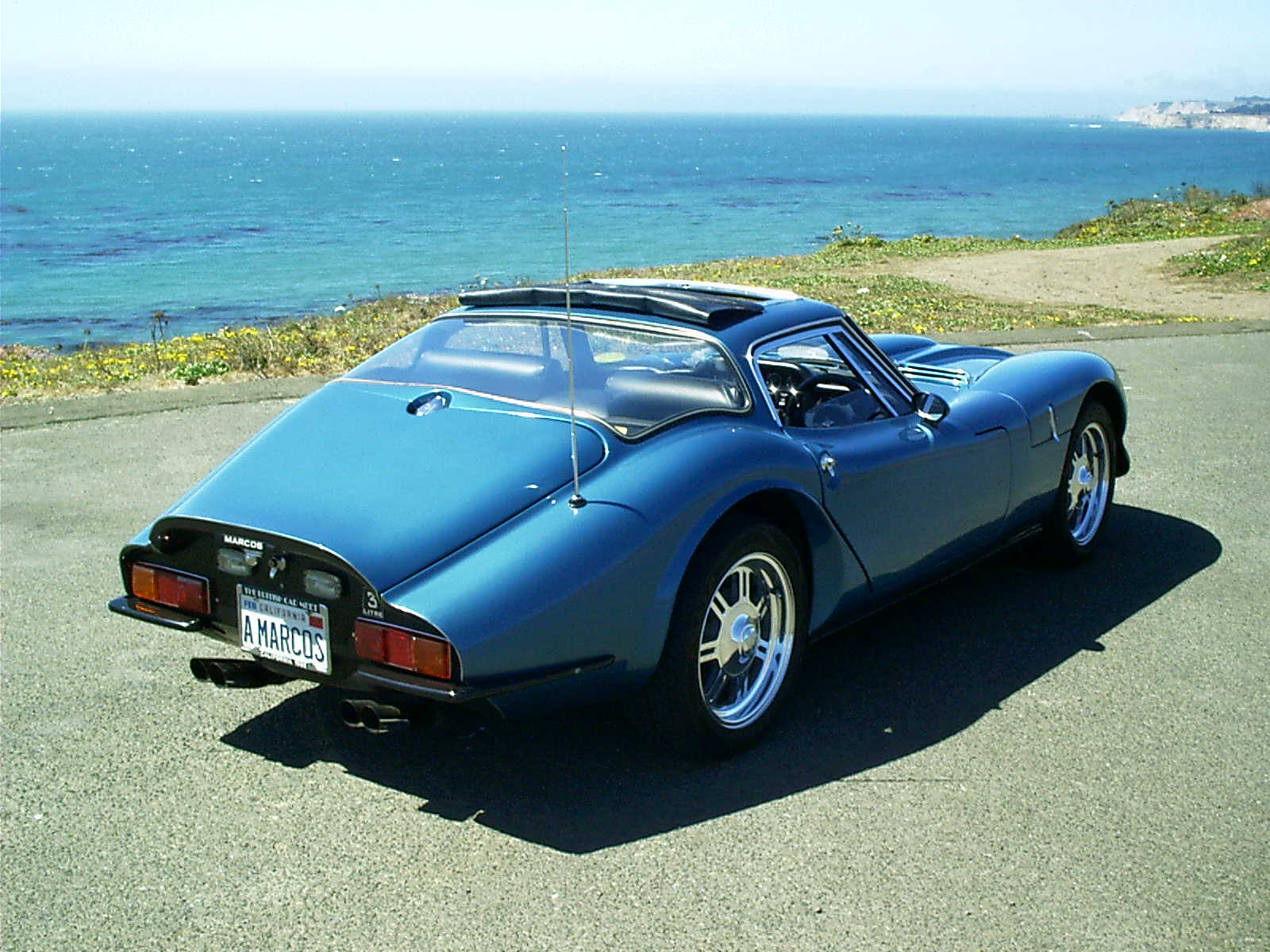
Tire size, ground clearance, Toe in,and bolt pattern, Anti-sway bars
2001-11-10 by Mike Denman
Hi guys,
First off, I don't consider myself an expert on suspensions. Having
said that, lets look at some "facts".

The Marcos 1800 came 175-13 inch tires and had a ground clearance of
4.7 inches (Source Road and Track Magazine)and a toe in of 1/8 Castor
of 7 1/2 degrees (source Motor Magazine)

The Marcos 1600 came with 165-13 tires and had a ground clearance of
4.25 inches toe in 1/8. Castor 6 1/2, and camber 0 (source Motor
Magazine)

The Marcos 3 liter V6 came with 175-13 inch tires and had a ground
clearance of 3 1/2 inches, toe in of 1/8, castor of 6 degrees, and
camber of 0 (source Motor Magazine)

The Marcos 3 liter Volvo engine came with 175 -13 inch tires, and had
a ground clearance of 4 1/2 inches (Source Autocar Magazine)

The Marcos Mantula was still using the Triumph front suspension and
came with 225/60VR14 inch tires (source Autocar magazine)No suspension
settings noted or ground clearance.

So, if you are having ground clearance problems, you might want to
measure what you have and compare that measurement to what the car had
originally.  In addition to the problem modern tires pose with their
lower profile and resulting lower rolling diameter, we also have the
problem of what previous owners have done inaddition to other
mechanical problems like tired springs etc. What exactly is scraping
when you "bottom out".  Is it something that can be mounted closer to
the body and farther from the ground?  I have spent a lot of time
building my own exhaust system to get it up and out of the way.  The
result is an exhaust system that doesn't scrape when I go over bumps.
The only place that I have a problem scraping in on some LARGE speed
bumps and the engine pan will scrape slightly if I am not careful.  I
don't scrape going into and out of drives etc.

Wheel and tire combinations are endless. However, if you compare a 14
inch wheel and tire with the exact thing in a 13 inch size (apples to
apples) the 14 inch size will be heavier.  This doesn't mean that you
can't find an 14 inch alloy wheel that is lighter than the 13 inch
wheels that are on your car (apples to oranges). How this additional
unsprung weight effects your car's handling will always be negative,
if everything is equal (apples to apples).  It doesn't mean that a 14
inch wheel with new modern low profile tires MAY perform as well or
BETTER than your original 13 inch wheels and tires (apples to
oranges). I simply don't know.  There are a lot of factors that would
have to be considered if you want a really professional answer. If you
are real concerned about the unsprung weight you can buy aluminum hubs
that fit the Triumph front axles (two different style bearings) and
have them drilled to either the Triumph pattern 3 3/4 (measured
diagonally from centerline of stud to stud) or British Ford (Cortina)
4 1/4(measured diagonally from centerline of stud to stud)to partially
offset the additional weight of the larger wheels. You can also get
lighter brakes either by buying some of the aftermarket units in
aluminum or changing to the smaller and lighter Triumph units (Triumph
made two different size caliphers that fit the front end of the
Marcos)

Rolling diameters... In addition to everthing else, be sure if you are
changing wheel size to gain additional clearance that your new tire
/wheel combination nets you an increase in rolling diameter.  You can
get 14 inch wheels and tires combinations (40 series tires for
example) that are smaller than a 13 inch wheel with say a 75 series
tire. Also realize that for every inch in height of rolling diameter,
you only get 1/2 inch of increased ground clearance.

Anti-sway bars... Sway bars are fitted to the front of cars to shift
part of the cornerning load to the rear tires.   Again, I am not an
expert but how does your car corner?  If it understeers, it Might need
a anti-sway bar.  If the car oversteers, it MAY need an anti-sway bar
that is smaller in diameter or it MAY not need one at all.  (The
Triumphs came with two different diameters,by the way.) Anti-sway bars
shouldn't be added or changed "willy-nilly".  They are an engineering
answer to a specific problem.  So make sure you have the problem
before you start changing things.

Mike Denman
1966 Marcos 1800
Chassis # 4079