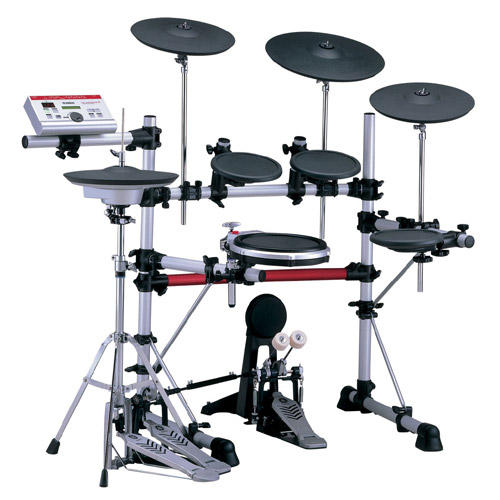
Yamaha DTXpress/DTXplorer/DTXtreme group photo

Yahoo Groups archive

Yamaha DTXpress/DTXplorer/DTXtreme

Index last updated: 2026-04-28 22:44 UTC

Thread

recommendation for cheap brain?

recommendation for cheap brain?

2003-09-13 by smoerk

hello,

i'm new to the list and digital drums. i recently bought a yamaha kp-120 
kick pad (real head) and now looking for a inexpensive drum module only 
for the bass drum. i'm not going to buy hihat, cymbal or snare pads.

what module would you recommend to start with, which fits to the kp-120? 
i don't care, if it's a alesis, roland or yamaha. and don't want to 
spend more than 200\ufffd for a used one.


i hope it's not off topic to ask this kind of questions here and to talk 
about DTXtreme hardware.


thx,
-s

Re: recommendation for cheap brain?

2003-09-13 by liberatusvirus

--- In DTXpress@yahoogroups.com, smoerk <smoerk@g...> wrote:
> i'm new to the list and digital drums. i recently bought a yamaha 
kp-120 
> kick pad (real head) and now looking for a inexpensive drum module 
only 
> for the bass drum. 

Hi Smoerk and welcome,

It is not at all off topic to discuss Xtreme equipmment, or any other 
equipment, here. First of all, I'm wondering what purpose you had in 
mind when you bought the KP-120. Assuming nothing tricky, the easy 
answer to your question is that modules from all of the companies 
that you mention would work with the pad. The important issues are 
determining what is a reasonable amount to spend on triggering a 
single drum and which company's sounds do you prefer. I personally 
like many of the abundant DTXpress bass-drum voices; a used 
discontinued DTXPU, v.I, has the added advantage of being inexpensive 
(less than $200). Discontinued modules from other companies, like the 
Alesis D4 or Roland TD-5, may be good options as well. Trying them is 
the best way to find out, but that is often difficult to arrange. 

The higher the price, both used and new, the more you will be able to 
do with the module. For instance, some modules allow stacking/ 
alternating four notes or more on a single pad--meaning either 
chords/short melodic phrases or simply layered percussive voices or 
patterns. But even an entry-level module can do interesting things. 
One member of this group recently devised a strategy for recording a 
walking bass line with quarter-note kicks on the DTXpress sequencer. 
You can find it on our sister site, dtxpressions.com, under Tips and 
Tricks. After you've experimented with programming voices other than 
standard kicks through the KP-120, and become more familiar with what 
a module can do to enhance your drumming, you might find the prospect 
of triggering your acoustic drums or adding other electronic pads 
more attractive. Otherwise, the module may be going largely to waste.

If none of the extras appeals to you, maybe you could find a cheaper 
method to trigger your KP-120--for instance, connecting with another 
band member's (keyboard player's?) MIDI interface. Others from this 
group may have suggestions. 

Ed

Re: [DTXpress] Re: recommendation for cheap brain?

2003-09-13 by smoerk

liberatusvirus wrote:

Hello Ed,

thanks for the detailed reply. :-)

> First of all, I'm wondering what purpose you had in 
> mind when you bought the KP-120. 

I have an acoustic set and the worst part of it is the bass drum. You 
cannot change the sound of the bass drum easily and quickly and i want 
to have a little bit more choice. So for me it was clear to start with a 
kick pad and see if i like digital drums or not.

> The important issues are 
> determining what is a reasonable amount to spend on triggering a 
> single drum and which company's sounds do you prefer.

hard to say as i don't know the company's sounds. Are there some samples 
available in the net?

> If none of the extras appeals to you, maybe you could find a cheaper 
> method to trigger your KP-120--for instance, connecting with another 
> band member's (keyboard player's?) MIDI interface.

But how to get a MIDI signal out of the KP120? :-)

I thought about using a computer for this. It should be possible to 
connect the trigger output to the mic input of the sound card and 
convert the amplitude to a MIDI signal. But I doubt that the latency is 
low enough for a natural feeling. What do you think is an acceptable 
delay between trigger impulse (hit the drum) and hearing the audio 
signal? 1, 2 or 3 ms?

How big are the latencies of the drum module?

Re: recommendation for cheap brain?

2003-09-13 by liberatusvirus

--- In DTXpress@yahoogroups.com, smoerk <smoerk@g...> wrote:
> liberatusvirus wrote:
i don't know the company's sounds. Are there some samples 
> available in the net?

The Clavia site has ddrum demos; Yamaha's drum site has a demo of the 
DTXpressII; Hart Dynamics has demos of their kits played through 
Roland and Alesis modules; this group's site has a few mp3 files of 
people playing their kits live or in the studio. But I don't know of 
any individual samples from the DTXPU or other modules.
 
> But how to get a MIDI signal out of the KP120? :-)

There's no getting around the 1/4" output; I was hoping that someone 
had a MIDI interface with 1/4" inputs available to you--a Kat, a 
Roland, or something. 

> I thought about using a computer for this. It should be possible to 
> connect the trigger output to the mic input of the sound card and 
> convert the amplitude to a MIDI signal. But I doubt that the 
latency is 
> low enough for a natural feeling. What do you think is an 
acceptable 
> delay between trigger impulse (hit the drum) and hearing the audio 
> signal? 1, 2 or 3 ms?

Frankly, I don't know. You'd have to try it, or wait for someone with 
more knowledge about it to respond. My gut feeling is that latency 
due to such a conversion would be too large.

>How big are the latencies of the drum module?

I would think that latency would depend on where the module is 
connected. If you were using a sequencer, you would have to adjust 
the latency there. If you're referring to how nimbly the module is 
able to send/receive MIDI data to be processed and heard, we do it 
all the time without any problem. 

Ed

Re: [DTXpress] Re: recommendation for cheap brain?

2003-09-14 by smoerk

liberatusvirus wrote:

>>I thought about using a computer for this. It should be possible to 
>>connect the trigger output to the mic input of the sound card and 
>>convert the amplitude to a MIDI signal. But I doubt that the latency is 
>>low enough for a natural feeling. What do you think is an acceptable 
>>delay between trigger impulse (hit the drum) and hearing the audio 
>>signal? 1, 2 or 3 ms?

> Frankly, I don't know. You'd have to try it, or wait for someone with 
> more knowledge about it to respond. My gut feeling is that latency 
> due to such a conversion would be too large.

latencies around 3 ms should be possible. what you need is a computer 
capable processing the input without delays an interrupts, for example a 
linux with a lw latency kernel and sound card, which can be configured 
to only use 64 samples buffer size. 64 samples at 48khz sample rate 
equals a latency of 1,33 ms, at 96khz you have 0,66 ms. the problem is 
that most operating systems are not designed for low-latency or 
real-time operation.

but i think 3 ms should be possible. is this too much? what is the 
latency of a dtxth, dtxpress, alesis dm5/d4/dm-pro, roland td-5/7/8/10?

Re: recommendation for cheap brain/latency with e-drums

2003-09-14 by liberatusvirus

--- In DTXpress@yahoogroups.com, smoerk <smoerk@g...> wrote:
> latencies around 3 ms should be possible. what you need is a 
computer 
> capable processing the input without delays an interrupts, for 
example a 
> linux with a lw latency kernel and sound card, which can be 
configured 
> to only use 64 samples buffer size. 64 samples at 48khz sample rate 
> equals a latency of 1,33 ms, at 96khz you have 0,66 ms. the problem 
is 
> that most operating systems are not designed for low-latency or 
> real-time operation.
> 
> but i think 3 ms should be possible. is this too much? what is the 
> latency of a dtxth, dtxpress, alesis dm5/d4/dm-pro, roland td-
5/7/8/10?

We may be getting into an area that you know far better than I do. 
But I will venture to say that the latency of a drum module with pads 
is next to negligible. Unfortunately, I've never seen any figures on 
it, but then again I've never looked for them. I once read about 
someone who had latency issues with the Alesis DM5 when triggering 
complex samples, preferring the D4 instead, but I've never 
encountered anyone else in any way, shape, or form who was 
dissatisfied with a drum module because of high latency. That said, 
the ddrum4 module is universally considered to be the fastest module 
to play in captivity, mainly because of its analog triggering stage. 
The drawback is that its extracurricular MIDI functionality suffers 
because of it. I hope to do some serious testing of the ddrum soon, 
with particular attention to its speed. I want to know how the theory 
translates into actual performance; I have never noticed any 
difference between Yamaha and Roland modules in this respect.

Maybe people will jump all over me--and if they can, they should, 
because I am nowhere up to speed (no pun intended) on this issue--but 
a latency of 3ms. seems like it would be workable, maybe even as much 
as 5. Latencies of 10, 15, 20ms--fuggedaboudit. But even then, I can 
imagine some happy-go-lucky drummer merrily trampling right over the 
delay without blinking an eye. Somebody want to help me out here? 
What are the acceptable latency readings that people are getting with 
their sequencers and other MIDI processing equipment?
Move to quarantaine

This moves the raw source file on disk only. The archive index is not changed automatically, so you still need to run a manual refresh afterward.