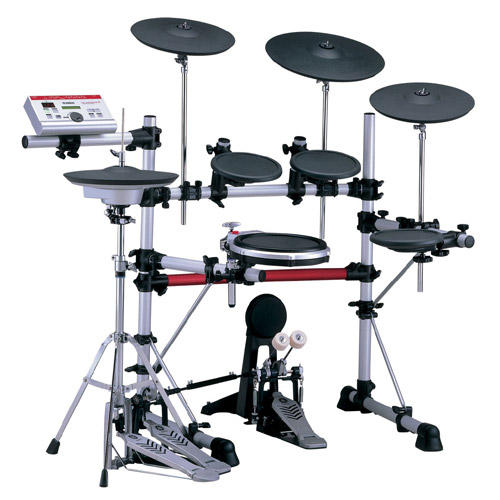
Yamaha DTXpress/DTXplorer/DTXtreme group photo

Yahoo Groups archive

Yamaha DTXpress/DTXplorer/DTXtreme

Index last updated: 2026-04-28 22:44 UTC

Thread

question about DTX hihat input

question about DTX hihat input

2005-01-04 by Michael Walker

Hi! i just got a DXT "brain" and hooked it up to my new pads. But i 
find the Hihat is stuck "open" with my old hihat "switch". I realize 
that i am going to have to buy (or make) a variable Hihat pedal to 
take advantage of the variable HH function ( way-cool.. SLOSHY 
HIHATS!)

but its gonna be weeks or months until i can get one here in MOSCOW ( 
Russia) since the yamaha dealer is out of stock on all the yamaha 
pedals.. and i dont think there is a pintech dealer here!

SO.. i was wondering does anybody know the "pinout" for the Yamaha 
hihat control input? Its some sort of Control voltage across three 
wires, right?

I would like to be able to at least jury-rig a cable so that I can 
switch from open to closed with a footswitch... if anyone knows how 
to do this i would greatly appreciate it! Or even if i can just lock 
the hihats "closed" it would be useful for the moment ( rather than 
editing all the kits)

Speaking of editing, is there a good software editor/librarian for 
the DTX? (I have the original model)

Thanks in Advance!

Re: question about DTX hihat input

2005-01-04 by Keith

> SO.. i was wondering does anybody know the "pinout" for the Yamaha 
> hihat control input? Its some sort of Control voltage across three 
> wires, right?
> 
> I would like to be able to at least jury-rig a cable so that I can 
> switch from open to closed with a footswitch... if anyone knows how 
> to do this i would greatly appreciate it! Or even if i can just lock 
> the hihats "closed" it would be useful for the moment ( rather than 
> editing all the kits)

If someone has taken one apart then they may be of more use than me,
but putting a multimeter on the pedal shows that the cable ring has a
1k resistor connected to the screen when the high hat is closed.  The
resistance progressively reduces down to 1k as the high hat is closed.
 The tip is strange because that also reduces as the high hat is
closed, but only as low as 150k.  I am not sure if one is position and
the other is pressure sensitive.  So if you can lay your hands on a
couple of resistors you should at least be able to fudge it shut (1k &
150k).  A couple of potentiometers and you could make your own.

If I get chance I will open mine up.

Keith.

Re: question about DTX hihat input

2005-01-04 by emf

--- In DTXpress@yahoogroups.com, "Keith" <keith@k...> wrote:
> If someone has taken one apart then they may be of more use than me,
> but putting a multimeter on the pedal shows that the cable ring has 
a
> 1k resistor connected to the screen when the high hat is closed.  
The
> resistance progressively reduces down to 1k as the high hat is 
closed.
>  The tip is strange because that also reduces as the high hat is
> closed, but only as low as 150k.  I am not sure if one is position 
and
> the other is pressure sensitive.  So if you can lay your hands on a
> couple of resistors you should at least be able to fudge it shut 
(1k &
> 150k).  A couple of potentiometers and you could make your own.
> 
> If I get chance I will open mine up.

Keith and all,

Take a look at the the HH65's guts in the photo section 
under "insides." That'll give you at least an idea of what to expect 
when you start re-inventing the wheel.

Ed

Re: question about DTX hihat input

2005-01-04 by Keith

> Keith and all,
> 
> Take a look at the the HH65's guts in the photo section 
> under "insides." That'll give you at least an idea of what to expect 
> when you start re-inventing the wheel.
> 
> Ed

You are right - I should have looked there first - I was in a rush and
thought about your pictures after I posted.  

It looks like a few force sensitive switches with series resistors to
give a few zones as you squash your foot down.  I am still puzzled by
why it uses both connections on the stereo plug.

Now I will just have to take it apart!

Keith.

Re: question about DTX hihat input

2005-01-05 by emf

--- In DTXpress@yahoogroups.com, "Keith" <keith@k...> wrote:
> You are right - I should have looked there first - I was in a rush 
and
> thought about your pictures after I posted.  
> 
> It looks like a few force sensitive switches with series resistors 
to
> give a few zones as you squash your foot down.  I am still puzzled 
by
> why it uses both connections on the stereo plug.
> 
> Now I will just have to take it apart!

OGD, our resident electronics surgeon, must be sleeping in today. 
Otherwise he'd be all over this question. He probably knows why both 
connections come into play.

Re: question about DTX hihat input

2005-01-05 by Keith

> OGD, our resident electronics surgeon, must be sleeping in today. 
> Otherwise he'd be all over this question. He probably knows why both 
> connections come into play.

Well, I have just had to take mine apart then.  

There are four "zones" and the force sensitive resistor progressively
shorts them out.  Three of the resistors are in series and
progressively shorted out with 1k always in series.  The resistors are
10k, 47k and 150k.  This means you get 1k, 11k, 58k, and 208k
approximately.  I am still puzzled by the tip of the plug.  It has a
150k resistor in series and seems to detect the bottom of the stroke,
but will give higher resitances at other points.  There is also a
diode and resistor across the 1k in series with the ring.

Kkeith.

Re: question about DTX hihat input

2005-01-05 by emf

--- In DTXpress@yahoogroups.com, "Keith" <keith@k...> wrote:
> There are four "zones" and the force sensitive resistor 
progressively
> shorts them out.  Three of the resistors are in series and
> progressively shorted out with 1k always in series.  The resistors 
are
> 10k, 47k and 150k.  This means you get 1k, 11k, 58k, and 208k
> approximately.  I am still puzzled by the tip of the plug.  It has a
> 150k resistor in series and seems to detect the bottom of the 
stroke,
> but will give higher resitances at other points.  There is also a
> diode and resistor across the 1k in series with the ring.

Keith,

Could the tip be responsible for the foot splash at the bottom of the 
stroke?

Ed

Re: question about DTX hihat input

2005-01-06 by Keith

--- In DTXpress@yahoogroups.com, "emf" <liberatusvirus@y...> wrote:
>
> Could the tip be responsible for the foot splash at the bottom of the 
> stroke?
> 
> Ed

It is possible, it just seems strange that it has 150k in series with
it.  I will have to play around with some resistors and see what happens.

Oh, and I just ordered a TP100 as a snare.  I find the TP65 a little
small and the postioning difficult so a 10" pad which is freestanding
sounded like a good idea.

Also, I have a Logitech Z2300 for amplification.  I think it is pretty
good - 120W of bass and 40W for each satellite speaker and not
expensive.  Not giggable, but good for practive.

Keith.

Re: question about DTX hihat input

2005-01-06 by emf

--- In DTXpress@yahoogroups.com, "Keith" <keith@k...> wrote:
> It is possible, it just seems strange that it has 150k in series 
with
> it.  I will have to play around with some resistors and see what 
happens.
> 
> Oh, and I just ordered a TP100 as a snare.  I find the TP65 a little
> small and the postioning difficult so a 10" pad which is 
freestanding
> sounded like a good idea.
> 
> Also, I have a Logitech Z2300 for amplification.  I think it is 
pretty
> good - 120W of bass and 40W for each satellite speaker and not
> expensive.  Not giggable, but good for practive.

Keith,

You'll probably have to keep the volume and gain parameters down when 
using the Logitech. But when convenient, can you give us a report on 
how this system behaves with the DTXpress? Can you hear any strain, 
breakup, distortion, etc., when you turn it up a little? Are the 
toms/kick through the woofer and the snare/cymbals/transients through 
the tweeter convincing and well-defined or legless and indistinct? 
Overall, is the Logitech a satisfactory way to amplify the kit 
compared to a modest keyboard amp? My suspicion is that, at the very 
least, body is seriously thin at low levels, and clarity suffers at 
higher levels, but in the interests of saving money, the thunder and 
lightening may be expendable for some people who don't want to wear 
cans all the time, although once you've felt the power,it's hard to 
be satisfied with less.

Ed

Re: question about DTX hihat input

2005-01-06 by Keith

--- In DTXpress@yahoogroups.com, "emf" <liberatusvirus@y...> wrote:
> 
> You'll probably have to keep the volume and gain parameters down when 
> using the Logitech. But when convenient, can you give us a report on 
> how this system behaves with the DTXpress? Can you hear any strain, 
> breakup, distortion, etc., when you turn it up a little? Are the 
> toms/kick through the woofer and the snare/cymbals/transients through 
> the tweeter convincing and well-defined or legless and indistinct? 
> Overall, is the Logitech a satisfactory way to amplify the kit 
> compared to a modest keyboard amp? My suspicion is that, at the very 
> least, body is seriously thin at low levels, and clarity suffers at 
> higher levels, but in the interests of saving money, the thunder and 
> lightening may be expendable for some people who don't want to wear 
> cans all the time, although once you've felt the power,it's hard to 
> be satisfied with less.
> 
> Ed

Ed,

I am impressed with the Logitech and have not heard any distortion
from it yet, and it goes pretty loud.  The reason I chose it was that
it uses a sub-woofer which, while a little smaller than the Yamaha
one, is claimed to be a proper 6th order design.  I spent a lot of
time looking at speaker design for Hi-Fi a while ago and decided that
a well designed sub-woofer can give seriously good bass.  It is what
Bose have been using for years (and I thought they had patents on some
designs).  I am dubious as to the design pedigree of some of the
keyboard speaker enclosures.

Yesterday at the end of my drum lesson I cranked up the volume and let
the drum teacher have a play and he seemed impressed, particulalry
with the floor tom sound (Room1 Lo).  Still no distortion.

There is a sub-woofer adjustment knob on the wired remote which is
useful because in my small room the bass resonates a bit if it is
turned up too far.  It helps to balance out the midrange and bass as well.

I cannot yet compare with a keyboard amp but when I get chance I am
hoping to get round to meeting John Allsop who is local and has the
Behringer KX1200.  I was planning on buying one of those but it got
the thumbs down from 'er indoors when she saw a picture and the
dimensions!  The Logitech is also half the price.

I have been using computer speakers since I bought the DTXpress III
but they were "80W" PMPO which probably translates to around 5W RMS. 
There was no kick to the bass and if you turned it up to drown out the
stick noise the bass distorted horribly.  I managed to avoid blowing
them up, although that was plan B to get the wife to agree to some new
ones - turn it up so you rip the cones to bits and have to buy some
new ones!

I did try some Wharfdale Active Diamonds I had lying around, but they
were woolly sounding and distorted on the bass at anything above
modest volumes.  The Logitechs are made for home theatre so are
designed to shake the room a bit I think.

Keith.

Re: subwoofers (question about DTX hihat input)

2005-01-06 by emf

--- In DTXpress@yahoogroups.com, "Keith" <keith@k...> wrote:
> Ed,
> 
> I am impressed with the Logitech and have not heard any distortion
> from it yet, and it goes pretty loud.  The reason I chose it was 
that
> it uses a sub-woofer which, while a little smaller than the Yamaha
> one, is claimed to be a proper 6th order design.  I spent a lot of
> time looking at speaker design for Hi-Fi a while ago and decided 
that
> a well designed sub-woofer can give seriously good bass.  It is what
> Bose have been using for years (and I thought they had patents on 
some
> designs).  I am dubious as to the design pedigree of some of the
> keyboard speaker enclosures.
> 
> Yesterday at the end of my drum lesson I cranked up the volume and 
let
> the drum teacher have a play and he seemed impressed, particulalry
> with the floor tom sound (Room1 Lo).  Still no distortion.
> 
> There is a sub-woofer adjustment knob on the wired remote which is
> useful because in my small room the bass resonates a bit if it is
> turned up too far.  It helps to balance out the midrange and bass 
as well.
> 
> I cannot yet compare with a keyboard amp but when I get chance I am
> hoping to get round to meeting John Allsop who is local and has the
> Behringer KX1200.  I was planning on buying one of those but it got
> the thumbs down from 'er indoors when she saw a picture and the
> dimensions!  The Logitech is also half the price.

Keith,

It sounds impressive for computer-system performance. Bose holds the 
patent on dual-chamber 6th-order design. Though this design is said 
to increase efficiency and decrease audible distortion, it apparently 
is a bitch to construct and puts the driver at risk for damage unless 
the build quality is extraordinary or some serious means of negating 
the limits on driver excursion enter into it. I've never heard a 
reputedly high-quality Bose subwoofer in action, but the scuttle is 
that Bose's transient performance isn't too good, and the overall 
effect is more suited to something like sound reinforcement than 
accurate musical reproduction. I've been a high-end audio enthusiast 
for a long time--listening and reading, anyway--and Bose usually gets 
short shrift, if any, in the press. But there apparently isn't a 
subwoofer design in existence that doesn't have its drawbacks--the 
most obvious being a tradeoff between punchy and deep. Of course, if 
money and size are no objects, the odds of a more complete success go 
up considerably, but who has the money or the space? I suspect that 
many of the pro audio designs are maximized to protect the elements 
from heavy abuse rather than to optimize fidelity. Personally, I 
don't like boomy and indistinct; I like my toms and kick to have snap 
and at least a reasonable frequency response. A home theater 
subwoofer that doesn't have to meet the needs of critical music 
appreciation could easily thrive on high efficiency and a bottom end 
of 40Hz or so, even if it really plays only one note. Given that 
dipoles have become an important part of the THX home theater 
environment, especially in the surround channels, a subwoofer of that 
type might be right at home. Since E-drum kicks and toms aren't note-
specific either, ballpark accuracy in the bass frequencies could 
suffice there as well, as long as the elements were able to handle 
the huge demands placed on them.

Ed
Re: subwoofers (question about DTX hihat input)

2005-01-06 by Keith

> It sounds impressive for computer-system performance. Bose holds the 
> patent on dual-chamber 6th-order design. Though this design is said 
> to increase efficiency and decrease audible distortion, it apparently 
> is a bitch to construct and puts the driver at risk for damage unless 
> the build quality is extraordinary or some serious means of negating 
> the limits on driver excursion enter into it. I've never heard a 
> reputedly high-quality Bose subwoofer in action, but the scuttle is 
> that Bose's transient performance isn't too good, and the overall 
> effect is more suited to something like sound reinforcement than 
> accurate musical reproduction. I've been a high-end audio enthusiast 
> for a long time--listening and reading, anyway--and Bose usually gets 
> short shrift, if any, in the press. 

I remember hearing a really impressive Bose system in Harrogate in the
late 1970s (Annual Hi-Fi show in the UK back then).  It filled a large
hall.  I seem to remember they were always fussy about postioning and
had to be just the right distance from walls - not too far away, not
too close.

> Personally, I 
> don't like boomy and indistinct; I like my toms and kick to have snap 
> and at least a reasonable frequency response. A home theater 
> subwoofer that doesn't have to meet the needs of critical music 
> appreciation could easily thrive on high efficiency and a bottom end 
> of 40Hz or so, even if it really plays only one note. 

I think you are right.  I plugged a CD player into the Logitech and it
isn't what I would call Hi-Fi - I don't think the freqeuncy response
is flat enough for that.  Sub-woofer systems often seem to suffer from
a mid range hole.  But it produces a good range of frequencies without
sloppy bass and LOUD without distortion which is what I wanted.

If you like Hi-Fi, then you might like my Castle Harlech speakers with
two different quarter wave pipes (powered by a 20W class A amplifier).

http://www.castle.uk.com/pages/classic_harlech.htm

Keith.

Re: subwoofers (question about DTX hihat input)

2005-01-06 by emf

--- In DTXpress@yahoogroups.com, "Keith" <keith@k...> wrote:
> If you like Hi-Fi, then you might like my Castle Harlech speakers 
with
> two different quarter wave pipes (powered by a 20W class A 
amplifier).
> 
> http://www.castle.uk.com/pages/classic_harlech.htm

Keith,

At the risk of corrupting our e-drum pedigree, I'd love to hear your 
speakers. They don't appear to have a US distributor. You may have to 
lug them over to my place, or maybe Stewart can take them with him on 
his next visit.  Seriously, is the 20w class A amp a valve design? 
Who makes it? My favorite British system of all time, which I haven't 
heard for some time, was a Meridian from top to bottom. A bunch of 
friends who ran a high-end salon played me a demo of Jim Keltner 
drumming solo through it. I couldn't believe my ears. It was the only 
time that I've ever closed my eyes and truly believed that the music 
from a stereo system was live. Unfortunately, the system cost about 
$50,000 in the 1990s.

On the Bose thing, a friend of mine designed their new tower 
amplification system, with dedicated subwoofer(s)--the Personal 
Amplification System--mainly for small-to-medium stage use. He was 
going to set it up for me so that we could audition it for e-drums--
an accidental use that seemed promising. But, first, inventory was 
too small to spare a review sample, and then we both got too busy. I 
may be seeing him soon; maybe we can still get it done. Expensive 
though. His name is Paul Fidlin. He worked for Fender and then 
Celestion before getting the more secure gig at Bose. I was later to 
find out that he designed Celestion's first serious sub-satellite 
system back in the late 1980s, I think, which I coveted at the time 
even if only for its looks. 

Ed

Re: subwoofers (question about DTX hihat input)

2005-01-06 by Keith

--- In DTXpress@yahoogroups.com, "emf" <liberatusvirus@y...> wrote:
>  Seriously, is the 20w class A amp a valve design? 
> Who makes it? My favorite British system of all time, which I haven't 
> heard for some time, was a Meridian from top to bottom.

The amp is actually a Pioneer M73!  It is little known over here, but
I picked one up with pre-amp and CD half price ex demo from a small
shop which tried to set themselves up as a top end demo place and I
think couldn't sell much of the expensive stuff.  It can be switched
to class AB to give 120W per channel.  It gets HOT in class A (takes
up to 1000W from the mains).  I had some home built KEF 105.2 speakers
at the time (CS9 was the home constructor series with the mid range
and tweeter in the main box and a modified crossover to compensate for
the small loss of physical volume, rather than perched on top like the
original 105.2).  They had a 15" bass but were infinite baffle.  It
was after auditioning lots of speakers that I realised you don't need
a big woofer for big bass.  The twin 5" 1/4 wave design is far tighter
than the 15" KEF in the infinite baffle design.  The two 1/4 waves are
tuned to different frequencies.  It may not be obvious from the
picture but one of the 5" units points upwards, the other forwards. 
They also do a larger one, the Howard, but in the auditioning room I
preferred the Harlech.  

Keith.

Re: [DTXpress] Re: subwoofers (question about DTX hihat input)

2005-01-06 by Vernon Graner

emf said:
> --- In DTXpress@yahoogroups.com, "Keith" <keith@k...> wrote:
>> If you like Hi-Fi, then you might like my Castle Harlech
>> speakers with two different quarter wave pipes (powered
>> by a 20W class A amplifier).
>
> Keith,
<snip>
>  Seriously, is the 20w class A amp a valve design?

As amplifier "classes" seem to be of interest, in case anyone wants to
experiment with a Class "D" amplifier design ("D" or "Digital" amplifier
that creates next to no heat at rated power, *very* efficient), Ramsey
has them for sale as kits with a very good set of "teaching" docs
included so you learn amplifier theory as you build. Their kit is here:

http://www.ramseyelectronics.com/cgi-bin/commerce.exe?preadd=action&key=UAM2

or

http://tinyurl.com/5hgqh

Vern

-- 
Vern Graner CNE/CNA/SSE    | "If the network is down, then you're
Senior Systems Engineer    | obviously incompetent so why are we
Texas Information Services | paying you? Of course, if the network
http://www.txis.com        | is up, then we obviously don't need
Austin Office 512 328-8947 | you, so why are we paying you?" \ufffdVLG

Move to quarantaine

This moves the raw source file on disk only. The archive index is not changed automatically, so you still need to run a manual refresh afterward.