Wow. Now we're getting a little philosophical here. So let's say you
learned to play the acoustic guitar, and spend your whole life playing
without ever touching an electric. Aren't you still a 'guitarist'? As
a former *classical* musician, as well as guitarist, I'd have to say
no. Mastering your instrument means exactly what it means: mastering
the instrument-in all of its forms.

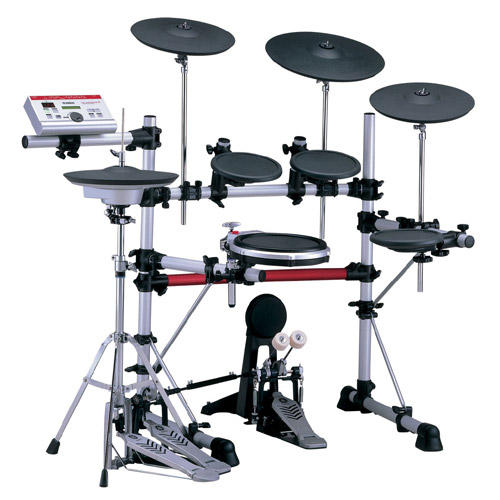
But aren't there some forms of edrums out there that cross the line
between traditional and electronic? The ones with real heads and
shells that I've seen out there on the web seem to be able to give
almost the exact same physical sensation as playing a real drum. I
suspect that line will be blurred more as technology advances. As for
the DTX, you're hitting 8" rubber pads. It may sound as realistic as
the best kit out there, but you're still just hitting rubber pads.
They will never *feel* the same as an acoustic kit, but they're also
another form of drum that needs to be explored for you to become a
master of your craft.

As far as my 2 cents goes, edrums are indeed 'real' drums.

--- In DTXpress@yahoogroups.com, "emf" <liberatusvirus@y...> wrote:
> --- In DTXpress@yahoogroups.com, "Vernon Graner" <vern@t...> wrote:
> > This train of thought seems to imply that "edrums" are not "real"
> drums
> > and are some form of "lessor" stand-in for people who cannot use the
> > "real" thing. Is this the general consensus? That is, if various
> > obsticles (noise, storage space, etc.) were removed, we'd all have
> > acoustic sets?
>
> Vern raises an interesting point. On the one hand, electronic and
> acoustic "drums" have a family resemblance that makes the latter a
> convenient double for the former in many situations. And we often
> treat electronic drumkits as more versatile versions of acoustic ones
> --that is, embodying hundreds of sonic possibilities as opposed to
> just a few--with certain tradeoffs. On the other hand, electronics
> are instruments in their own right, with their own quirks and
> strengths (their weaknesses involve their inability to duplicate the
> characteristics of acoustics or the electronic capabilities of
> computer programs or MIDI keyboards).
>
> To me, if someone wants to learn traditional drums, electronic drums
> are not a perfect substitute. But they are a viable substitute under
> certain conditions--that is, if acoustics are not convenient,
> affordable, etc. In that case, as I said before, parallel instruction
> whenever possible can help to fill in the gaps and guard against the
> development of a lopsided technique. I do think that the relationship
> between electronics and acoustics, however, is natural enough to
> justify teaching them in tandem without doing any injustice to
> either. The mere fact that someone has learned to play an acoustic
> snare drum in the school band does not automatically qualify him/her
> to play timpani in the philharmonic, but it does provide a leg up on
> doing so. Anyone who's learned to play acoustic drums will be able to
> do something credible on electronics (aside from the electronics
> learning curve) immediately. By the same token, someone who's played
> only on a gum-rubber kit will be able to transfer some of their
> skills to an acoustic, though probably with a little more practice.
> I'd always recommend acoustic, or parallel, instruction first. In
> this day and age, you really can't claim to be a percussionist if you
> have no experience on at least something that answers to a
> traditional drum. Despite how far electronics have come, claiming to
> be a drummer with only an electonics background is a little like
> claiming to be a cook with only a knowledge of garnishes. No?
> Differing views are more than welcome.
>
> Ed
Message
Re: Are "edrums", "real" drums? (was: Comparison: electronic vs. acoustic kit
2003-12-23 by Jay
Attachments
- No local attachments were found for this message.