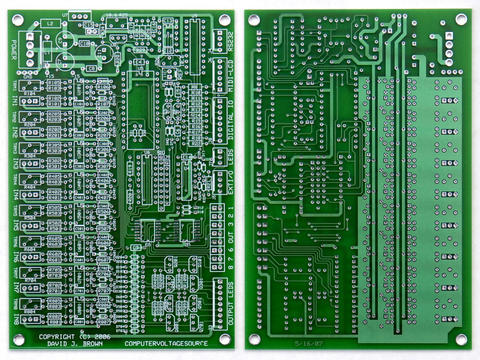
ComputerVoltageSources group photo

Yahoo Groups archive

ComputerVoltageSources

Archive for ComputerVoltageSources.

Index last updated: 2026-03-30 01:00 UTC

Thread

Arduino ComputerVoltageSource

Arduino ComputerVoltageSource

2013-05-24 by djbrow54

I know this group is dead but thought I would post here anyways. I played around with an Arduino Mega 2560 and replaced the AtomPro28 processor on a four channel CVS to see what it would do. The SPI update rate for the DACs is considerably faster since the Arduino uses native hardware support in the AVR. I've only benchmarked one program between the Arduino and the AtomPro28 which was a tight loop stepping through 128 semitone CVs.

I don't know that I will go anywhere with this as I have enough programmable modules and the speed difference wasn't that compelling but it was an interesting exercise. Some details and photos on my Arduino CVS page.

http://modularsynthesis.com/arduino/arduino-cvs/arduino-cvs.htm

Dave

RE: [ComputerVoltageSources] Arduino ComputerVoltageSource

2013-05-24 by Greg James

I'm not dead yet!

I've actually got 2 PCBs and a semi-finished CVS on my shelf waiting for
attention.

Nice upgrade.

Greg

-----Original Message-----
From: ComputerVoltageSources@yahoogroups.com
[mailto:ComputerVoltageSources@yahoogroups.com] On Behalf Of djbrow54
Sent: Thursday, May 23, 2013 8:26 PM
To: ComputerVoltageSources@yahoogroups.com
Subject: [ComputerVoltageSources] Arduino ComputerVoltageSource

I know this group is dead but thought I would post here anyways. I played
around with an Arduino Mega 2560 and replaced the AtomPro28 processor on a
four channel CVS to see what it would do. The SPI update rate for the DACs
is considerably faster since the Arduino uses native hardware support in the
AVR. I've only benchmarked one program between the Arduino and the
AtomPro28 which was a tight loop stepping through 128 semitone CVs.

I don't know that I will go anywhere with this as I have enough programmable
modules and the speed difference wasn't that compelling but it was an
interesting exercise. Some details and photos on my Arduino CVS page.

http://modularsynthesis.com/arduino/arduino-cvs/arduino-cvs.htm

Dave


------------------------------------

Yahoo! Groups Links

Re: [ComputerVoltageSources] Arduino ComputerVoltageSource

2013-05-24 by eric

Me too!  After an issue with a JH board that I couldn't solve, I've been outsourcing more complex builds to Megaohm, but I let him choose from the menu of projects.  One day...


>________________________________
> From: Greg James <gjames@...>
>To: ComputerVoltageSources@yahoogroups.com
>Sent: Friday, May 24, 2013 6:10 AM
>Subject: RE: [ComputerVoltageSources] Arduino ComputerVoltageSource
>
>
>I'm not dead yet!
>
>I've actually got 2 PCBs and a semi-finished CVS on my shelf waiting for
>attention.
>
>Nice upgrade.
>
>Greg
>
>-----Original Message-----
>From: ComputerVoltageSources@yahoogroups.com
>[mailto:ComputerVoltageSources@yahoogroups.com] On Behalf Of djbrow54
>Sent: Thursday, May 23, 2013 8:26 PM
>To: ComputerVoltageSources@yahoogroups.com
>Subject: [ComputerVoltageSources] Arduino ComputerVoltageSource
>
>I know this group is dead but thought I would post here anyways.  I played
>around with an Arduino Mega 2560 and replaced the AtomPro28 processor on a
>four channel CVS to see what it would do.  The SPI update rate for the DACs
>is considerably faster since the Arduino uses native hardware support in the
>AVR.  I've only benchmarked one program between the Arduino and the
>AtomPro28 which was a tight loop stepping through 128 semitone CVs.
>
>I don't know that I will go anywhere with this as I have enough programmable
>modules and the speed difference wasn't that compelling but it was an
>interesting exercise.  Some details and photos on my Arduino CVS page.
>
>http://modularsynthesis.com/arduino/arduino-cvs/arduino-cvs.htm
>
>Dave
>
>
>
>------------------------------------
>
>Yahoo! Groups Links
>
>
>
>
>
>
>------------------------------------
>
>Yahoo! Groups Links
>
>
>
>
>
>

[Non-text portions of this message have been removed]

Re: [ComputerVoltageSources] Arduino ComputerVoltageSource

2013-05-24 by Eric Brombaugh

It would be sad if this group really is dead as this seems like a prime time for experimentation in Computer Voltage Sources. The Atom processor boards may not be the leading edge any longer, but there are plenty of new and capable parts to take their place. I'm somewhat surprised it's taken this long for Arduino to show up here as it seems to be the obvious heir to this role.

Another family of parts to consider are the STM32F3xx microcontrollers. These are 32-bit ARM Cortex M4F processors (72MHz clock, DSP and Floating Point built-in) coupled with a wide variety of capable peripherals and available at very reasonable prices (<$10 in small qty). I've been doing a bit of work with them lately and find them to be very powerful. The primary stumbling block is that they don't have a slick IDE for programming and downloading like the one for Arduino, but if you can drive the development tools you can leap far beyond what's possible with the AVR processors.

Here's a couple of web pages that describe some breakout boards I did for these devices:

http://ebrombaugh.studionebula.com/embedded/stm32f373breakout/index.html


http://ebrombaugh.studionebula.com/embedded/stm32f303breakout/index.html


Eric


________________________________
From: djbrow54 <davebr@...>
To: ComputerVoltageSources@yahoogroups.com
Sent: Thursday, May 23, 2013 5:25 PM
Subject: [ComputerVoltageSources] Arduino ComputerVoltageSource


I know this group is dead but thought I would post here anyways. I played around with an Arduino Mega 2560 and replaced the AtomPro28 processor on a four channel CVS to see what it would do. The SPI update rate for the DACs is considerably faster since the Arduino uses native hardware support in the AVR. I've only benchmarked one program between the Arduino and the AtomPro28 which was a tight loop stepping through 128 semitone CVs.

I don't know that I will go anywhere with this as I have enough programmable modules and the speed difference wasn't that compelling but it was an interesting exercise. Some details and photos on my Arduino CVS page.

http://modularsynthesis.com/arduino/arduino-cvs/arduino-cvs.htm

Dave


[Non-text portions of this message have been removed]
Re: Arduino ComputerVoltageSource

2013-05-25 by djbrow54

That's a nice looking breakout board.

The AtomPro still holds it's own for processing CVs. It has plenty of flash and ram although the RS-232 port should be upgraded to USB. The IDE environment is nice and simple and pretty forgiving. I just wish they implemented hardware SPI. A small graphics display instead of 2x20 characters would be nice but just increases the programming complexity.

The Arduino is a bit more complex to program but has the advantage of a multitude of shields and software. My feelings is the programming scared users away. Even though BASIC is pretty easy to learn, I think the Arduino language would shrink the pool of users even smaller. Maybe not though as there might be enough Arduino users who would migrate over to synthesis. I think that number is much larger than the number of musicians who would migrate over to programming.

I would like a zippy enough processor/dsp to do some audio processing but that would make the pool of users miniscule. I'm not sure it needs to be the same platform for control voltages and audio so maybe there is room for an audio processing module. After all, the name of this group is computer-voltage-sources.

Dave

--- In ComputerVoltageSources@yahoogroups.com, Eric Brombaugh <ebrombaugh@...> wrote:
>
> It would be sad if this group really is dead as this seems like a prime time for experimentation in Computer Voltage Sources. The Atom processor boards may not be the leading edge any longer, but there are plenty of new and capable parts to take their place. I'm somewhat surprised it's taken this long for Arduino to show up here as it seems to be the obvious heir to this role.
>
> Another family of parts to consider are the STM32F3xx microcontrollers. These are 32-bit ARM Cortex M4F processors (72MHz clock, DSP and Floating Point built-in) coupled with a wide variety of capable peripherals and available at very reasonable prices (<$10 in small qty). I've been doing a bit of work with them lately and find them to be very powerful. The primary stumbling block is that they don't have a slick IDE for programming and downloading like the one for Arduino, but if you can drive the development tools you can leap far beyond what's possible with the AVR processors.
>
> Here's a couple of web pages that describe some breakout boards I did for these devices:
>
> http://ebrombaugh.studionebula.com/embedded/stm32f373breakout/index.html
>
>
> http://ebrombaugh.studionebula.com/embedded/stm32f303breakout/index.html
>
>
> Eric
>
>
> ________________________________
> From: djbrow54 <davebr@...>
> To: ComputerVoltageSources@yahoogroups.com
> Sent: Thursday, May 23, 2013 5:25 PM
> Subject: [ComputerVoltageSources] Arduino ComputerVoltageSource
>
>
>
>  
> I know this group is dead but thought I would post here anyways. I played around with an Arduino Mega 2560 and replaced the AtomPro28 processor on a four channel CVS to see what it would do. The SPI update rate for the DACs is considerably faster since the Arduino uses native hardware support in the AVR. I've only benchmarked one program between the Arduino and the AtomPro28 which was a tight loop stepping through 128 semitone CVs.
>
> I don't know that I will go anywhere with this as I have enough programmable modules and the speed difference wasn't that compelling but it was an interesting exercise. Some details and photos on my Arduino CVS page.
>
> http://modularsynthesis.com/arduino/arduino-cvs/arduino-cvs.htm
>
> Dave
>
>
>
>
> [Non-text portions of this message have been removed]
>

Re: [ComputerVoltageSources] Re: Arduino ComputerVoltageSource

2013-05-26 by gino wong

I am sitting on 4 boards waiting for me get time.

On Sat, May 25, 2013 at 7:41 PM, djbrow54 <davebr@...> wrote:

> **
>
>
>
>
> That's a nice looking breakout board.
>
> The AtomPro still holds it's own for processing CVs. It has plenty of
> flash and ram although the RS-232 port should be upgraded to USB. The IDE
> environment is nice and simple and pretty forgiving. I just wish they
> implemented hardware SPI. A small graphics display instead of 2x20
> characters would be nice but just increases the programming complexity.
>
> The Arduino is a bit more complex to program but has the advantage of a
> multitude of shields and software. My feelings is the programming scared
> users away. Even though BASIC is pretty easy to learn, I think the Arduino
> language would shrink the pool of users even smaller. Maybe not though as
> there might be enough Arduino users who would migrate over to synthesis. I
> think that number is much larger than the number of musicians who would
> migrate over to programming.
>
> I would like a zippy enough processor/dsp to do some audio processing but
> that would make the pool of users miniscule. I'm not sure it needs to be
> the same platform for control voltages and audio so maybe there is room for
> an audio processing module. After all, the name of this group is
> computer-voltage-sources.
>
> Dave
>
>
> --- In ComputerVoltageSources@yahoogroups.com, Eric Brombaugh <ebrombaugh@...>
> wrote:
> >
> > It would be sad if this group really is dead as this seems like a prime
> time for experimentation in Computer Voltage Sources. The Atom processor
> boards may not be the leading edge any longer, but there are plenty of new
> and capable parts to take their place. I'm somewhat surprised it's taken
> this long for Arduino to show up here as it seems to be the obvious heir to
> this role.
> >
> > Another family of parts to consider are the STM32F3xx microcontrollers.
> These are 32-bit ARM Cortex M4F processors (72MHz clock, DSP and Floating
> Point built-in) coupled with a wide variety of capable peripherals and
> available at very reasonable prices (<$10 in small qty). I've been doing a
> bit of work with them lately and find them to be very powerful. The primary
> stumbling block is that they don't have a slick IDE for programming and
> downloading like the one for Arduino, but if you can drive the development
> tools you can leap far beyond what's possible with the AVR processors.
> >
> > Here's a couple of web pages that describe some breakout boards I did
> for these devices:
> >
> > http://ebrombaugh.studionebula.com/embedded/stm32f373breakout/index.html
> >
> >
> > http://ebrombaugh.studionebula.com/embedded/stm32f303breakout/index.html
> >
> >
> > Eric
> >
> >
> > ________________________________
> > From: djbrow54 <davebr@...>
>
> > To: ComputerVoltageSources@yahoogroups.com
> > Sent: Thursday, May 23, 2013 5:25 PM
> > Subject: [ComputerVoltageSources] Arduino ComputerVoltageSource
> >
> >
> >
> > �
> > I know this group is dead but thought I would post here anyways. I
> played around with an Arduino Mega 2560 and replaced the AtomPro28
> processor on a four channel CVS to see what it would do. The SPI update
> rate for the DACs is considerably faster since the Arduino uses native
> hardware support in the AVR. I've only benchmarked one program between the
> Arduino and the AtomPro28 which was a tight loop stepping through 128
> semitone CVs.
> >
> > I don't know that I will go anywhere with this as I have enough
> programmable modules and the speed difference wasn't that compelling but it
> was an interesting exercise. Some details and photos on my Arduino CVS page.
> >
> > http://modularsynthesis.com/arduino/arduino-cvs/arduino-cvs.htm
> >
> > Dave
> >
> >
> >
> >
> > [Non-text portions of this message have been removed]
> >
>
>
>


--
*
*
*Gino Wong Birgelo*
BSComm, BSEE,
ReRED Recording, *Analog Sound Design*
*Audio Mastering, Recording & Restoration, Logistics*

*Ginowong@...*
*
*


[Non-text portions of this message have been removed]