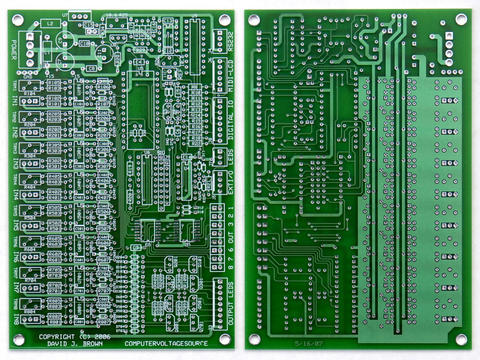
ComputerVoltageSources group photo

Yahoo Groups archive

ComputerVoltageSources

Archive for ComputerVoltageSources.

Index last updated: 2026-03-30 01:00 UTC

Thread

Finished my CVS!

Finished my CVS!

2008-05-10 by supisuzoi

Hi everyone,

Just thought I'd mention that another CVS has been born today. I
built my CVS as a 12" wide frac module (only 3.5" deep, though!). I'm
quite happy with the design, and I'll post some pictures in a couple
of weeks when the last couple of parts have been put in place : )

So far, my only trouble has been getting the IDE to communicate with
the AtomPRO. I'm a Mac laptop user, so between the requisite
USB-to-Serial converter, and the Windows-on-a-Mac ordeal, I've only
found one combination of port settings that are able to talk to the
Atom, and even that works only 1 time in 10 at best : { On the bright
side, it will eventually agree to program my chip. (Just to note: I'm
using the USB-RS232 converter from SparkFun Electronics - it uses a
Prolific PL2303. I've just ordered Parallax's FTDI-based converter to
see if I have better luck with it.)

Next step: Analyzing the code in the Files section, and figuring out
how to write my first program (a gate delay with voltage-controlled
delay time and gate length).

Thanks so much to Dave and John and everyone else who made this
project happen! I hope we hear from more people out there who have
completed theirs, and get some new code written!

Cheers,
Kevin

Re: Finished my CVS!

2008-05-23 by djbrow54

Did you build it with a display? I would think that using
programmable characters or the block character you could build some
nice visual displays of the gate setting and time delay progress. I
have done both vertical and horizontal bar graphs with the display.
They don't take much work.

Are you triggering it with a gate or a trigger pulse?

Dave

--- In ComputerVoltageSources@yahoogroups.com,
"supisuzoi" <son_of_zoggs@...> wrote:
>
> Hi everyone,
>
> Next step: Analyzing the code in the Files section, and figuring out
> how to write my first program (a gate delay with voltage-controlled
> delay time and gate length).
>
> Thanks so much to Dave and John and everyone else who made this
> project happen! I hope we hear from more people out there who have
> completed theirs, and get some new code written!
>
> Cheers,
> Kevin

Re: Finished my CVS!

2008-06-04 by supisuzoi

Sorry for the slow response, but i just never want to sign into yahoo
(mostly because of their "privacy" policies)! The Electro-Music
forums feel very comfortable for us synth folk these days... I wish
they had the resources to handle all of the current yahoo groups over
there : )

The fancy use of the display is definitely a good idea, but one which
I suspect I'd integrate at a later time, simply because of lack of
time and lack of experience with this type of development platform.

My plan is to trigger on any rising edge, and otherwise operate
independently of what the trigger source is doing, because I want the
CVS itself to define the output's delay time and gate length.

Cheers,
Kevin


--- In ComputerVoltageSources@yahoogroups.com, "djbrow54" <davebr@...>
wrote:
>
> Did you build it with a display? I would think that using
> programmable characters or the block character you could build some
> nice visual displays of the gate setting and time delay progress. I
> have done both vertical and horizontal bar graphs with the display.
> They don't take much work.
>
> Are you triggering it with a gate or a trigger pulse?
>
> Dave
>
> --- In ComputerVoltageSources@yahoogroups.com,
> "supisuzoi" <son_of_zoggs@> wrote:
> >
> > Hi everyone,
> >
> > Next step: Analyzing the code in the Files section, and figuring out
> > how to write my first program (a gate delay with voltage-controlled
> > delay time and gate length).
> >
> > Thanks so much to Dave and John and everyone else who made this
> > project happen! I hope we hear from more people out there who have
> > completed theirs, and get some new code written!
> >
> > Cheers,
> > Kevin
>

Re: Finished my CVS!

2008-06-05 by djbrow54

It depends on what latency you want. The CVS can poll looking for a
state change on the input. You can do this on any analog input by
doing an ADC, but since the input is binary, you could treat this as
a digital input as long as the input signal has the appropriate
amplitude to read as a logical 1 when divided by two which is the
input stage gain. You have to figure out if the latency is
tolerable. Certainly the Aux input can be polled quickly.

Alternatively, I wrote some code that is in my template that can
generate interrupts on edges for the Aux input, so you can have very
little latency. I wrote this so I could detect triggers. My
triggers are fast, and if occur when the processor is busy elsewhere
in the code, are missed. Edge interrupts always guarantee they are
sensed.

Dave

--- In ComputerVoltageSources@yahoogroups.com,
"supisuzoi" <son_of_zoggs@...> wrote:
> My plan is to trigger on any rising edge, and otherwise operate
> independently of what the trigger source is doing, because I want
the
> CVS itself to define the output's delay time and gate length.
>
> Cheers,
> Kevin

Re: Finished my CVS!

2008-06-05 by supisuzoi

That's great to know, thank you!

Kevin


--- In ComputerVoltageSources@yahoogroups.com, "djbrow54" <davebr@...>
wrote:
>
> It depends on what latency you want. The CVS can poll looking for a
> state change on the input. You can do this on any analog input by
> doing an ADC, but since the input is binary, you could treat this as
> a digital input as long as the input signal has the appropriate
> amplitude to read as a logical 1 when divided by two which is the
> input stage gain. You have to figure out if the latency is
> tolerable. Certainly the Aux input can be polled quickly.
>
> Alternatively, I wrote some code that is in my template that can
> generate interrupts on edges for the Aux input, so you can have very
> little latency. I wrote this so I could detect triggers. My
> triggers are fast, and if occur when the processor is busy elsewhere
> in the code, are missed. Edge interrupts always guarantee they are
> sensed.
>
> Dave
>
> --- In ComputerVoltageSources@yahoogroups.com,
> "supisuzoi" <son_of_zoggs@> wrote:
> > My plan is to trigger on any rising edge, and otherwise operate
> > independently of what the trigger source is doing, because I want
> the
> > CVS itself to define the output's delay time and gate length.
> >
> > Cheers,
> > Kevin
>

Hardware synchronous port control of DACs

2008-06-07 by Grant Richter

The residual latency in the CV update times of 2 milliseconds is almost entirely based on the
serial bit transmission time to the DACs. The software serial support currently in place has a
limited top end speed.

In theory, switching the DACs to the hardware synchronous port could increase their update
rate by a factor of 10 or so.

That would increase through put from 500 Hz to 5000 Hz, then audio processing becomes a
possibility.

I will try to get to it sometime this summer. Maybe someone else has more time now.

Re: Hardware synchronous port control of DACs

2008-06-17 by djbrow54

The DACs use SPI and I don't think there is hardware SPI on the
H8/3664 processor. There is hardware I2C and serial, but no SPI.

At one time I thought about rewriting the drivers in assembler but
BasicMicro has since clarified that assembly language is not an
option.

I did play at one time with tight loops to see how fast I could
process. I ended up with just square waves on the Aux Out and could
reasonably do bass notes. There's a program on my site that
implements a sequencer drving the Aux Out as audio which plays the
bass line to Riders on the Storm. I never went any further with this.

Dave

--- In ComputerVoltageSources@yahoogroups.com, "Grant Richter"
<grichter@...> wrote:
>
> The residual latency in the CV update times of 2 milliseconds is
almost entirely based on the
> serial bit transmission time to the DACs. The software serial
support currently in place has a
> limited top end speed.
>
> In theory, switching the DACs to the hardware synchronous port
could increase their update
> rate by a factor of 10 or so.
>
> That would increase through put from 500 Hz to 5000 Hz, then audio
processing becomes a
> possibility.
>
> I will try to get to it sometime this summer. Maybe someone else
has more time now.
>