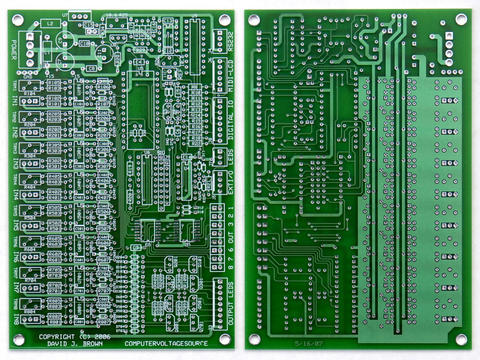
ComputerVoltageSources group photo

Yahoo Groups archive

ComputerVoltageSources

Archive for ComputerVoltageSources.

Index last updated: 2026-03-30 01:00 UTC

Thread

Hardware thoughts

Hardware thoughts

2006-03-08 by Eric Brombaugh

What's the hardware architecture going to be? I
haven't ever seen a PSIM up close, but here's what I
think is baseline:

* BasicATOM Pro 28-M
http://www.basicmicro.com/Product.aspx?productID=151&CategoryID=2
- Up to 8 channels 10-bit Analog inputs
- Serial digital I/O
- parallel digital I/O.
All shared on 20 GPIO pins.

* 4-channels serially loaded DAC.
What brand of DAC was used on the PSIM?
2 Dual DACs or one Quad DAC?
Separate or simultaneous load strobe?
How many bits?

* Analog Signal conditioning.
- Input gain & offset pots or fixed?
- Output gain & offset pots or fixed?
- Lowpass filtering?

* Serial I/O
- BasicATOM Pro uses built-in UART on H8/3664
processor for firmware loads.
- Need to re-task serial I/O for MIDI interfaces
- Front panel switch to select MIDI mode?
Do we want a built in USB-Serial interface?
- Many (most?) modern PCs now come without RS-232
interfaces, but a USB-Serial chip is fairly cheap
and readily available. See the SiLabs CP210x:
http://www.silabs.com/tgwWebApp/public/web_content/products/Microcontrollers/Interface/en/interface.htm


* Digital I/O
- Digital I/O is somewhat scarce on the 28-pin
BasicATOM Pro. Use 74HC595 serial-parallel for
dedicated outputs, or Maxim MAX6957 port extender
for flexible I/O over SPI.

* LCD
- 2x16 char LCD w/ backlight seems a fairly useful
& common mod. Use Serial I/O with
external processor, or hook up parallel via SPI
port extender (see above).

* Buttons
- Used for run/stop/etc.
- Use dedicated GPIO pins on BasicATOM Pro, or
hook up via SPI port extender using available
interrupt line.

Just a collection of thoughts about hardware. Comments
& criticism invited.

Eric


__________________________________________________
Do You Yahoo!?
Tired of spam? Yahoo! Mail has the best spam protection around
http://mail.yahoo.com

Re: [ComputerVoltageSources] Hardware thoughts

2006-03-08 by john mahoney

----- Original Message ----- (edited significantly by john)
From: "Eric Brombaugh"
Subject: [ComputerVoltageSources] Hardware thoughts


> What's the hardware architecture going to be? I
> haven't ever seen a PSIM up close, but here's what I
> think is baseline:
>
> * BasicATOM Pro 28-M

Agreed, this looks like to be a top candidate, if not the first choice.


> * 4-channels serially loaded DAC.
> What brand of DAC was used on the PSIM?

There was an issue with the PSIM that resulted in a slower-than-anticipated
ALLDACSOUT routine, IIRC. No idea if this was a PSIM-specific thing that we
could avoid.


> * Analog Signal conditioning.
> - Input gain & offset pots or fixed?
> - Output gain & offset pots or fixed?
> - Lowpass filtering?

Seems to me that these are implementation-specific features, i.e. each
builder will have his/her own requirements. Having said that, these are good
ideas.

I assume that Harry Bissell's offer to lay out a PC board for something like
this still stands, in case we eventually need such a resource.
--
john

Re: Hardware thoughts

2006-03-08 by djbrow54

What do you mean by retask serial I/O? You just use it for MIDI.
Why a front panel switch to select MIDI mode? What mode? Just use
the other controls.

For a display, I used a 2x20 and a 2x8. While the 2x20 is great, it
is impractical in a modular due to the width. I made mine in a small
external package. It is great for streaming data as in monitoring
MIDI data streams but I find it a bit impractical for PSIM output.
The 2x8 is much nicer as I can fit it into a 1U module and it has
sufficient characters to display the name of the program and various
user prompts. The backlight is a concern as these can draw a lot of
power. The smaller displays have lower backlight power requirements.

I chose to use a microcontroller for the display because the display
controllers are a real pain. Scrolling & line wrap require lots of
manipulation by the processor. Clearing the display takes a lot of
time. And, in the smaller displays with serial interfaces, there is
no status feedback so you have to time all communications. I decided
to offload the PSIM from this burden and use a microcontroller in more
of a TTY character-oriented interface. That also allows me a power-up
default message.

Since I used a microcontroller, I was trying to determine the most
appropriate interface. I came up with lots of schemes such as SPI,
multiplexing other lines, and serial. The AtomPro programming port
can be used as a general purpose input or output. I even had a
version that used this interface. It has a screwy pseudo-RS232
circuit so the levels are odd and change whether a RS232 cable is
attached or not. I came up with two schemes that could use this I/O,
one as simple as a pulldown resistor. I didn't want to dedicate
multiple pins to a display interface. In future designs, an SPI
interface could be shared with DACs and other perphiperals however the
timing is slow (described later).

The larger issue was how to communicate with the display that would
not interfer with MIDI or timers. Using the serial command for a
general I/O line requires interrupts to be off. I wrote some code but
it was so convoluted with enable and disable statements that I
abandoned this approach. Instead, I decided to use the MIDI
subsystem. The hserout command is fully interrupt driven with a 128
byte circular buffer. I ended up encoding my display commands as an
educational sysex command. This requires wrapping the display
messages with 2 bytes at the beginning and one byte at the end.
However, the command executes lightning fast and the communications
all happen in the background via interrupts. Sending a 21 byte
message to the display (3 wrapper, 16 characters, 2 display control
commands) takes only 250 uS. Sending a 4 byte message to the display
(3 wrapper and 1 character) takes only 100 uS. Thus it has little
impact on processing performance. The SPI commands take much more
time to execute. For comparison, sending four 16 bit words to the DAC
with some manipulation requires 750 uS.

Now the actual transmission time will be slower so subsequent MIDI
data output will be delayed by the display transmission time but I
find that I don't send MIDI data in large batches or necessarily
interleaved with display messages. It hasn't been an issue so far.

I'd appreciate comments about this scheme. Seemed simple, high
performance, and easily retrofittable. Since I had extra outputs on
the microcontroller, I added 4 digital outputs. I was always lacking
enough outputs for trigger and gate and hated to dedicate a full DAC
channel for each of these. These I/Os can be set, reset, and toggled.

One future feature ... a mode to capture triggers. You can't scan for
them because of timing. I'd either use an edge capture or edge
interrupt mode. Unfortunately on the PSIM the I/Os capable of edge
interrupts are not easily accessible.

This weekend I did design a PCB that combines MIDI and display. If
there is enough interest I could use some help to make this available.

Dave

--- In ComputerVoltageSources@yahoogroups.com, Eric Brombaugh
<ebrombaugh@...> wrote:
>
> What's the hardware architecture going to be? I
> * BasicATOM Pro 28-M
>
> * Serial I/O
> - BasicATOM Pro uses built-in UART on H8/3664
> processor for firmware loads.
> - Need to re-task serial I/O for MIDI interfaces
> - Front panel switch to select MIDI mode?
>
> * LCD
> - 2x16 char LCD w/ backlight seems a fairly useful
> & common mod. Use Serial I/O with
> external processor, or hook up parallel via SPI
> port extender (see above).

Re: [ComputerVoltageSources] Re: Hardware thoughts

2006-03-08 by Eric Brombaugh

I meant that to receive MIDI you might want to select
either the RS-232 serial input or the MIDI serial
input. I suppose you could OR them together also,
which wouldn't require any switches/modes/etc.

For MIDI output it's not an issue of course.

Eric

--- djbrow54 <davebr@...> wrote:

> What do you mean by retask serial I/O? You just use
> it for MIDI.
> Why a front panel switch to select MIDI mode? What
> mode? Just use
> the other controls.


__________________________________________________
Do You Yahoo!?
Tired of spam? Yahoo! Mail has the best spam protection around
http://mail.yahoo.com

Re: Hardware thoughts

2006-03-08 by djbrow54

I understand. I actually needed to do this. I made a RS232 to MIDI
adapter to connect my computer to my PSIM. No flagging but the
program is fast enough to keep up. I used this to loop through my
PSIM to connect the computer to the SpeakJet for the Phrasalator
program. It works with just a few passive components. You can use
the programming port but it has issues also

Dave

--- In ComputerVoltageSources@yahoogroups.com, Eric Brombaugh
<ebrombaugh@...> wrote:
>
> I meant that to receive MIDI you might want to select
> either the RS-232 serial input or the MIDI serial
> input. I suppose you could OR them together also,
> which wouldn't require any switches/modes/etc.
>
> For MIDI output it's not an issue of course.
>
> Eric

Re: Hardware thoughts

2006-03-08 by Grant Richter

Comments inline.

--- In ComputerVoltageSources@yahoogroups.com, Eric Brombaugh <ebrombaugh@...>
wrote:
>
> What's the hardware architecture going to be? I
> haven't ever seen a PSIM up close, but here's what I
> think is baseline:
>
> * BasicATOM Pro 28-M
> http://www.basicmicro.com/Product.aspx?productID=151&CategoryID=2
> - Up to 8 channels 10-bit Analog inputs
> - Serial digital I/O
> - parallel digital I/O.
> All shared on 20 GPIO pins.

For $10 more adds 4 more port pins and 32K of EEPROM.

>
> * 4-channels serially loaded DAC.
> What brand of DAC was used on the PSIM?
> 2 Dual DACs or one Quad DAC?
> Separate or simultaneous load strobe?
> How many bits?

Lack of port pins keeps it to a serial interface. The AD8420 is the original to the DAC7714
and requires no software change. The DAC7714 is only available in surface mount where
the DAC8420 is available in DIP or SM. The DAC8420 is $44 single piece. Probably put a
dual footprint on the board for DIP or SM.

http://www.analog.com/en/prod/0%2C2877%2CDAC8420%2C00.html

All 4 input channels can be read and all 4 output channels updated in 1.2 millisecond.
Plenty fast for CV generation.

>
> * Analog Signal conditioning.
> - Input gain & offset pots or fixed?

Both plus 1 volt per octave in calibrated.

> - Output gain & offset pots or fixed?

Fixed at 10.625 volts full scale. 4 steps per semitone at one volt per octave 12 bit.

> - Lowpass filtering?

Haven't seen a need for it so far.

>
> * Serial I/O
> - BasicATOM Pro uses built-in UART on H8/3664
> processor for firmware loads.
> - Need to re-task serial I/O for MIDI interfaces

There is a hardware serial interface TXD and RXD you can hang MIDI hardware on. Done
and tested.

Don't forget a DIN synch interface for the XOX boxes.

> - Front panel switch to select MIDI mode?
> Do we want a built in USB-Serial interface?
> - Many (most?) modern PCs now come without RS-232
> interfaces, but a USB-Serial chip is fairly cheap
> and readily available. See the SiLabs CP210x:
> http://www.silabs.com/tgwWebApp/public/web_content/products/Microcontrollers/
Interface/en/interface.htm

You completely lost me there. MBasic doesn't support USB (that I know of). Those without
RS232 will need to get USB to Serial cable.

>
> * Digital I/O
> - Digital I/O is somewhat scarce on the 28-pin
> BasicATOM Pro. Use 74HC595 serial-parallel for
> dedicated outputs, or Maxim MAX6957 port extender
> for flexible I/O over SPI.

Seems reasonable.

>
> * LCD
> - 2x16 char LCD w/ backlight seems a fairly useful
> & common mod. Use Serial I/O with
> external processor, or hook up parallel via SPI
> port extender (see above).

There is a good question. Dave seems to have a design already. If he volunteers it, it could
go into copper on PC board.

> * Buttons
> - Used for run/stop/etc.
> - Use dedicated GPIO pins on BasicATOM Pro, or
> hook up via SPI port extender using available
> interrupt line.
>

Certainly keep the Run/Stop with external gated OR logic and Run/Stop LEDs.

RE: [ComputerVoltageSources] Hardware thoughts

2006-03-08 by John Loffink

Eric,

Thanks for putting that together. It is a good starting point for
discussion.

It will be valuable to have a common base platform and have an extension
header for addons for customized projects. This might be as simple as an
extension of the SPI bus and any unused IO brought to a dual row header. I
will volunteer to track any useful features that don't make it to the common
base platform and design an extension at minimal cost to provide additional
custom features. The intent is that additional hardware can be added
external to the base system.

John Loffink
The Microtonal Synthesis Web Site
http://www.microtonal-synthesis.com
The Wavemakers Synthesizer Web Site
http://www.wavemakers-synth.com


> -----Original Message-----
> From: ComputerVoltageSources@yahoogroups.com
> [mailto:ComputerVoltageSources@yahoogroups.com] On Behalf Of Eric
> Brombaugh
>
> What's the hardware architecture going to be? I
> haven't ever seen a PSIM up close, but here's what I
> think is baseline:
>
> * BasicATOM Pro 28-M
> http://www.basicmicro.com/Product.aspx?productID=151&CategoryID=2
> - Up to 8 channels 10-bit Analog inputs
> - Serial digital I/O
> - parallel digital I/O.
> All shared on 20 GPIO pins.
>
> * 4-channels serially loaded DAC.
> What brand of DAC was used on the PSIM?
> 2 Dual DACs or one Quad DAC?
> Separate or simultaneous load strobe?
> How many bits?
>
> * Analog Signal conditioning.
> - Input gain & offset pots or fixed?
> - Output gain & offset pots or fixed?
> - Lowpass filtering?
>
> * Serial I/O
> - BasicATOM Pro uses built-in UART on H8/3664
> processor for firmware loads.
> - Need to re-task serial I/O for MIDI interfaces
> - Front panel switch to select MIDI mode?
> Do we want a built in USB-Serial interface?
> - Many (most?) modern PCs now come without RS-232
> interfaces, but a USB-Serial chip is fairly cheap
> and readily available. See the SiLabs CP210x:
> http://www.silabs.com/tgwWebApp/public/web_content/products/Microcontrolle
> rs/Interface/en/interface.htm
>
>
> * Digital I/O
> - Digital I/O is somewhat scarce on the 28-pin
> BasicATOM Pro. Use 74HC595 serial-parallel for
> dedicated outputs, or Maxim MAX6957 port extender
> for flexible I/O over SPI.
>
> * LCD
> - 2x16 char LCD w/ backlight seems a fairly useful
> & common mod. Use Serial I/O with
> external processor, or hook up parallel via SPI
> port extender (see above).
>
> * Buttons
> - Used for run/stop/etc.
> - Use dedicated GPIO pins on BasicATOM Pro, or
> hook up via SPI port extender using available
> interrupt line.
>
> Just a collection of thoughts about hardware. Comments
> & criticism invited.
>
> Eric
>

Re: [ComputerVoltageSources] Re: Hardware thoughts

2006-03-08 by Eric Brombaugh

Yes, I understand that neither MBasic nor the
BasicATOM Pro support USB. My suggestion was to
include a CP210x chip in the design which acts to
convert USB<->Serial. Essentially it would be like
building a USB/Serial cable right into the system.

Since the CP210x parts are surface mount and only
slightly less expensive than a USB<->Serial cable,
it's probably better to skip it entirely and let those
who need it buy the converter cable if required.

Eric

--- Grant Richter <grichter@...> wrote:
> > Do we want a built in USB-Serial interface?
> > - Many (most?) modern PCs now come without
> RS-232
> > interfaces, but a USB-Serial chip is fairly
> cheap
> > and readily available. See the SiLabs CP210x:
> >
>
http://www.silabs.com/tgwWebApp/public/web_content/products/Microcontrollers/
> Interface/en/interface.htm
>
> You completely lost me there. MBasic doesn't support
> USB (that I know of). Those without
> RS232 will need to get USB to Serial cable.


__________________________________________________
Do You Yahoo!?
Tired of spam? Yahoo! Mail has the best spam protection around
http://mail.yahoo.com

RE: [ComputerVoltageSources] DACs

2006-03-09 by John Loffink

The TI DAC7614P is a 16 pin DIP second source part for the DAC8420. It is
$16.47 from Newark.

John Loffink
The Microtonal Synthesis Web Site
http://www.microtonal-synthesis.com
The Wavemakers Synthesizer Web Site
http://www.wavemakers-synth.com


> -----Original Message-----
> From: ComputerVoltageSources@yahoogroups.com
> [mailto:ComputerVoltageSources@yahoogroups.com] On Behalf Of Grant Richter

> > * 4-channels serially loaded DAC.
> > What brand of DAC was used on the PSIM?
> > 2 Dual DACs or one Quad DAC?
> > Separate or simultaneous load strobe?
> > How many bits?
>
> Lack of port pins keeps it to a serial interface. The AD8420 is the
> original to the DAC7714
> and requires no software change. The DAC7714 is only available in surface
> mount where
> the DAC8420 is available in DIP or SM. The DAC8420 is $44 single piece.
> Probably put a
> dual footprint on the board for DIP or SM.
>
> http://www.analog.com/en/prod/0%2C2877%2CDAC8420%2C00.html
>

RE: [ComputerVoltageSources] Outputs

2006-03-09 by John Loffink

For a 12 bit output, that's 4096 steps in 10.625 volts full scale, or 2.59
mV per step. A semitone is 1V / 12 = 83.33 mV. So that should be 32.17
steps per semitone. In cents the resolution is 3.1 cents.

I think there could be value in having a fixed programmable offset of half
the full scale voltage, for LFO waveforms centered around zero. This could
be tapped from the voltage reference (DACC does not have one onboard),
toggled through an analog switch to an output op amp. To avoid effecting
the accuracy of 0 to 10.625 volt scale output, one could feed that output
directly to the switch, and feed the op amp/offset circuit to the other
input to the switch. Or else simply run the two in parallel without any
software control at all, doubling the number of output jacks, one each for
0-10 and +/-5 volts.

John Loffink
The Microtonal Synthesis Web Site
http://www.microtonal-synthesis.com
The Wavemakers Synthesizer Web Site
http://www.wavemakers-synth.com


> -----Original Message-----
> From: ComputerVoltageSources@yahoogroups.com
>
>
> > - Output gain & offset pots or fixed?
>
> Fixed at 10.625 volts full scale. 4 steps per semitone at one volt per
> octave 12 bit.
>

RE: [ComputerVoltageSources] Re: Hardware thoughts

2006-03-09 by John Loffink

Low pass filtering or linear slew on the outputs could reduce zippering
effects. I'll have to try the sine/cos out on my Frequency Shifter which
are 12 bit and see how much zippering really occurs. Most MIDI devices with
zippering byproducts are using only 7 or 8 bits of resolution.

John Loffink
The Microtonal Synthesis Web Site
http://www.microtonal-synthesis.com
The Wavemakers Synthesizer Web Site
http://www.wavemakers-synth.com


> -----Original Message-----
> From: ComputerVoltageSources@yahoogroups.com
> [mailto:ComputerVoltageSources@yahoogroups.com] On Behalf Of Grant Richter
> Fixed at 10.625 volts full scale. 4 steps per semitone at one volt per
> octave 12 bit.
>
> > - Lowpass filtering?
>
> Haven't seen a need for it so far.
>

RE: [ComputerVoltageSources] LCD

2006-03-09 by John Loffink

I like the LCD idea too, but it could be fairly pricey as an add on. At a
minimum I think a two digit numeric LED display would help. For instance,
in a quantizer you could display which quantizing table was selected.

John Loffink
The Microtonal Synthesis Web Site
http://www.microtonal-synthesis.com
The Wavemakers Synthesizer Web Site
http://www.wavemakers-synth.com


> -----Original Message-----
> From: ComputerVoltageSources@yahoogroups.com
> [mailto:ComputerVoltageSources@yahoogroups.com] On Behalf Of Grant Richter
> > * LCD
> > - 2x16 char LCD w/ backlight seems a fairly useful
> > & common mod. Use Serial I/O with
> > external processor, or hook up parallel via SPI
> > port extender (see above).
>
> There is a good question. Dave seems to have a design already. If he
> volunteers it, it could
> go into copper on PC board.
>

RE: [ComputerVoltageSources] Digital I/O

2006-03-09 by John Loffink

I agree that added digital I/O is good. Why waste ADCs and DACs on gate
signals, for instance?

John Loffink
The Microtonal Synthesis Web Site
http://www.microtonal-synthesis.com
The Wavemakers Synthesizer Web Site
http://www.wavemakers-synth.com


> -----Original Message-----
> From: ComputerVoltageSources@yahoogroups.com
> [mailto:ComputerVoltageSources@yahoogroups.com] On Behalf Of Grant Richter
> >
> > * Digital I/O
> > - Digital I/O is somewhat scarce on the 28-pin
> > BasicATOM Pro. Use 74HC595 serial-parallel for
> > dedicated outputs, or Maxim MAX6957 port extender
> > for flexible I/O over SPI.
>
> Seems reasonable.
>

RE: [ComputerVoltageSources] LCD

2006-03-09 by Eric Brombaugh

LCDs aren't too expensive - typically $5 - $10. For
example:

http://www.allelectronics.com/cgi-bin/category/365/LCDs_(Liquid_Crystal_Displays).html

Eric

--- John Loffink <jloffink@...> wrote:

> I like the LCD idea too, but it could be fairly
> pricey as an add on. At a
> minimum I think a two digit numeric LED display
> would help. For instance,
> in a quantizer you could display which quantizing
> table was selected.
>
> John Loffink
> The Microtonal Synthesis Web Site
> http://www.microtonal-synthesis.com
> The Wavemakers Synthesizer Web Site
> http://www.wavemakers-synth.com
>
>
> > -----Original Message-----
> > From: ComputerVoltageSources@yahoogroups.com
> > [mailto:ComputerVoltageSources@yahoogroups.com] On
> Behalf Of Grant Richter
> > > * LCD
> > > - 2x16 char LCD w/ backlight seems a fairly
> useful
> > > & common mod. Use Serial I/O with
> > > external processor, or hook up parallel via
> SPI
> > > port extender (see above).
> >
> > There is a good question. Dave seems to have a
> design already. If he
> > volunteers it, it could
> > go into copper on PC board.
> >
>
>


__________________________________________________
Do You Yahoo!?
Tired of spam? Yahoo! Mail has the best spam protection around
http://mail.yahoo.com

RE: [ComputerVoltageSources] LCD

2006-03-09 by John Loffink

It is true that you can get a bare bones 8x2 or 16x2 LCD for $10 or less.
It is the support circuitry that adds the cost. Add backlighting
(recommended) and you add another $5 or so to the cost. The LCDs you
mention require IO that doesn't exist on the BASIC ATOM PRO controller.
There aren't enough pins to drive it. Add decoders/drivers, serial
interface, and other necessary parts and the cost easily doubles.

Dave responded offlist that he used a surplus LCD with a serial port to
reduce IO and processing requirements for the BASIC ATOM PRO controller.
The serial port LCD typically has its own microcontroller onboard.

I can work with Dave offlist to investigate LCD options, or we can work it
on the list to get other design feedback.

On a side note, as a general rule we should not specify surplus parts for
this project. There is no guarantee they'll be available at any time in the
future.

John Loffink
The Microtonal Synthesis Web Site
http://www.microtonal-synthesis.com
The Wavemakers Synthesizer Web Site
http://www.wavemakers-synth.com


> -----Original Message-----
> From: ComputerVoltageSources@yahoogroups.com
> [mailto:ComputerVoltageSources@yahoogroups.com] On Behalf Of Eric
> Brombaugh
>
> LCDs aren't too expensive - typically $5 - $10. For
> example:
>
> http://www.allelectronics.com/cgi-
> bin/category/365/LCDs_(Liquid_Crystal_Displays).html
>
> Eric
>

Re: Outputs

2006-03-09 by Grant Richter

OK, My bad, dropped a digit. 0.0833 x 128 = 10.6624 volts

For Microtonal work you can always rescale the DAC reference to a smaller output range.

I guess we could put in a couple jumpers to change output and input range to 0 to 5 volts.
That should help interface to 5 volt systems.

Math

0.0833 x 64 = 5.3312 = 64 steps per semitone.

For 1 cent resolution, 0.0833 / 100 = 0.000833 * 4096 = 3.4119 volts Vref


--- In ComputerVoltageSources@yahoogroups.com, "John Loffink" <jloffink@...> wrote:
>
> For a 12 bit output, that's 4096 steps in 10.625 volts full scale, or 2.59
> mV per step. A semitone is 1V / 12 = 83.33 mV. So that should be 32.17
> steps per semitone. In cents the resolution is 3.1 cents.
>
> I think there could be value in having a fixed programmable offset of half
> the full scale voltage, for LFO waveforms centered around zero. This could
> be tapped from the voltage reference (DACC does not have one onboard),
> toggled through an analog switch to an output op amp. To avoid effecting
> the accuracy of 0 to 10.625 volt scale output, one could feed that output
> directly to the switch, and feed the op amp/offset circuit to the other
> input to the switch. Or else simply run the two in parallel without any
> software control at all, doubling the number of output jacks, one each for
> 0-10 and +/-5 volts.
>
> John Loffink
> The Microtonal Synthesis Web Site
> http://www.microtonal-synthesis.com
> The Wavemakers Synthesizer Web Site
> http://www.wavemakers-synth.com
>
>
> > -----Original Message-----
> > From: ComputerVoltageSources@yahoogroups.com
> >
> >
> > > - Output gain & offset pots or fixed?
> >
> > Fixed at 10.625 volts full scale. 4 steps per semitone at one volt per
> > octave 12 bit.
> >
>

Re: Hardware thoughts

2006-03-09 by Grant Richter

In signal to noise terms, it is 6 dB per bit (6 dB is an octave in dBv)

So 12 x 6 = 72 dB S/N, about 20 dB better than magnetic tape.

--- In ComputerVoltageSources@yahoogroups.com, "John Loffink" <jloffink@...> wrote:
>
> Low pass filtering or linear slew on the outputs could reduce zippering
> effects. I'll have to try the sine/cos out on my Frequency Shifter which
> are 12 bit and see how much zippering really occurs. Most MIDI devices with
> zippering byproducts are using only 7 or 8 bits of resolution.
>
> John Loffink
> The Microtonal Synthesis Web Site
> http://www.microtonal-synthesis.com
> The Wavemakers Synthesizer Web Site
> http://www.wavemakers-synth.com
>
>
> > -----Original Message-----
> > From: ComputerVoltageSources@yahoogroups.com
> > [mailto:ComputerVoltageSources@yahoogroups.com] On Behalf Of Grant Richter
> > Fixed at 10.625 volts full scale. 4 steps per semitone at one volt per
> > octave 12 bit.
> >
> > > - Lowpass filtering?
> >
> > Haven't seen a need for it so far.
> >
>

Re: LCD

2006-03-09 by Grant Richter

There is not guarantee that any of these parts will be available in the future.

Or any through hole parts.

There has always been a very small window of opportunity for a device of this type.

That is why the two years wasted is such a crime (IMHO).

--- In ComputerVoltageSources@yahoogroups.com, "John Loffink" <jloffink@...> wrote:
>
> It is true that you can get a bare bones 8x2 or 16x2 LCD for $10 or less.
> It is the support circuitry that adds the cost. Add backlighting
> (recommended) and you add another $5 or so to the cost. The LCDs you
> mention require IO that doesn't exist on the BASIC ATOM PRO controller.
> There aren't enough pins to drive it. Add decoders/drivers, serial
> interface, and other necessary parts and the cost easily doubles.
>
> Dave responded offlist that he used a surplus LCD with a serial port to
> reduce IO and processing requirements for the BASIC ATOM PRO controller.
> The serial port LCD typically has its own microcontroller onboard.
>
> I can work with Dave offlist to investigate LCD options, or we can work it
> on the list to get other design feedback.
>
> On a side note, as a general rule we should not specify surplus parts for
> this project. There is no guarantee they'll be available at any time in the
> future.
>
> John Loffink
> The Microtonal Synthesis Web Site
> http://www.microtonal-synthesis.com
> The Wavemakers Synthesizer Web Site
> http://www.wavemakers-synth.com
>
>
> > -----Original Message-----
> > From: ComputerVoltageSources@yahoogroups.com
> > [mailto:ComputerVoltageSources@yahoogroups.com] On Behalf Of Eric
> > Brombaugh
> >
> > LCDs aren't too expensive - typically $5 - $10. For
> > example:
> >
> > http://www.allelectronics.com/cgi-
> > bin/category/365/LCDs_(Liquid_Crystal_Displays).html
> >
> > Eric
> >
>

Re: [ComputerVoltageSources] Re: LCD

2006-03-09 by Eric Brombaugh

Matrix Orbital is popular with the PC case modding
crowd and has a wide variety of serial LCDs in the
$50+ range:

http://www.matrixorbital.com/index.php?cName=lcd-character-lcds

Scott Edwards has been selling serial interface LCDs &
accessories for more than 10 years. $49 for a 2x16
serial LCD w/ backlight:

http://www.seetron.com/slcds.htm

Crystalfonz has them for less than $40:

http://www.crystalfontz.com/products/index-ser.html

None of these options would require anything more than
a power/data header on the main board.

Eric

--- Grant Richter <grichter@...> wrote:

> There is not guarantee that any of these parts will
> be available in the future.
>
> Or any through hole parts.
>
> There has always been a very small window of
> opportunity for a device of this type.
>
> That is why the two years wasted is such a crime
> (IMHO).
>
> --- In ComputerVoltageSources@yahoogroups.com, "John
> Loffink" <jloffink@...> wrote:
> >
> > It is true that you can get a bare bones 8x2 or
> 16x2 LCD for $10 or less.
> > It is the support circuitry that adds the cost.
> Add backlighting
> > (recommended) and you add another $5 or so to the
> cost. The LCDs you
> > mention require IO that doesn't exist on the BASIC
> ATOM PRO controller.
> > There aren't enough pins to drive it. Add
> decoders/drivers, serial
> > interface, and other necessary parts and the cost
> easily doubles.
> >
> > Dave responded offlist that he used a surplus LCD
> with a serial port to
> > reduce IO and processing requirements for the
> BASIC ATOM PRO controller.
> > The serial port LCD typically has its own
> microcontroller onboard.
> >
> > I can work with Dave offlist to investigate LCD
> options, or we can work it
> > on the list to get other design feedback.
> >
> > On a side note, as a general rule we should not
> specify surplus parts for
> > this project. There is no guarantee they'll be
> available at any time in the
> > future.
> >
> > John Loffink
> > The Microtonal Synthesis Web Site
> > http://www.microtonal-synthesis.com
> > The Wavemakers Synthesizer Web Site
> > http://www.wavemakers-synth.com
> >
> >
> > > -----Original Message-----
> > > From: ComputerVoltageSources@yahoogroups.com
> > > [mailto:ComputerVoltageSources@yahoogroups.com]
> On Behalf Of Eric
> > > Brombaugh
> > >
> > > LCDs aren't too expensive - typically $5 - $10.
> For
> > > example:
> > >
> > > http://www.allelectronics.com/cgi-
> > >
> bin/category/365/LCDs_(Liquid_Crystal_Displays).html
> > >
> > > Eric
> > >
> >
>
>
>
>
>
>


__________________________________________________
Do You Yahoo!?
Tired of spam? Yahoo! Mail has the best spam protection around
http://mail.yahoo.com

Re: Hardware thoughts

2006-03-09 by Gary Chang

"Grant Richter" <grichter@...> wrote:
>
> >
> > * 4-channels serially loaded DAC.
> > What brand of DAC was used on the PSIM?
> > 2 Dual DACs or one Quad DAC?
> > Separate or simultaneous load strobe?
> > How many bits?
>
> Lack of port pins keeps it to a serial interface. The AD8420 is the
original to the DAC7714
> and requires no software change. The DAC7714 is only available in
surface mount where
> the DAC8420 is available in DIP or SM. The DAC8420 is $44 single
piece. Probably put a
> dual footprint on the board for DIP or SM.
>
> http://www.analog.com/en/prod/0%2C2877%2CDAC8420%2C00.html
>
> All 4 input channels can be read and all 4 output channels updated
in 1.2 millisecond.
> Plenty fast for CV generation.

I want to bring up an issue that was uncovered in early PSIM usage -
although the DAC outputs were precise enough for 1 v/oct scaling, the
INPUTS were not as precise - for instance, when using Woody Wall's
Quantized Shift Register, errors were discovered when sampling a
pre-quantized source (the shift register's output was a different
pitch than the input). When discussing this with Grant, he surmised
that it was the lack of bit resolution on the input side, which had a
limited precision - therefore the encoding error. Can we address this
hardware issue?

Conxiser this please, oh kind sirs, (bowing as I recceed back into the
shaddows) 8-)

gary

Re: Hardware thoughts

2006-03-09 by djbrow54

I have no issue with the accuracy of the input sampling. It took me
a while to figure out that the scaling was different. The reference
for the input is 10 volts and 10.66 for the output. This is where I
was getting all my errors. I had to scale inputs prior to outputs.
I use a factor of 15/4 which scales from 10 bits to 12 bits and
compensates for the different reference. This keeps me to integer
arithmetic and is reasonably fast. Not sure if this is what you are
referring to or not.

Dave

--- In ComputerVoltageSources@yahoogroups.com, "Gary Chang"
<gchang@...> wrote:
>
> "Grant Richter" <grichter@> wrote:
> >
> > >
> > > * 4-channels serially loaded DAC.
> > > What brand of DAC was used on the PSIM?
> > > 2 Dual DACs or one Quad DAC?
> > > Separate or simultaneous load strobe?
> > > How many bits?
> >
> > Lack of port pins keeps it to a serial interface. The AD8420 is
the
> original to the DAC7714
> > and requires no software change. The DAC7714 is only available in
> surface mount where
> > the DAC8420 is available in DIP or SM. The DAC8420 is $44 single
> piece. Probably put a
> > dual footprint on the board for DIP or SM.
> >
> > http://www.analog.com/en/prod/0%2C2877%2CDAC8420%2C00.html
> >
> > All 4 input channels can be read and all 4 output channels
updated
> in 1.2 millisecond.
> > Plenty fast for CV generation.
>
> I want to bring up an issue that was uncovered in early PSIM
usage -
> although the DAC outputs were precise enough for 1 v/oct scaling,
the
> INPUTS were not as precise - for instance, when using Woody Wall's
> Quantized Shift Register, errors were discovered when sampling a
> pre-quantized source (the shift register's output was a different
> pitch than the input). When discussing this with Grant, he
surmised
> that it was the lack of bit resolution on the input side, which
had a
> limited precision - therefore the encoding error. Can we address
this
> hardware issue?
>
> Conxiser this please, oh kind sirs, (bowing as I recceed back into
the
> shaddows) 8-)
>
> gary
>

Re: LCD

2006-03-09 by djbrow54

It depends. This is where I started. I had a really nice serial
VFD display. I figured out how to use the S_OUT pin for an extra
output and interfaced this to the display. However, timing is the
issue. Since I used my hardware serial for MIDI, you have to use
software serial for any other pins. Software serial timing is
incompatible with interrupts so you can't reliably talk to the
display and use either the timer or MIDI interrupts. I do use both
MIDI and timer interrupts so this was an issue. One way to solve it
is to always disable interrupts prior to the display but since MIDI
is at 31250 and the displays typically are at 9600 you will loose
MIDI notes. Also, your code gets littered with enable and disable
statements.

A parallel interface is a waste of pins. These LCDs take 11 bits.
Plus the overhead is tremendous. Each line is non-contiguous with
the next. There is a 64 byte offset between the first characters of
each line and horizontally scrolling is a real pain if you want
the lines contiguous (e.g. line 2 starts at the end of line 1). As
such, I used a $3 microcontroller to minimize the number of lines
and manage the overhead of the display. I believe all of these
RS232 serial displays do the same. However, you still have the
timing issue with interrupts.

I ended up encoding my serial communications stream to the display
as a MIDI sysex command. Thus I could use the interrupt mechanism
to communicate with the display and not have any MIDI or timer
issues. That was the benefit of the microcontroller. And, once you
have it, you can use any of the $10 LCDs with a parallel or non-
RS232 serial interfaces. You could also use SPI but that requires
more pins. I'd rather save my pins for I/O and not the display.

Just what I found with my experimentation.

Dave


--- In ComputerVoltageSources@yahoogroups.com, Eric Brombaugh > None
of these options would require anything more than
> a power/data header on the main board.

Calibrated Inputs

2006-03-09 by Grant Richter

Hi Gary,

Already got you covered on this one. The original problem was the inputs were scaled to
only approx. 10 volts. The internal A/Ds are ratiometric to the 5 volt supply, that can vary
by 10%, then each channel is only matched to 1% because of the resistors.

The new input structure will have a trimmable input where the A/D reading can be
adjusted to exactly 1023 for an exact 5.000 volt input for each of the 4 channels. That will
read a 5 octave keyboard. Hopefully that is enough keyboard range.

The input routine may have to be 60 conditional statements to convert the voltage into
semitone note values. Perhaps an equation that reads the real input voltage, subtracts
0.044 volts and divides the result by 0.0833 volts and round off to get a semitone number
between 0 and 59.

Only thing is to try it and see what works reliably.


> I want to bring up an issue that was uncovered in early PSIM usage -
> although the DAC outputs were precise enough for 1 v/oct scaling, the
> INPUTS were not as precise - for instance, when using Woody Wall's
> Quantized Shift Register, errors were discovered when sampling a
> pre-quantized source (the shift register's output was a different
> pitch than the input). When discussing this with Grant, he surmised
> that it was the lack of bit resolution on the input side, which had a
> limited precision - therefore the encoding error. Can we address this
> hardware issue?
>
> Conxiser this please, oh kind sirs, (bowing as I recceed back into the
> shaddows) 8-)
>
> gary
>

Re: LCD

2006-03-09 by Grant Richter

Hi Dave,

Sounds great. How about if we put a connector on with TXD and ground in paralell to the
MIDI hardware? The you could just hang the display on that connector at 5 volt levels.

I want this all hashed out ASAP so board layout can begin.

Feature creep can kill projects, but not this one.

We will put in as much smart infrastructure for future expansion as possible, but no
stopping for navel gazing (not you of course, your a practical guy).

It doesn't have to BE perfect, it just has to BE.


--- In ComputerVoltageSources@yahoogroups.com, "djbrow54" <davebr@...> wrote:
>
> It depends. This is where I started. I had a really nice serial
> VFD display. I figured out how to use the S_OUT pin for an extra
> output and interfaced this to the display. However, timing is the
> issue. Since I used my hardware serial for MIDI, you have to use
> software serial for any other pins. Software serial timing is
> incompatible with interrupts so you can't reliably talk to the
> display and use either the timer or MIDI interrupts. I do use both
> MIDI and timer interrupts so this was an issue. One way to solve it
> is to always disable interrupts prior to the display but since MIDI
> is at 31250 and the displays typically are at 9600 you will loose
> MIDI notes. Also, your code gets littered with enable and disable
> statements.
>
> A parallel interface is a waste of pins. These LCDs take 11 bits.
> Plus the overhead is tremendous. Each line is non-contiguous with
> the next. There is a 64 byte offset between the first characters of
> each line and horizontally scrolling is a real pain if you want
> the lines contiguous (e.g. line 2 starts at the end of line 1). As
> such, I used a $3 microcontroller to minimize the number of lines
> and manage the overhead of the display. I believe all of these
> RS232 serial displays do the same. However, you still have the
> timing issue with interrupts.
>
> I ended up encoding my serial communications stream to the display
> as a MIDI sysex command. Thus I could use the interrupt mechanism
> to communicate with the display and not have any MIDI or timer
> issues. That was the benefit of the microcontroller. And, once you
> have it, you can use any of the $10 LCDs with a parallel or non-
> RS232 serial interfaces. You could also use SPI but that requires
> more pins. I'd rather save my pins for I/O and not the display.
>
> Just what I found with my experimentation.
>
> Dave
>
>
> --- In ComputerVoltageSources@yahoogroups.com, Eric Brombaugh > None
> of these options would require anything more than
> > a power/data header on the main board.
>

Re: [ComputerVoltageSources] Calibrated Inputs

2006-03-26 by harrybissell

The trimpot in the feedback would allow you to calibrate
exactly ONE input resistor perfectly... as would having the
pot in series with exactly ONE input resistor.

In either case... absolute precison requires you to use the
very same resistor (input) each time.

.1% resistors can be bought... or again I submit that you
can match them easily with the average multimeter. It would not
matter if they were all 99.7K or 103.5K... the pot would calibrate
them out as long as they are ratio matched.

H^) harry

Grant Richter wrote:
>
> > Lots of jacks - not sure what the difference is between the
> calibrated
> > and uncalibrated inputs.
> >
>
> In the summing section of a typical VCO or synth module, you use 1%
> resistors. That is 1
> part in 100 accuracy.
>
> The input A/D is 10 bits or 1 part in 1024. So using any two 1%
> resistors, the input
> reading could differ by 20 "counts" (one res at +1%, one res at -1%).
> The simplest way to
> trim that precisely is with a trimpot.
>
> We want an input that is 0 counts at 0 volts and exactly 1023 counts
> at 5.000 volts (with
> 0.00499 volts per count). We can convert that to floating point and
> actually calculate in
> real world voltages. Since the ouput is calibrated, you can work in
> real world voltages also.
>
> The non-trimpot input is close but not precise. Unless you match the
> resistors by hand to
> 0.1% or buy them matched for 80 cents apiece.
>
> ----------------------------------------------------------------------
> YAHOO! GROUPS LINKS
>
> + Visit your group "ComputerVoltageSources" on the web.
>
> + To unsubscribe from this group, send an email to:
> ComputerVoltageSources-unsubscribe@yahoogroups.com
>
> + Your use of Yahoo! Groups is subject to the Yahoo! Terms of
> Service.
>
> ----------------------------------------------------------------------