ComputerVoltageSources group photo

Yahoo Groups archive

ComputerVoltageSources

Archive for ComputerVoltageSources.

Index last updated: 2026-03-30 01:00 UTC

Thread

Sequencers

Sequencers

2006-12-15 by Andrew Scheidler

I am hoping to build the step sequencer of my dreams, using the "CVS
thing" as the brain.

I've done this in a limited way with a Metalbox/CGS Sequential Switch
and a PSIM-1. For example, the DIN SYNC clock goes into the PSIM, which
then uses the voltage at IN4 to determine the gate time (in 24ppq ticks)
to feed the sequencer via OUT4.

But to really do what I want, I need to address the individual steps.
This would allow the Atom24 to point at specific steps instead of always
going sequentially. So things like "random" sequence and "skip" would
be possible. (right?)

(this is multiplexing, correct? any good resources on this on the web?)

I'd be interested in hearing anyone else's thoughts...

Andrew

ps - Happy Birthday Grant !

Re: [ComputerVoltageSources] Sequencers

2006-12-15 by laxt57@aol.com

Hi
Some activity at last!!!!!
I guess this whole project is dead, yes?
Anything I can do to help?
Jeri


-----Original Message-----
From: xpandrew@...
To: ComputerVoltageSources@yahoogroups.com
Sent: Fri, 15 Dec 2006 10:58 AM
Subject: [ComputerVoltageSources] Sequencers


I am hoping to build the step sequencer of my dreams, using the "CVS
thing" as the brain.

I've done this in a limited way with a Metalbox/CGS Sequential Switch
and a PSIM-1. For example, the DIN SYNC clock goes into the PSIM, which
then uses the voltage at IN4 to determine the gate time (in 24ppq ticks)
to feed the sequencer via OUT4.

But to really do what I want, I need to address the individual steps.
This would allow the Atom24 to point at specific steps instead of always
going sequentially. So things like "random" sequence and "skip" would
be possible. (right?)

(this is multiplexing, correct? any good resources on this on the web?)

I'd be interested in hearing anyone else's thoughts...

Andrew

ps - Happy Birthday Grant !


________________________________________________________________________
Check out the new AOL. Most comprehensive set of free safety and security tools, free access to millions of high-quality videos from across the web, free AOL Mail and more.


[Non-text portions of this message have been removed]

Re: Sequencers

2006-12-16 by djbrow54

It's been designed so the 8 analog inputs can be multiplexed (with no
external inputs) to read 16 potentiometers. My intentions are to
write a sequencer for it, somewhat emulating the ARP sequencer. You
should be able to do 16x1, 8x2, sequential or random. The exact
features are left to be designed but with the display I can do a
pretty decent interface. There really aren't enough inputs / controls
to do a decent internal clock so I am thinking of using the edge-
detect interrupts on the Aux input for a clock. That will give really
low latency. The Start and Stop switches can be used to go into a
setup mode and select various parameters such as mode, skip, etc.
Specific outputs would be trigger and gate.

Another interesting possibility is to use the CVS for the sequencer
and use a PSIM for the clock generation. The PSIM could generate the
clock with a CV and FM input. I can write a serial (e.g. MIDI)
protocol
to sync the two if necessary. However, if I can't think of any extra
features to put in it, one might as well just use an LFO as the clock.

Dave

--- In ComputerVoltageSources@yahoogroups.com, "Andrew Scheidler"
<xpandrew@...> wrote:
>
> I am hoping to build the step sequencer of my dreams, using the "CVS
> thing" as the brain.
>
> I've done this in a limited way with a Metalbox/CGS Sequential
Switch
> and a PSIM-1. For example, the DIN SYNC clock goes into the PSIM,
which
> then uses the voltage at IN4 to determine the gate time (in 24ppq
ticks)
> to feed the sequencer via OUT4.
>
> But to really do what I want, I need to address the individual
steps.
> This would allow the Atom24 to point at specific steps instead of
always
> going sequentially. So things like "random" sequence and "skip"
would
> be possible. (right?)
>
> (this is multiplexing, correct? any good resources on this on the
web?)
>
> I'd be interested in hearing anyone else's thoughts...
>
> Andrew
>
> ps - Happy Birthday Grant !
>
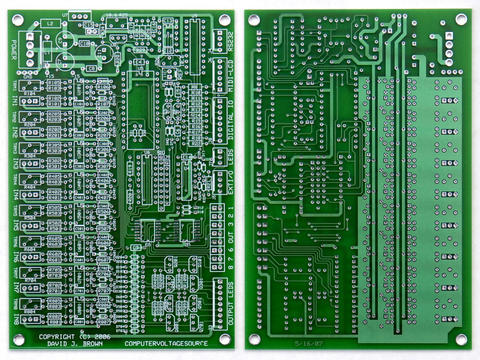
Re: [ComputerVoltageSources] Re: Sequencers

2006-12-16 by John Mahoney

At 11:50 AM 12/16/2006, djbrow54 wrote:
>.... The Start and Stop switches can be used to go into a
>setup mode and select various parameters such as mode, skip, etc.
>Specific outputs would be trigger and gate.
>
>Another interesting possibility is to use the CVS for the sequencer
>and use a PSIM for the clock generation. The PSIM could generate the
>clock with a CV and FM input. I can write a serial (e.g. MIDI)
>protocol
>to sync the two if necessary. However, if I can't think of any extra
>features to put in it, one might as well just use an LFO as the clock.
>
>Dave


I forget... Are there some extra (digital) inputs that could be used
to change the mode on the fly? That would be useful with any clock.
Likewise for a reset-to-step-1 input.

If using a programmable clock such as a PSIM, the clock could exert
additional control via the mode inputs -- switching between up and
down modes every 'N' beats, for example.

I suppose this kind of thing could be handled via the MIDI interface,
but we like voltage control, right? :-)
--
john

Re: Sequencers

2006-12-17 by djbrow54

There are three digital inputs - start, stop, and aux. Aux can be
either an input or output. If Aux is clock, start is a run / setup
toggle, then stop could be a mode.

Dave


--- In ComputerVoltageSources@yahoogroups.com, John Mahoney > I
forget... Are there some extra (digital) inputs that could be used
> to change the mode on the fly? That would be useful with any clock.
> Likewise for a reset-to-step-1 input.
>
> If using a programmable clock such as a PSIM, the clock could exert
> additional control via the mode inputs -- switching between up and
> down modes every 'N' beats, for example.
>
> I suppose this kind of thing could be handled via the MIDI
interface,
> but we like voltage control, right? :-)
> --
> john
>

Re: [ComputerVoltageSources] Re: Sequencers

2006-12-18 by laxt57@aol.com

Hi
My pcb designs skills are a little rusty and
I do not have a commercial quality pcb software package
(I use diptrace) but yes, I would give it a shot if
a set of specs could be agreed upon.
Jeri

-----Original Message-----
From: davebr@...
To: ComputerVoltageSources@yahoogroups.com
Sent: Sat, 16 Dec 2006 10:38 AM
Subject: [ComputerVoltageSources] Re: Sequencers


Care to help lay out a circuit board?

--- In ComputerVoltageSources@yahoogroups.com, laxt57@... wrote:
>
> Hi
> Some activity at last!!!!!
> I guess this whole project is dead, yes?
> Anything I can do to help?
> Jeri
>


________________________________________________________________________
Check out the new AOL. Most comprehensive set of free safety and security tools, free access to millions of high-quality videos from across the web, free AOL Mail and more.


[Non-text portions of this message have been removed]

Re: [ComputerVoltageSources] Re: Sequencers

2006-12-18 by Andrew Scheidler

This was what I was thinking:

DIN Sync (24ppq) clock goes into the PSIM

PSIM software reads the output of one of the sequencer's pot rows and
uses this to determine the step length (1/32, 1/16, 1/8, etc) in terms
of those incoming clock ticks. After playing with a Roland System 700
sequencer, this is a must-have feature. I've done this with my PSIM &
CGS Sequential Switch and it is a blast!

The PSIM also determines the "mode" from a CV input. Forward, Reverse,
Pendulum Odd, Pendulum Even, Random, Binary Walk, etc. This is why the
multiplexing is needed; you have to be able to assign *any* step as the
active one via the software to do some of these modes.

Then the PSIM feeds the multiplexing bits to the 4067 chip which then
feeds 10v to the appropriate step (column) of the sequencer, which is
really just a bunch of 16 channel mixers. The PSIM also provides the
Gate, but that has nothing to do with the sequencer at this point, it
just goes out to the synth's EGs.

Here's what I need HELP to know how to do:

Since it's multiplexed, having SKIP available on each step is easy in
the software, but how do you have 16 hardware on/off switches so that
the PSIM can easily tell which are On and which are Off?

Can you feed voltage thru these 16 switches, and then to another 4067
chip as 16 inputs, then feed the 4 bits to the PSIM?

Ideally I'd want to have *two* rows of on/off switches that could be
constantly "sniffed" by the PSIM for various functions.

Along the same lines, is there a way to for one voltage to be converted
into bits (0000~1111) so that just *one* PSIM output can give the
multiplexer the "which step to be active" information?


Andrew, small brain/big ideas :)

>>> "djbrow54" <davebr@...> 12/16/06 11:50 AM >>>
It's been designed so the 8 analog inputs can be multiplexed (with no
external inputs) to read 16 potentiometers. My intentions are to
write a sequencer for it, somewhat emulating the ARP sequencer. You
should be able to do 16x1, 8x2, sequential or random. The exact
features are left to be designed but with the display I can do a
pretty decent interface. There really aren't enough inputs / controls
to do a decent internal clock so I am thinking of using the edge-
detect interrupts on the Aux input for a clock. That will give really
low latency. The Start and Stop switches can be used to go into a
setup mode and select various parameters such as mode, skip, etc.
Specific outputs would be trigger and gate.

Another interesting possibility is to use the CVS for the sequencer
and use a PSIM for the clock generation. The PSIM could generate the
clock with a CV and FM input. I can write a serial (e.g. MIDI)
protocol
to sync the two if necessary. However, if I can't think of any extra
features to put in it, one might as well just use an LFO as the clock.

Dave

--- In ComputerVoltageSources@yahoogroups.com, "Andrew Scheidler"
<xpandrew@...> wrote:
>
> I am hoping to build the step sequencer of my dreams, using the "CVS
> thing" as the brain.
>
> I've done this in a limited way with a Metalbox/CGS Sequential
Switch
> and a PSIM-1. For example, the DIN SYNC clock goes into the PSIM,
which
> then uses the voltage at IN4 to determine the gate time (in 24ppq
ticks)
> to feed the sequencer via OUT4.
>
> But to really do what I want, I need to address the individual
steps.
> This would allow the Atom24 to point at specific steps instead of
always
> going sequentially. So things like "random" sequence and "skip"
would
> be possible. (right?)
>
> (this is multiplexing, correct? any good resources on this on the
web?)
>
> I'd be interested in hearing anyone else's thoughts...
>
> Andrew
>
> ps - Happy Birthday Grant !
>

Re: [ComputerVoltageSources] Re: Sequencers

2006-12-18 by Andrew Scheidler

Dave -

Can the existing PSIM-1 have four more inputs added? Outputs too?

Are there schematics or instructions for this somewhere? I have a
soldering station and I'm not afraid to use it :)

Andrew

>>> "djbrow54" <davebr@...> 12/16/06 11:50 AM >>>
It's been designed so the 8 analog inputs can be multiplexed (with no

Re: [ComputerVoltageSources] Re: Sequencers

2006-12-18 by Dave Bradley

Andrew,

If the 4 psim outputs were set up to be a binary address, you could have
complete specification of any arbitrary number between 0 and 15.

Then set up two inputs as you described, one for control of clock pulse
advancement for rhythm, and one for control of direction/next stage select
mode.

Set up a third input as a skip input.

Aux would be an output that fires a pulse every time the state changes for
envelopes. The width could be controlled up to 100% by the 4th input.

Now you need a pot matrix with binary inputs, kind of like what I was trying
to do with SuperMoe:

http://www.hotrodmotm.com/images/CV_Generator_8x4new.jpg

This module can do 8x4 steps, 16x2 steps, or 32x1 steps. Since you only have
4 psim outputs for address, you could do 2 rows of 16 steps worth of
control, randomly accessible from the psim.

Moe

On 12/18/06, Andrew Scheidler <xpandrew@...> wrote:
>
> Dave -
>
> Can the existing PSIM-1 have four more inputs added? Outputs too?
>
> Are there schematics or instructions for this somewhere? I have a
> soldering station and I'm not afraid to use it :)
>
> Andrew
>
> >>> "djbrow54" <davebr@...> 12/16/06 11:50 AM >>>
> It's been designed so the 8 analog inputs can be multiplexed (with no
>
>
>
>
>
> Yahoo! Groups Links
>
>
>
>


--
Dave Bradley


[Non-text portions of this message have been removed]

Re: [ComputerVoltageSources] Re: Sequencers

2006-12-18 by Andrew Scheidler

Moe -

The AUX can be the Gate Out of course, but I must have one input &
output for note quantization :)

There must be some way to take *one* PSIM output and turn that into
addresses 0~15.

On the MiniWave, the Wave Selection input voltage is somehow converted
into binary, which then lights up the 4 leds; that's what I'm thinking
about. So 0~0.5v = 0000, 0.6~1.0v=0001, 1.1v~1.5v=0010, etc. The
PSIM program could specify the sequencer step 1~16 by outputting =
0.25v*requiredstepnumber.

I don't yet understand how 16 skip switches can all communicate with the
PSIM. If there is a way to do that using just one PSIM input? With
another multiplexer you could scan across all the switches between
steps, but I don't think the DAC could be scanned 16 times and still be
fast enough at even moderate tempos. (?)

I guess you could (assuming the switches were multiplexed)
#1) choose which step to go to next
#2) look at the status of that switch's SKIP switch
#3) if SKIP=on then go back to step #1
#4) go ahead and fire up that step
But this could result in noticable delays if several SKIPs were ON.

If you dedicated two PSIM inputs to 16 on/off switches, you'd have 20
bits to work with, yes? Would that make it possible?

I feel like the greatest hardware step sequencer is just a couple minor
problems away...

Andrew


>>> "Dave Bradley" <mate.stubb@...> 12/18/06 12:22 PM >>>
Andrew,

If the 4 psim outputs were set up to be a binary address, you could have
complete specification of any arbitrary number between 0 and 15.

Then set up two inputs as you described, one for control of clock pulse
advancement for rhythm, and one for control of direction/next stage
select
mode.

Set up a third input as a skip input.

Aux would be an output that fires a pulse every time the state changes
for
envelopes. The width could be controlled up to 100% by the 4th input.

Now you need a pot matrix with binary inputs, kind of like what I was
trying
to do with SuperMoe:

http://www.hotrodmotm.com/images/CV_Generator_8x4new.jpg

This module can do 8x4 steps, 16x2 steps, or 32x1 steps. Since you only
have
4 psim outputs for address, you could do 2 rows of 16 steps worth of
control, randomly accessible from the psim.

Moe

On 12/18/06, Andrew Scheidler <xpandrew@...> wrote:
>
> Dave -
>
> Can the existing PSIM-1 have four more inputs added? Outputs too?
>
> Are there schematics or instructions for this somewhere? I have a
> soldering station and I'm not afraid to use it :)
>
> Andrew
>
> >>> "djbrow54" <davebr@...> 12/16/06 11:50 AM >>>
> It's been designed so the 8 analog inputs can be multiplexed (with no
>
>
>
>
>
> Yahoo! Groups Links
>
>
>
>


--
Dave Bradley


[Non-text portions of this message have been removed]

Re: [ComputerVoltageSources] Re: Sequencers

2006-12-18 by John Mahoney

>From: Andrew Scheidler <xpandrew@...>
>
>The AUX can be the Gate Out of course, but I must have one input &
>output for note quantization :)

Unless you use MIDI for Note In...


>There must be some way to take *one* PSIM output and turn that into
>addresses 0~15.

Sure, use a 4-bit ADC. Or maybe the Blacet Analog Bar Graph could be modified for this.
--
john

Re: Sequencers

2006-12-19 by djbrow54

Brice designed the PSIM board with a 40 pin socket for the AtomPro.
If you remove the AtomPro24 and replace it with an AtomPro28, you get
four additional pins. There is an on-board reset circuit on the
AtomPro28 that doesn't like it's output grounded (the guys at
BasicMicro disagree with me on this) but shorting reset to ground with
a switch will blow the part. You just need to put a resistor in
series with the switch. I think I used 47R (I wrote it down
somewhere). The four additional pins are then connected to square
pins on the PSIM board. Fly some wires off to an auxiliary board and
you can buffer them for whatever. You can use them as four additional
analog inputs, digital inputs, or outputs. There is one constraint
that one of the 8 inputs must be analog (so you can't set all to
digital - who would?)

For additional digital inputs or outputs, you can expand the PSIM with
I2C. There is a two pin jack for P6 and P7 which can be used to
expand the I/O. I have an I2C to RS-232 and an I2C to MIDI that I
use. I have also tested the PSIM with an MCP23008 I2C to 8 bit port
expander. This will give you any combination of digital inputs and
outputs. This is what I plan on using to control the second DAC and
programmable reference voltages on the CVS. I used 5 of the 8 pins
with 3 spare. All you need is two pullup resistors and there is even
room on the PSIM board to add these. You can see my schematic for an
I2C to RS-232 to drive the TTS-256/SpeakJet at
http://modularsynthesis.com/modules/synthmodules/PSIM-SpeakJet/PSIM-
speakjet.htm (sorry - long link)

I have an AtomPro FAQ on my
http://modularsynthesis.com/modules/synthmodules/synthmodules.htm
page. The link is just above the programs. Some of this is
documented in there along with some timing information. Reading
digital inputs via I2C isn't that fast as you have a number of bytes
for the transfer. Outputs are pretty quick.

Lots of opportunities. This is basically what the CVS design is with
a second DAC for 8 analog outputs, MIDI, and programmable references
so you can read 16 potentiometers.

However, we're stalled at the PCB layout. I'm ready to give up and
just hand wire my board.

Dave

--- In ComputerVoltageSources@yahoogroups.com, "Andrew Scheidler"
<xpandrew@...> wrote:
>
> Moe -
>
> The AUX can be the Gate Out of course, but I must have one input &
> output for note quantization :)
>
> There must be some way to take *one* PSIM output and turn that into
> addresses 0~15.
>
> On the MiniWave, the Wave Selection input voltage is somehow
converted
> into binary, which then lights up the 4 leds; that's what I'm
thinking
> about. So 0~0.5v = 0000, 0.6~1.0v=0001, 1.1v~1.5v=0010, etc. The
> PSIM program could specify the sequencer step 1~16 by outputting =
> 0.25v*requiredstepnumber.
>
> I don't yet understand how 16 skip switches can all communicate with
the
> PSIM. If there is a way to do that using just one PSIM input? With
> another multiplexer you could scan across all the switches between
> steps, but I don't think the DAC could be scanned 16 times and still
be
> fast enough at even moderate tempos. (?)
>
> I guess you could (assuming the switches were multiplexed)
> #1) choose which step to go to next
> #2) look at the status of that switch's SKIP switch
> #3) if SKIP=on then go back to step #1
> #4) go ahead and fire up that step
> But this could result in noticable delays if several SKIPs were ON.
>
> If you dedicated two PSIM inputs to 16 on/off switches, you'd have
20
> bits to work with, yes? Would that make it possible?
>
> I feel like the greatest hardware step sequencer is just a couple
minor
> problems away...
>
> Andrew
>
>
> >>> "Dave Bradley" <mate.stubb@...> 12/18/06 12:22 PM >>>
> Andrew,
>
> If the 4 psim outputs were set up to be a binary address, you could
have
> complete specification of any arbitrary number between 0 and 15.
>
> Then set up two inputs as you described, one for control of clock
pulse
> advancement for rhythm, and one for control of direction/next stage
> select
> mode.
>
> Set up a third input as a skip input.
>
> Aux would be an output that fires a pulse every time the state
changes
> for
> envelopes. The width could be controlled up to 100% by the 4th
input.
>
> Now you need a pot matrix with binary inputs, kind of like what I
was
> trying
> to do with SuperMoe:
>
> http://www.hotrodmotm.com/images/CV_Generator_8x4new.jpg
>
> This module can do 8x4 steps, 16x2 steps, or 32x1 steps. Since you
only
> have
> 4 psim outputs for address, you could do 2 rows of 16 steps worth of
> control, randomly accessible from the psim.
>
> Moe
>
> On 12/18/06, Andrew Scheidler <xpandrew@...> wrote:
> >
> > Dave -
> >
> > Can the existing PSIM-1 have four more inputs added? Outputs too?
> >
> > Are there schematics or instructions for this somewhere? I have a
> > soldering station and I'm not afraid to use it :)
> >
> > Andrew
> >
> > >>> "djbrow54" <davebr@...> 12/16/06 11:50 AM >>>
> > It's been designed so the 8 analog inputs can be multiplexed (with
no
> >
> >
> >
> >
> >
> > Yahoo! Groups Links
> >
> >
> >
> >
>
>
> --
> Dave Bradley
>
>
> [Non-text portions of this message have been removed]
>

Re: [ComputerVoltageSources] Re: Sequencers

2006-12-21 by Brice D. Hornback

Hello everyone. I also designed the PSIM-1 so you can plug in a daughter
board on top of the Atom-PRO (those are what the pins running along side the
DIP socket are for).

Anyway...

Additional analog inputs:

Check out the MAX1270 12-bit A\D chip. It's an 8-channel, 12-bit, 0-10V
serial ADC. So, you need four I/O pins from the PSIM-1 for the serial
communication with the ADC. Simply use the four ADC pins you already have
(P0-P3 - yes, you'll have to cut some traces and re-write some code). Use a
similar buffer on the inputs though. Right now, they are set for 0-5V
through a divider. That can be eliminated, but you'll still want
protection.

Additional analog outputs:

When I designed the PSIM-1, I was running out of I/O pins (the 28 wasn't
available yet and the 40 was/still is "in the works". Well, the DAC has a
chip select pin (pin 12) that is pulled low. Cut the trace going to that
and you can add as many of those DACs as you have extra digital output pins
for selecting which DAC you want to send data to by pulling the DAC pin 12
low (you'll want to add a pull-up resistor to VDD on the original DAC as
well as any others you add. For example, you could use P14 & P15 (J5) to
select between two DACs. The other wires going to the DAC(s) can all be
connected together.

Well, for about $60 in parts and a few hours with a soldering iron... you
could have eight 12-bit analog inputs and eight 12-bit analog outputs.

I almost forgot to mention... the MAX1270 A/D also has a chip select pin (it
too is active low). So let your imagination go WILD! All you need is I/O!
If you do go to the 28-pin Atom-PRO, you have four additonal I/O pins but
like Dave stated, one has to be an analog input but the other three could be
used as DAC chip selects. So, you could have (still using J5) up to TWENTY
12-bit analog outputs to play with. Throw in P6 and P7 (J3 - the I2C
header) and that gives you sixteen analog inputs and twenty analog outputs.
Well, twenty-one counting the extra on the 28-pin but it's a 10-bit so I'd
use it for maybe the AUX port which then frees up P8 and gives you yet
another digital I/O pin to add another A/D. That now gives you TWENTY
12-bit analog inputs and TWENTY 12-bit analog outputs!!! Put a heatsink on
the voltage regulator!

Enjoy! HAPPY HOLIDAYS to everyone!

To anyone still waiting on a PSIM-1... only nine left to go. Thanks for
your patience.

Best regards,
Brice

----- Original Message -----
From: "djbrow54" <davebr@...>
To: <ComputerVoltageSources@yahoogroups.com>
Sent: Monday, December 18, 2006 11:11 PM
Subject: [ComputerVoltageSources] Re: Sequencers


> Brice designed the PSIM board with a 40 pin socket for the AtomPro.
> If you remove the AtomPro24 and replace it with an AtomPro28, you get
> four additional pins. There is an on-board reset circuit on the
> AtomPro28 that doesn't like it's output grounded (the guys at
> BasicMicro disagree with me on this) but shorting reset to ground with
> a switch will blow the part. You just need to put a resistor in
> series with the switch. I think I used 47R (I wrote it down
> somewhere). The four additional pins are then connected to square
> pins on the PSIM board. Fly some wires off to an auxiliary board and
> you can buffer them for whatever. You can use them as four additional
> analog inputs, digital inputs, or outputs. There is one constraint
> that one of the 8 inputs must be analog (so you can't set all to
> digital - who would?)
>
> For additional digital inputs or outputs, you can expand the PSIM with
> I2C. There is a two pin jack for P6 and P7 which can be used to
> expand the I/O. I have an I2C to RS-232 and an I2C to MIDI that I
> use. I have also tested the PSIM with an MCP23008 I2C to 8 bit port
> expander. This will give you any combination of digital inputs and
> outputs. This is what I plan on using to control the second DAC and
> programmable reference voltages on the CVS. I used 5 of the 8 pins
> with 3 spare. All you need is two pullup resistors and there is even
> room on the PSIM board to add these. You can see my schematic for an
> I2C to RS-232 to drive the TTS-256/SpeakJet at
> http://modularsynthesis.com/modules/synthmodules/PSIM-SpeakJet/PSIM-
> speakjet.htm (sorry - long link)
>
> I have an AtomPro FAQ on my
> http://modularsynthesis.com/modules/synthmodules/synthmodules.htm
> page. The link is just above the programs. Some of this is
> documented in there along with some timing information. Reading
> digital inputs via I2C isn't that fast as you have a number of bytes
> for the transfer. Outputs are pretty quick.
>
> Lots of opportunities. This is basically what the CVS design is with
> a second DAC for 8 analog outputs, MIDI, and programmable references
> so you can read 16 potentiometers.
>
> However, we're stalled at the PCB layout. I'm ready to give up and
> just hand wire my board.
>
> Dave
>
> --- In ComputerVoltageSources@yahoogroups.com, "Andrew Scheidler"
> <xpandrew@...> wrote:
>>
>> Moe -
>>
>> The AUX can be the Gate Out of course, but I must have one input &
>> output for note quantization :)
>>
>> There must be some way to take *one* PSIM output and turn that into
>> addresses 0~15.
>>
>> On the MiniWave, the Wave Selection input voltage is somehow
> converted
>> into binary, which then lights up the 4 leds; that's what I'm
> thinking
>> about. So 0~0.5v = 0000, 0.6~1.0v=0001, 1.1v~1.5v=0010, etc. The
>> PSIM program could specify the sequencer step 1~16 by outputting =
>> 0.25v*requiredstepnumber.
>>
>> I don't yet understand how 16 skip switches can all communicate with
> the
>> PSIM. If there is a way to do that using just one PSIM input? With
>> another multiplexer you could scan across all the switches between
>> steps, but I don't think the DAC could be scanned 16 times and still
> be
>> fast enough at even moderate tempos. (?)
>>
>> I guess you could (assuming the switches were multiplexed)
>> #1) choose which step to go to next
>> #2) look at the status of that switch's SKIP switch
>> #3) if SKIP=on then go back to step #1
>> #4) go ahead and fire up that step
>> But this could result in noticable delays if several SKIPs were ON.
>>
>> If you dedicated two PSIM inputs to 16 on/off switches, you'd have
> 20
>> bits to work with, yes? Would that make it possible?
>>
>> I feel like the greatest hardware step sequencer is just a couple
> minor
>> problems away...
>>
>> Andrew
>>
>>
>> >>> "Dave Bradley" <mate.stubb@...> 12/18/06 12:22 PM >>>
>> Andrew,
>>
>> If the 4 psim outputs were set up to be a binary address, you could
> have
>> complete specification of any arbitrary number between 0 and 15.
>>
>> Then set up two inputs as you described, one for control of clock
> pulse
>> advancement for rhythm, and one for control of direction/next stage
>> select
>> mode.
>>
>> Set up a third input as a skip input.
>>
>> Aux would be an output that fires a pulse every time the state
> changes
>> for
>> envelopes. The width could be controlled up to 100% by the 4th
> input.
>>
>> Now you need a pot matrix with binary inputs, kind of like what I
> was
>> trying
>> to do with SuperMoe:
>>
>> http://www.hotrodmotm.com/images/CV_Generator_8x4new.jpg
>>
>> This module can do 8x4 steps, 16x2 steps, or 32x1 steps. Since you
> only
>> have
>> 4 psim outputs for address, you could do 2 rows of 16 steps worth of
>> control, randomly accessible from the psim.
>>
>> Moe
>>
>> On 12/18/06, Andrew Scheidler <xpandrew@...> wrote:
>> >
>> > Dave -
>> >
>> > Can the existing PSIM-1 have four more inputs added? Outputs too?
>> >
>> > Are there schematics or instructions for this somewhere? I have a
>> > soldering station and I'm not afraid to use it :)
>> >
>> > Andrew
>> >
>> > >>> "djbrow54" <davebr@...> 12/16/06 11:50 AM >>>
>> > It's been designed so the 8 analog inputs can be multiplexed (with
> no
>> >
>> >
>> >
>> >
>> >
>> > Yahoo! Groups Links
>> >
>> >
>> >
>> >
>>
>>
>> --
>> Dave Bradley
>>
>>
>> [Non-text portions of this message have been removed]
>>
>
>
>
>
>
> Yahoo! Groups Links
>
>
>
>

Re: [ComputerVoltageSources] Re: Sequencers

2007-01-30 by Andrew Scheidler

Dear Dave -

OK, I'm going to dive into this I2C thing headfirst without checking the
water depth :) The good news is I've built some CGS modules with
great success; but I still have very little understanding of what's
going on in the circuits...

I'm ordering an MCP23008 ($1.04 at mouser!) and want to try hooking up 8
toggle switches to it, and then on to P6/P7 on the PSIM; the most
minimal setup possible so I can experiment. If you have time for a
couple questions...


[voltage source] --> toggle switch --> input pin of MCP23008
a) What should I use for the [voltage source], ie. what voltage ?
(Is there somewhere on the PSIM I can pull this from?)


MCP23008 --> P6
MCP23008 --> P7
b) Which pins on the MCP go to P6/P7?
c) Do I need a resistor in between them? (you mentioned a pullup
resistor)


Power/ground/other connections to the MCP23008
d) What other connections (minimal!) do I need to make?


I was looking at your I2C/RS-232 .jpg on your site, but that was with a
different chip. And I've looked at the datasheets for the MCP that you
sent me, but for me the majority of info there might as well be in
Icelandic :)

Any help you can provide would be great!
Thanks again,
Andrew


>>> "djbrow54" <davebr@...> 12/18/06 11:11 PM >>>
For additional digital inputs or outputs, you can expand the PSIM with
I2C. There is a two pin jack for P6 and P7 which can be used to
expand the I/O. I have an I2C to RS-232 and an I2C to MIDI that I
use. I have also tested the PSIM with an MCP23008 I2C to 8 bit port
expander. This will give you any combination of digital inputs and
outputs. This is what I plan on using to control the second DAC and
programmable reference voltages on the CVS. I used 5 of the 8 pins
with 3 spare. All you need is two pullup resistors and there is even
room on the PSIM board to add these. You can see my schematic for an
I2C to RS-232 to drive the TTS-256/SpeakJet at
http://modularsynthesis.com/modules/synthmodules/PSIM-SpeakJet/PSIM-
speakjet.htm (sorry - long link)

I have an AtomPro FAQ on my
http://modularsynthesis.com/modules/synthmodules/synthmodules.htm
page. The link is just above the programs. Some of this is
documented in there along with some timing information. Reading
digital inputs via I2C isn't that fast as you have a number of bytes
for the transfer. Outputs are pretty quick.

Lots of opportunities. This is basically what the CVS design is with
a second DAC for 8 analog outputs, MIDI, and programmable references
so you can read 16 potentiometers.

However, we're stalled at the PCB layout. I'm ready to give up and
just hand wire my board.

Dave

Re: Sequencers

2007-01-31 by djbrow54

See answers in-line. I'll walk you through the code when you are
ready to try out your parts. It will power up in input mode so
basically you could just try reading the part but you'll want to set
the pullups first with a write command.

Dave

--- In ComputerVoltageSources@yahoogroups.com, "Andrew Scheidler"
<xpandrew@...> wrote:
> [voltage source] --> toggle switch --> input pin of MCP23008
> a) What should I use for the [voltage source], ie. what voltage ?

Make it easier - inpu pin to switch to ground. The part has internal
pullups so you can have the no switch closure read a 1 and the switch
closure will read a 0. A write of $ff to the GPPU register will turn
on the pullups. You can also write to the IPOL register to invert the
inputs so a switch closure would read as a 1 (wouldn't bother).

> (Is there somewhere on the PSIM I can pull this from?)

You'll need a minimal amount of +5 volts for the MCP23008. Pin 3 of
J5 is +5 but you are using that for your midi interface. You could
tap into the connector for your midi interface to connect to that pin.
The part only needs 1 mA which is no big deal.

> MCP23008 --> P6
> MCP23008 --> P7
> b) Which pins on the MCP go to P6/P7?

You can wire either P6 or P7 to SCL (pin 1) and SDA (pin 2). I
connected mine as P6 to SDA pin 2 and P7 to SCL pin 1. These are
defined in the I2C commands.

> c) Do I need a resistor in between them? (you mentioned a pullup
> resistor)
No, but you need a 4K7 resistor from pin 1 to +5 volts and another
from pin 2 to +5 volts. These lines are open drain so they have no
active pullup. The resistors are needed for logical 1's.

> Power/ground/other connections to the MCP23008
> d) What other connections (minimal!) do I need to make?

To make it easy, don't wire up the address (let them float) and you'll
need to use address $27 instead of $20. Note this has to be shifted
left to become $4E. I let the compiler do this for me. A better
solution would be to ground them all (floating is susceptable to
noise). This would be grounding pins 3,4,5. Pin 9 is ground, pin 18
is +5. I would wire reset pin 6 directly to the reset switch. Make
sure you get the non-grounded side of the switch or wire it directly
to J10 (you'll have a wire there for the switch).