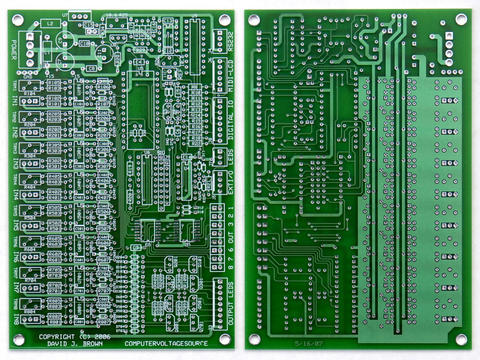
ComputerVoltageSources group photo

Yahoo Groups archive

ComputerVoltageSources

Archive for ComputerVoltageSources.

Index last updated: 2026-03-30 01:00 UTC

Thread

SpeakJet

SpeakJet

2006-04-09 by djbrow54

I've spent some time programming I2C on an AVR ATMEGA8. It has the
advantage of a full I2C implementation in hardware so it's pretty easy
to interface. I've got it interfaced into my PSIM to convert to 9600
baud for driving the SpeakJet. Tomorrow I want to try and put the
TTS256 in front of the SpeakJet and see what I can do with that. If
everything works out, I may upgrade my PSIM to this architecture.

I put an image of the inputs and outputs in my photo folder. The top
two traces are the data and clock for the I2C. The bottom trace is
the serial output to the SpeakJet. The total transmission time to the
SpeakJet is about 46 mS while the I2C is about half of that. I'm not
using strings so every byte to the SpeakJet requires two bytes to be
sent via I2C (address & data). It doesn't cut the time down that much
but is compatible with interrupts.

To use a smaller AVR, I may try and get this running via software I2C
in a ATTINY part. Don't know if I feel up to that much work for the
SpeakJet. The ATMEGA8 is in a narrow 28 pin package.

Dave

Re: SpeakJet

2006-04-11 by djbrow54

I got my TTS256 interfaced yesterday to my SpeakJet. What a neat
chip. You just send messages to the chip terminated in a
carriage return ($0d) and it speaks! No more endless strings of
numbers to get this chip to say a few words. The input buffer is 256
bytes and you cannot send data to the chip when it is speaking. I
decided to stay with the larger ATMEGA8 since the ram is larger and
implemented a 832 byte buffer. I can send three complete buffers to
the ATMEGA8 for queuing to the TTS256. The speakjet speaking pin
should interface back to the ATMEGA8 although I haven't tried this in
my configuration yet.

So ... some questions.

Who is interested in a SpeakJet?
What are you planning on doing with it?
Are you interested in the TTS256 chip?
Any interest in an I2C bridge chip to connect to the SpeakJet/TTS256?

Dave

Re: [ComputerVoltageSources] Re: SpeakJet

2006-04-11 by xamboldt

I'm moderately interested in the SpeakJet. I'm not sure how practical
it would be outside of making singing robot sounds - which as corny
as it is, is something I'd most likely do... :)

Would the TTS256 preclude one from sending particular pitch & timing
information about the allophones being voiced?

-Chris

On Apr 10, 2006, at 9:59 PM, djbrow54 wrote:

> I got my TTS256 interfaced yesterday to my SpeakJet. What a neat
> chip. You just send messages to the chip terminated in a
> carriage return ($0d) and it speaks! No more endless strings of
> numbers to get this chip to say a few words. The input buffer is 256
> bytes and you cannot send data to the chip when it is speaking. I
> decided to stay with the larger ATMEGA8 since the ram is larger and
> implemented a 832 byte buffer. I can send three complete buffers to
> the ATMEGA8 for queuing to the TTS256. The speakjet speaking pin
> should interface back to the ATMEGA8 although I haven't tried this in
> my configuration yet.
>
> So ... some questions.
>
> Who is interested in a SpeakJet?
> What are you planning on doing with it?
> Are you interested in the TTS256 chip?
> Any interest in an I2C bridge chip to connect to the SpeakJet/TTS256?
>
> Dave
>
>
>
>
>
>
>
> YAHOO! GROUPS LINKS
>
> Visit your group "ComputerVoltageSources" on the web.
>
> To unsubscribe from this group, send an email to:
> ComputerVoltageSources-unsubscribe@yahoogroups.com
>
> Your use of Yahoo! Groups is subject to the Yahoo! Terms of Service.
>
>

Re: [ComputerVoltageSources] Re: SpeakJet

2006-04-12 by Scott E.

But imagine the SpeakJet through a vocoder.....

Scott
========================================
John Mahoney wrote:
>
> >... singing robot sounds - which as corny
> >as it is, is something I'd most likely do... :)
>
> Ditto. Corny as charged.
> --
> john
>
>
> ------------------------------------------------------------------------
> YAHOO! GROUPS LINKS
>
> * Visit your group "ComputerVoltageSources
> <http://groups.yahoo.com/group/ComputerVoltageSources>" on the web.
>
> * To unsubscribe from this group, send an email to:
> ComputerVoltageSources-unsubscribe@yahoogroups.com
> <mailto:ComputerVoltageSources-unsubscribe@yahoogroups.com?subject=Unsubscribe>
>
> * Your use of Yahoo! Groups is subject to the Yahoo! Terms of
> Service <http://docs.yahoo.com/info/terms/>.
>
>
> ------------------------------------------------------------------------
>

Re: [ComputerVoltageSources] Re: SpeakJet

2006-04-12 by xamboldt

I used to send the output from my Amiga's vocal synthesizer (which
sounded a lot like the SpeakJet) through a vocoder. It does sound
cool. But I could never get the Amiga to sing pitches on its own.
There's that Vocalwriter software for Macs, but the Mac vocal
synthesizer doesn't have the same gritty quality of the Amiga and
Speakjet. Being able to use the CVS to interface a modular system, or
even MIDI to allow pitch control of a lo-fi vocal synth with will be
quite fun, I think. It certainly won't be the most broadly appealing
or useful feature of the CVS, but it'll make me laugh for a while at
least.

-Chris

On Apr 12, 2006, at 1:40 PM, Scott E. wrote:

> But imagine the SpeakJet through a vocoder.....
>
> Scott
> ========================================
> John Mahoney wrote:
> >
> > >... singing robot sounds - which as corny
> > >as it is, is something I'd most likely do... :)
> >
> > Ditto. Corny as charged.
> > --
> > john
> >
> >
> >
> ----------------------------------------------------------------------
> --
> > YAHOO! GROUPS LINKS
> >
> > * Visit your group "ComputerVoltageSources
> > <http://groups.yahoo.com/group/ComputerVoltageSources>" on
> the web.
> >
> > * To unsubscribe from this group, send an email to:
> > ComputerVoltageSources-unsubscribe@yahoogroups.com
> > <mailto:ComputerVoltageSources-unsubscribe@yahoogroups.com?
> subject=Unsubscribe>
> >
> > * Your use of Yahoo! Groups is subject to the Yahoo! Terms of
> > Service <http://docs.yahoo.com/info/terms/>.
> >
> >
> >
> ----------------------------------------------------------------------
> --
> >
>
> YAHOO! GROUPS LINKS
>
> Visit your group "ComputerVoltageSources" on the web.
>
> To unsubscribe from this group, send an email to:
> ComputerVoltageSources-unsubscribe@yahoogroups.com
>
> Your use of Yahoo! Groups is subject to the Yahoo! Terms of Service.
>
>

Re: SpeakJet

2006-04-13 by djbrow54

That is the only use I have really figured out for my SpeakJet. I
have an mp3 sample on my webpage (very short - just the word 'welcome'
through a Roland vocoder. Given how difficult the SpeakJet is to
program, I would recommend the TTS256 for text. There is supposed to
be a loop through mode for specific sound programming but no
documentation for the TTS256. I'll play with it when I have time.

Welcome mp3 sample
http://modularsynthesis.com/samples/samples.htm (last link)

Tonight I got my program running which converts the I2C to 9600 baud
RS232 to drive the TTS256 which interfaces to the SpeakJet. I have an
832 byte buffer with flow control and am sending ~1000 bytes to it.
The buffer flags at 512 bytes and the AtomPro loops on the I2COut
command until the data is sent and acknowledged. It's about one
minute and 25 seconds of speech.

Dave


--- In ComputerVoltageSources@yahoogroups.com, John Mahoney
<jmahoney@...> wrote:
>
> At 01:40 PM 4/12/2006, you wrote:
> >But imagine the SpeakJet through a vocoder.....
>
> I have imagined exactly that.
> --
> john
>