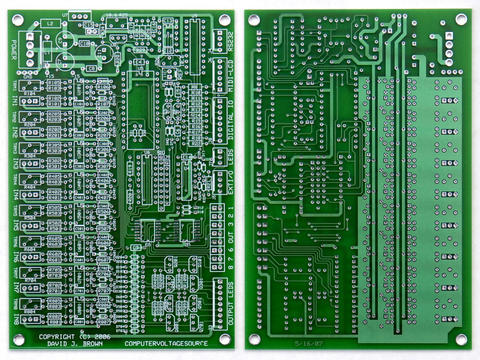
tom,

i'd like to invite you to our yahoo discussion group ComputerVoltageSources (http://launch.groups.yahoo.com/group/ComputerVoltageSources/)... we're set up specifically to develop and discuss computer-based CV sources for modular analog synthesis, sounds like you'd fit right in.  you'd also be welcome to use the Files section to post details of your project... i for one would be very interested in additional detail on your project.

best regards
bbob drake

>----- ------- Original Message ------- -----
>From: Tom Wiltshire <tom@...>
>To: synth-DIY <synth-diy@...>
>Sent: Sun, 1 Oct 2006 23:38:08
>
>
>Hello all,
>
>I'm new to the list, but I hope you don't mind if I
>explain what I've
>been up to.
>
>My initial impetus came from reading about PIC
>microprocessors, and
>thinking that I might be able to simulate the
>functionality of other
>ICs using them. Specifically, it occured to me to
>try and
>imitate/simulate/copy the unobtainable (or at least
>extremely
>expensive) SSM and CEM synth chips that I wanted
>but can't get.
>
>Towards this end, I've developed a PIC 16F684-based
>LFO which offers 8
>waveforms including noise, and provides a
>sample-and-hold that samples
>the selected waveform. All the waves are generated
>by the
>microprocessor, and output via a 10-bit PWM module
>on the chip. Passing
>the PWM output through a simple lowpass filter
>gives a good analogue
>output. The nice part is that the PIC also includes
>analogue inputs
>which I use as 0-5V control voltage inputs. These
>are passed to an
>8-bit D/A on the chip so the microprocessor can
>deal with it. In
>practice, the chip behaves pretty much like an
>analogue IC - you give
>it voltages, it gives you an LFO output. Circuit
>diagram available on
>request - how does the list feel about attachments
>for things like
>that?
>
>I started off with an LFO because (A) the
>frequencies are low and means
>the sampling frequency can be low too, giving you
>more clock cycles to
>play with, and (B) because there is already loads
>of stuff on the web
>about generating sine waves with a PIC which I
>could use to get me
>started.
>
>I followed this up by working on a
>voltage-controlled envelope
>generator along similar lines. The circuit is
>more-or-less identical to
>the LFO, except with more inputs to spare pins on
>the PIC. It uses many
>analogue inputs on the chip to provide
>voltage-controlled A, D, S and
>R, but also output level (like the CEM 3310) and a
>general time input
>which shortens the entire envelope (like the SSM
>2056). Finally,
>because of the design of the firmware, I was able
>to add an input which
>switches between an exponential or linear response.
>Again, the PWM
>output needs to be followed by a simple op-amp
>lowpass filter, but it
>is considerably simpler and more compact than a
>discrete design for
>what it is able to do. The only people I've managed
>to find doing
>something similar are Encore Electronics
>(http://www.encoreelectronics.com/cont_ueg1.html),
>although maybe they
>used a more serious processor than the �1.42 PIC
>that I had available.
>The price of the finished module certainly suggests
>so! It is quite
>possible that they didn't, however. As the envelope
>generator only
>deals with a single stage at once (it is EITHER
>attacking OR decaying
>or whatever, never both at once) adding more stages
>doesn't actually
>increase the load on the processor significantly.
>
>I'm hoping to put these parts together with an old
>SSM2047 VCF/VCA that
>I've had hanging around for years (now THAT I can't
>simulate using a
>PIC...) and build a (mainly) analogue programmable
>monosynth. Working
>out how to do the modulation matrix (or alternative
>arrangement) is
>proving difficult though.
>
>Hope this is of interest - any comments
>appreciated!
>
>Tom
>
>
>++++ Electric Druid ++++
>Web Design & Development
>http://www.electricdruid.net
Message
RE: [sdiy] Imitating CEMs with PICs
2006-10-02 by rdrake
Attachments
- No local attachments were found for this message.