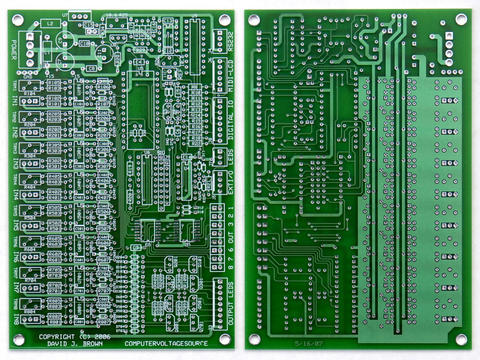
I believe the calibrated jacks will go directly to the A/D summing nodes,
while the non-calibrated jacks will go through the attenuators.  Correct?

The problem with trimming is that most DIYers have sub $100 DMMs with 1%
accuracy.  Trimming isn't really valid at 10 bit resolution unless your DMM
approaches 0.1% accuracy = 1/1000th.

One option is the 80 cent 0.1% resistors.  Another option is to match a pile
of 1% resistors with a 4 digit DMM and hope the DMM relative accuracy is
much better than the absolute accuracy.  This is usually the case, but
without calibrating against a higher accuracy instrument you can't really
tell for certain.

The other option is you just don't care and leave out the calibrated inputs.
:-)

John Loffink
The Microtonal Synthesis Web Site
http://www.microtonal-synthesis.com
The Wavemakers Synthesizer Web Site
http://www.wavemakers-synth.com


> -----Original Message-----
> From: ComputerVoltageSources@yahoogroups.com
> [mailto:ComputerVoltageSources@yahoogroups.com] On Behalf Of Grant Richter
>
> > Lots of jacks - not sure what the difference is between the calibrated
> > and uncalibrated inputs.
> >
>
> In the summing section of a typical VCO or synth module, you use 1%
> resistors. That is 1
> part in 100 accuracy.
>
> The input A/D is 10 bits or 1 part in 1024. So using any two 1% resistors,
> the input
> reading could differ by 20 "counts" (one res at +1%, one res at -1%). The
> simplest way to
> trim that precisely is with a trimpot.
>
> We want an input that is 0 counts at 0 volts and exactly 1023 counts at
> 5.000 volts (with
> 0.00499 volts per count). We can convert that to floating point and
> actually calculate in
> real world voltages. Since the ouput is calibrated, you can work in real
> world voltages also.
>
> The non-trimpot input is close but not precise. Unless you match the
> resistors by hand to
> 0.1% or buy them matched for 80 cents apiece.
>
Message
RE: [ComputerVoltageSources] Calibrated Inputs
2006-03-24 by John Loffink
Attachments
- No local attachments were found for this message.