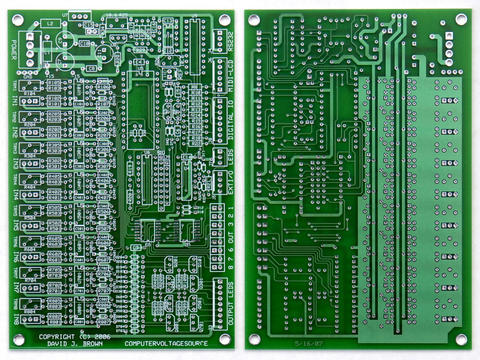
Hi Chris
--- In ComputerVoltageSources@yahoogroups.com, xamboldt <xamboldt@...>
wrote:
in fact, one of the reaons i'm riding these threads so hard is that
NOW is the time to brainstorm these issues , and get on with it
so.... fire away!
current in the quick zap that happens while the plug passes thru....
but it would work fine
(but what Grant proposes below)
and (speaking strictly for myself) i've found offset to be invaluable
when interfacing to a wide range of external gadgets.
that's why i'm behind this one!
best,
-doc
--- In ComputerVoltageSources@yahoogroups.com, xamboldt <xamboldt@...>
wrote:
>not at all!
> This may be drifting a little OT,
in fact, one of the reaons i'm riding these threads so hard is that
NOW is the time to brainstorm these issues , and get on with it
so.... fire away!
> but I'm wondering why you couldn'tthat'd work fine (ya might want a resistor in series to limit the
> just wire the 10V source to the normalling lug of the input jack, and
> then wire the tip lug to the attenuating pot, so that it would act as
> an attenuator for the 10V source or any signal you plugged in...
>
> Am I missing something? It would be far from the first time :)
current in the quick zap that happens while the plug passes thru....
but it would work fine
(but what Grant proposes below)
> Since we are spinning a new board, I think it would be useful tohave full synthesizer style
> inputs. That is algebraic summing with offset and span for eachchannel. Plus calibratable
> voltage inputs, so you can compute in real floating point voltagesand interface 1 volt per
> octave keyboards.yields OFFSET
>
and (speaking strictly for myself) i've found offset to be invaluable
when interfacing to a wide range of external gadgets.
that's why i'm behind this one!
best,
-doc