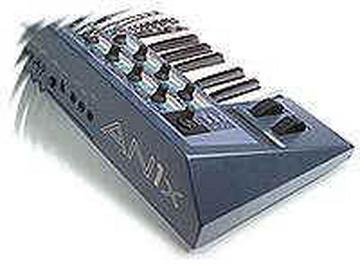
The Yamaha AN1x Synthesizer mailing list group photo

Yahoo Groups archive

The Yamaha AN1x Synthesizer mailing list

Index last updated: 2026-04-28 22:40 UTC

Thread

Aliasing

Aliasing

2005-04-11 by d97macla

The AN1x is very versatile as you know. It can generate a lot of
aliasing for example. To get analog sounds you should avoid that with
the Edge control of the VCOs. I have tested it with the excellent free
vst plug-in Frea(k)oscope from smartelectronix.

To get all aliasing components up to 15kHz below -70dB relative to the
fundamental I found these upper limits for the Edge value:

<Fundamental> Hz : <Edge value>
125  Hz : 105
250  Hz : 95
500  Hz : 85
1000 Hz : 75
2000 Hz : 65
4000 Hz : 55

As a rule, Edge values below 80 will remove a lot of aliasing.

Martin

Re: [AN1x] Aliasing

2005-04-11 by Summa

The downside is, that basses sound dampened without the high harmonics. At 15khz -
70db it shouldn't be a problem, since most ppl. won't recognise it. Afaik only 
aliasing/mirror frequencies at lower frequencies are realy inlfuencing sound 
quality...
Other than that how do you know it's aliasing? 

...Summa


On 11 Apr 2005 at 12:49, d97macla wrote:

> 
> 
> The AN1x is very versatile as you know. It can generate a lot of
> aliasing for example. To get analog sounds you should avoid that with
> the Edge control of the VCOs. I have tested it with the excellent free
> vst plug-in Frea(k)oscope from smartelectronix.
> 
> To get all aliasing components up to 15kHz below -70dB relative to the
> fundamental I found these upper limits for the Edge value:
> 
> <Fundamental> Hz : <Edge value>
> 125  Hz : 105
> 250  Hz : 95
> 500  Hz : 85
> 1000 Hz : 75
> 2000 Hz : 65
> 4000 Hz : 55
> 
> As a rule, Edge values below 80 will remove a lot of aliasing.
> 
> Martin
> 
> 
> 
> 
> 
> ------------------------ Yahoo! Groups Sponsor
> --------------------~--> Has someone you know been affected by illness
> or disease? Network for Good is THE place to support health awareness
> efforts! http://us.click.yahoo.com/pKxVKC/UOnJAA/n1hLAA/QnLolB/TM
> --------------------------------------------------------------------~-
> > 
> 
> Community email addresses:
>   Post message: AN1x-list@yahoogroups.com
>   Subscribe:    AN1x-list-subscribe@yahoogroups.com
>   Unsubscribe:  AN1x-list-unsubscribe@yahoogroups.com
>   List owner:   AN1x-list-owner@yahoogroups.com
> 
> Shortcut URL to this page:
>    http://groups.yahoo.com/group/AN1x-list
> 
> The AN1x Control Synthesizer FAQ::
>   http://www.geocities.com/jondl_2000/an1x_faq/an1x_faq_toc.htm
> 
> Yahoo! Groups Links
> 
> 
> 
> 
> 
> 
> 
> 


-- 

CZ/VZ 		mailing list	: http://groups.yahoo.com/group/CZsynth
FMHeaven	mailing list	: http://groups.yahoo.com/group/fmheaven/
FS1R 		mailing list	: http://www.ampfea.org/mailman/listinfo/fss-list
Vokator		mailing list	: http://groups.yahoo.com/group/vokator


Wellenform Chat  So and Do 22.00 CET: http://chat.moogulator.com/
Re: [AN1x] Aliasing

2005-04-11 by d97macla

For basses (low frequency fundamental) aliasing is not a big problem.
 Harmonics lie closer to each other in the spectrum and few reach
above the nyquist frequency, at which they fold/mirror down. I
recognize aliasing by watching the spectrum in real-time with the
plug-in i mentioned. When I modulate the pitch aliased components move
in the wrong direction.

If you like bright sounding VCOs, use them. But for those who want
analog sounds, avoid aliasing with the method i described.

Martin


--- In AN1x-list@yahoogroups.com, "Summa" <flotorian@f...> wrote:
> The downside is, that basses sound dampened without the high
harmonics. At 15khz -
> 70db it shouldn't be a problem, since most ppl. won't recognise it.
Afaik only 
> aliasing/mirror frequencies at lower frequencies are realy
inlfuencing sound 
Show quoted textHide quoted text
> quality...
> Other than that how do you know it's aliasing? 
> 
> ...Summa
> 
> 
> On 11 Apr 2005 at 12:49, d97macla wrote:
> 
> > 
> > 
> > The AN1x is very versatile as you know. It can generate a lot of
> > aliasing for example. To get analog sounds you should avoid that with
> > the Edge control of the VCOs. I have tested it with the excellent free
> > vst plug-in Frea(k)oscope from smartelectronix.
> > 
> > To get all aliasing components up to 15kHz below -70dB relative to the
> > fundamental I found these upper limits for the Edge value:
> > 
> > <Fundamental> Hz : <Edge value>
> > 125  Hz : 105
> > 250  Hz : 95
> > 500  Hz : 85
> > 1000 Hz : 75
> > 2000 Hz : 65
> > 4000 Hz : 55
> > 
> > As a rule, Edge values below 80 will remove a lot of aliasing.
> > 
> > Martin
> > 
> > 
> > 
> > 
> > 
> > ------------------------ Yahoo! Groups Sponsor
> > --------------------~--> Has someone you know been affected by illness
> > or disease? Network for Good is THE place to support health awareness
> > efforts! http://us.click.yahoo.com/pKxVKC/UOnJAA/n1hLAA/QnLolB/TM
> > --------------------------------------------------------------------~-
> > > 
> > 
> > Community email addresses:
> >   Post message: AN1x-list@yahoogroups.com
> >   Subscribe:    AN1x-list-subscribe@yahoogroups.com
> >   Unsubscribe:  AN1x-list-unsubscribe@yahoogroups.com
> >   List owner:   AN1x-list-owner@yahoogroups.com
> > 
> > Shortcut URL to this page:
> >    http://groups.yahoo.com/group/AN1x-list
> > 
> > The AN1x Control Synthesizer FAQ::
> >   http://www.geocities.com/jondl_2000/an1x_faq/an1x_faq_toc.htm
> > 
> > Yahoo! Groups Links
> > 
> > 
> > 
> > 
> > 
> > 
> > 
> > 
> 
> 
> -- 
> 
> CZ/VZ 		mailing list	: http://groups.yahoo.com/group/CZsynth
> FMHeaven	mailing list	: http://groups.yahoo.com/group/fmheaven/
> FS1R 		mailing list	: http://www.ampfea.org/mailman/listinfo/fss-list
> Vokator		mailing list	: http://groups.yahoo.com/group/vokator
> 
> 
> Wellenform Chat  So and Do 22.00 CET: http://chat.moogulator.com/

Re: [AN1x] Aliasing

2005-04-11 by Dan

> If you like bright sounding VCOs, use them. But for those who want
> analog sounds, avoid aliasing with the method i described.

I think that's where most VAs get analog emulation wrong - Modst VAs 
tend to sound too bright.  This is also one of the reasons that I 
think the AN1X/AN200/PLG150-AN are so good at sounding analog; their 
oscillators can have their brightness reduced...IMO reducing the edge 
parameter sounds different than just reducing the low-pass filter cut-
off.

Re: [AN1x] Aliasing

2005-04-11 by Summa

Most analogs have an even higher bandwidth than VA, no bandlimitation needed. 
Ever tried a Sunsyn or Evolver?

On 11 Apr 2005 at 18:41, Dan wrote:

> 
> 
> > If you like bright sounding VCOs, use them. But for those who want
> > analog sounds, avoid aliasing with the method i described.
> 
> I think that's where most VAs get analog emulation wrong - Modst VAs
> tend to sound too bright.  This is also one of the reasons that I
> think the AN1X/AN200/PLG150-AN are so good at sounding analog; their
> oscillators can have their brightness reduced...IMO reducing the edge
> parameter sounds different than just reducing the low-pass filter cut-
> off.
> 
> 
> 
> 
> 
> 
> ------------------------ Yahoo! Groups Sponsor
> --------------------~--> In low income neighborhoods, 84% do not own
> computers. At Network for Good, help bridge the Digital Divide!
> http://us.click.yahoo.com/c9hWNA/3MnJAA/n1hLAA/QnLolB/TM
> --------------------------------------------------------------------~-
> > 
> 
> Community email addresses:
>   Post message: AN1x-list@yahoogroups.com
>   Subscribe:    AN1x-list-subscribe@yahoogroups.com
>   Unsubscribe:  AN1x-list-unsubscribe@yahoogroups.com
>   List owner:   AN1x-list-owner@yahoogroups.com
> 
> Shortcut URL to this page:
>    http://groups.yahoo.com/group/AN1x-list
> 
> The AN1x Control Synthesizer FAQ::
>   http://www.geocities.com/jondl_2000/an1x_faq/an1x_faq_toc.htm
> 
> Yahoo! Groups Links
> 
> 
> 
> 
> 
> 
> 
> 


-- 

CZ/VZ 		mailing list	: http://groups.yahoo.com/group/CZsynth
FMHeaven	mailing list	: http://groups.yahoo.com/group/fmheaven/
FS1R 		mailing list	: http://www.ampfea.org/mailman/listinfo/fss-list
Vokator		mailing list	: http://groups.yahoo.com/group/vokator


Wellenform Chat  So and Do 22.00 CET: http://chat.moogulator.com/

Re: [AN1x] Aliasing

2005-04-11 by Dan

> Most analogs have an even higher bandwidth than VA, no
bandlimitation needed. Ever tried a Sunsyn or Evolver?

I read (a fairly scholarly) paper on modular synthesis for the Nord
Micro Modular and it said unequivocally that digital oscillators have
more energy above 10,000 Hz than their analog counterparts but my own
ears tell me the same thing. What are you saying the bandwidth of
typical analog oscillators are - In excess of 20 - 20,000 Hz (?)

Yes, I owned an Evolver for a while but then sold it.  I really wanted
to like the Evolver (and Dave Smith seems like a genuinely nice guy)
but I just didn't like how the Evolver sounded (at all).  I was hoping
for the equivalent of a Pro-One with the VS waveforms thrown in as a
bonus but it wasn't that.

Re: [AN1x] Aliasing

2005-04-11 by spaceanimals

Dan wrote:

> 
> I read (a fairly scholarly) paper on modular synthesis for the Nord
> Micro Modular and it said unequivocally that digital oscillators have
> more energy above 10,000 Hz than their analog counterparts 

Run the synth through a tube amp. Beefs things up nicely, cuts the 
high end.

Seriously,to my ears, in a mix, recorded or live, the AN1x sounds 
analog. Soloed it sounds a bit bright.

Rainbow Jimmy

Re: [AN1x] Aliasing

2005-04-12 by Dan

> Seriously,to my ears, in a mix, recorded or live, the AN1x sounds 
> analog. Soloed it sounds a bit bright.

I think my AN200 sounds pretty analog too; that's comparing it mainly
with a Roland JX8-P and Alpha Juno 1 (both with DCOs, I know)...and to
my ears, my AN200 is nowhere near as bright as my Novation A-Station -
probably a fairer VA to VA comparison.

Re: [AN1x] Aliasing

2005-04-12 by Summa

On 11 Apr 2005 at 23:19, Dan wrote:

> 
> 
> > Most analogs have an even higher bandwidth than VA, no
> bandlimitation needed. Ever tried a Sunsyn or Evolver?
> 
> I read (a fairly scholarly) paper on modular synthesis for the Nord
> Micro Modular and it said unequivocally that digital oscillators have
> more energy above 10,000 Hz than their analog counterparts but my own
> ears tell me the same thing. 

Well, more energy don't means more bandwith. Synth designers tends to increase 
the region slightly below the least possible frequencies of their engine as a 
psycho accoustical trick to mask the lack bandwidth anyway a trained ear will 
recognise that. That's why some VAs sound that harsh...

> What are you saying the bandwidth of
> typical analog oscillators are - In excess of 20 - 20,000 Hz (?)

Why not? If your speakers can do that, there's no bandwidth or sampling frequency 
limitation, but the mostly higher noise floor of analog synths will swallow some 
of the frequencies...

> Yes, I owned an Evolver for a while but then sold it.  I really wanted
> to like the Evolver (and Dave Smith seems like a genuinely nice guy)
> but I just didn't like how the Evolver sounded (at all).  I was hoping
> for the equivalent of a Pro-One with the VS waveforms thrown in as a
> bonus but it wasn't that.

Well.. I guess you rather like synths like Juno, it at least would fit to the 
description of sound you like. Anyway, it's rather soft sounding compared most of 
the analog synths I know. So I think it's rather a matter of taste than a sign of 
analog sound...

...Summa


-- 

CZ/VZ 		mailing list	: http://groups.yahoo.com/group/CZsynth
FMHeaven	mailing list	: http://groups.yahoo.com/group/fmheaven/
FS1R 		mailing list	: http://www.ampfea.org/mailman/listinfo/fss-list
Vokator		mailing list	: http://groups.yahoo.com/group/vokator


Wellenform Chat  So and Do 22.00 CET: http://chat.moogulator.com/

Re: [AN1x] Aliasing

2005-04-12 by Dan

> Well, more energy don't means more bandwith.

Right - not always but it can imply that because, if higher
frequencies aren't there to begin with, then there is no energy
required to produce them.  Conversely, if there are higher frequencies
then they will require energy to be produced.  (Actually my question
about the 20 -20,000 Hz range was included in anticipation of that
response.) 

>Synth designers tends to increase the region slightly below the least
possible frequencies of their engine as a 
psycho accoustical trick to mask the lack bandwidth anyway a trained
ear will recognise that. That's why some VAs sound that harsh...

Junos have a built-in sub bass boost. (I think.)


> > What are you saying the bandwidth of
> > typical analog oscillators are - In excess of 20 - 20,000 Hz (?)
> 
> Why not? If your speakers can do that, there's no bandwidth or
sampling frequency 

I was wondering what the actual frequency range is of analog
oscillators that were used in popular analog synhtesizers - not the
theoretical limit.
 

> Well.. I guess you rather like synths like Juno, it at least would
fit to the description of sound you like. Anyway, it's rather soft
sounding compared most of the analog synths I know. So I think it's
rather a matter of taste

I do tend to like soft rather than hard sounding synths and that is
indeed why I didn't like the Evolver.  For people that like
screaming/ripping leads, the Evolver would be great.  

Junos or "The Japanese Sound" in general is usually described as
bright (as analogs go) compared the "The American Sound" that includes
Moogs, SCI and, ironically, The Korg Poly-6.


>than a sign of analog sound...

Well, I guess the question of what other quality/qualities make a
synth sound analog is so wide open to subjectivity that it would be
another long topic or thread  : )

RE: [AN1x] Aliasing

2005-04-12 by Ed Edwards

> oscillators can have their brightness reduced...IMO reducing the edge
> parameter sounds different than just reducing the low-pass filter cut-
> off.

Yep.  I gotta pipe in here on this thread.  ;^)
In my and my band's audio pursuits over the years we've learned time and again
that "if it doesn't go in, it won't come out".  For example after recording a
track in the studio we notice an acoustic guitar that lacks bottom.  Instead of
spending hours using plug-ins to try to put something reasonable into the track
via EQ, exciter, amp sim or whatever --- we just re-mic the track, fix the
preamp EQ and record again.

Same principle here with the AN1x series - if there's no rumble in the initial
oscillators or there's no bite, then trying to use processing (which includes
the internal VCF filter and resonance) just won't sound good.

Or maybe in summary: GIGO  (garbage in garbage out)

Ed Edwards
Leader: Ezekiel's Wheel  \ufffd\ufffd\ufffd\ufffdRetro-Progressive Rock\ufffd\ufffd\ufffd\ufffd
http://www.ezekielswheel.com
http://www.untiedmusic.com/ezekiel
http://www.headholemines.blogspot.com
\ufffd\ufffd.\ufffd\ufffd\ufffd.\ufffd\ufffd\ufffd.\ufffd\ufffd\ufffd.\ufffd\ufffd\ufffd.\ufffd\ufffd\ufffd.\ufffd\ufffd\ufffd.\ufffd\ufffd\ufffd.\ufffd\ufffd\ufffd.\ufffd\ufffd\ufffd.\ufffd\ufffd\ufffd.\ufffd\ufffd

RE: [AN1x] Aliasing

2005-04-12 by Ed Edwards

> Junos have a built-in sub bass boost. (I think.)

Yes, and it growls and rumbles very nicely.  I have an MKS-50 which is the rack
version of the Juno.

> I was wondering what the actual frequency range is of analog
> oscillators that were used in popular analog synthesizers - not the
> theoretical limit.

I have a book on synthesizers somewhere around here which is a compilation of
articles from Keyboard.  On chapter is called "The Most Dangerous Synth in the
World" and is about Keith Emerson's Moog.  The extended frequency range is
explained to have resulted in the enormous sound he got.  The author quotes
technicians who had to deal with blown tweeters and subs on a regular basis.
I'd have to really agree with Dan.  If you want it to sound big the synth should
not roll off frequencies "beyond hearing limits".  Although our eyes can't
directly see colors in the fluorescent range studies have proven that those
colors provide emphasis.  (Flower blooms are a primary example.)  This effect is
because of the roll-off of response at the extreme ranges... the analog sensors
of the body do not have brick-wall filters for perception.

Ed Edwards
Leader: Ezekiel's Wheel  \ufffd\ufffd\ufffd\ufffdRetro-Progressive Rock\ufffd\ufffd\ufffd\ufffd
http://www.ezekielswheel.com
http://www.untiedmusic.com/ezekiel
http://www.headholemines.blogspot.com
\ufffd\ufffd.\ufffd\ufffd\ufffd.\ufffd\ufffd\ufffd.\ufffd\ufffd\ufffd.\ufffd\ufffd\ufffd.\ufffd\ufffd\ufffd.\ufffd\ufffd\ufffd.\ufffd\ufffd\ufffd.\ufffd\ufffd\ufffd.\ufffd\ufffd\ufffd.\ufffd\ufffd\ufffd.\ufffd\ufffd

Re: [AN1x] Aliasing

2005-04-12 by Dan

> I have a book on synthesizers somewhere around here which is a 
compilation of
> articles from Keyboard.  On chapter is called "The Most Dangerous 
Synth in the
> World" and is about Keith Emerson's Moog.  The extended frequency 
range is
> explained to have resulted in the enormous sound he got.  The author 
quotes
> technicians who had to deal with blown tweeters and subs on a 
regular basis.

I read somewhere in an analog vs. digital debate where someone 
speculated that Bob Moog would have probably used brighter sounding 
oscillators if it had been practical at the time; I don't know whether 
that's true or not (and I'm definitely not an electrical engineer BTW 
so take any of my theories with a grain of salt).  Anyway, now we're 
trying to imitate endearing analog imperfections with digital devices 
but, in the day, the analog pioneers would have probably given their 
right arms for some of the digital capabilities that exist today.

It's always fun to get sounds from your synth that go beyond the scope 
of what you'd normally expect (e.g. analog-ish sounds from a DX7)but 
there's also something to be said for using particular synths for what 
they do best (or for what other synths can't do as well).  Because of 
that, I tend to think of analog/virtual analog for warm, soft, & murky 
sounds.

Extended frequency range (was [AN1x] Aliasing)

2005-04-13 by uralmoto2001

Keiths' Moog is definitely dangerous. I was listening to ELPs' "Live 
in Poland" on my home stereo (it's bi-amped w/2-15" subs that normally 
don't get much of a workout). When he hit a low note in the synth solo 
in "Lucky Man", it nearly blew me out of my chair...serious cone 
excursion. The AN can come pretty close to the "Lucky solo" sound, but 
doesn't seem to have the same sub-bass 
energy.                                                                
                                                                       
 --- In AN1x-list@yahoogroups.com, "Ed Edwards" <edward.edwards@v...> 
wrote:
> ...I have a book on synthesizers somewhere around here which is a 
compilation of
> articles from Keyboard.  On chapter is called "The Most Dangerous 
Synth in the
> World" and is about Keith Emerson's Moog.  The extended frequency 
range is
> explained to have resulted in the enormous sound he got...

Re: Extended frequency range (was [AN1x] Aliasing)

2005-04-14 by Dan

> The AN can come pretty close to the "Lucky solo" sound, but 
> doesn't seem to have the same sub-bass 
> energy.                                                                


...not a bad compromise IMO considering you don't have to ever worry
about the tuning of the AN plus the portability of the AN(200) vs. the
Moog  counts for something!

Re: Extended frequency range (was [AN1x] Aliasing)

2005-04-14 by Dan

> > The AN can come pretty close to the "Lucky solo" sound, but 
> > doesn't seem to have the same sub-bass 
> > energy.                                                          
     
> 
> 
> ...not a bad compromise IMO considering you don't have to ever worry
> about the tuning of the AN plus the portability of the AN(200) vs. the
> Moog  counts for something!

...and let's see Keith just try to play a chord on his Moog. (3
transposed oscillators don't count!)

Re: [AN1x] Aliasing

2005-04-15 by d97macla

I was curious and tested the frequency range of my MKS-50. Recorded a
 high-pitched sawtooth with 192 kHz sample rate. Harmonics reached
beyond 96 kHz. But I believe it's very rare that anyone will be able
to recognize anything that goes on over 15 kHz. Particularly when
using regular equipment.

Martin

--- In AN1x-list@yahoogroups.com, "Ed Edwards" <edward.edwards@v...>
wrote:
> > Junos have a built-in sub bass boost. (I think.)
> 
> Yes, and it growls and rumbles very nicely.  I have an MKS-50 which
is the rack
> version of the Juno.
> 
> > I was wondering what the actual frequency range is of analog
> > oscillators that were used in popular analog synthesizers - not the
> > theoretical limit.
> 
> I have a book on synthesizers somewhere around here which is a
compilation of
> articles from Keyboard.  On chapter is called "The Most Dangerous
Synth in the
> World" and is about Keith Emerson's Moog.  The extended frequency
range is
> explained to have resulted in the enormous sound he got.  The author
quotes
> technicians who had to deal with blown tweeters and subs on a
regular basis.
> I'd have to really agree with Dan.  If you want it to sound big the
synth should
> not roll off frequencies "beyond hearing limits".  Although our eyes
can't
> directly see colors in the fluorescent range studies have proven
that those
> colors provide emphasis.  (Flower blooms are a primary example.) 
This effect is
> because of the roll-off of response at the extreme ranges... the
analog sensors
Show quoted textHide quoted text
> of the body do not have brick-wall filters for perception.
> 
> Ed Edwards
> Leader: Ezekiel's Wheel  »»»»Retro-Progressive Rock««««
> http://www.ezekielswheel.com
> http://www.untiedmusic.com/ezekiel
> http://www.headholemines.blogspot.com
> °·.·°·.·°·.·°·.·°·.·°·.·°·.·°·.·°·.·°·.·°·.·°

RE: [AN1x] Aliasing

2005-04-16 by Ed Edwards

> I was curious and tested the frequency range of my MKS-50. Recorded a
>  high-pitched sawtooth with 192 kHz sample rate. Harmonics reached
> beyond 96 kHz. But I believe it's very rare that anyone will be able
> to recognize anything that goes on over 15 kHz. Particularly when
> using regular equipment.

??
The MKS-50 is truly analog.  I don't understand.

Ed Edwards
Leader: Ezekiel's Wheel  \ufffd\ufffd\ufffd\ufffdRetro-Progressive Rock\ufffd\ufffd\ufffd\ufffd
http://www.ezekielswheel.com
http://www.untiedmusic.com/ezekiel
http://www.headholemines.blogspot.com
\ufffd\ufffd.\ufffd\ufffd\ufffd.\ufffd\ufffd\ufffd.\ufffd\ufffd\ufffd.\ufffd\ufffd\ufffd.\ufffd\ufffd\ufffd.\ufffd\ufffd\ufffd.\ufffd\ufffd\ufffd.\ufffd\ufffd\ufffd.\ufffd\ufffd\ufffd.\ufffd\ufffd\ufffd.\ufffd\ufffd

>

Re: [AN1x] Aliasing

2005-04-17 by d97macla

I just wanted to test if the lowpass filter (cut-off frequency set to
max) or some other limitation would make the synth unable to produce
really high frecuencies. That was not the case, because it went beyond
my recording band-width limits as I recorded with 192kHz sample rate.

What I wrote about perception of sounds above 15 kHz was a bit bad
formulated. What I meant was that those frequencies most likely won't
make any noticable difference to the listener.

Martin

--- In AN1x-list@yahoogroups.com, "Ed Edwards" <edward.edwards@v...>
wrote:
Show quoted textHide quoted text
> > I was curious and tested the frequency range of my MKS-50. Recorded a
> >  high-pitched sawtooth with 192 kHz sample rate. Harmonics reached
> > beyond 96 kHz. But I believe it's very rare that anyone will be able
> > to recognize anything that goes on over 15 kHz. Particularly when
> > using regular equipment.
> 
> ??
> The MKS-50 is truly analog.  I don't understand.
> 
> Ed Edwards
> Leader: Ezekiel's Wheel  »»»»Retro-Progressive Rock««««
> http://www.ezekielswheel.com
> http://www.untiedmusic.com/ezekiel
> http://www.headholemines.blogspot.com
> °·.·°·.·°·.·°·.·°·.·°·.·°·.·°·.·°·.·°·.·°·.·°
> 
> >

Re: [AN1x] Aliasing

2005-04-17 by Dale Kay

I don't know about that, adds a sense of direction for the listener.. 
a crazy trick I do, on a rotary speaker effect or planned pan effect, I add or make sure I got some upper highs in the mix... purpose is to give a clue that something moved...
I did not say a sine wave at 15KHz and above now... was talking about a workable part of a patch or music riff... but I guess you can use a sine wave too if you want... ;-)

dale
dale@...
Lancaster CA

Are you a musician that needs to promote yourself or tell everyone about your
musical event?
promotions_n_events-subscribe@yahoogroups.com
is designed just for this.

band web pages
Inquisitor Betrayer
http://www.soundclick.com/bands/7/inquisitorbetrayermusic.htm

Angel's Wings 
http://www.soundclick.com/angelswings
Show quoted textHide quoted text
----- Original Message ----- 
  From: d97macla 
  To: AN1x-list@yahoogroups.com 
  Sent: Saturday, April 16, 2005 5:00 PM
  Subject: Re: [AN1x] Aliasing
  I just wanted to test if the lowpass filter (cut-off frequency set to
  max) or some other limitation would make the synth unable to produce
  really high frecuencies. That was not the case, because it went beyond
  my recording band-width limits as I recorded with 192kHz sample rate.
  What I wrote about perception of sounds above 15 kHz was a bit bad
  formulated. What I meant was that those frequencies most likely won't
  make any noticable difference to the listener.
  Martin

[Non-text portions of this message have been removed]

RE: [AN1x] Aliasing

2005-04-17 by Ed Edwards

> What I wrote about perception of sounds above 15 kHz was a bit bad
> formulated. What I meant was that those frequencies most likely won't
> make any noticeable difference to the listener.

OK, understood.  For the most part, I might agree.  Some "super-audio"
frequencies may be necessary, though.  I haven't fooled around with this idea
yet.

Ed Edwards
Leader: Ezekiel's Wheel  \ufffd\ufffd\ufffd\ufffdRetro-Progressive Rock\ufffd\ufffd\ufffd\ufffd
http://www.ezekielswheel.com
http://www.untiedmusic.com/ezekiel
http://www.headholemines.blogspot.com
\ufffd\ufffd.\ufffd\ufffd\ufffd.\ufffd\ufffd\ufffd.\ufffd\ufffd\ufffd.\ufffd\ufffd\ufffd.\ufffd\ufffd\ufffd.\ufffd\ufffd\ufffd.\ufffd\ufffd\ufffd.\ufffd\ufffd\ufffd.\ufffd\ufffd\ufffd.\ufffd\ufffd\ufffd.\ufffd\ufffd

RE: [AN1x] Aliasing

2005-04-17 by Giblet

> > What I wrote about perception of sounds above 15 kHz was a bit bad
> > formulated. What I meant was that those frequencies most likely won't
> > make any noticeable difference to the listener.
> 
> OK, understood.  For the most part, I might agree.  Some "super-audio"
> frequencies may be necessary, though.  I haven't fooled around with this
> idea
> yet.

For the vast majority of listeners, frequencies above 15Khz are lost. Most
people's hearing is severely attenuated above that. However, most discerning
listeners can hear these higher frequencies -- perhaps it's why they run
around discerning in the first place. My hearing is good to 21Khz but I can
hear REALLY loud notes at 25Khz. So can you, and so can your aunt Gertie.

In fact, adding a pair of electrostatic tweeter columns can make a day/night
difference to a pair of otherwise superb speakers. Mine respond up to 42Khz
-- way beyond human hearing -- yet they add a presence that is missing in
the titanium dome tweeters that were stock equipment. Those stock guys do
very well up to 22Khz (according to a scope and a Behringer mic). Flat and
accurate, so where does all this dramatic live-ness come from with the
electrostats? I think it's sensed pressure I hear from frequencies in the
22-28Khz range. It's obvious in any A/B test.

I've noticed that if I throw HF pink noise (in the 19K+ range) into an
ambient-type sample on the Triton, eg waterfalls, it sounds more 'real'.
Even my wife hears the difference and her hearing is awful (telephones have
more range than her ears).

Don't believe what anyone tells you about what you can and can't hear.
Everyone is different and just because you can't hear as well above 15 or 16
khz, that does not mean you can't hear 17, 18, or even 25Khz sounds. They
just have to be a bit louder for you to perceive them as being as loud as
lower notes.

Re: [AN1x] Aliasing

2005-04-17 by Dale Kay

yep
my extreme likes this very well...

my use to have, home audio speaker had a extra tweeter in each (4 total speakers) that did just what you said... ;-)

not all VA synths however have the output range beyond 20k if that much... in most cases it is rolled off to mask the aliasing... ION is a good example, they change the OS just to mask this, you don't have the last high octave on the synth, it repeats the lower octave on the keys...

dale
dale@...
Lancaster CA

Are you a musician that needs to promote yourself or tell everyone about your
musical event?
promotions_n_events-subscribe@yahoogroups.com
is designed just for this.

band web pages
Inquisitor Betrayer
http://www.soundclick.com/bands/7/inquisitorbetrayermusic.htm
band forum http://www.inquisitorbetrayer.com/forum/main/

Angel's Wings 
http://www.soundclick.com/angelswings
Show quoted textHide quoted text
  ----- Original Message ----- 
  From: Giblet 
  To: AN1x-list@yahoogroups.com 
  Sent: Saturday, April 16, 2005 11:25 PM
  Subject: RE: [AN1x] Aliasing


  <snip>In fact, adding a pair of electrostatic tweeter columns can make a day/night
  difference to a pair of otherwise superb speakers. Mine respond up to 42Khz
  -- way beyond human hearing -- yet they add a presence that is missing in
  the titanium dome tweeters that were stock equipment. Those stock guys do
  very well up to 22Khz (according to a scope and a Behringer mic). Flat and
  accurate, so where does all this dramatic live-ness come from with the
  electrostats? I think it's sensed pressure I hear from frequencies in the
  22-28Khz range. It's obvious in any A/B test.

  I've noticed that if I throw HF pink noise (in the 19K+ range) into an
  ambient-type sample on the Triton, eg waterfalls, it sounds more 'real'.
  <snip>

[Non-text portions of this message have been removed]

Re: [AN1x] Aliasing

2005-04-18 by Dan

> I read (a fairly scholarly) paper on modular synthesis for the 
Nord
> Micro Modular and it said unequivocally that digital oscillators 
have
> more energy above 10,000 Hz than their analog counterparts 
============================
Here's part of the article that I was referencing:

http://www.cim.mcgill.ca/%7Eclark/nordmodularbook/nm_oscillator.html

> "Rob Hordijk has developed a very nice sounding "analog" style 
filter. His filter avoids the "buzzy" sound produced by many digital 
resonant filters. The buzziness arises because digital oscillators 
contain a relatively large amount of energy above 10kHz. Most analog 
oscillators have less energy in this region, as the analog circuitry 
itself filters part of it away. Imagine a sawtooth set to 200 Hz, 
therefore having overtones 200 Hz apart from each other. This means 
that in the area between 10 kHz and 20 kHz there are 50 overtones 
present, all crowded together within a single octave! When using, 
for example, 3 slightly detuned oscillators you're talking about 3 * 
50 = 150 overtones all in that one high octave, and all phasing fast 
with each other. The amplitudes of these overtones are very small, 
but there are a lot of them and very high sounds are perceived quite 
well, so there is a distinct buzz in the high. If the cutoff 
frequency is set to this area the buzziness is increased even more 
at high resonance levels. The resonance band of a 12 dB filter is a 
bit broader than that of a 24 dB filter, so the 12 dB filter suffers 
a bit more from the buzz. 

The problem with this buzz is that it can mess up those other sounds 
that have by nature lots of energy in the same band, notably hihats 
and cymbals and some dipthongs in the vocals. Thus it is a good 
practice to filter everything above 10kHz away from all instruments 
when there are hihats and cymbals in the rhythm track, or if you use 
vocals from someone with a clear voice. Otherwise these hihats and 
the s's and t's will drown in the high of the other instruments. Its 
even worse if the 10kHz+ area gets in a reverb with a very bright 
tail. That will start to produce lots of noise. 

For most synth sounds, especially strings, its not the 10kHz+ area 
which is important, but the area between 3.5kHz and 10 kHz. So 
filtering away all above 10kHz but slightly emphasizing the 3.5 to 8 
kHz area greatly improves the warmth and depth of stringsounds. A 
single 6 dB LP filter set to 10kHz won't do the job, the cutoff 
frequency should be set to 2.5 kHz or less to effectively remove the 
buzz. Even the cutoff frequency of a 24 dB filter should be set to 
something like 5kHz. But in both cases you would also lose part of 
the important 3.5 to 8 kHz area. The most useful solution is to use 
a dipfilter with a notch around 12 kHz. 

The filter is composed of two 12 dB filters that are cascaded to get 
a 24 dB filter. On the first filter a little bit of the HP output is 
mixed to the LP output. This is tuned by a MasterOsc module. As it 
apparently needs some bizarre overexponential control to get 
everything right, the grey signal is raised to the power of two and 
mixed with the grey signal to control the amount of HP. This creates 
a notch at the top end of the spectrum, which does three things: 

1) it attenuates the very high end, making the filter less "buzzy ". 
2) it reduces the resonance at the top end of the spectrum relative 
to the rest of the spectrum, especially at high resonance settings. 
This also makes the sound less buzzy. 
3) the notch increases the filter slope slightly. 

The messing about with that grey signal is just to keep the notch at 
the right place, which is tuned to taste by ear. 

The second 12dB filter increases the filter cutoff slope to 24 dB. 
The feedback from the LP output of the second filter increases the 
bottom end of the spectrum, giving the sound a little bit more guts. 

This filter can give good analog bass sounds with even a single 
sawtooth oscillator. "

Re: [AN1x] Aliasing

2005-04-18 by Summa

Well, you don't have to be an audio engineer to create nice sounding filters with 
the nord modular synth. In this case a good ear is much more usefull..
In my experience cutting out the high frequencies are causing the sound to miss 
texture. It's not hearing but rather feeling that something is missing, 
especially on some on the softsynths I know. Those frequency don't have to be 
loud they simply have to be present. Anyway when having a synth engine working 
with 192khz this probably wouldn't be a problem anymore, but would cut down the 
amount of voices alot...
Another problem is, that synth creators are not simply filtering out the higher 
frequencies, since you can't filter aliasing, it has to create the aliasing free 
oscillators, not sure if the edge parameter works that way or this whole 
discussion is pure nonsense. At lower notes that could mean the calculation 512 
harmonics and more otherwise it might sound a little LOFI (I'm certain since I 
have some experience with addtive synthesis). Some of the synths simply don't go 
that far and a juicy bass is simply not possible and all the resonant filters of 
the world will not amplify non present frequencies...
My vote is having a synth with an enormous bandwith that can be limited by the 
synths engine if needed. That's why I like FM (especially the FS1R) or having the 
edge parameter. But it makes no sense to ban certain edge settings for all 
sounds, I'd rather recommend to use keytracking on that parameter, since they're 
suspected to cause aliasing, what at this frequency is rather quantisation noise 
since Aliasing would go a lot further into audiable frequencies...

....Summa


On 18 Apr 2005 at 21:10, Dan wrote:

> 
> 
>  > I read (a fairly scholarly) paper on modular synthesis for the Nord
> > Micro Modular and it said unequivocally that digital oscillators
> have > more energy above 10,000 Hz than their analog counterparts
> ============================ Here's part of the article that I was
> referencing:
> 
> http://www.cim.mcgill.ca/%7Eclark/nordmodularbook/nm_oscillator.html
> 
> > "Rob Hordijk has developed a very nice sounding "analog" style 
> filter. His filter avoids the "buzzy" sound produced by many digital
> resonant filters. The buzziness arises because digital oscillators
> contain a relatively large amount of energy above 10kHz. Most analog
> oscillators have less energy in this region, as the analog circuitry
> itself filters part of it away. Imagine a sawtooth set to 200 Hz,
> therefore having overtones 200 Hz apart from each other. This means
> that in the area between 10 kHz and 20 kHz there are 50 overtones
> present, all crowded together within a single octave! When using, for
> example, 3 slightly detuned oscillators you're talking about 3 * 50 =
> 150 overtones all in that one high octave, and all phasing fast with
> each other. The amplitudes of these overtones are very small, but
> there are a lot of them and very high sounds are perceived quite well,
> so there is a distinct buzz in the high. If the cutoff frequency is
> set to this area the buzziness is increased even more at high
> resonance levels. The resonance band of a 12 dB filter is a bit
> broader than that of a 24 dB filter, so the 12 dB filter suffers a bit
> more from the buzz. 
> 
> The problem with this buzz is that it can mess up those other sounds
> that have by nature lots of energy in the same band, notably hihats
> and cymbals and some dipthongs in the vocals. Thus it is a good
> practice to filter everything above 10kHz away from all instruments
> when there are hihats and cymbals in the rhythm track, or if you use
> vocals from someone with a clear voice. Otherwise these hihats and the
> s's and t's will drown in the high of the other instruments. Its even
> worse if the 10kHz+ area gets in a reverb with a very bright tail.
> That will start to produce lots of noise. 
> 
> For most synth sounds, especially strings, its not the 10kHz+ area
> which is important, but the area between 3.5kHz and 10 kHz. So
> filtering away all above 10kHz but slightly emphasizing the 3.5 to 8
> kHz area greatly improves the warmth and depth of stringsounds. A
> single 6 dB LP filter set to 10kHz won't do the job, the cutoff
> frequency should be set to 2.5 kHz or less to effectively remove the
> buzz. Even the cutoff frequency of a 24 dB filter should be set to
> something like 5kHz. But in both cases you would also lose part of the
> important 3.5 to 8 kHz area. The most useful solution is to use a
> dipfilter with a notch around 12 kHz. 
> 
> The filter is composed of two 12 dB filters that are cascaded to get a
> 24 dB filter. On the first filter a little bit of the HP output is
> mixed to the LP output. This is tuned by a MasterOsc module. As it
> apparently needs some bizarre overexponential control to get
> everything right, the grey signal is raised to the power of two and
> mixed with the grey signal to control the amount of HP. This creates a
> notch at the top end of the spectrum, which does three things: 
> 
> 1) it attenuates the very high end, making the filter less "buzzy ".
> 2) it reduces the resonance at the top end of the spectrum relative to
> the rest of the spectrum, especially at high resonance settings. This
> also makes the sound less buzzy. 3) the notch increases the filter
> slope slightly. 
> 
> The messing about with that grey signal is just to keep the notch at
> the right place, which is tuned to taste by ear. 
> 
> The second 12dB filter increases the filter cutoff slope to 24 dB. The
> feedback from the LP output of the second filter increases the bottom
> end of the spectrum, giving the sound a little bit more guts. 
> 
> This filter can give good analog bass sounds with even a single 
> sawtooth oscillator. "
> 
> 
> 
> 
> 
> 
> 
> 
> 
> 
> ------------------------ Yahoo! Groups Sponsor
> --------------------~--> What would our lives be like without music,
> dance, and theater? Donate or volunteer in the arts today at Network
> for Good! http://us.click.yahoo.com/rKxVKC/SOnJAA/n1hLAA/QnLolB/TM
> --------------------------------------------------------------------~-
> > 
> 
> Community email addresses:
>   Post message: AN1x-list@yahoogroups.com
>   Subscribe:    AN1x-list-subscribe@yahoogroups.com
>   Unsubscribe:  AN1x-list-unsubscribe@yahoogroups.com
>   List owner:   AN1x-list-owner@yahoogroups.com
> 
> Shortcut URL to this page:
>    http://groups.yahoo.com/group/AN1x-list
> 
> The AN1x Control Synthesizer FAQ::
>   http://www.geocities.com/jondl_2000/an1x_faq/an1x_faq_toc.htm
> 
> Yahoo! Groups Links
> 
> 
> 
> 
> 
> 
> 
> 


-- 

CZ/VZ 		mailing list	: http://groups.yahoo.com/group/CZsynth
FMHeaven	mailing list	: http://groups.yahoo.com/group/fmheaven/
FS1R 		mailing list	: http://www.ampfea.org/mailman/listinfo/fss-list
Vokator		mailing list	: http://groups.yahoo.com/group/vokator


Wellenform Chat  So and Do 22.00 CET: http://chat.moogulator.com/

Re: [AN1x] Aliasing

2005-04-19 by Dan

> In my experience cutting out the high frequencies are causing the  
  > sound to miss texture. It's not hearing but rather feeling that  
    > something is missing

That's a good point - A large part of a filter's character isn't just
what it takes out but rather what it leaves in.

RE: [AN1x] Aliasing

2005-04-19 by Ed Edwards

>  > I read (a fairly scholarly) paper on modular synthesis

Oww.
I sprained my tweaky finger when I read this.

Hope you don't mind if I comp along in the background while you engineers go on
a bit.

[Hhreene breenay whooommple plink.  Plakelee pladaa squeeedle deedle doodlee
oomple.]
[DC al Coda]


Ed Edwards
Leader: Ezekiel's Wheel  \ufffd\ufffd\ufffd\ufffdRetro-Progressive Rock\ufffd\ufffd\ufffd\ufffd
http://www.ezekielswheel.com
http://www.untiedmusic.com/ezekiel
http://www.headholemines.blogspot.com
\ufffd\ufffd.\ufffd\ufffd\ufffd.\ufffd\ufffd\ufffd.\ufffd\ufffd\ufffd.\ufffd\ufffd\ufffd.\ufffd\ufffd\ufffd.\ufffd\ufffd\ufffd.\ufffd\ufffd\ufffd.\ufffd\ufffd\ufffd.\ufffd\ufffd\ufffd.\ufffd\ufffd\ufffd.\ufffd\ufffd


> -----Original Message-----
> From: AN1x-list@yahoogroups.com [mailto:AN1x-list@yahoogroups.com]On
> Behalf Of Dan
> Sent: Monday, April 18, 2005 5:10 PM
> To: AN1x-list@yahoogroups.com
> Subject: Re: [AN1x] Aliasing
>
>
>
>
 for the
Show quoted textHide quoted text
> Nord
> > Micro Modular and it said unequivocally that digital oscillators
> have
> > more energy above 10,000 Hz than their analog counterparts
> ============================
> Here's part of the article that I was referencing:
>
> http://www.cim.mcgill.ca/%7Eclark/nordmodularbook/nm_oscillator.html
>
> > "Rob Hordijk has developed a very nice sounding "analog" style
> filter. His filter avoids the "buzzy" sound produced by many digital
> resonant filters. The buzziness arises because digital oscillators
> contain a relatively large amount of energy above 10kHz. Most analog
> oscillators have less energy in this region, as the analog circuitry
> itself filters part of it away. Imagine a sawtooth set to 200 Hz,
> therefore having overtones 200 Hz apart from each other. This means
> that in the area between 10 kHz and 20 kHz there are 50 overtones
> present, all crowded together within a single octave! When using,
> for example, 3 slightly detuned oscillators you're talking about 3 *
> 50 = 150 overtones all in that one high octave, and all phasing fast
> with each other. The amplitudes of these overtones are very small,
> but there are a lot of them and very high sounds are perceived quite
> well, so there is a distinct buzz in the high. If the cutoff
> frequency is set to this area the buzziness is increased even more
> at high resonance levels. The resonance band of a 12 dB filter is a
> bit broader than that of a 24 dB filter, so the 12 dB filter suffers
> a bit more from the buzz.
>
> The problem with this buzz is that it can mess up those other sounds
> that have by nature lots of energy in the same band, notably hihats
> and cymbals and some dipthongs in the vocals. Thus it is a good
> practice to filter everything above 10kHz away from all instruments
> when there are hihats and cymbals in the rhythm track, or if you use
> vocals from someone with a clear voice. Otherwise these hihats and
> the s's and t's will drown in the high of the other instruments. Its
> even worse if the 10kHz+ area gets in a reverb with a very bright
> tail. That will start to produce lots of noise.
>
> For most synth sounds, especially strings, its not the 10kHz+ area
> which is important, but the area between 3.5kHz and 10 kHz. So
> filtering away all above 10kHz but slightly emphasizing the 3.5 to 8
> kHz area greatly improves the warmth and depth of stringsounds. A
> single 6 dB LP filter set to 10kHz won't do the job, the cutoff
> frequency should be set to 2.5 kHz or less to effectively remove the
> buzz. Even the cutoff frequency of a 24 dB filter should be set to
> something like 5kHz. But in both cases you would also lose part of
> the important 3.5 to 8 kHz area. The most useful solution is to use
> a dipfilter with a notch around 12 kHz.
>
> The filter is composed of two 12 dB filters that are cascaded to get
> a 24 dB filter. On the first filter a little bit of the HP output is
> mixed to the LP output. This is tuned by a MasterOsc module. As it
> apparently needs some bizarre overexponential control to get
> everything right, the grey signal is raised to the power of two and
> mixed with the grey signal to control the amount of HP. This creates
> a notch at the top end of the spectrum, which does three things:
>
> 1) it attenuates the very high end, making the filter less "buzzy ".
> 2) it reduces the resonance at the top end of the spectrum relative
> to the rest of the spectrum, especially at high resonance settings.
> This also makes the sound less buzzy.
> 3) the notch increases the filter slope slightly.
>
> The messing about with that grey signal is just to keep the notch at
> the right place, which is tuned to taste by ear.
>
> The second 12dB filter increases the filter cutoff slope to 24 dB.
> The feedback from the LP output of the second filter increases the
> bottom end of the spectrum, giving the sound a little bit more guts.
>
> This filter can give good analog bass sounds with even a single
> sawtooth oscillator. "
>
>
>
>
>
>
>
>
>
>
>
> Community email addresses:
>   Post message: AN1x-list@yahoogroups.com
>   Subscribe:    AN1x-list-subscribe@yahoogroups.com
>   Unsubscribe:  AN1x-list-unsubscribe@yahoogroups.com
>   List owner:   AN1x-list-owner@yahoogroups.com
>
> Shortcut URL to this page:
>    http://groups.yahoo.com/group/AN1x-list
>
> The AN1x Control Synthesizer FAQ::
>   http://www.geocities.com/jondl_2000/an1x_faq/an1x_faq_toc.htm
>
> Yahoo! Groups Links
>
>
>
>
>
>
>

Move to quarantaine

This moves the raw source file on disk only. The archive index is not changed automatically, so you still need to run a manual refresh afterward.