How to get inharmonic clangorous spectra:
- with additive synthesis - use more oscillators, preferably with square waveform, and tune them (and detune) to get bell sound. Some frequency analysis of real bells can be probably found on the internet, but exact tuning it's not so critical. And play dissonant quartal chord using pure fourths alternated with tritones. It will work also with sine waveforms.
- with audio modulation - use audio modulation to modulate frequency (FM), PWM, filter cutoff frequency or amplitude (AM). For example on subtractive modular synth use one oscillator for such modulation.
- use cross modulation if your synth has it
- use self oscillation on the filter, switch off keyboard scaling and detune filter from oscillator
- with audio processing - use ring modulator, balanced modulator or similar. It's also possible to get strange metallic colors with very short delay mixed with original signal - for example use flanger but switch off delay time modulation, and set delay (and resulting timbre) manually.
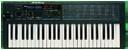
I'm afraid nothing of this is available on Poly 800, so the best we can do is to use two DCOs, square waveforms, strong detuning, max filter resonance, and chorus on... Envelopes with no attack and long release. And play wide dissonant chord, like C - E - Bb - F#.
What you offer concerning tuning individual voices in DCOs is not possible.
Daniel Forro
I was wondering if there is a way to create some kind of decent bell sound with only 2 DCO we have in Poly 800. I ran across some papers telling one'd need six or more voices with frequencies like 0.5F, 1.2F, 1.5F, 2F, 2.5F and a simple envelope with sharp attack and long decay.
So I was just curious, if every DCO has 4 voice polyphony, perhaps there could be a way to tune/detune 8 of them in both DCOs to those frequencies? Yes, there will be no more polyphony, but for a bell sound it should not be that important.