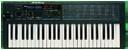
Archive of the former Yahoo!Groups mailing list: Korg Poly800/EX800 Users

previous by date index next by date
previous in topic topic list next in topic

Subject: Re: [korgpolyex] Re: Arpeggiator for HAWK-800

From: Michael Hawkins <korgpolyex800@...>
Date: 2009-04-30

99 USD gets you the HAWK-800 and all of the features that come along with it.

There is also the AtomaHawk for 29 USD which gets you parameter control of the Moog Slayer, FM-800 and 12/24db /octave filter mods.

Check it all out at www.hawk800.com

Mike


From: Frequency Spectrum <freqspec@...>
To: korgpolyex@yahoogroups.com
Sent: Wednesday, April 29, 2009 7:18:51 PM
Subject: Re: [korgpolyex] Re: Arpeggiator for HAWK-800

 How much is one of these kits going to cost for my mk2?


On Wed, Apr 29, 2009 at 4:23 PM, korgpolyex800 <korgpolyex800@ yahoo.com> wrote:


LOL, that's pretty funny that you should ask for something that is not only difficult - but in actuality, damn near impossible. ROFL.

But since you asked in jest and since I am as high as a kite on Benadryl to stop my ugly allergies and also since I have been listening to Solarfields Brainbow and other incredibly uplifting trance tracks. And what's more, since I have cleaned my office top to bottom and the weather is fantastic - well, here is a little off topic rant that I hope you all enjoy.

First of all, the Arpeggiator is going to be clocked by MIDI or the built in sequencer so you can always vary the ARP rate by changing either of those clocks. But I am assuming that you wanted to vary the rate in the sense that you want to modulate the clock rate. Say, by sending an LFO into the clock rate in order to modulate it. Now that is the kind of question that makes my head go off in all directions.

But thankfully, before that happened, I received a great article - at just the right moment - about the history of software programming and all of the problems that go with it.

http://www.computer world.com/ action/article. do?command= viewArticleBasic&taxonomyName= Development&articleId=9132061&taxonomyId=11&pageNumber=1

And boy did I get a laugh reading through that article, because just about everything it mentions has been a big factor in the last two years of programming the HAWK-800. You have to keep in mind that the Poly 800 is based on the 80C85 microprocessor and I didn't want to buy a C compiler, and also there was a free 8085 assembler out there called TASM - well, I ended up doing this entire project using assembler. Which seemed like it would be fun (and difficult) at the time I chose that direction but since I had also found a free disassembler that I was able to put the original ROM code through - well, here we are - two years later and a lot of spaghetti code has been produced which actually does the job rather nicely but - well, to be honest, maintaining the new code has been a lesson in programming that I never thought I would experience. Certainly not in the year 2009! The last time I wrote any assembler at all was around 1994 and even then I wrote awful code!

So then what's this all about you say. Well, in my own silly way I just had to have a laugh thinking about how mad crazy this project really is and has been the whole time. But dang! if I didn't have the most awesome time doing all of this and I frankly don't mind if the only thing I am remembered for in the wider world after I'm gone is that I was mad enough, crazy enough and or stupid enough to have created a kit that so far only about 30 people have gained benefit from. And that, even then, the HAWK-800 kit is just an enhancement to a synthesizer that is widely considered to be one of the cheapest (because it was) pieces of crap masquerading as a real synthesizer.

The irony, oh the irony of it all is that probably even this kit won't be remembered at all and the only benefit from most of this work is that I can honestly say that I learned more about programming and more about the wizardry of sound synthesis and then made not a single a buck out of it but did just have a wonderful time doing it. And so it really isn't about the destination, it's the journey that matters after all.

Anyway, for those of you who managed to read this far and were hoping for a wider or more poignant point - I hate to say it - but there isn't one. Consider yourself to be Rick Rolled! LOL

Now back to this ARP thing.

Cheers all!

Mike.


--- In korgpolyex@yahoogro ups.com, Frequency Spectrum <freqspec@...> wrote:
>
> any chance of having a swing rate included.
> If so i would buy the mod for my mk2
>
> Im only joking this would be very difficult i suspect.
>
>
>
>
> On Mon, Apr 27, 2009 at 9:00 PM, patrioticduo <patrioticduo@ ...>wrote:

>
> >
> >
> > Hi Poly fans,
> >
> > I am in the process of writing the code for an arpeggiator for the Poly.
> >
> > I have a couple of questions since I've not used an arp for some time and
> > also, I want to make the ARP unique in its functions compared to other
> > ARP's.
> >
> > What does everybody think about the following ARP features?
> >
> > In ARP mode, the display will show "A" (replacing the "P") and only Poly
> > mode is supported when in ARP mode. You select ARP mode by holding down the
> > "Poly" button and then pressing the Seq. Start button. This makes it very
> > easy to get into ARP mode for performances. To exit ARP mode, simply press
> > the sequencer start/stop button again.
> >
> > In ARP mode, any MIDI received notes or played notes will be inserted into
> > the arpeggiator buffer. The notes will not be immediately played but
> > instead, will be inserted into the arpeggiator such that the notes
> > will be played out in sequence according to the arpeggiator clock rate
> > (based upon either on board sequencer rate or MIDI clock rate). So if you
> > were to hit four notes at once then each one would be played out on
> > subsequent note ticks. The notes would be played out in order according to
> > the sweep mode.
> >
> > The arpeggiator user settings will be stored in global mode parameters and
> > will include the following:
> >
> > ARP_SWEEP - 1=Up, 2=Down, 3=Up/Down, 4=Down/Up, 5=FIFO, 6=random.
> > Up - plays the notes in an upward sweep.
> > Down - plays the notes in a downward sweep.
> > Up/Down - plays the notes in an initial upward sweep followed by a downward
> > sweep and thereupon repeats.
> > Down/Up - plays the notes in an initial downward sweep followed by an
> > upward sweep and thereupon repeats.
> > FIFO - plays the notes in the order in which they were originally played.
> > Random - plays the notes in random order.
> >
> > ARP_RANGE - 0=none, 1=1 octave, 2=2 octaves, 3=3 octaves.
> > 0 - plays only the notes that are played.
> > 1 - plays the played notes and the same notes one octave higher.
> > 2 - plays the played notes and the same notes one octave higher and one
> > octave lower.
> > 3 - plays the played notes along with one and two octaves higher and lower.
> >
> > ARP_DELAY - 1-64 = number of arp ticks to delay note off
> > ARP_FORSTEP - 0=off, 1 thru 128. On each arp tick skip forward this number
> > of arp notes.
> > ARP_BACKSTEP - 0=off, 1 thru 128. On each arp tick move backward this
> > number of arp notes
> > ARP_REST - 0=off, 1 thru 128. The number of arp notes to play before a rest
> > is played instead of the arp note.
> > ARP_SINGLE - 1=play the arpeggiator when 1 or more notes are played, 2=play
> > when 2 or more notes are played.
> >
> > Now, you can see that I am trying to make the ARP behave in a way that
> > allows for some funky stepping forward and backward as well as skipping on
> > sounding notes. What does everyone think of those features?
> >
> > Mike.
> >
> >
> >
>