Overview
Eml synthesizers
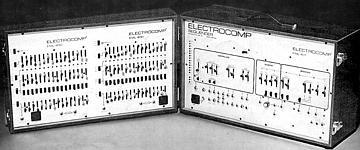
This is the place for discussion of EML / Electrocomp / Electronic Music Laboratories voltage controlled analog synthesizers, sequencers, and controllers. The products in this little modular and semi-modular synth line(out of business since 1984) were well built and designed to be simple and intuitive to play, they invite experimentation.
Join in and talk about patches, mods, trading, maintenance, related weblinks, artists and/or recordings, anything else pertaining to the EML electronic synthesizer , sequencer , and contoller and their history.
Posting of FS/FT/FA/WTB messages is restricted to EML items only, please.
If you have any relevant image files, text files, or schematics you'd like to share, by all means feel free to upload them. PDF and text type documents should be placed in the "Files" section.. JPEG and GIF image files should be stored in the "Photos" section. In both sections you can use the existing folders or create new ones.
Please feel free to post any interesting relevant links to EML or other vintage analog related gear in the Bookmarks section.
Looking in particular for more info and/or images about the following items to add to the files and photos sections:
The EML Electrocomp 100 (predecessor to the 101).
The EML "Black Box" (aka "The Black Monster").
EML custom made pieces.
Unusual modifications to the regular EML line.
Any other prototypes or unique EML pieces.
The "mystery mod boxes" (see photos and file sections here for details) are they really from EML?
- Members
- 234
- Created
- 2001-02-19
Search
Search this archive
Thread snapshot
Last 10 threads
- Yahoo groups going, going... (7 messages, 2019-10-28)
- Todd Barton- EMS VCS3 and EML 200 (5 messages, 2018-11-20)
- EML 200 electronic switch (4 messages, 2015-03-20)
- EML 500 documentation (5 messages, 2015-03-15)
- EML 200 pot replacement (7 messages, 2015-02-22)
- Correct or Incorrect - EML 100 OSC 3 waves? (3 messages, 2014-11-13)
- EML 400-401 replacement slider knobs (2 messages, 2014-10-04)
- EML 200 reverb help!! (3 messages, 2013-06-09)
- Improving the eml-101 envelopes (1 messages, 2013-03-24)
- EML diy (5 messages, 2013-02-18)