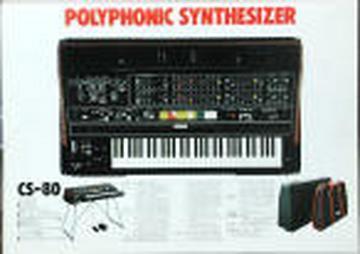
Yamaha CS80 group photo

Yahoo Groups archive

Yamaha CS80

Index last updated: 2026-03-31 01:50 UTC

Thread

CS80 touch reponse: mistery solved!!!

CS80 touch reponse: mistery solved!!!

2006-05-18 by Max Fazio

Hi guys
Just to share with you this fantastic discovery: I had a new look among the patents related to the GX1 and CS synthesizers and found u.s.pn 3636232 and u.s.pn 3784718 relating to the touch response cv circuit : the circuit acts as a double signal which encodes two types of signals going into the same output:

1. a so-called "touch responsive" signal which provides a cv on a level which could be both on amplitude and cutoff: the level isn't just flat but has a decay of 1.5 seconds and a peak slightly higher than the actual sustain level which becomes hearable when the level of the touch responsive signal surpasses the sustain-cutoff level.

2. a so-called "touch irresponsive" signal which provides a sharp AR envelope waveform which has a peak which is independent from the velocity and relates to the first , attack transient, providing a sharp , punchy amplitude cv to the controlled signal. Even though this AR envelope is able o raise its amplitude peak along with velocity

The combination of the two produces a combined cv that acts to give the long sought after "natural" touch response: the AR of the t.i. signal stays quiet under the touch responsive signal under acertain velocity value, then , with high velocities it can raise up to a level higher than the touch responsive signal then decaying down to the touch responsive signal ( for itself the t.i. signal decays to 0 but the combination of the two allows a kind of ADS(R) as the velocity's CV

This solves the mistery about my long debated "plucked" response on certain presets.
What do youthink of this discovery? could it be recreated as an encoder into a whatever keyboard??
M

[Non-text portions of this message have been removed]

Re: [yamahacs80] CS80 touch reponse: mistery solved!!!

2006-05-18 by laurie

Do you think this is there so you could overwrite a slow attack with
aftertouch prior to the decay sequence and is this vector based as in
+Change of CV is touch responsive and -Change of CV is touch
irresponsive.......

BTW....My girlfriend is exactly like this....When I touch her, her
response is to peak at a high amplitude before I get cutoff and then she
is in touch irrisponsive mode...with sharp punchy control....releasing
me to hang with the transients.... thats why I still hang on to the ol
eighty.....lol

Max Fazio wrote:

> Hi guys
> Just to share with you this fantastic discovery: I had a new look
> among the patents related to the GX1 and CS synthesizers and found
> u.s.pn 3636232 and u.s.pn 3784718 relating to the touch response cv
> circuit : the circuit acts as a double signal which encodes two types
> of signals going into the same output:
>
> 1. a so-called "touch responsive" signal which provides a cv on a
> level which could be both on amplitude and cutoff: the level isn't
> just flat but has a decay of 1.5 seconds and a peak slightly higher
> than the actual sustain level which becomes hearable when the level of
> the touch responsive signal surpasses the sustain-cutoff level.
>
> 2. a so-called "touch irresponsive" signal which provides a sharp AR
> envelope waveform which has a peak which is independent from the
> velocity and relates to the first , attack transient, providing a
> sharp , punchy amplitude cv to the controlled signal. Even though this
> AR envelope is able o raise its amplitude peak along with velocity
>
> The combination of the two produces a combined cv that acts to give
> the long sought after "natural" touch response: the AR of the t.i.
> signal stays quiet under the touch responsive signal under acertain
> velocity value, then , with high velocities it can raise up to a level
> higher than the touch responsive signal then decaying down to the
> touch responsive signal ( for itself the t.i. signal decays to 0 but
> the combination of the two allows a kind of ADS(R) as the velocity's
> CV
>
> This solves the mistery about my long debated "plucked" response on
> certain presets.
> What do youthink of this discovery? could it be recreated as an
> encoder into a whatever keyboard??
> M
>
> [Non-text portions of this message have been removed]
>
> -----------------------------------------------------------------------
> YAHOO! GROUPS LINKS
>
> + Visit your group "yamahacs80" on the web.
>
> + To unsubscribe from this group, send an email to:
> yamahacs80-unsubscribe@yahoogroups.com
>
> + Your use of Yahoo! Groups is subject to the Yahoo! Terms of
> Service.
>
> -----------------------------------------------------------------------
>


[Non-text portions of this message have been removed]

Re: [yamahacs80] CS80 touch reponse: mistery solved!!!

2006-05-19 by Max Fazio

Yeah, Laurie, a kind of!
You were right about your statement, actually, the implementations of the
touch response which came after the patents I mentioned ( mostly uspns
4018125 , 3816636 and 3626075 ) , reported a touch response as a derivative
function of the aftertouch , with FETs and OTAs combined to "sample" the
higest AT value you play on an estimated basis then keeping it and lowering
it to the velocity level value you set then havng the double advantage of a
sharp attack at high levels ( then also the "bump" when the waveform starts
to output ) which focuses also on the filters giving the piano or pluck
effect....

PS: My ex girlfriend loved aftertouch and varied pitch by sliding a finger
or two on her, you could start from 0Hz to high pitch.....happily she didn't
love velocity at all..... ;-)

M
----- Original Message -----
From: "laurie" <laurie@...>
To: <yamahacs80@yahoogroups.com>
Sent: Friday, May 19, 2006 1:41 AM
Subject: Re: [yamahacs80] CS80 touch reponse: mistery solved!!!


> Do you think this is there so you could overwrite a slow attack with
> aftertouch prior to the decay sequence and is this vector based as in
> +Change of CV is touch responsive and -Change of CV is touch
> irresponsive.......
>
> BTW....My girlfriend is exactly like this....When I touch her, her
> response is to peak at a high amplitude before I get cutoff and then she
> is in touch irrisponsive mode...with sharp punchy control....releasing
> me to hang with the transients.... thats why I still hang on to the ol
> eighty.....lol
>
> Max Fazio wrote:
>
> > Hi guys
> > Just to share with you this fantastic discovery: I had a new look
> > among the patents related to the GX1 and CS synthesizers and found
> > u.s.pn 3636232 and u.s.pn 3784718 relating to the touch response cv
> > circuit : the circuit acts as a double signal which encodes two types
> > of signals going into the same output:
> >
> > 1. a so-called "touch responsive" signal which provides a cv on a
> > level which could be both on amplitude and cutoff: the level isn't
> > just flat but has a decay of 1.5 seconds and a peak slightly higher
> > than the actual sustain level which becomes hearable when the level of
> > the touch responsive signal surpasses the sustain-cutoff level.
> >
> > 2. a so-called "touch irresponsive" signal which provides a sharp AR
> > envelope waveform which has a peak which is independent from the
> > velocity and relates to the first , attack transient, providing a
> > sharp , punchy amplitude cv to the controlled signal. Even though this
> > AR envelope is able o raise its amplitude peak along with velocity
> >
> > The combination of the two produces a combined cv that acts to give
> > the long sought after "natural" touch response: the AR of the t.i.
> > signal stays quiet under the touch responsive signal under acertain
> > velocity value, then , with high velocities it can raise up to a level
> > higher than the touch responsive signal then decaying down to the
> > touch responsive signal ( for itself the t.i. signal decays to 0 but
> > the combination of the two allows a kind of ADS(R) as the velocity's
> > CV
> >
> > This solves the mistery about my long debated "plucked" response on
> > certain presets.
> > What do youthink of this discovery? could it be recreated as an
> > encoder into a whatever keyboard??
> > M
> >
> > [Non-text portions of this message have been removed]
> >
> > -----------------------------------------------------------------------
> > YAHOO! GROUPS LINKS
> >
> > + Visit your group "yamahacs80" on the web.
> >
> > + To unsubscribe from this group, send an email to:
> > yamahacs80-unsubscribe@yahoogroups.com
> >
> > + Your use of Yahoo! Groups is subject to the Yahoo! Terms of
> > Service.
> >
> > -----------------------------------------------------------------------
> >
>
>
> [Non-text portions of this message have been removed]
>
>
>
>
>
> Yahoo! Groups Links
>
>
>
>
>
>

Re: [yamahacs80] CS80 touch reponse: mistery solved!!!

2006-05-19 by laurie

When you say this ,it makes sence to sample/hold the top most pressure
with one key......I find you can apply more pressure on a single key
than on a key within a chord as your strength gets more evenly
distributed across the hand with a chord....If the hold time didnt
exist, playing a loud melody and then adding notes in the same hand
would cause a drop in effect of the AT you are trying to maintain on
that note....Pretty clever but...
Is it possible to hit that "hard" velocity without causing some AT
happening......I thought when I pounded down to cause a high velocity
occurrence my inertia would add aftertouch briefly to the note causing
an extra amplification around the attack time....would this slight hold
of my initial AT be in play as the decay portion commences??? thus
causing the bump or is this circuit actually modifying the attack time
which is set with the envelope?????

BTW if you try to use too much single fingering on the G.F while in
irresponsive mode.......you end up with a lot of time for intimate full
hand clusters.....:o

Max Fazio wrote:

> Yeah, Laurie, a kind of!
> You were right about your statement, actually, the implementations of
> the
> touch response which came after the patents I mentioned ( mostly uspns
>
> 4018125 , 3816636 and 3626075 ) , reported a touch response as a
> derivative
> function of the aftertouch , with FETs and OTAs combined to "sample"
> the
> higest AT value you play on an estimated basis then keeping it and
> lowering
> it to the velocity level value you set then havng the double advantage
> of a
> sharp attack at high levels ( then also the "bump" when the waveform
> starts
> to output ) which focuses also on the filters giving the piano or
> pluck
> effect....
>
> PS: My ex girlfriend loved aftertouch and varied pitch by sliding a
> finger
> or two on her, you could start from 0Hz to high pitch.....happily she
> didn't
> love velocity at all..... ;-)
>
> M
> ----- Original Message -----
> From: "laurie" <laurie@...>
> To: <yamahacs80@yahoogroups.com>
> Sent: Friday, May 19, 2006 1:41 AM
> Subject: Re: [yamahacs80] CS80 touch reponse: mistery solved!!!
>
>
> > Do you think this is there so you could overwrite a slow attack with
>
> > aftertouch prior to the decay sequence and is this vector based as
> in
> > +Change of CV is touch responsive and -Change of CV is touch
> > irresponsive.......
> >
> > BTW....My girlfriend is exactly like this....When I touch her, her
> > response is to peak at a high amplitude before I get cutoff and then
> she
> > is in touch irrisponsive mode...with sharp punchy
> control....releasing
> > me to hang with the transients.... thats why I still hang on to the
> ol
> > eighty.....lol
> >
> > Max Fazio wrote:
> >
> > > Hi guys
> > > Just to share with you this fantastic discovery: I had a new look
> > > among the patents related to the GX1 and CS synthesizers and found
>
> > > u.s.pn 3636232 and u.s.pn 3784718 relating to the touch response
> cv
> > > circuit : the circuit acts as a double signal which encodes two
> types
> > > of signals going into the same output:
> > >
> > > 1. a so-called "touch responsive" signal which provides a cv on a
> > > level which could be both on amplitude and cutoff: the level isn't
>
> > > just flat but has a decay of 1.5 seconds and a peak slightly
> higher
> > > than the actual sustain level which becomes hearable when the
> level of
> > > the touch responsive signal surpasses the sustain-cutoff level.
> > >
> > > 2. a so-called "touch irresponsive" signal which provides a sharp
> AR
> > > envelope waveform which has a peak which is independent from the
> > > velocity and relates to the first , attack transient, providing a
> > > sharp , punchy amplitude cv to the controlled signal. Even though
> this
> > > AR envelope is able o raise its amplitude peak along with
> velocity
> > >
> > > The combination of the two produces a combined cv that acts to
> give
> > > the long sought after "natural" touch response: the AR of the t.i.
>
> > > signal stays quiet under the touch responsive signal under
> acertain
> > > velocity value, then , with high velocities it can raise up to a
> level
> > > higher than the touch responsive signal then decaying down to the
> > > touch responsive signal ( for itself the t.i. signal decays to 0
> but
> > > the combination of the two allows a kind of ADS(R) as the
> velocity's
> > > CV
> > >
> > > This solves the mistery about my long debated "plucked" response
> on
> > > certain presets.
> > > What do youthink of this discovery? could it be recreated as an
> > > encoder into a whatever keyboard??
> > > M
> > >
> > > [Non-text portions of this message have been removed]
> > >
> > >
> -----------------------------------------------------------------------
>
> > > YAHOO! GROUPS LINKS
> > >
> > > + Visit your group "yamahacs80" on the web.
> > >
> > > + To unsubscribe from this group, send an email to:
> > > yamahacs80-unsubscribe@yahoogroups.com
> > >
> > > + Your use of Yahoo! Groups is subject to the Yahoo! Terms of
> > > Service.
> > >
> > >
> -----------------------------------------------------------------------
>
> > >
> >
> >
> > [Non-text portions of this message have been removed]
> >
> >
> >
> >
> >
> > Yahoo! Groups Links
> >
> >
> >
> >
> >
> >
>
>
>
> SPONSORED LINKS
>
Music sampler Unit Sampler

> -----------------------------------------------------------------------
> YAHOO! GROUPS LINKS
>
> + Visit your group "yamahacs80" on the web.
>
> + To unsubscribe from this group, send an email to:
> yamahacs80-unsubscribe@yahoogroups.com
>
> + Your use of Yahoo! Groups is subject to the Yahoo! Terms of
> Service.
>
> -----------------------------------------------------------------------
>


[Non-text portions of this message have been removed]

Re: [yamahacs80] CS80 touch reponse: mistery solved!!!

2006-05-19 by laurie

Is that because it is accessible from behind???or if you trim her you
can give her more juice???

Max Fazio wrote:

> ...and , what I like the most is her external input.......!
> M
> ----- Original Message -----
> From: "laurie" <laurie@...>
> To: <yamahacs80@yahoogroups.com>
> Sent: Friday, May 19, 2006 3:49 PM
> Subject: Re: [yamahacs80] CS80 touch reponse: mistery solved!!!
>
>
> > When you say this ,it makes sence to sample/hold the top most
> pressure
> > with one key......I find you can apply more pressure on a single key
>
> > than on a key within a chord as your strength gets more evenly
> > distributed across the hand with a chord....If the hold time didnt
> > exist, playing a loud melody and then adding notes in the same hand
> > would cause a drop in effect of the AT you are trying to maintain on
>
> > that note....Pretty clever but...
> > Is it possible to hit that "hard" velocity without causing some AT
> > happening......I thought when I pounded down to cause a high
> velocity
> > occurrence my inertia would add aftertouch briefly to the note
> causing
> > an extra amplification around the attack time....would this slight
> hold
> > of my initial AT be in play as the decay portion commences??? thus
> > causing the bump or is this circuit actually modifying the attack
> time
> > which is set with the envelope?????
> >
> > BTW if you try to use too much single fingering on the G.F while in
> > irresponsive mode.......you end up with a lot of time for intimate
> full
> > hand clusters.....:o
> >
> > Max Fazio wrote:
> >
> > > Yeah, Laurie, a kind of!
> > > You were right about your statement, actually, the implementations
> of
> > > the
> > > touch response which came after the patents I mentioned ( mostly
> uspns
> > >
> > > 4018125 , 3816636 and 3626075 ) , reported a touch response as a
> > > derivative
> > > function of the aftertouch , with FETs and OTAs combined to
> "sample"
> > > the
> > > higest AT value you play on an estimated basis then keeping it and
>
> > > lowering
> > > it to the velocity level value you set then havng the double
> advantage
> > > of a
> > > sharp attack at high levels ( then also the "bump" when the
> waveform
> > > starts
> > > to output ) which focuses also on the filters giving the piano or
> > > pluck
> > > effect....
> > >
> > > PS: My ex girlfriend loved aftertouch and varied pitch by sliding
> a
> > > finger
> > > or two on her, you could start from 0Hz to high pitch.....happily
> she
> > > didn't
> > > love velocity at all..... ;-)
> > >
> > > M
> > > ----- Original Message -----
> > > From: "laurie" <laurie@...>
> > > To: <yamahacs80@yahoogroups.com>
> > > Sent: Friday, May 19, 2006 1:41 AM
> > > Subject: Re: [yamahacs80] CS80 touch reponse: mistery solved!!!
> > >
> > >
> > > > Do you think this is there so you could overwrite a slow attack
> with
> > >
> > > > aftertouch prior to the decay sequence and is this vector based
> as
> > > in
> > > > +Change of CV is touch responsive and -Change of CV is touch
> > > > irresponsive.......
> > > >
> > > > BTW....My girlfriend is exactly like this....When I touch her,
> her
> > > > response is to peak at a high amplitude before I get cutoff and
> then
> > > she
> > > > is in touch irrisponsive mode...with sharp punchy
> > > control....releasing
> > > > me to hang with the transients.... thats why I still hang on to
> the
> > > ol
> > > > eighty.....lol
> > > >
> > > > Max Fazio wrote:
> > > >
> > > > > Hi guys
> > > > > Just to share with you this fantastic discovery: I had a new
> look
> > > > > among the patents related to the GX1 and CS synthesizers and
> found
> > >
> > > > > u.s.pn 3636232 and u.s.pn 3784718 relating to the touch
> response
> > > cv
> > > > > circuit : the circuit acts as a double signal which encodes
> two
> > > types
> > > > > of signals going into the same output:
> > > > >
> > > > > 1. a so-called "touch responsive" signal which provides a cv
> on a
> > > > > level which could be both on amplitude and cutoff: the level
> isn't
> > >
> > > > > just flat but has a decay of 1.5 seconds and a peak slightly
> > > higher
> > > > > than the actual sustain level which becomes hearable when the
> > > level of
> > > > > the touch responsive signal surpasses the sustain-cutoff
> level.
> > > > >
> > > > > 2. a so-called "touch irresponsive" signal which provides a
> sharp
> > > AR
> > > > > envelope waveform which has a peak which is independent from
> the
> > > > > velocity and relates to the first , attack transient,
> providing a
> > > > > sharp , punchy amplitude cv to the controlled signal. Even
> though
> > > this
> > > > > AR envelope is able o raise its amplitude peak along with
> > > velocity
> > > > >
> > > > > The combination of the two produces a combined cv that acts to
>
> > > give
> > > > > the long sought after "natural" touch response: the AR of the
> t.i.
> > >
> > > > > signal stays quiet under the touch responsive signal under
> > > acertain
> > > > > velocity value, then , with high velocities it can raise up to
> a
> > > level
> > > > > higher than the touch responsive signal then decaying down to
> the
> > > > > touch responsive signal ( for itself the t.i. signal decays to
> 0
> > > but
> > > > > the combination of the two allows a kind of ADS(R) as the
> > > velocity's
> > > > > CV
> > > > >
> > > > > This solves the mistery about my long debated "plucked"
> response
> > > on
> > > > > certain presets.
> > > > > What do youthink of this discovery? could it be recreated as
> an
> > > > > encoder into a whatever keyboard??
> > > > > M
> > > > >
> > > > > [Non-text portions of this message have been removed]
> > > > >
> > > > >
> > >
> -----------------------------------------------------------------------
>
> > >
> > > > > YAHOO! GROUPS LINKS
> > > > >
> > > > > + Visit your group "yamahacs80" on the web.
> > > > >
> > > > > + To unsubscribe from this group, send an email to:
> > > > > yamahacs80-unsubscribe@yahoogroups.com
> > > > >
> > > > > + Your use of Yahoo! Groups is subject to the Yahoo! Terms
> of
> > > > > Service.
> > > > >
> > > > >
> > >
> -----------------------------------------------------------------------
>
> > >
> > > > >
> > > >
> > > >
> > > > [Non-text portions of this message have been removed]
> > > >
> > > >
> > > >
> > > >
> > > >
> > > > Yahoo! Groups Links
> > > >
> > > >
> > > >
> > > >
> > > >
> > > >
> > >
> > >
> > >
> > > SPONSORED LINKS
> > >
> > Music sampler Unit Sampler
> >
> > >
> -----------------------------------------------------------------------
>
> > > YAHOO! GROUPS LINKS
> > >
> > > + Visit your group "yamahacs80" on the web.
> > >
> > > + To unsubscribe from this group, send an email to:
> > > yamahacs80-unsubscribe@yahoogroups.com
> > >
> > > + Your use of Yahoo! Groups is subject to the Yahoo! Terms of
> > > Service.
> > >
> > >
> -----------------------------------------------------------------------
>
> > >
> >
> >
> > [Non-text portions of this message have been removed]
> >
> >
> >
> >
> >
> > Yahoo! Groups Links
> >
> >
> >
> >
> >
> >
> >
>
>
> SPONSORED LINKS
>
Music sampler Unit Sampler

> -----------------------------------------------------------------------
> YAHOO! GROUPS LINKS
>
> + Visit your group "yamahacs80" on the web.
>
> + To unsubscribe from this group, send an email to:
> yamahacs80-unsubscribe@yahoogroups.com
>
> + Your use of Yahoo! Groups is subject to the Yahoo! Terms of
> Service.
>
> -----------------------------------------------------------------------
>


[Non-text portions of this message have been removed]

Re: [yamahacs80] CS80 touch reponse: mistery solved!!!

2006-05-19 by laurie

my apologies.......I am a road pig and so is the ol 80.....

David Rogoff wrote:

> Max Fazio wrote:
> > ...and , what I like the most is her
> ok guys - enough. Back to Max's original topic...
>
>
> --
> No virus found in this outgoing message.
> Checked by AVG Free Edition.
> Version: 7.1.392 / Virus Database: 268.6.1/344 - Release Date:
> 5/19/2006
>
>
>
> SPONSORED LINKS
>
Music sampler Unit Sampler

> -----------------------------------------------------------------------
> YAHOO! GROUPS LINKS
>
> + Visit your group "yamahacs80" on the web.
>
> + To unsubscribe from this group, send an email to:
> yamahacs80-unsubscribe@yahoogroups.com
>
> + Your use of Yahoo! Groups is subject to the Yahoo! Terms of
> Service.
>
> -----------------------------------------------------------------------
>


[Non-text portions of this message have been removed]

Re: [yamahacs80] CS80 touch reponse: mistery solved!!!

2006-05-20 by Max Fazio

OK....just to say you can enjoy yourself with a synth like the CS80 almost
the same way you could do with a human!!!!
Apologies from me too....
----- Original Message -----
From: "Max Fazio" <faxiomas@...>
To: <yamahacs80@yahoogroups.com>
Sent: Friday, May 19, 2006 8:13 PM
Subject: Re: [yamahacs80] CS80 touch reponse: mistery solved!!!


> ...and , what I like the most is her external input.......!
> M
> ----- Original Message -----
> From: "laurie" <laurie@...>
> To: <yamahacs80@yahoogroups.com>
> Sent: Friday, May 19, 2006 3:49 PM
> Subject: Re: [yamahacs80] CS80 touch reponse: mistery solved!!!
>
>
> > When you say this ,it makes sence to sample/hold the top most pressure
> > with one key......I find you can apply more pressure on a single key
> > than on a key within a chord as your strength gets more evenly
> > distributed across the hand with a chord....If the hold time didnt
> > exist, playing a loud melody and then adding notes in the same hand
> > would cause a drop in effect of the AT you are trying to maintain on
> > that note....Pretty clever but...
> > Is it possible to hit that "hard" velocity without causing some AT
> > happening......I thought when I pounded down to cause a high velocity
> > occurrence my inertia would add aftertouch briefly to the note causing
> > an extra amplification around the attack time....would this slight hold
> > of my initial AT be in play as the decay portion commences??? thus
> > causing the bump or is this circuit actually modifying the attack time
> > which is set with the envelope?????
> >
> > BTW if you try to use too much single fingering on the G.F while in
> > irresponsive mode.......you end up with a lot of time for intimate full
> > hand clusters.....:o
> >
> > Max Fazio wrote:
> >
> > > Yeah, Laurie, a kind of!
> > > You were right about your statement, actually, the implementations of
> > > the
> > > touch response which came after the patents I mentioned ( mostly uspns
> > >
> > > 4018125 , 3816636 and 3626075 ) , reported a touch response as a
> > > derivative
> > > function of the aftertouch , with FETs and OTAs combined to "sample"
> > > the
> > > higest AT value you play on an estimated basis then keeping it and
> > > lowering
> > > it to the velocity level value you set then havng the double advantage
> > > of a
> > > sharp attack at high levels ( then also the "bump" when the waveform
> > > starts
> > > to output ) which focuses also on the filters giving the piano or
> > > pluck
> > > effect....
> > >
> > > PS: My ex girlfriend loved aftertouch and varied pitch by sliding a
> > > finger
> > > or two on her, you could start from 0Hz to high pitch.....happily she
> > > didn't
> > > love velocity at all..... ;-)
> > >
> > > M
> > > ----- Original Message -----
> > > From: "laurie" <laurie@...>
> > > To: <yamahacs80@yahoogroups.com>
> > > Sent: Friday, May 19, 2006 1:41 AM
> > > Subject: Re: [yamahacs80] CS80 touch reponse: mistery solved!!!
> > >
> > >
> > > > Do you think this is there so you could overwrite a slow attack with
> > >
> > > > aftertouch prior to the decay sequence and is this vector based as
> > > in
> > > > +Change of CV is touch responsive and -Change of CV is touch
> > > > irresponsive.......
> > > >
> > > > BTW....My girlfriend is exactly like this....When I touch her, her
> > > > response is to peak at a high amplitude before I get cutoff and then
> > > she
> > > > is in touch irrisponsive mode...with sharp punchy
> > > control....releasing
> > > > me to hang with the transients.... thats why I still hang on to the
> > > ol
> > > > eighty.....lol
> > > >
> > > > Max Fazio wrote:
> > > >
> > > > > Hi guys
> > > > > Just to share with you this fantastic discovery: I had a new look
> > > > > among the patents related to the GX1 and CS synthesizers and found
> > >
> > > > > u.s.pn 3636232 and u.s.pn 3784718 relating to the touch response
> > > cv
> > > > > circuit : the circuit acts as a double signal which encodes two
> > > types
> > > > > of signals going into the same output:
> > > > >
> > > > > 1. a so-called "touch responsive" signal which provides a cv on a
> > > > > level which could be both on amplitude and cutoff: the level isn't
> > >
> > > > > just flat but has a decay of 1.5 seconds and a peak slightly
> > > higher
> > > > > than the actual sustain level which becomes hearable when the
> > > level of
> > > > > the touch responsive signal surpasses the sustain-cutoff level.
> > > > >
> > > > > 2. a so-called "touch irresponsive" signal which provides a sharp
> > > AR
> > > > > envelope waveform which has a peak which is independent from the
> > > > > velocity and relates to the first , attack transient, providing a
> > > > > sharp , punchy amplitude cv to the controlled signal. Even though
> > > this
> > > > > AR envelope is able o raise its amplitude peak along with
> > > velocity
> > > > >
> > > > > The combination of the two produces a combined cv that acts to
> > > give
> > > > > the long sought after "natural" touch response: the AR of the t.i.
> > >
> > > > > signal stays quiet under the touch responsive signal under
> > > acertain
> > > > > velocity value, then , with high velocities it can raise up to a
> > > level
> > > > > higher than the touch responsive signal then decaying down to the
> > > > > touch responsive signal ( for itself the t.i. signal decays to 0
> > > but
> > > > > the combination of the two allows a kind of ADS(R) as the
> > > velocity's
> > > > > CV
> > > > >
> > > > > This solves the mistery about my long debated "plucked" response
> > > on
> > > > > certain presets.
> > > > > What do youthink of this discovery? could it be recreated as an
> > > > > encoder into a whatever keyboard??
> > > > > M
> > > > >
> > > > > [Non-text portions of this message have been removed]
> > > > >
> > > > >
> >
> -----------------------------------------------------------------------
> > >
> > > > > YAHOO! GROUPS LINKS
> > > > >
> > > > > + Visit your group "yamahacs80" on the web.
> > > > >
> > > > > + To unsubscribe from this group, send an email to:
> > > > > yamahacs80-unsubscribe@yahoogroups.com
> > > > >
> > > > > + Your use of Yahoo! Groups is subject to the Yahoo! Terms of
> > > > > Service.
> > > > >
> > > > >
> >
> -----------------------------------------------------------------------
> > >
> > > > >
> > > >
> > > >
> > > > [Non-text portions of this message have been removed]
> > > >
> > > >
> > > >
> > > >
> > > >
> > > > Yahoo! Groups Links
> > > >
> > > >
> > > >
> > > >
> > > >
> > > >
> > >
> > >
> > >
> > > SPONSORED LINKS
> > >
> > Music sampler Unit Sampler
> >
> >
> -----------------------------------------------------------------------
> > > YAHOO! GROUPS LINKS
> > >
> > > + Visit your group "yamahacs80" on the web.
> > >
> > > + To unsubscribe from this group, send an email to:
> > > yamahacs80-unsubscribe@yahoogroups.com
> > >
> > > + Your use of Yahoo! Groups is subject to the Yahoo! Terms of
> > > Service.
> > >
> >
> -----------------------------------------------------------------------
> > >
> >
> >
> > [Non-text portions of this message have been removed]
> >
> >
> >
> >
> >
> > Yahoo! Groups Links
> >
> >
> >
> >
> >
> >
> >
>
>
>
>
> Yahoo! Groups Links
>
>
>
>
>
>