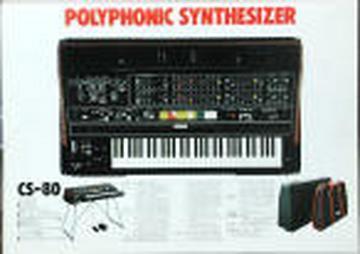
Yamaha CS80 group photo

Yahoo Groups archive

Yamaha CS80

Index last updated: 2026-04-02 22:17 UTC

Thread

My own CS-80

My own CS-80

2011-02-20 by effegee

Hi. I'm new here. I just acquired a CS-80 that originally belonged to Oscar Peterson, who sold it when he put together a Synclavier system. The guy I bought it from has played on records for Bon Jovi, Aerosmith, the Cult, Scorpions, etc. He had the CS-80 for 16 years, keeping it in the studio and storage, and never once had it tuned. I'm amazed, because the tuning sounds great. There is one dead (or barely audible) voice on Ch. I, but everything else seems in working order, and it sounds great. This is the first CS-80 I've ever played and I'm having fun exploring is sonic and expressive possibilities. I'm planning on having a synth tech a few hours away in Seattle work on the dead voice and tune it, and I'm looking at having the Kenton MIDI installed (though I don't know how I feel about drilling into the beautiful front panel to install switches-- we'll see).

I also own an Arp 2600, the internals of which I had overhauled by an Arp specialist (Cirocco). When I go it, the Arp's enclosure was so water damaged and the hinges & corners so rusted that I had to have a new enclosure made for it. Fortunately I have a woodworking friend who replicated the original enclosure out of plywood and I tolexed it (using the old tolex as a pattern), and put on the corner/hinges/handle hardware, hand-setting every rivet. That was a huge, weeks-long project, but I learned a lot about tolex, rivets, hard-to-find case hardware, and people that shamelessly lie to you on eBay about what they're selling you. In the end, I have the most mint (if not original) cases for an Arp 2600 in existence. If only it could hold it's tuning as well as the CS-80…

So, back to the CS-80: I'm somewhat concerned. With all of the reading I've done here and on the net about replacing parts, etc., I feel like I'm sitting on a time bomb. Is my CS-80 going to just stop working one day? I understand that there are aging components, but I don't know what I need to do right now for a unit that seems to be functioning well. It seems that I should have the power supply refurbished (Circuit Solutions kit) based on what others have written, but what about the other stuff? Should I wait until something breaks before I have it fixed? Or is there potential for worse damage if I don't do something now? I want to do what's best, yet avoid overkill.

I'm glad to be here. Thanks for letting me share.

Doug

Re: [yamahacs80] My own CS-80

2011-02-20 by Max Fazio

Hi Effegee, welcome to the Group!

So, back to the CS-80: I'm somewhat concerned. With all of the reading I've done here and on the net about replacing parts, etc., I feel like I'm
sitting on a time bomb. Is my CS-80 going to just stop working one day?

As all things "organic"...it will surely be one day :-(


I understand that there are aging components, but I don't know what I need to do right now for a unit that seems to be functioning well. It seems that I should have the power supply refurbished (Circuit Solutions kit) based on what others have written, but what about the other stuff? Should I wait until something breaks before I have it fixed? Or is there potential for worse damage if I don't do something now? I want to do what's best, yet avoid overkill.

You can do a thorough check on all the CMOS chips in the machine, there is plenty of them inside; the good news are these are common components you can find pretty anywhere they sell electronic components; also look at the soldering and the state of the cables; custom chips are robust so they are not too compromised by age going on, anyway go look after any sale of things CS related, especially the rare levers; except for the custom chips there is common electronic circuitry inside the machine...so enjoy !

M


----- Original Message -----
Show quoted textHide quoted text
From: effegee
To: yamahacs80@yahoogroups.com
Sent: Sunday, February 20, 2011 8:42 AM
Subject: [yamahacs80] My own CS-80


Hi. I'm new here. I just acquired a CS-80 that originally belonged to Oscar Peterson, who sold it when he put together a Synclavier system. The guy I bought it from has played on records for Bon Jovi, Aerosmith, the Cult, Scorpions, etc. He had the CS-80 for 16 years, keeping it in the studio and storage, and never once had it tuned. I'm amazed, because the tuning sounds great. There is one dead (or barely audible) voice on Ch. I, but everything else seems in working order, and it sounds great. This is the first CS-80 I've ever played and I'm having fun exploring is sonic and expressive possibilities. I'm planning on having a synth tech a few hours away in Seattle work on the dead voice and tune it, and I'm looking at having the Kenton MIDI installed (though I don't know how I feel about drilling into the beautiful front panel to install switches-- we'll see).

I also own an Arp 2600, the internals of which I had overhauled by an Arp specialist (Cirocco). When I go it, the Arp's enclosure was so water damaged and the hinges & corners so rusted that I had to have a new enclosure made for it. Fortunately I have a woodworking friend who replicated the original enclosure out of plywood and I tolexed it (using the old tolex as a pattern), and put on the corner/hinges/handle hardware, hand-setting every rivet. That was a huge, weeks-long project, but I learned a lot about tolex, rivets, hard-to-find case hardware, and people that shamelessly lie to you on eBay about what they're selling you. In the end, I have the most mint (if not original) cases for an Arp 2600 in existence. If only it could hold it's tuning as well as the CS-80.

So, back to the CS-80: I'm somewhat concerned. With all of the reading I've done here and on the net about replacing parts, etc., I feel like I'm sitting on a time bomb. Is my CS-80 going to just stop working one day? I understand that there are aging components, but I don't know what I need to do right now for a unit that seems to be functioning well. It seems that I should have the power supply refurbished (Circuit Solutions kit) based on what others have written, but what about the other stuff? Should I wait until something breaks before I have it fixed? Or is there potential for worse damage if I don't do something now? I want to do what's best, yet avoid overkill.

I'm glad to be here. Thanks for letting me share.

Doug


[Non-text portions of this message have been removed]

Re: [yamahacs80] My own CS-80

2011-02-20 by Csaba Zvekan

Hi Doug,

Long story short : if you are pretty good with the soldering iron I
would start replacing the 4000 series CMOS chips , make sockets and
put additional bypass capacitors. Replace systematically all
capacitors starting with the power supply. That way you could rest a
sure that the Yamaha custom chips are a bit out of the danger zone.
How ever this is not a ten minutes job . Take your time as it is
worth the work and effort. If you have questions we are glad to help
you.

Kind Regards

Csaba Zvekan


Show quoted textHide quoted text
On Feb 20, 2011, at 8:42 AM, effegee wrote:

> Hi. I'm new here. I just acquired a CS-80 that originally belonged
> to Oscar Peterson, who sold it when he put together a Synclavier
> system. The guy I bought it from has played on records for Bon
> Jovi, Aerosmith, the Cult, Scorpions, etc. He had the CS-80 for 16
> years, keeping it in the studio and storage, and never once had it
> tuned. I'm amazed, because the tuning sounds great. There is one
> dead (or barely audible) voice on Ch. I, but everything else seems
> in working order, and it sounds great. This is the first CS-80 I've
> ever played and I'm having fun exploring is sonic and expressive
> possibilities. I'm planning on having a synth tech a few hours away
> in Seattle work on the dead voice and tune it, and I'm looking at
> having the Kenton MIDI installed (though I don't know how I feel
> about drilling into the beautiful front panel to install switches--
> we'll see).
>
> I also own an Arp 2600, the internals of which I had overhauled by
> an Arp specialist (Cirocco). When I go it, the Arp's enclosure was
> so water damaged and the hinges & corners so rusted that I had to
> have a new enclosure made for it. Fortunately I have a woodworking
> friend who replicated the original enclosure out of plywood and I
> tolexed it (using the old tolex as a pattern), and put on the
> corner/hinges/handle hardware, hand-setting every rivet. That was a
> huge, weeks-long project, but I learned a lot about tolex, rivets,
> hard-to-find case hardware, and people that shamelessly lie to you
> on eBay about what they're selling you. In the end, I have the most
> mint (if not original) cases for an Arp 2600 in existence. If only
> it could hold it's tuning as well as the CS-80�
>
> So, back to the CS-80: I'm somewhat concerned. With all of the
> reading I've done here and on the net about replacing parts, etc.,
> I feel like I'm sitting on a time bomb. Is my CS-80 going to just
> stop working one day? I understand that there are aging components,
> but I don't know what I need to do right now for a unit that seems
> to be functioning well. It seems that I should have the power
> supply refurbished (Circuit Solutions kit) based on what others
> have written, but what about the other stuff? Should I wait until
> something breaks before I have it fixed? Or is there potential for
> worse damage if I don't do something now? I want to do what's best,
> yet avoid overkill.
>
> I'm glad to be here. Thanks for letting me share.
>
> Doug
>
>


[Non-text portions of this message have been removed]

Re: My own CS-80

2011-02-20 by Quazimodo

Hey Max,
In my CS80's it's the custom chips that I have had the most problems with!! Up to now I have had 4 VCO chips and two VCF-EG chips blow. Many years ago I had a tantalum on one of the TSB boards go short (blowing a fuse every time a certain Bb key was hit... a real bugger to trace that was!)... and currently in one of my 80's I think I have a couple of VCO chips that don't scale perfectly during the tuning procedure. They work and play OK but are also probably on their way out...!?! Oh, and one preset bulb needed replacing...;c)

Cheers,
TOM


Show quoted textHide quoted text
--- In yamahacs80@yahoogroups.com, "Max Fazio" <faxiomas@...> wrote:
>
>... custom chips are robust so they are not too compromised by age going on,
>
> M
>
>

RE: Re: My own CS-80

2011-02-20 by Leslie Schwartz

On the specific point of tantalum IC decoupling caps, is there a consensus
to avoid them, as I have heard?

-----Original Message-----
From: yamahacs80@yahoogroups.com [mailto:yamahacs80@yahoogroups.com] On
Behalf Of Quazimodo
Sent: Sunday, February 20, 2011 10:06 AM
To: yamahacs80@yahoogroups.com
Subject: [yamahacs80] Re: My own CS-80

Hey Max,
In my CS80's it's the custom chips that I have had the most problems with!!
Up to now I have had 4 VCO chips and two VCF-EG chips blow. Many years ago I
had a tantalum on one of the TSB boards go short (blowing a fuse every time
a certain Bb key was hit... a real bugger to trace that was!)... and
currently in one of my 80's I think I have a couple of VCO chips that don't
scale perfectly during the tuning procedure. They work and play OK but are
also probably on their way out...!?! Oh, and one preset bulb needed
replacing...;c)

Cheers,
TOM


--- In yamahacs80@yahoogroups.com, "Max Fazio" <faxiomas@...> wrote:
>
>... custom chips are robust so they are not too compromised by age going
on,
>
> M
>
>


------------------------------------

Yahoo! Groups Links

Re: My own CS-80

2011-02-20 by Quazimodo

I think the YouTube series of videos on saving the CS80 - by Gavin Curtis - shows those tantalum capacitors replaced with non-polarised polystyrene caps.... can that be right, replacing polarized with non-polarized?

http://www.youtube.com/user/gavincurtis#p/u/4/h8BQ-y8Y1zU

Cheers,
TOM


Show quoted textHide quoted text
--- In yamahacs80@yahoogroups.com, "Leslie Schwartz" <lhs_emf@...> wrote:
>
> On the specific point of tantalum IC decoupling caps, is there a consensus
> to avoid them, as I have heard?
>

RE: Re: My own CS-80

2011-02-20 by Leslie Schwartz

I agree that the recommendation is puzzling to me too. I would have expected
that new polarized electrolytics would have been the type to use for a
replacement of the tantalums.

Good video though, and some more good info on CS-80 maintenance/repairs.
Thanks.

-----Original Message-----
From: yamahacs80@yahoogroups.com [mailto:yamahacs80@yahoogroups.com] On
Behalf Of Quazimodo
Sent: Sunday, February 20, 2011 10:31 AM
To: yamahacs80@yahoogroups.com
Subject: [yamahacs80] Re: My own CS-80

I think the YouTube series of videos on saving the CS80 - by Gavin Curtis -
shows those tantalum capacitors replaced with non-polarised polystyrene
caps.... can that be right, replacing polarized with non-polarized?

http://www.youtube.com/user/gavincurtis#p/u/4/h8BQ-y8Y1zU

Cheers,
TOM


--- In yamahacs80@yahoogroups.com, "Leslie Schwartz" <lhs_emf@...> wrote:
>
> On the specific point of tantalum IC decoupling caps, is there a consensus
> to avoid them, as I have heard?
>


------------------------------------

Yahoo! Groups Links

Re: [yamahacs80] My own CS-80

2011-02-20 by David Rogoff

> effegee <mailto:floobygoop@...>
> February 19, 2011 11:42 PM
>
>
> Hi. I'm new here. I just acquired a CS-80 ... I'm looking at having
> the Kenton MIDI installed (though I don't know how I feel about
> drilling into the beautiful front panel to install switches-- we'll see).
>
> So, back to the CS-80: I'm somewhat concerned. With all of the reading
> I've done here and on the net about replacing parts, etc., I feel like
> I'm sitting on a time bomb. Is my CS-80 going to just stop working one
> day? I understand that there are aging components, but I don't know
> what I need to do right now for a
Hi Doug. Welcome to the club! Just a quick note for now. First, I've
put in 4 Kenton MIDI kits. After the first one, I came up with my own
mounting method that put the switches and jack in the power-cord
compartment. No holes drilled anywhere on the outside of the keyboard!

Also, I think the CS80s should stay working for at least another 20
years given what I've seen on failures and availability of parts, so I
wouldn't worry much there. If you see a CS50 cheap (unfortunately
doesn't happen anymore), pick it up for spare parts!

David


[Non-text portions of this message have been removed]

Re: [yamahacs80] RE: Re: My own CS-80

2011-02-20 by David Rogoff

>
>
>
>
> ------------------------------------------------------------------------
>
> Leslie Schwartz <mailto:lhs_emf@...>
> February 20, 2011 8:55 AM
>
>
>
> I agree that the recommendation is puzzling to me too. I would have
> expected
> that new polarized electrolytics would have been the type to use for a
> replacement of the tantalums.
>
> Good video though, and some more good info on CS-80 maintenance/repairs.
> Thanks.
>
> -----Original Message-----
> From: yamahacs80@yahoogroups.com [mailto:yamahacs80@yahoogroups.com] On
> Behalf Of Quazimodo
> Sent: Sunday, February 20, 2011 10:31 AM
> To: yamahacs80@yahoogroups.com
> Subject: [yamahacs80] Re: My own CS-80
>
> I think the YouTube series of videos on saving the CS80 - by Gavin
> Curtis -
> shows those tantalum capacitors replaced with non-polarised polystyrene
> caps.... can that be right, replacing polarized with non-polarized?
> ------------------------------------------------------------------------
I haven't seen the videos, but a couple of general capacitor notes.
First, pretty much no one has used tantalums in many years now. They
were a way to get a high value in a very small package. However, they
turned out to be really flaky, especially if ever connected backwards.
There are much better replacements now. Also, there's nothing wrong
with using a non-polarized cap to replace a polarized one. Again,
polarized (e.g. tantalums - which can blow up, electrolytics - which dry
out and fail over the years) caps were a way to get a higher value in a
smaller package if you knew the voltage only would go one way - like in
a power supply.

I'll have to look into the polystyrene caps more, but if they have the
same capacitance value, voltage rating, and they're small enough
physically, they're probably a much better choice. They shouldn't dry
out like electrolytics. Non-polarized means you don't have to worry
about putting it in backwards. And, I'm sure they better in other ways
- better tolerance, lower ESR, etc that could make them perform better
in some applications.

David


[Non-text portions of this message have been removed]

RE: [yamahacs80] RE: Re: My own CS-80

2011-02-20 by Leslie Schwartz

Dave,

I appreciate the information and this is not a challenge, just an attempt to
follow up.

The fact that the tantalum was intended for DC bypass, appears not to
require a polarized cap? Again, it was my expectation that a polar cap would
be preferable in this application?

And of course all caps can eventually leak, and modern electrolytics appear
to have a better reputation for longevity and size to capacitance rations
than they did 25 years ago.

And as to sizing and precision of the capacitance spec, again I would think
the more capacitance the better in this application?

And comments and information is appreciated.

-----Original Message-----
From: yamahacs80@yahoogroups.com [mailto:yamahacs80@yahoogroups.com] On
Behalf Of David Rogoff
Sent: Sunday, February 20, 2011 11:48 AM
To: yamahacs80@yahoogroups.com
Subject: Re: [yamahacs80] RE: Re: My own CS-80

>
>
>
>
> ------------------------------------------------------------------------
>
> Leslie Schwartz <mailto:lhs_emf@...>
> February 20, 2011 8:55 AM
>
>
>
> I agree that the recommendation is puzzling to me too. I would have
> expected
> that new polarized electrolytics would have been the type to use for a
> replacement of the tantalums.
>
> Good video though, and some more good info on CS-80 maintenance/repairs.
> Thanks.
>
> -----Original Message-----
> From: yamahacs80@yahoogroups.com [mailto:yamahacs80@yahoogroups.com] On
> Behalf Of Quazimodo
> Sent: Sunday, February 20, 2011 10:31 AM
> To: yamahacs80@yahoogroups.com
> Subject: [yamahacs80] Re: My own CS-80
>
> I think the YouTube series of videos on saving the CS80 - by Gavin
> Curtis -
> shows those tantalum capacitors replaced with non-polarised polystyrene
> caps.... can that be right, replacing polarized with non-polarized?
> ------------------------------------------------------------------------
I haven't seen the videos, but a couple of general capacitor notes.
First, pretty much no one has used tantalums in many years now. They
were a way to get a high value in a very small package. However, they
turned out to be really flaky, especially if ever connected backwards.
There are much better replacements now. Also, there's nothing wrong
with using a non-polarized cap to replace a polarized one. Again,
polarized (e.g. tantalums - which can blow up, electrolytics - which dry
out and fail over the years) caps were a way to get a higher value in a
smaller package if you knew the voltage only would go one way - like in
a power supply.

I'll have to look into the polystyrene caps more, but if they have the
same capacitance value, voltage rating, and they're small enough
physically, they're probably a much better choice. They shouldn't dry
out like electrolytics. Non-polarized means you don't have to worry
about putting it in backwards. And, I'm sure they better in other ways
- better tolerance, lower ESR, etc that could make them perform better
in some applications.

David


[Non-text portions of this message have been removed]


------------------------------------

Yahoo! Groups Links

Re: [yamahacs80] My own CS-80

2011-02-20 by Laurie Curry

I have owned a CS80 since the early 80s....
The only problems I ever had was back in the 80's, trying to adjust one without the knowlege and support I have now...
any damage done to it, was done by my error and stupidity...I once burnt out a ground rail by trying a alternate pedal in the Volume pedal jack... Don't try that...
stick with the original pedal... or "(though I have not yet tried it) a yamaha fc7 volume pedal...
I have used on the road and studio ...as of yesterday, have tune up down to an hour now with my newly aquired tuner( korg pitchblack+) which goes to 0 .1 cent accuracy in focus mode and responds chromatically from 20 hz to almost 5 khz....perfect for tuning up the 2 foot and the 2 foot calibration.....I was gonna shell out more for a real strobe tuner, but they dont have the input range in their spec sheets...
I have never heard her so strong pitch wise.....
-----Original Message-----
From: effegee <floobygoop@...>
To: yamahacs80@yahoogroups.com
Date: 02/20/2011 01:42
Subject: [yamahacs80] My own CS-80


Hi. I'm new here. I just acquired a CS-80 that originally belonged to Oscar Peterson, who sold it when he put together a Synclavier system. The guy I bought it from has played on records for Bon Jovi, Aerosmith, the Cult, Scorpions, etc. He had the CS-80 for 16 years, keeping it in the studio and storage, and never once had it tuned. I'm amazed, because the tuning sounds great. There is one dead (or barely audible) voice on Ch. I, but everything else seems in working order, and it sounds great. This is the first CS-80 I've ever played and I'm having fun exploring is sonic and expressive possibilities. I'm planning on having a synth tech a few hours away in Seattle work on the dead voice and tune it, and I'm looking at having the Kenton MIDI installed (though I don't know how I feel about drilling into the beautiful front panel to install switches-- we'll see).

I also own an Arp 2600, the internals of which I had overhauled by an Arp specialist (Cirocco). When I go it, the Arp's enclosure was so water damaged and the hinges & corners so rusted that I had to have a new enclosure made for it. Fortunately I have a woodworking friend who replicated the original enclosure out of plywood and I tolexed it (using the old tolex as a pattern), and put on the corner/hinges/handle hardware, hand-setting every rivet. That was a huge, weeks-long project, but I learned a lot about tolex, rivets, hard-to-find case hardware, and people that shamelessly lie to you on eBay about what they're selling you. In the end, I have the most mint (if not original) cases for an Arp 2600 in existence. If only it could hold it's tuning as well as the CS-80…

So, back to the CS-80: I'm somewhat concerned. With all of the reading I've done here and on the net about replacing parts, etc., I feel like I'm sitting on a time bomb. Is my CS-80 going to just stop working one day? I understand that there are aging components, but I don't know what I need to do right now for a unit that seems to be functioning well. It seems that I should have the power supply refurbished (Circuit Solutions kit) based on what others have written, but what about the other stuff? Should I wait until something breaks before I have it fixed? Or is there potential for worse damage if I don't do something now? I want to do what's best, yet avoid overkill.

I'm glad to be here. Thanks for letting me share.

Doug


[Non-text portions of this message have been removed]

Re: [yamahacs80] My own CS-80

2011-02-21 by François Globensky

Welcome to you in this wonderful world of the CS, I'm not a great tech wiz like some folks here but i have my own and played it for a good while. But sadly now it's been in storage for some years. Anyways i thank everyone in this group for their input and their music and all.
Frank

--- En date de : Dim, 20.2.11, Laurie Curry <laurie@...> a écrit :


De : Laurie Curry <laurie@...>
Objet : Re: [yamahacs80] My own CS-80
À : yamahacs80@yahoogroups.com
Date: dimanche 20 février 2011 16 h 52


I have owned a CS80 since the early 80s....
The only problems I ever had was back in the 80's, trying to adjust one without the knowlege and support I have now...
any damage done to it, was done by my error and stupidity...I once burnt out a ground rail by trying a alternate pedal in the Volume pedal jack... Don't try that...
stick with the original pedal... or "(though I have not yet tried it) a yamaha fc7 volume pedal...
I have used on the road and studio ...as of yesterday, have tune up down to an hour now with my newly aquired tuner( korg pitchblack+) which goes to 0 .1 cent accuracy in focus mode and responds chromatically from 20 hz to almost 5 khz....perfect for tuning up the 2 foot and the 2 foot calibration.....I was gonna shell out more for a real strobe tuner, but they dont have the input range in their spec sheets...
I have never heard her so strong pitch wise.....
-----Original Message-----
From: effegee <floobygoop@...>
To: yamahacs80@yahoogroups.com
Date: 02/20/2011 01:42
Subject: [yamahacs80] My own CS-80

Hi. I'm new here. I just acquired a CS-80 that originally belonged to Oscar Peterson, who sold it when he put together a Synclavier system. The guy I bought it from has played on records for Bon Jovi, Aerosmith, the Cult, Scorpions, etc. He had the CS-80 for 16 years, keeping it in the studio and storage, and never once had it tuned. I'm amazed, because the tuning sounds great. There is one dead (or barely audible) voice on Ch. I, but everything else seems in working order, and it sounds great. This is the first CS-80 I've ever played and I'm having fun exploring is sonic and expressive possibilities. I'm planning on having a synth tech a few hours away in Seattle work on the dead voice and tune it, and I'm looking at having the Kenton MIDI installed (though I don't know how I feel about drilling into the beautiful front panel to install switches-- we'll see).

I also own an Arp 2600, the internals of which I had overhauled by an Arp specialist (Cirocco). When I go it, the Arp's enclosure was so water damaged and the hinges & corners so rusted that I had to have a new enclosure made for it. Fortunately I have a woodworking friend who replicated the original enclosure out of plywood and I tolexed it (using the old tolex as a pattern), and put on the corner/hinges/handle hardware, hand-setting every rivet. That was a huge, weeks-long project, but I learned a lot about tolex, rivets, hard-to-find case hardware, and people that shamelessly lie to you on eBay about what they're selling you. In the end, I have the most mint (if not original) cases for an Arp 2600 in existence. If only it could hold it's tuning as well as the CS-80…

So, back to the CS-80: I'm somewhat concerned. With all of the reading I've done here and on the net about replacing parts, etc., I feel like I'm sitting on a time bomb. Is my CS-80 going to just stop working one day? I understand that there are aging components, but I don't know what I need to do right now for a unit that seems to be functioning well. It seems that I should have the power supply refurbished (Circuit Solutions kit) based on what others have written, but what about the other stuff? Should I wait until something breaks before I have it fixed? Or is there potential for worse damage if I don't do something now? I want to do what's best, yet avoid overkill.

I'm glad to be here. Thanks for letting me share.

Doug

[Non-text portions of this message have been removed]


[Non-text portions of this message have been removed]

Re: My own CS-80

2011-02-21 by effegee

David,
I just saw your MIDI mod pics in the Photos section. Nice work! I much prefer your method as far as cosmetics go. Of course, my dream mod is to have some kind of external CV interface where you could jack into the VCF cutoff, resonance, etc., to be modulated from an external sequencer. I saw an Arp Odyssey on eBay once that had been moded with jacks on the front panel. Maybe with the 80, the jacks could be inside the memory compartment, hidden under the door. One can dream...

So, they're good for another 20 years, huh? Maybe virtual technology will advance to the point of truly replacing it by then. (Ok, no flame wars here!)

Oh, can someone tell me-- the serial number is 16XX, is that a later model?

Doug

Show quoted textHide quoted text
--- In yamahacs80@yahoogroups.com, David Rogoff <david@...> wrote:
>
> > effegee <mailto:floobygoop@...>
> > February 19, 2011 11:42 PM
> >
> >
> > Hi. I'm new here. I just acquired a CS-80 ... I'm looking at having
> > the Kenton MIDI installed (though I don't know how I feel about
> > drilling into the beautiful front panel to install switches-- we'll see).
> >
> > So, back to the CS-80: I'm somewhat concerned. With all of the reading
> > I've done here and on the net about replacing parts, etc., I feel like
> > I'm sitting on a time bomb. Is my CS-80 going to just stop working one
> > day? I understand that there are aging components, but I don't know
> > what I need to do right now for a
> Hi Doug. Welcome to the club! Just a quick note for now. First, I've
> put in 4 Kenton MIDI kits. After the first one, I came up with my own
> mounting method that put the switches and jack in the power-cord
> compartment. No holes drilled anywhere on the outside of the keyboard!
>
> Also, I think the CS80s should stay working for at least another 20
> years given what I've seen on failures and availability of parts, so I
> wouldn't worry much there. If you see a CS50 cheap (unfortunately
> doesn't happen anymore), pick it up for spare parts!
>
> David
>
>
> [Non-text portions of this message have been removed]
>

Re: My own CS-80

2011-02-23 by Mike

Those caps aren't DC bypass at all. They're functioning as a resistance capacitance time constant. The discharge speed of the cap value is what gives you your velocity intensity; the quicker you hit the key, the more charge that is transferred to the multiplexer. DON"T CHANGE THE VALUE!!

There's an argument that Tantalum has a very poor charge and discharge consistency... that's why he suggests Polystyrene. Also, polystyrene has a longer life expectancy. If you're a purist like me, and you think that the tantalum idiosyncrasies were what the designers intended, replace them with tantalum. Otherwise, Polystyrene would probably give you a more uniform attack throughout the keyboard.

The guy that posted those videos is doing an excellent job and knows his stuff.

Just for your info, tantalum caps are way more reliable now than the ones from the 70's.

Please don't mess with these things if you don't know what you are doing.

Show quoted textHide quoted text
--- In yamahacs80@yahoogroups.com, "Leslie Schwartz" <lhs_emf@...> wrote:
>
> Dave,
>
> I appreciate the information and this is not a challenge, just an attempt to
> follow up.
>
> The fact that the tantalum was intended for DC bypass, appears not to
> require a polarized cap? Again, it was my expectation that a polar cap would
> be preferable in this application?
>
> And of course all caps can eventually leak, and modern electrolytics appear
> to have a better reputation for longevity and size to capacitance rations
> than they did 25 years ago.
>
> And as to sizing and precision of the capacitance spec, again I would think
> the more capacitance the better in this application?
>
> And comments and information is appreciated.
>
> -----Original Message-----
> From: yamahacs80@yahoogroups.com [mailto:yamahacs80@yahoogroups.com] On
> Behalf Of David Rogoff
> Sent: Sunday, February 20, 2011 11:48 AM
> To: yamahacs80@yahoogroups.com
> Subject: Re: [yamahacs80] RE: Re: My own CS-80
>
> >
> >
> >
> >
> > ------------------------------------------------------------------------
> >
> > Leslie Schwartz <mailto:lhs_emf@...>
> > February 20, 2011 8:55 AM
> >
> >
> >
> > I agree that the recommendation is puzzling to me too. I would have
> > expected
> > that new polarized electrolytics would have been the type to use for a
> > replacement of the tantalums.
> >
> > Good video though, and some more good info on CS-80 maintenance/repairs.
> > Thanks.
> >
> > -----Original Message-----
> > From: yamahacs80@yahoogroups.com [mailto:yamahacs80@yahoogroups.com] On
> > Behalf Of Quazimodo
> > Sent: Sunday, February 20, 2011 10:31 AM
> > To: yamahacs80@yahoogroups.com
> > Subject: [yamahacs80] Re: My own CS-80
> >
> > I think the YouTube series of videos on saving the CS80 - by Gavin
> > Curtis -
> > shows those tantalum capacitors replaced with non-polarised polystyrene
> > caps.... can that be right, replacing polarized with non-polarized?
> > ------------------------------------------------------------------------
> I haven't seen the videos, but a couple of general capacitor notes.
> First, pretty much no one has used tantalums in many years now. They
> were a way to get a high value in a very small package. However, they
> turned out to be really flaky, especially if ever connected backwards.
> There are much better replacements now. Also, there's nothing wrong
> with using a non-polarized cap to replace a polarized one. Again,
> polarized (e.g. tantalums - which can blow up, electrolytics - which dry
> out and fail over the years) caps were a way to get a higher value in a
> smaller package if you knew the voltage only would go one way - like in
> a power supply.
>
> I'll have to look into the polystyrene caps more, but if they have the
> same capacitance value, voltage rating, and they're small enough
> physically, they're probably a much better choice. They shouldn't dry
> out like electrolytics. Non-polarized means you don't have to worry
> about putting it in backwards. And, I'm sure they better in other ways
> - better tolerance, lower ESR, etc that could make them perform better
> in some applications.
>
> David
>
>
> [Non-text portions of this message have been removed]
>
>
>
> ------------------------------------
>
> Yahoo! Groups Links
>

Re: My own CS-80

2011-02-23 by Leslie H Schwartz

I appreciate the information and I don't need or want the warning or lecture.

I agree with the approach that you don't change anything until you know why they
used a certain component and value.

Therefore my reluctance to use a non-polar cap instead of the tantalum.


________________________________
Show quoted textHide quoted text
From: Mike <mborish_2000@...>
To: yamahacs80@yahoogroups.com
Sent: Tue, February 22, 2011 6:48:52 PM
Subject: [yamahacs80] Re: My own CS-80

Those caps aren't DC bypass at all. They're functioning as a resistance
capacitance time constant. The discharge speed of the cap value is what gives
you your velocity intensity; the quicker you hit the key, the more charge that
is transferred to the multiplexer. DON"T CHANGE THE VALUE!!


There's an argument that Tantalum has a very poor charge and discharge
consistency... that's why he suggests Polystyrene. Also, polystyrene has a
longer life expectancy. If you're a purist like me, and you think that the
tantalum idiosyncrasies were what the designers intended, replace them with
tantalum. Otherwise, Polystyrene would probably give you a more uniform attack
throughout the keyboard.

The guy that posted those videos is doing an excellent job and knows his stuff.

Just for your info, tantalum caps are way more reliable now than the ones from
the 70's.

Please don't mess with these things if you don't know what you are doing.

--- In yamahacs80@yahoogroups.com, "Leslie Schwartz" <lhs_emf@...> wrote:
>
> Dave,
>
> I appreciate the information and this is not a challenge, just an attempt to
> follow up.
>
> The fact that the tantalum was intended for DC bypass, appears not to
> require a polarized cap? Again, it was my expectation that a polar cap would
> be preferable in this application?
>
> And of course all caps can eventually leak, and modern electrolytics appear
> to have a better reputation for longevity and size to capacitance rations
> than they did 25 years ago.
>
> And as to sizing and precision of the capacitance spec, again I would think
> the more capacitance the better in this application?
>
> And comments and information is appreciated.
>
> -----Original Message-----
> From: yamahacs80@yahoogroups.com [mailto:yamahacs80@yahoogroups.com] On
> Behalf Of David Rogoff
> Sent: Sunday, February 20, 2011 11:48 AM
> To: yamahacs80@yahoogroups.com
> Subject: Re: [yamahacs80] RE: Re: My own CS-80
>
> >
> >
> >
> >
> > ------------------------------------------------------------------------
> >
> > Leslie Schwartz <mailto:lhs_emf@...>
> > February 20, 2011 8:55 AM
> >
> >
> >
> > I agree that the recommendation is puzzling to me too. I would have
> > expected
> > that new polarized electrolytics would have been the type to use for a
> > replacement of the tantalums.
> >
> > Good video though, and some more good info on CS-80 maintenance/repairs.
> > Thanks.
> >
> > -----Original Message-----
> > From: yamahacs80@yahoogroups.com [mailto:yamahacs80@yahoogroups.com] On
> > Behalf Of Quazimodo
> > Sent: Sunday, February 20, 2011 10:31 AM
> > To: yamahacs80@yahoogroups.com
> > Subject: [yamahacs80] Re: My own CS-80
> >
> > I think the YouTube series of videos on saving the CS80 - by Gavin
> > Curtis -
> > shows those tantalum capacitors replaced with non-polarised polystyrene
> > caps.... can that be right, replacing polarized with non-polarized?
> > ------------------------------------------------------------------------
> I haven't seen the videos, but a couple of general capacitor notes.
> First, pretty much no one has used tantalums in many years now. They
> were a way to get a high value in a very small package. However, they
> turned out to be really flaky, especially if ever connected backwards.
> There are much better replacements now. Also, there's nothing wrong
> with using a non-polarized cap to replace a polarized one. Again,
> polarized (e.g. tantalums - which can blow up, electrolytics - which dry
> out and fail over the years) caps were a way to get a higher value in a
> smaller package if you knew the voltage only would go one way - like in
> a power supply.
>
> I'll have to look into the polystyrene caps more, but if they have the
> same capacitance value, voltage rating, and they're small enough
> physically, they're probably a much better choice. They shouldn't dry
> out like electrolytics. Non-polarized means you don't have to worry
> about putting it in backwards. And, I'm sure they better in other ways
> - better tolerance, lower ESR, etc that could make them perform better
> in some applications.
>
> David
>
>
> [Non-text portions of this message have been removed]
>
>
>
> ------------------------------------
>
> Yahoo! Groups Links
>


------------------------------------

Yahoo! Groups Links


[Non-text portions of this message have been removed]

Re: My own CS-80

2011-02-23 by Quazimodo

This is exactly what I'd heard... which originally begged the question...!


Show quoted textHide quoted text
--- In yamahacs80@yahoogroups.com, "Mike" <mborish_2000@...> wrote:
>
>
> Just for your info, tantalum caps are way more reliable now than the ones from the 70's.
>
>

Re: My own CS-80

2011-02-23 by Mike

They have a longer life expectancy than electrolytics and have different degradation qualities. A tantalum cap will work fine throughout its life expectancy without any problems or signs of lacking performance.

In lots of ways, their characteristics are superior to electrolytics: smaller size, low equivalent series resistance, high parallel resistance and good capacitance stability. However, they have some strange failure modes if they are misapplied and have a reputation for exploding! If I remember correctly, most newer tantalum has a fuse so that they don't explode.

-Mike

Show quoted textHide quoted text
--- In yamahacs80@yahoogroups.com, "Quazimodo" <noddyspuncture@...> wrote:
>
> This is exactly what I'd heard... which originally begged the question...!
>
>
>
> --- In yamahacs80@yahoogroups.com, "Mike" <mborish_2000@> wrote:
> >
> >
> > Just for your info, tantalum caps are way more reliable now than the ones from the 70's.
> >
> >
>

Re: [yamahacs80] My own CS-80

2011-02-25 by Douglas Rodriguez

Csaba,
Thanks for the reply and sharing your advice. Why should I replace components that seem to be working properly? Is there any harm in waiting for something to break rather than "fix" it first? What will happen if I don't?
Doug

Show quoted textHide quoted text
--- On Sun, 2/20/11, Csaba Zvekan <czvekan@...> wrote:

From: Csaba Zvekan <czvekan@...>
Subject: Re: [yamahacs80] My own CS-80
To: yamahacs80@yahoogroups.com
Date: Sunday, February 20, 2011, 5:57 AM

Hi Doug,

Long story short : if you are pretty good with the soldering iron I
would start replacing the 4000 series CMOS chips , make sockets and
put additional bypass capacitors. Replace systematically all
capacitors starting with the power supply. That way you could rest a
sure that the Yamaha custom chips are a bit out of the danger zone.
How ever this is not a ten minutes job . Take your time as it is
worth the work and effort. If you have questions we are glad to help
you.

Kind Regards

Csaba Zvekan


On Feb 20, 2011, at 8:42 AM, effegee wrote:

> Hi. I'm new here. I just acquired a CS-80 that originally belonged
> to Oscar Peterson, who sold it when he put together a Synclavier
> system. The guy I bought it from has played on records for Bon
> Jovi, Aerosmith, the Cult, Scorpions, etc. He had the CS-80 for 16
> years, keeping it in the studio and storage, and never once had it
> tuned. I'm amazed, because the tuning sounds great. There is one
> dead (or barely audible) voice on Ch. I, but everything else seems
> in working order, and it sounds great. This is the first CS-80 I've
> ever played and I'm having fun exploring is sonic and expressive
> possibilities. I'm planning on having a synth tech a few hours away
> in Seattle work on the dead voice and tune it, and I'm looking at
> having the Kenton MIDI installed (though I don't know how I feel
> about drilling into the beautiful front panel to install switches--
> we'll see).
>
> I also own an Arp 2600, the internals of which I had overhauled by
> an Arp specialist (Cirocco). When I go it, the Arp's enclosure was
> so water damaged and the hinges & corners so rusted that I had to
> have a new enclosure made for it. Fortunately I have a woodworking
> friend who replicated the original enclosure out of plywood and I
> tolexed it (using the old tolex as a pattern), and put on the
> corner/hinges/handle hardware, hand-setting every rivet. That was a
> huge, weeks-long project, but I learned a lot about tolex, rivets,
> hard-to-find case hardware, and people that shamelessly lie to you
> on eBay about what they're selling you. In the end, I have the most
> mint (if not original) cases for an Arp 2600 in existence. If only
> it could hold it's tuning as well as the CS-80…
>
> So, back to the CS-80: I'm somewhat concerned. With all of the
> reading I've done here and on the net about replacing parts, etc.,
> I feel like I'm sitting on a time bomb. Is my CS-80 going to just
> stop working one day? I understand that there are aging components,
> but I don't know what I need to do right now for a unit that seems
> to be functioning well. It seems that I should have the power
> supply refurbished (Circuit Solutions kit) based on what others
> have written, but what about the other stuff? Should I wait until
> something breaks before I have it fixed? Or is there potential for
> worse damage if I don't do something now? I want to do what's best,
> yet avoid overkill.
>
> I'm glad to be here. Thanks for letting me share.
>
> Doug
>
>


[Non-text portions of this message have been removed]


------------------------------------

Yahoo! Groups Links


[Non-text portions of this message have been removed]

Re: [yamahacs80] My own CS-80

2011-02-25 by Csaba Zvekan

Hi Doug,

Exactly , you are right . You want to play this instrument maybe even on a daily basis but then it needs to stay in tune and stay reliable. The parts that are in there are very old. Capacitor values are probably degraded . 4000 series CMOS chips from the seventies are never as good manufactured as the parts today.
Read the article by Old Crow's Synthshop CS-80 repair. It explains why we should do that.
Think of it more as a oil change on a car. Just take your time don't rush things ! Start with the power supply , recalibrate it and go from board to board.
At last work on the M-boards (voice boards) . That probably is the most challenging . And then the finally job restoring to factory specs and tuning.
It's worth it .

With kind Regards

Csaba


Show quoted textHide quoted text
On Feb 25, 2011, at 8:42 AM, Douglas Rodriguez wrote:

> Csaba,
> Thanks for the reply and sharing your advice. Why should I replace components that seem to be working properly? Is there any harm in waiting for something to break rather than "fix" it first? What will happen if I don't?
> Doug
>
> --- On Sun, 2/20/11, Csaba Zvekan <czvekan@...> wrote:
>
> From: Csaba Zvekan <czvekan@...>
> Subject: Re: [yamahacs80] My own CS-80
> To: yamahacs80@yahoogroups.com
> Date: Sunday, February 20, 2011, 5:57 AM
>
> Hi Doug,
>
> Long story short : if you are pretty good with the soldering iron I
> would start replacing the 4000 series CMOS chips , make sockets and
> put additional bypass capacitors. Replace systematically all
> capacitors starting with the power supply. That way you could rest a
> sure that the Yamaha custom chips are a bit out of the danger zone.
> How ever this is not a ten minutes job . Take your time as it is
> worth the work and effort. If you have questions we are glad to help
> you.
>
> Kind Regards
>
> Csaba Zvekan
>
> On Feb 20, 2011, at 8:42 AM, effegee wrote:
>
> > Hi. I'm new here. I just acquired a CS-80 that originally belonged
> > to Oscar Peterson, who sold it when he put together a Synclavier
> > system. The guy I bought it from has played on records for Bon
> > Jovi, Aerosmith, the Cult, Scorpions, etc. He had the CS-80 for 16
> > years, keeping it in the studio and storage, and never once had it
> > tuned. I'm amazed, because the tuning sounds great. There is one
> > dead (or barely audible) voice on Ch. I, but everything else seems
> > in working order, and it sounds great. This is the first CS-80 I've
> > ever played and I'm having fun exploring is sonic and expressive
> > possibilities. I'm planning on having a synth tech a few hours away
> > in Seattle work on the dead voice and tune it, and I'm looking at
> > having the Kenton MIDI installed (though I don't know how I feel
> > about drilling into the beautiful front panel to install switches--
> > we'll see).
> >
> > I also own an Arp 2600, the internals of which I had overhauled by
> > an Arp specialist (Cirocco). When I go it, the Arp's enclosure was
> > so water damaged and the hinges & corners so rusted that I had to
> > have a new enclosure made for it. Fortunately I have a woodworking
> > friend who replicated the original enclosure out of plywood and I
> > tolexed it (using the old tolex as a pattern), and put on the
> > corner/hinges/handle hardware, hand-setting every rivet. That was a
> > huge, weeks-long project, but I learned a lot about tolex, rivets,
> > hard-to-find case hardware, and people that shamelessly lie to you
> > on eBay about what they're selling you. In the end, I have the most
> > mint (if not original) cases for an Arp 2600 in existence. If only
> > it could hold it's tuning as well as the CS-80�
> >
> > So, back to the CS-80: I'm somewhat concerned. With all of the
> > reading I've done here and on the net about replacing parts, etc.,
> > I feel like I'm sitting on a time bomb. Is my CS-80 going to just
> > stop working one day? I understand that there are aging components,
> > but I don't know what I need to do right now for a unit that seems
> > to be functioning well. It seems that I should have the power
> > supply refurbished (Circuit Solutions kit) based on what others
> > have written, but what about the other stuff? Should I wait until
> > something breaks before I have it fixed? Or is there potential for
> > worse damage if I don't do something now? I want to do what's best,
> > yet avoid overkill.
> >
> > I'm glad to be here. Thanks for letting me share.
> >
> > Doug
> >
> >
>
> [Non-text portions of this message have been removed]
>
> ------------------------------------
>
> Yahoo! Groups Links
>
> [Non-text portions of this message have been removed]
>
>


[Non-text portions of this message have been removed]