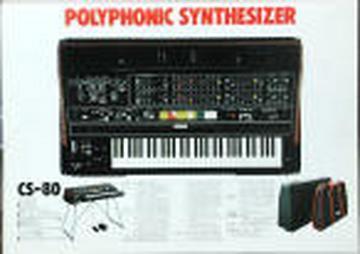
Yamaha CS80 group photo

Yahoo Groups archive

Yamaha CS80

Index last updated: 2026-04-03 01:46 UTC

Thread

RE: Replacing all CMOS 4000 Series Logic IC's

RE: Replacing all CMOS 4000 Series Logic IC's

2009-01-17 by mborish_2000

So, I just finished replacing almost all of the 4000 series logic IC's in my Yamaha CS-80.  I 
totally screwed it up.  I've got sustaining voices, unusual behavior and a couple of voices 
that only track the keyboard if you play a few notes at the same time.    

In retrospect, replacing most of the IC's might have been a bad idea.    One theory that I 
have is that the 4006 registry shifters that I couldn't replace are having problems keeping 
up with the propagation delay of the new IC's?   Furthermore, soldering a cap across the 
rails on the TKC board might have been a bad idea too.  Electrically, it doesn't make any 
sense to couple two rails together but a respectable website suggested it and other people 
said that it didn't cause any adverse affects?

Is there any systematic proceedure for restoring these things?   Initially, I was hesitant to 
turn any of the potentionometers - I figured that the thing would probably get back into 
calibration once I replaced the faulty IC's.  I was scared of stressing the potentionometers 
too. Maybe I should have calibrated it after I recaped and before I installed all of the new 
IC's.  Some of the calibration proceedures were off by significant values - another reason I 
figured that my problem was rooted within the IC's.

Here's a brief synopsis of the problems I'm facing:

1.) Before I replaced the IC's square wave output was distorted if more than one voice was 
sounding.  This was basically the main reason I replaced most of the IC's.  I still have this 
problem.  

2.) One voice, the last voice played, sustains indefinately in sustain I and II.

3.) Aftertouch doesn't work on the voice that is sustaining.

This thing is really sick and hard to isolate problems.  I don't have it in front of me either 
so it's harder to blog about it. 

Does anybody have any suggestions or referrals?

-Mike
312-363-7286

Re: [yamahacs80] RE: Replacing all CMOS 4000 Series Logic IC's

2009-01-17 by rj krohn

oof. sorry about your luck, mike. the most thorough way i can think of to tackle this
would be to remove all IC's from sockets, and read voltages on all sockets to make sure
you are getting proper power to them. then, start adding IC's and measuring pins. this is
obviously a very labor intensive approach. best of luck....

--- On Fri, 1/16/09, mborish_2000 <mborish_2000@yahoo.com> wrote:
Show quoted textHide quoted text
From: mborish_2000 <mborish_2000@...>
Subject: [yamahacs80] RE: Replacing all CMOS 4000 Series Logic IC's
To: yamahacs80@yahoogroups.com
Date: Friday, January 16, 2009, 7:40 PM


            So, I just finished replacing almost all of the 4000 series logic IC's in my Yamaha CS-80.  I 

totally screwed it up.  I've got sustaining voices, unusual behavior and a couple of voices 

that only track the keyboard if you play a few notes at the same time.    


In retrospect, replacing most of the IC's might have been a bad idea.    One theory that I 

have is that the 4006 registry shifters that I couldn't replace are having problems keeping 

up with the propagation delay of the new IC's?   Furthermore, soldering a cap across the 

rails on the TKC board might have been a bad idea too.  Electrically, it doesn't make any 

sense to couple two rails together but a respectable website suggested it and other people 

said that it didn't cause any adverse affects?


Is there any systematic proceedure for restoring these things?   Initially, I was hesitant to 

turn any of the potentionometers - I figured that the thing would probably get back into 

calibration once I replaced the faulty IC's.  I was scared of stressing the potentionometers 

too. Maybe I should have calibrated it after I recaped and before I installed all of the new 

IC's.  Some of the calibration proceedures were off by significant values - another reason I 

figured that my problem was rooted within the IC's.


Here's a brief synopsis of the problems I'm facing:


1.) Before I replaced the IC's square wave output was distorted if more than one voice was 

sounding.  This was basically the main reason I replaced most of the IC's.  I still have this 

problem.  


2.) One voice, the last voice played, sustains indefinately in sustain I and II.


3.) Aftertouch doesn't work on the voice that is sustaining.


This thing is really sick and hard to isolate problems.  I don't have it in front of me either 

so it's harder to blog about it. 


Does anybody have any suggestions or referrals?


-Mike

312-363-7286


[Non-text portions of this message have been removed]

Re: Replacing all CMOS 4000 Series Logic IC's

2009-01-17 by Quazimodo

I can sympathize Mike ... did the same myself a year ago, and only
just recently managed fixed all the problems. Although I did only do
the power supply and then the TKC board. My after touch screwed up big
time... in the end I have more than one fault. I think I blew a couple
of the IC's on the TKC - but more importantly - I had broken wires
going to one of the TSB boards.

I reckon anyone working with any board in the CS80 needs to bear in
mind that the constant turning of them *to-and fro* does put a strain
on the fine wires in the looms going to the solder points.

If I were you I'd check visually first - and then move them gently.
That's how I discovered mine... if I touched the nearby loom the fault
fixed itself, then re-appeared as I let go..!!

Hope you get to the bottom of it.
Cheers,
TOM


--- In yamahacs80@yahoogroups.com, "mborish_2000" <mborish_2000@...>
wrote:
Show quoted textHide quoted text
>
> So, I just finished replacing almost all of the 4000 series logic
> IC's in my Yamaha CS-80.  I 
> totally screwed it up.
> 
> Does anybody have any suggestions or referrals?
> 
> -Mike

Re: Replacing all CMOS 4000 Series Logic IC's

2009-01-19 by mborish_2000

Thanks for your help everybody.  Eventually, I am going to do a
continuity check.  Right now I am worried about propagation delay. 
I'm not going to run into any propagation delay issues if I keep most
of the  CMOS in there am I?

-Mike

Re: Replacing all CMOS 4000 Series Logic IC's

2009-01-19 by Quazimodo

Mike I just Googled and read up on it (a bit..)

Should you really worry... it looks like it would be in the
*nanosecond* region anyway.... or am I wrong..?

Cheers,
TOM


--- In yamahacs80@yahoogroups.com, "mborish_2000" <mborish_2000@...>
wrote:
Show quoted textHide quoted text
>
> Thanks for your help everybody.  Eventually, I am going to do a
> continuity check.  Right now I am worried about propagation delay. 
> I'm not going to run into any propagation delay issues if I keep most
> of the  CMOS in there am I?
> 
> -Mike
>

Re: Replacing all CMOS 4000 Series Logic IC's

2009-01-20 by mborish_2000

I'm not sure.  It doesn't work.  I'm hunting for some sort of theory
or explanation that will get me out of this pickle.  There's a smaller
 resistance through the switches on the new switching IC's too; maybe
that is also causing problems.  I think what I'm going to do is find a
chip broker and replace all of the new TI IC's with the original
Toshiba IC's - TCXXXXP.  

Before I replaced all of the chips, I didn't really have any big
problems with the exception of the square wave function not working on
Oscillator bank II when more than one key is engaged - probably a
logic problem.  One voice rang really loud because of initial
aftertouch in both banks too - I also assumed that that was a logic
problem.  I did notice that lots of things were way out of tolerance
in the calibration manual but didn't take note because I assumed that
I had massive 4000 series failures.  Working backwards, it seems that
the 4000 series IC's were working.  My square wave problem is still there.

Who knows what is causing so many problems.  I'm glad I didn't buy the
chip sockets with the internal cap.  Now I can just switch out the
IC's and go backwards.  I'm amazed that my CS80 could be so far out of
tolerance.  Has anybody else had huge tolerance discrepancies
restoring their CS80's?

In retrospect, I think that this is the best way to restore these things:

1.) Recap Power Supply without powering up or calibrating.  

2.) Power Up PSU with Remote sense wires jumpered and check with a
load. if PSU checks out ok, connect it to the rest of the unit.
Inventory functions of the unit if PSU is within reasonable tolerance
with the CS80 load.  Correct any recap mistakes if found. Do not
calibrate PSU.

3.) Recap the rest of the unit.

4.) Inventory Functions and correct any recap mistakes if found.

5.) Walk through all calibration measurements without calibrating and
take note of everything.  

6.) By now, it might be prudent to calibrate, check for contunity, or
replace IC's.  Use good judgment and try not to stress the cables.

Re: Replacing all CMOS 4000 Series Logic IC's

2009-01-20 by mborish_2000

It might.  Some of the older chips took forever to switch.  I haven't
seen a datasheet for the original 4000 series Toshiba IC's. I'm going
to do that next.  The new 4000 series chips have much lower internal
resistances.   

--- In yamahacs80@yahoogroups.com, "Quazimodo" <noddyspuncture@...> wrote:
Show quoted textHide quoted text
>
> Mike I just Googled and read up on it (a bit..)
> 
> Should you really worry... it looks like it would be in the
> *nanosecond* region anyway.... or am I wrong..?
> 
> Cheers,
> TOM
> 
> 
> 
> --- In yamahacs80@yahoogroups.com, "mborish_2000" <mborish_2000@>
> wrote:
> >
> > Thanks for your help everybody.  Eventually, I am going to do a
> > continuity check.  Right now I am worried about propagation delay. 
> > I'm not going to run into any propagation delay issues if I keep most
> > of the  CMOS in there am I?
> > 
> > -Mike
> >
>

Re: Replacing all CMOS 4000 Series Logic IC's

2009-01-20 by kent_spong

If I could make a suggestion to you here.

Forget about the IC's being too fast or slightly different to the 
originals. I think your barking up the wrong tree here.

This sounds to me like a physical problem created by replacing the 
IC's, and not the IC's themselves. 

When I KSR an 80 I use off the shelve new IC's, the make is of no 
concern at all. 

If you have used dil sockets for the IC's, check for bent legs, pins 
soldered together and even orientation. After doing over 60 CS80 
restorations now I can still screw it up from time to time so don't 
be offended if I sound like I'm putting your work down. 


If you like, send me a detailed list of all the problems your having 
and I will work through them with you to fix your beautiful synth (I 
do love CS80's so much).


--- In yamahacs80@yahoogroups.com, "mborish_2000" <mborish_2000@...> 
wrote:
>
> It might.  Some of the older chips took forever to switch.  I 
haven't
> seen a datasheet for the original 4000 series Toshiba IC's. I'm 
going
> to do that next.  The new 4000 series chips have much lower 
internal
> resistances.   
> 
> --- In yamahacs80@yahoogroups.com, "Quazimodo" <noddyspuncture@> 
wrote:
> >
> > Mike I just Googled and read up on it (a bit..)
> > 
> > Should you really worry... it looks like it would be in the
> > *nanosecond* region anyway.... or am I wrong..?
> > 
> > Cheers,
> > TOM
> > 
> > 
> > 
> > --- In yamahacs80@yahoogroups.com, "mborish_2000" <mborish_2000@>
> > wrote:
> > >
> > > Thanks for your help everybody.  Eventually, I am going to do a
> > > continuity check.  Right now I am worried about propagation 
delay. 
> > > I'm not going to run into any propagation delay issues if I 
keep most
Show quoted textHide quoted text
> > > of the  CMOS in there am I?
> > > 
> > > -Mike
> > >
> >
>

Re: [yamahacs80] Re: Replacing all CMOS 4000 Series Logic IC's

2009-01-20 by David Rogoff

Mike,

I agree with Kent.  As I told you, when I re-chiped my CS80 I had a few 
problems that were all tiny solder bridges between pads.  I'd spend a 
bunch of time with a lighted magnifier to start.  Do you know which 
board it is?  I had strongly suggested to you that you only re-chip one 
board at a time to help isolate any possible re-work goofs.

Good luck,

 David

kent_spong wrote:
Show quoted textHide quoted text
> If I could make a suggestion to you here.
>
> Forget about the IC's being too fast or slightly different to the 
> originals. I think your barking up the wrong tree here.
>
> This sounds to me like a physical problem created by replacing the 
> IC's, and not the IC's themselves. 
>
> When I KSR an 80 I use off the shelve new IC's, the make is of no 
> concern at all. 
>
> If you have used dil sockets for the IC's, check for bent legs, pins 
> soldered together and even orientation. After doing over 60 CS80 
> restorations now I can still screw it up from time to time so don't 
> be offended if I sound like I'm putting your work down. 
>
>
> If you like, send me a detailed list of all the problems your having 
> and I will work through them with you to fix your beautiful synth (I 
> do love CS80's so much).
>
>
>
> --- In yamahacs80@yahoogroups.com, "mborish_2000" <mborish_2000@...> 
> wrote:
> >
> > It might.  Some of the older chips took forever to switch.  I 
> haven't
> > seen a datasheet for the original 4000 series Toshiba IC's. I'm 
> going
> > to do that next.  The new 4000 series chips have much lower 
> internal
> > resistances.   
> > 
> > --- In yamahacs80@yahoogroups.com, "Quazimodo" <noddyspuncture@> 
> wrote:
> > >
> > > Mike I just Googled and read up on it (a bit..)
> > > 
> > > Should you really worry... it looks like it would be in the
> > > *nanosecond* region anyway.... or am I wrong..?
> > > 
> > > Cheers,
> > > TOM
> > > 
> > > 
>

Re: [yamahacs80] Re: Replacing all CMOS 4000 Series Logic IC's

2009-01-20 by Stephen Jones

I agree with Kent, I have done the CMOS/decoupling cap job before with no problems. The circuits in the CS-80 are not critical enough to be worrying about switching speeds. Look for broken wires, bridges, cracked tracks, and if you find nothing then look for a fault unrelated to the re-chip, because sometimes coincidences do happen. Also, if you are doing things like measuring the resistance of CMOS switches, remember that the chips do not like having voltages applied to their pins if the chip itself is unpowered.


________________________________
Show quoted textHide quoted text
From: mborish_2000 <mborish_2000@...>
To: yamahacs80@yahoogroups.com
Sent: Tuesday, January 20, 2009 12:19:54 PM
Subject: [yamahacs80] Re: Replacing all CMOS 4000 Series Logic IC's


It might.  Some of the older chips took forever to switch.  I haven't
seen a datasheet for the original 4000 series Toshiba IC's. I'm going
to do that next.  The new 4000 series chips have much lower internal
resistances. 


[Non-text portions of this message have been removed]

Re: [yamahacs80] Re: Replacing all CMOS 4000 Series Logic IC's

2009-01-20 by rj krohn

another  thing to consider: when i did my CMOS job, i used the decoupled sockets. they
are $3 a pop, but the prospect of my potentially botching any of the cap placements
seemed pretty high(i hate jamming 2 legs in one pad hole). IMO, i'd consider redoing the sockets with the readymade ones. 

also, in the interest of preserving your highly valuable synth, if you see yourself doing
a lot of desoldering, id invest in a hakko desoldering iron. i use it ALL the time; it preserves traces like you wouldnt believe! amazing piece of machinery. good luck-rj

--- On Mon, 1/19/09, Stephen Jones <thirteentech@...> wrote:
Show quoted textHide quoted text
From: Stephen Jones <thirteentech@...>
Subject: Re: [yamahacs80] Re: Replacing all CMOS 4000 Series Logic IC's
To: yamahacs80@yahoogroups.com
Date: Monday, January 19, 2009, 9:47 PM


I agree with Kent, I have done the CMOS/decoupling cap job before with no problems. The circuits in the CS-80 are not critical enough to be worrying about switching speeds. Look for broken wires, bridges, cracked tracks, and if you find nothing then look for a fault unrelated to the re-chip, because sometimes coincidences do happen. Also, if you are doing things like measuring the resistance of CMOS switches, remember that the chips do not like having voltages applied to their pins if the chip itself is unpowered.


____________ _________ _________ __

From: mborish_2000 <mborish_2000@ yahoo.com>

To: yamahacs80@yahoogro ups.com

Sent: Tuesday, January 20, 2009 12:19:54 PM

Subject: [yamahacs80] Re: Replacing all CMOS 4000 Series Logic IC's


It might.  Some of the older chips took forever to switch.  I haven't

seen a datasheet for the original 4000 series Toshiba IC's. I'm going

to do that next.  The new 4000 series chips have much lower internal

resistances. 


[Non-text portions of this message have been removed]


[Non-text portions of this message have been removed]

Re: Replacing all CMOS 4000 Series Logic IC's

2009-01-20 by mborish_2000

Wow, thanks for your help everybody.  I guess that i am overly
confident with my soldering.  It looks like I'm going to get a can of
deflux and follow everybody's suggestions.  I do have a professional
desoldering iron.  I kept it at 675 degrees farenheit and the iron at
650 when removing the old chips and installing the sockets.  I'm going
to clean the boards and check with a magnifying glass.  I'll be sure
to keep everybody posted.  Thanks again.  

One last question:  What is the point of decoupling the -8.5 rail to
the +6.5 rail?  Wouldn't it make more sense to go from ground to -8.5
and ground to +6.5?  Everybody keeps telling me I should buy the
sockets with the cap in them, I don't understand how this makes sense
electrically.  

Thanks again everybody.  

--- In yamahacs80@yahoogroups.com, David Rogoff <david@...> wrote:
Show quoted textHide quoted text
>
> Mike,
> 
> I agree with Kent.  As I told you, when I re-chiped my CS80 I had a few 
> problems that were all tiny solder bridges between pads.  I'd spend a 
> bunch of time with a lighted magnifier to start.  Do you know which 
> board it is?  I had strongly suggested to you that you only re-chip one 
> board at a time to help isolate any possible re-work goofs.
> 
> Good luck,
> 
>  David
> 
> kent_spong wrote:
> > If I could make a suggestion to you here.
> >
> > Forget about the IC's being too fast or slightly different to the 
> > originals. I think your barking up the wrong tree here.
> >
> > This sounds to me like a physical problem created by replacing the 
> > IC's, and not the IC's themselves. 
> >
> > When I KSR an 80 I use off the shelve new IC's, the make is of no 
> > concern at all. 
> >
> > If you have used dil sockets for the IC's, check for bent legs, pins 
> > soldered together and even orientation. After doing over 60 CS80 
> > restorations now I can still screw it up from time to time so don't 
> > be offended if I sound like I'm putting your work down. 
> >
> >
> > If you like, send me a detailed list of all the problems your having 
> > and I will work through them with you to fix your beautiful synth (I 
> > do love CS80's so much).
> >
> >
> >
> > --- In yamahacs80@yahoogroups.com, "mborish_2000" <mborish_2000@> 
> > wrote:
> > >
> > > It might.  Some of the older chips took forever to switch.  I 
> > haven't
> > > seen a datasheet for the original 4000 series Toshiba IC's. I'm 
> > going
> > > to do that next.  The new 4000 series chips have much lower 
> > internal
> > > resistances.   
> > > 
> > > --- In yamahacs80@yahoogroups.com, "Quazimodo" <noddyspuncture@> 
> > wrote:
> > > >
> > > > Mike I just Googled and read up on it (a bit..)
> > > > 
> > > > Should you really worry... it looks like it would be in the
> > > > *nanosecond* region anyway.... or am I wrong..?
> > > > 
> > > > Cheers,
> > > > TOM
> > > > 
> > > > 
> >
>

Re: Replacing all CMOS 4000 Series Logic IC's

2009-01-20 by Quazimodo

That's what I did on the TKC Mike.. but remember that the ground to
-8.5 cap needs to have it's (+) side to ground..!!

Cheers,
TOM


--- In yamahacs80@yahoogroups.com, "mborish_2000" <mborish_2000@...>
wrote:
Show quoted textHide quoted text
>
> One last question:  What is the point of decoupling the -8.5 rail to
> the +6.5 rail?  Wouldn't it make more sense to go from ground to -8.5
> and ground to +6.5?  Everybody keeps telling me I should buy the
> sockets with the cap in them, I don't understand how this makes sense
> electrically.  
>

My CS80, info required please kent.

2009-01-22 by blchrr@homecall.co.uk

Hi Kent, 

Hope your feeling better!
Just a quick email unfortunately ive not been able to resolve the touch 
response (aftertouch and initial touch) on my CS80. The aftertouch is dead 
and the velocity is pretty shocking. 

I would like to bring it back to you if possible to have this fixed, would 
like to have it tolexed at the same time. 

Also Kent for my records can you confirm what work was done to my Cs80 when 
i brought it you for restoration last year.
Did my 80 get the full KSR80 upgrade as detailed on the RL Music website. 
Specifically: 

Replacing *ALL* the CMOS logic IC's
Replacing *ALL* the dual op amps
Replacing *ALL* capacitors on the voice cards and power supply
Bypass/decoupling capacitors fitted to TKC board. 

Let me know please, thanks. 

Regards,
Rob.

Re: My CS80, info required please kent.

2009-01-22 by blchrr@homecall.co.uk

Sorry, this was not meant go to the list.. was supposed to be a private 
email.. 
Show quoted textHide quoted text
> Hi Kent,  
> 
> Hope your feeling better!
> Just a quick email unfortunately ive not been able to resolve the touch 
> response (aftertouch and initial touch) on my CS80. The aftertouch is dead 
> and the velocity is pretty shocking.  
> 
> I would like to bring it back to you if possible to have this fixed, would 
> like to have it tolexed at the same time.  
> 
> Also Kent for my records can you confirm what work was done to my Cs80 when 
> i brought it you for restoration last year.
> Did my 80 get the full KSR80 upgrade as detailed on the RL Music website. 
> Specifically:  
> 
> Replacing *ALL* the CMOS logic IC's
> Replacing *ALL* the dual op amps
> Replacing *ALL* capacitors on the voice cards and power supply
> Bypass/decoupling capacitors fitted to TKC board.  
> 
> Let me know please, thanks.  
> 
> Regards,
> Rob.  
> 
>