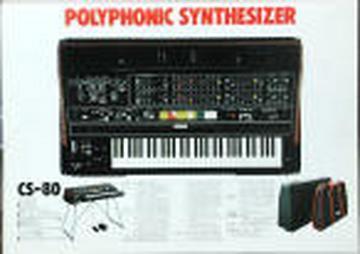
Yamaha CS80 group photo

Yahoo Groups archive

Yamaha CS80

Index last updated: 2026-03-31 22:34 UTC

Thread

another cs80 voice problem

another cs80 voice problem

2007-12-04 by rj krohn

hi folks, got an issue im wondering if you could point me in the right direction of....

the VCF envelope of one voice on my cs-80 wont open/close properly. im 100% sure its not a HPF/LPF issue, as they both sweep through the ranges properly. its just that the attack/decay settings dont cause it to open/close. i tried to calibrate this, but using the service manual instructions, i couldnt get the attack ttime to change at all via the trim pots.

i believe there is a filter EG chip on the voice cards, right? possibly a bad chip?

im looking forward to getting her to 100% shape. i honestly think the last time i enjoyed an instrument this much was learning "stairway to heaven" on gtr when i was 12 yrs old. i walk away from this thing in awe every time i sit down to play it....


thanks guys!


---------------------------------
Be a better friend, newshound, and know-it-all with Yahoo! Mobile. Try it now.

[Non-text portions of this message have been removed]

Re: another cs80 voice problem

2007-12-04 by cuari7

I have the same problem with my CS60.
I want to hear what solution needs to be applied here!


--- In yamahacs80@yahoogroups.com, rj krohn <r_j_d_2.phila@...> wrote:
>
> hi folks, got an issue im wondering if you could point me in the
right direction of....
>
> the VCF envelope of one voice on my cs-80 wont open/close properly.
im 100% sure its not a HPF/LPF issue, as they both sweep through the
ranges properly. its just that the attack/decay settings dont cause
it to open/close. i tried to calibrate this, but using the service
manual instructions, i couldnt get the attack ttime to change at all
via the trim pots.
>
> i believe there is a filter EG chip on the voice cards, right?
possibly a bad chip?
>
> im looking forward to getting her to 100% shape. i honestly think
the last time i enjoyed an instrument this much was
learning "stairway to heaven" on gtr when i was 12 yrs old. i walk
away from this thing in awe every time i sit down to play it....
>
>
> thanks guys!
>
>
> ---------------------------------
> Be a better friend, newshound, and know-it-all with Yahoo! Mobile.
Try it now.
>
> [Non-text portions of this message have been removed]
>

Re: another cs80 voice problem

2007-12-04 by Quazimodo

I think the filter envelope chip is IC12 on the 'M' board.

I also had strange results recently when trying to perform the
calbrations as per the CS80 manual. I wasn't getting the waveform
shown in Step#1 (on TP1) when you're supposed to be adjusting VR's 15&19.

Although in the end mine sounded OK to my ears (eventually) but you
just end up feeling as though there might be something amiss. And the
explanation in the 'How To Adjust' column isn't very clear either.

Anyone any ideas on these calibrations...?

Cheers,
TOM


--- In yamahacs80@yahoogroups.com, rj krohn <r_j_d_2.phila@...> wrote:
>
> hi folks, got an issue im wondering if you could point me in the
right direction of....
>
> the VCF envelope of one voice on my cs-80 wont open/close properly.
im 100% sure its not a HPF/LPF issue, as they both sweep through the
ranges properly. its just that the attack/decay settings dont cause it
to open/close. i tried to calibrate this, but using the service manual
instructions, i couldnt get the attack ttime to change at all via the
trim pots.
>
> i believe there is a filter EG chip on the voice cards, right?
possibly a bad chip?
>
> im looking forward to getting her to 100% shape. i honestly think
the last time i enjoyed an instrument this much was learning "stairway
to heaven" on gtr when i was 12 yrs old. i walk away from this thing
in awe every time i sit down to play it....
>
>
> thanks guys!

Re: [yamahacs80] Re: another cs80 voice problem

2007-12-04 by jkjelec@comcast.net

Hi All,

I'd be suspcious of a bad potentiometer (trimpot) before the I suspected the EG chip. Maybe you can probe the output of the potentiometer while adjusting it and be sure that the voltage chagnes appropriately as you turn the trimpot, if this is one of those trimpots that has its ends connected to the +/- power supplies and is simply putting out a reference voltage to the IC.

Regarding the waveform adjustment, I have always found that the waveforms matched the service manual very well. I'll check on the details of what you are saying (no manual handy right now).
One thing I found was that it was very important (as is usual) to perform all of the adjustments in the order shown in the manual. For example, if you think an EG is out of whack and you simply jump to the step that you think is the one that is relevant, you are just wasting time, and you really need to start that EG's calibration procedure right from step one. (My point is that, if steps 1 or 2 are out of whack, step 3 will never be able to be calibrated properly, even if your ears and scope are telling you that step 3's parameter is the one out of whack. Whent he EG's or VCAs are out of adjustment, the synth can sound very flat and tweezy; and generally not good.

Also I can say that it was very important to be sure all of the front panel settings are correct for each adjustment procedure, and that you are clear that the voice you are adjusting is the one presently sounding. (Not to imply that you folks are not aware of this, I'm just throwing it out there.

Regards,

Kyle Jarger

-------------- Original message --------------
From: "Quazimodo" <noddyspuncture@...>

> I think the filter envelope chip is IC12 on the 'M' board.
>
> I also had strange results recently when trying to perform the
> calbrations as per the CS80 manual. I wasn't getting the waveform
> shown in Step#1 (on TP1) when you're supposed to be adjusting VR's 15&19.
>
> Although in the end mine sounded OK to my ears (eventually) but you
> just end up feeling as though there might be something amiss. And the
> explanation in the 'How To Adjust' column isn't very clear either.
>
> Anyone any ideas on these calibrations...?
>
> Cheers,
> TOM
>
>
> --- In yamahacs80@yahoogroups.com, rj krohn wrote:
> >
> > hi folks, got an issue im wondering if you could point me in the
> right direction of....
> >
> > the VCF envelope of one voice on my cs-80 wont open/close properly.
> im 100% sure its not a HPF/LPF issue, as they both sweep through the
> ranges properly. its just that the attack/decay settings dont cause it
> to open/close. i tried to calibrate this, but using the service manual
> instructions, i couldnt get the attack ttime to change at all via the
> trim pots.
> >
> > i believe there is a filter EG chip on the voice cards, right?
> possibly a bad chip?
> >
> > im looking forward to getting her to 100% shape. i honestly think
> the last time i enjoyed an instrument this much was learning "stairway
> to heaven" on gtr when i was 12 yrs old. i walk away from this thing
> in awe every time i sit down to play it....
> >
> >
> > thanks guys!

[Non-text portions of this message have been removed]

Test equipment - Re: another cs80 voice problem

2007-12-04 by David Rogoff

On a related note, anyone trying to work on a CS80 (or other analog
synth) needs the following:

anti-static wrist strap - about $10
digital voltmeter - about $20 - $100 new/used
analog oscilloscope/probes - about $50 - $100 used (only need very
simple 10MHz 'scope)
non-conductive trimmer/adjuster - $5
tuner
a $30 chromatic tuner will work
Here's a cheap replacement for a strobe tuner if your 'scope has an
X/Y mode (most do)
1) create wave files of sine waves at the reference frequencies (I
used Sound Forge and can post the files)
2) attach your soundcard output to the 'scope's X/horizontal input
3) attach your CS80's output to the 'scope's Y/vertical (normal) input
4) set the sound to loop/repeat
5) set the CS80 to sine wave as directed in the standard tuning
instructions
6) when the frequencies match, the 'scope squiggle will be a
static, or very slowly changing line or ellipse
Look at this excellent website that shows what it will look
like: http://www.mathcats.com/explore/lissajous/lissajous.html
Make X and Y frequencies the same and then change one slightly
to see the "beating" effect. Notice that you can
change one frequency by octave (double, half, 4-times, etc) and
it still works, so you don't need to change the computer
sound file to tune different octaves.


If you're going to be replacing parts, add:
Good, grounded tip soldering iron -
Soldapullt solder remover - $10
Solder wick - $10

And, if you're going to replace all the CMOS chips:
de-soldering station - $100 - $300 new/used (I bought one and then sold
it when I was done)

Anything I missed?

David

Re: [yamahacs80] Test equipment - Re: another cs80 voice problem

2007-12-04 by rj krohn

yes, thanks for this list david. i've got everything on here(as i have been working on my own synths for years now).

one addition i would offer:
1-tuner. if you are on a mac, katsura(sp?) makes a strobe tuner that is a downloadable pgm, and works waaaaay better than the little chromatic tuners guitar center sells. assuming your comp as an audio input, you can plug right in, use internal audio, and get RIGHT on the dot, to the cent. awesome.

2-same with oscilloscope. there is a program called signalscope pro, same deal. available on versiontracker.com.

now it looks like i really need a spare 50/60/80 voice card for the chips.....if anyone ever comes across one, please drop me a line. i have been on the hunt for a 50/60 carcass to scavenge, i will post if i find one to part out.


David Rogoff <david@...> wrote: On a related note, anyone trying to work on a CS80 (or other analog
synth) needs the following:

anti-static wrist strap - about $10
digital voltmeter - about $20 - $100 new/used
analog oscilloscope/probes - about $50 - $100 used (only need very
simple 10MHz 'scope)
non-conductive trimmer/adjuster - $5
tuner
a $30 chromatic tuner will work
Here's a cheap replacement for a strobe tuner if your 'scope has an
X/Y mode (most do)
1) create wave files of sine waves at the reference frequencies (I
used Sound Forge and can post the files)
2) attach your soundcard output to the 'scope's X/horizontal input
3) attach your CS80's output to the 'scope's Y/vertical (normal) input
4) set the sound to loop/repeat
5) set the CS80 to sine wave as directed in the standard tuning
instructions
6) when the frequencies match, the 'scope squiggle will be a
static, or very slowly changing line or ellipse
Look at this excellent website that shows what it will look
like: http://www.mathcats.com/explore/lissajous/lissajous.html
Make X and Y frequencies the same and then change one slightly
to see the "beating" effect. Notice that you can
change one frequency by octave (double, half, 4-times, etc) and
it still works, so you don't need to change the computer
sound file to tune different octaves.

If you're going to be replacing parts, add:
Good, grounded tip soldering iron -
Soldapullt solder remover - $10
Solder wick - $10

And, if you're going to replace all the CMOS chips:
de-soldering station - $100 - $300 new/used (I bought one and then sold
it when I was done)

Anything I missed?

David


---------------------------------
Never miss a thing. Make Yahoo your homepage.

[Non-text portions of this message have been removed]