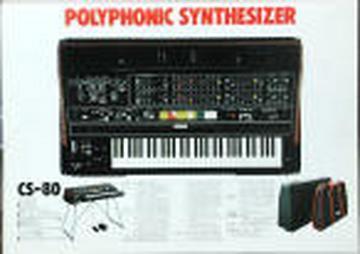
Yamaha CS80 group photo

Yahoo Groups archive

Yamaha CS80

Index last updated: 2026-04-03 01:46 UTC

Thread

warm-up time CS80

warm-up time CS80

2007-11-07 by erikfromhere

talking about stability:
one of my CS80's took over one hour to get all oscillators pitched 
correctly while my other took only a few minutes.
So, I removed the old (and hardened)silicon-grease from the oscillator-
ic's and applied new grease and made sure the diodes were completely 
covered by it. Now, it takes 15 minutes instead of an hour. Why it 
takes still 15 minutes is mainly caused -I guess- by the fact that 
I've 1 or 2 ic's with different temperature-codes.
Now I only hope the new grease doens't eat up the housing of the ic...

About the codes, I think it's ok to use different -non matching- 
codes, but then you'll have to accept that during warming up the 
pitches are uneven.

Of coarse, tuning the pitches should be done best on a hot summerday 
or using a towel to keep the heat inside the synth...

Since, I'm not technical, can someone explain how the diode influences 
the pitch of the oscillator ?

Re: [yamahacs80] warm-up time CS80

2007-11-07 by David Rogoff

erikfromhere wrote:
> talking about stability:
> one of my CS80's took over one hour to get all oscillators pitched 
> correctly while my other took only a few minutes.
> So, I removed the old (and hardened)silicon-grease from the oscillator-
> ic's and applied new grease and made sure the diodes were completely 
> covered by it. 
Thanks for the info.  Remember, the diode should be touching the VCO
chip. Could I ask something of you, and others talking about this:
please include the serial number of your CS80. This will help us figure
out the stability over the years they were built.
>
> About the codes, I think it's ok to use different -non matching- 
> codes, but then you'll have to accept that during warming up the 
> pitches are uneven.
>   
Probably ok in a studio.  If you're outside and the temperature / sun is
changing, good luck.
> Of coarse, tuning the pitches should be done best on a hot summerday 
> or using a towel to keep the heat inside the synth...
>   
I put my remote-probe oven thermometer inside my CS80 with it closed up
to measure the temp inside.  Then I opened it up and turned on a heater
in the room until the temperature was close.
> Since, I'm not technical, can someone explain how the diode influences 
> the pitch of the oscillator ?
>   
Simple version.  The current in almost all electronic components varies
with temperature. The varying current affects the circuits, which is
most noticeable for VCO/pitch. The diode is thermally coupled to the VCO
chip so that it tracks the same temperature. The diode current is then
used to try and cancel out the temperature effects of the diodes and
transistors inside the VCO chip.

The Yamaha VCOs are linear (Hz/volt), which don't need the exponential
converter found in more usual exponential VCOs (volts/octave) used in
most synths.  Exponential converters are very temperature sensitive, so
the CS80 is actually much more stable than synths like the Prophet 5,
which always need some kind of auto-tuning circuits.

Re: [yamahacs80] warm-up time CS80

2007-11-07 by rj krohn

thanks for this explanation, appreciate it. my serial # is 1418, but i am still in the process of a PSU recap, and replacement of the CMOS chips, so i will report back on general stability in a week or two when its done.

this still brings me back to that nagging question.....if the instability is due to temp change, and the temp change is caused by the PSU(right?), then wouldnt having the PSU on the outside of the chassis solve alot of this problem? sorry, still just thinking out loud on that....

David Rogoff <david@...> wrote:                               erikfromhere wrote:
 > talking about stability:
 > one of my CS80's took over one hour to get all oscillators pitched 
 > correctly while my other took only a few minutes.
 > So, I removed the old (and hardened)silicon-grease from the oscillator-
 > ic's and applied new grease and made sure the diodes were completely 
 > covered by it. 
 Thanks for the info.  Remember, the diode should be touching the VCO
 chip. Could I ask something of you, and others talking about this:
 please include the serial number of your CS80. This will help us figure
 out the stability over the years they were built.
 >
 > About the codes, I think it's ok to use different -non matching- 
 > codes, but then you'll have to accept that during warming up the 
 > pitches are uneven.
 >   
 Probably ok in a studio.  If you're outside and the temperature / sun is
 changing, good luck.
 > Of coarse, tuning the pitches should be done best on a hot summerday 
 > or using a towel to keep the heat inside the synth...
 >   
 I put my remote-probe oven thermometer inside my CS80 with it closed up
 to measure the temp inside.  Then I opened it up and turned on a heater
 in the room until the temperature was close.
 > Since, I'm not technical, can someone explain how the diode influences 
 > the pitch of the oscillator ?
 >   
 Simple version.  The current in almost all electronic components varies
 with temperature. The varying current affects the circuits, which is
 most noticeable for VCO/pitch. The diode is thermally coupled to the VCO
 chip so that it tracks the same temperature. The diode current is then
 used to try and cancel out the temperature effects of the diodes and
 transistors inside the VCO chip.
 
 The Yamaha VCOs are linear (Hz/volt), which don't need the exponential
 converter found in more usual exponential VCOs (volts/octave) used in
 most synths.  Exponential converters are very temperature sensitive, so
 the CS80 is actually much more stable than synths like the Prophet 5,
 which always need some kind of auto-tuning circuits.


 __________________________________________________
Do You Yahoo!?
Tired of spam?  Yahoo! Mail has the best spam protection around 
http://mail.yahoo.com 

[Non-text portions of this message have been removed]
Re: warm-up time CS80

2007-11-07 by erikfromhere

Maybe without the heat of the PSU, the voiceboards are more instable 
because there will be more temperature-fluctionation within the CS80 
(it will follow the roomtemperature which will differ from summer till 
winter unless you've a conditioned room)? The PSU pre-heats the 
interior making it more stable. Just a guess.
Anyway, my CS80's are fine once warmed up, I only need to tune them 
once a year or so. Not worth the effort.

--- In yamahacs80@yahoogroups.com, rj krohn <r_j_d_2.phila@...> wrote:
> 
> this still brings me back to that nagging question.....if the 
instability is due to temp change, and the temp change is caused by the 
PSU(right?), then wouldnt having the PSU on the outside of the chassis 
solve alot of this problem? sorry, still just thinking out loud on 
that....
>

Re: [yamahacs80] warm-up time CS80

2007-11-08 by Richard Atkinson

On Nov 7 2007, David Rogoff wrote:

>The Yamaha VCOs are linear (Hz/volt), which don't need the exponential
>converter found in more usual exponential VCOs (volts/octave) used in
>most synths.  Exponential converters are very temperature sensitive, so
>the CS80 is actually much more stable than synths like the Prophet 5,
>which always need some kind of auto-tuning circuits.

But doesn't a linear (Hz/Volt) synthesizer with a keyboard nearly always 
have an exponential convertor in it to convert the control voltages coming 
from the keyboard or voice assigner DAC (which are 'linear' in nature, as 
in 0 1 2 3) to exponential control voltages (as in 1 2 4 8) for the linear 
VCOs?

Re: [yamahacs80] warm-up time CS80

2007-11-08 by Magnus Danielson

From: Richard Atkinson <rga24@...>
Show quoted textHide quoted text
Subject: Re: [yamahacs80] warm-up time CS80
Date: 08 Nov 2007 08:40:58 +0000
Message-ID: <Prayer.1.0.18.0711080840580.29148@...>

> On Nov 7 2007, David Rogoff wrote:
> 
> >The Yamaha VCOs are linear (Hz/volt), which don't need the exponential
> >converter found in more usual exponential VCOs (volts/octave) used in
> >most synths. Exponential converters are very temperature sensitive, so
> >the CS80 is actually much more stable than synths like the Prophet 5,
> >which always need some kind of auto-tuning circuits.
> 
> But doesn't a linear (Hz/Volt) synthesizer with a keyboard nearly always
> have an exponential convertor in it to convert the control voltages coming
> from the keyboard or voice assigner DAC (which are 'linear' in nature, as
> in 0 1 2 3) to exponential control voltages (as in 1 2 4 8) for the linear
> VCOs?

Well, those that do use them wisely, so what you only get is a shift of scale
for modulation, but the pitch isn't greatly affected as the minimal modulation
causes a very small shift in current.

The MS-20 clearly does this. It also drops the tempco resistor as the
modulation won't need it.

Cheers,
Magnus

Re: [yamahacs80] warm-up time CS80

2007-11-08 by David Rogoff

Richard Atkinson wrote:
> On Nov 7 2007, David Rogoff wrote:
>
>   
>> The Yamaha VCOs are linear (Hz/volt), which don't need the exponential
>> converter found in more usual exponential VCOs (volts/octave) used in
>> most synths.  Exponential converters are very temperature sensitive, so
>> the CS80 is actually much more stable than synths like the Prophet 5,
>> which always need some kind of auto-tuning circuits.
>>     
>
> But doesn't a linear (Hz/Volt) synthesizer with a keyboard nearly always 
> have an exponential convertor in it to convert the control voltages coming 
> from the keyboard or voice assigner DAC 
The DAC in the CS80 directly generates the exponential voltage, so
there's no separate converter.
 
 David