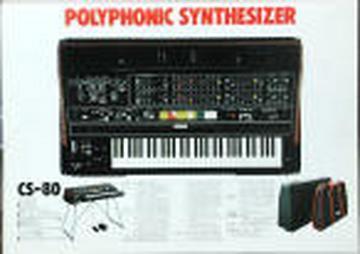
Hi all.

Well, we had out CS80 BBQ yesterday. It was a good time with lots of
noise :^).  More on that later.

Toward the end of the afternoon, we were talking (actually, Scott M.
was requesting/begging) about some kind of auto-tuner for the beast. I
thought about a few ways to do it, but then I realized I have a few
others things to do in the next couple of years, so I dropped the
plan. However, I have thought of a pretty simple board that could be
mounted in the CS80 to really speed up the manual tuning procedure and
not require any external tuner or test equipment.

I've put a scan of my first sketch here: http://launch.ph.groups.yahoo.com/group/yamahacs80/photos/browse/68f7?
c=

Quick explanation: I grab the 8 trigger/gate signals and convert them
to binary with a 4532 (this whole thing uses the same 4000-series CMOS
chips that are already used all over the CS80). One place this goes is
a 4511, which drives a 7-segment LED display, showing you a number
from 0 through 7 for which pair of board is triggered. If you hit more
than one key at a time, all bets are off!

The binary code also controls the 4051 8-to-1 muxes in the upper
right, which are wired with the pulse outputs from each voice card.
Therefore, you automatically select the correct oscillators. (I just
realized, since only one key is allowed to be hit at a time, the muxes
can just be OR gates).  These go through a couple of 4013 flip-flops
which turn them into nice, clean square waves at octave down.

Next, at the bottom of the page, we've got a crystal tuning reference
(could include a jack for an external reference??). This is divided
down to all the required octave for tuning. Another pair of 4051s pick
the correct octave automatically based on the Feet switches.

Finally, in the circuit above this, the oscillator outputs are X-ORed
(digital ring-mod - easy to hear/see beat frequency) with the
reference tone. These drive red/green LEDs that show the beat
frequency. Also, a pair of switches allow sending the oscillator,
reference tone, or X-OR tone from either channel to an audio output.
This lets you hear the tones, which can help with tuning, especially
if the oscillators are way off.

Comments? Criticisms? Suggestions?  Would this be something people
would want to install in their keyboards?  It would probably mount
inside the front panel, near the Feet switches.

More later,

 David
Message
Auto-tuner / tuner assist idea
2008-09-15 by David Rogoff
Attachments
- No local attachments were found for this message.