Hi Chris,
Wow! Deju Vu times about 10.....
About two years ago I bought a dead MicroKorg XL with the intention of fixing it. The only issue was a missing voltage regulator in the center of the KLM-2881 mainboard. It must have fried and a tech had removed it. Nobody would tell me what the chip was. I asked Korg for a service manual, no. I asked for a picture of the board in several groups, no. Finally I bought several floppy drive belts for my SY85 synths and mentioned to the tech selling the belts that I was trying to fix the XL. He sent me a page from the service manual and told me it was a BD00KA5WF voltage regulator. I bought several from Digikey, installed one, the XL came right up and has been working fine
ever since. So much for luck. No, the lottery ticket was a dud.
So being the glutton for punishment that I am... I bought a dead MicroSampler thinking maybe it might have a similar problem. Imagine my surprise when I opened it up and the mainboard was a KLM-2881! Korg uses the same board and flashes it for the personality required. Like your "second part of the story" I spent hours verifying every voltage and then traced the data lines until I came to the conclusion the DSP wasn't getting any instructions to load. Talking to Korg was the same deal, nothing. Fortunately John was able to help me even though several Korg dealers in the Albany, NY area were unable to find the 510c15472881 part number even after calling Korg.
If you want to discuss more about your ideas with creating a "happy flash" that will satisfy
the checksum feel free to email me directly. The only question I have is if the checksum is computed and analyzed by the CPU and it will know that it isn't right? Also there is a chance that when you read the chip it may not have anything on it because a stray voltage or buggy routine wiped it. Without ripping Korg to shreds it's becoming obvious that their DSP driven gear isn't going to be around down the road. I can understand a three or four hundred dollar synth losing it and not being supported but a synth that originally listed for sixteen hundred or more that's not good. What happens when a Kronos X or PA3X pukes? For three or four grand they say sorry buy a new one. NOT!!!
Enough ranting for today... Time to go to practice, Fran
From: "euklides69@..."
To: vintagesynthrepair@yahoogroups.com
Sent: Thursday, October 3, 2013 11:55 PM
Subject: [vintagesynthrepair] RE: Korg Radias - checksum error
I think its time of second part of my sad story :)Since I have enough desperation , some electronic background with PC mainboards repair , access to SMD rework station and eprom programmer I started looking for DIY solution.
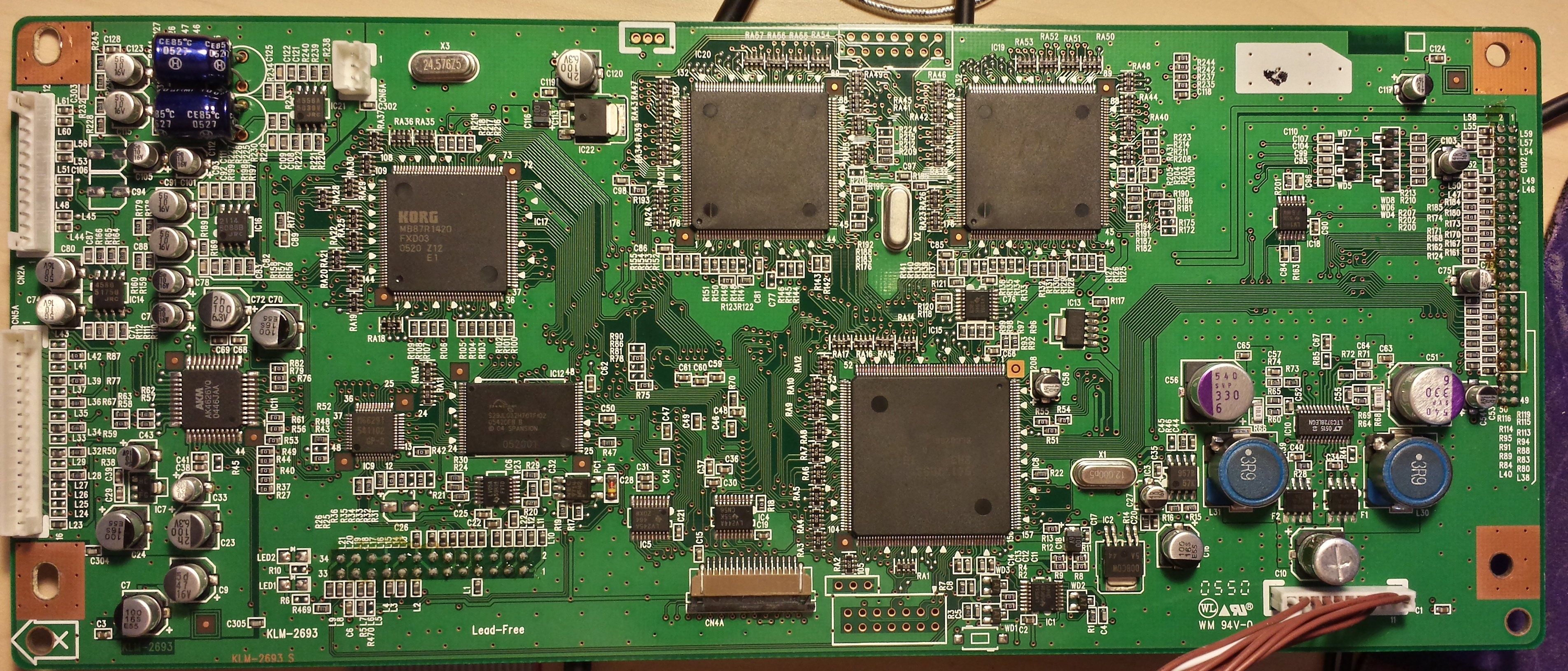
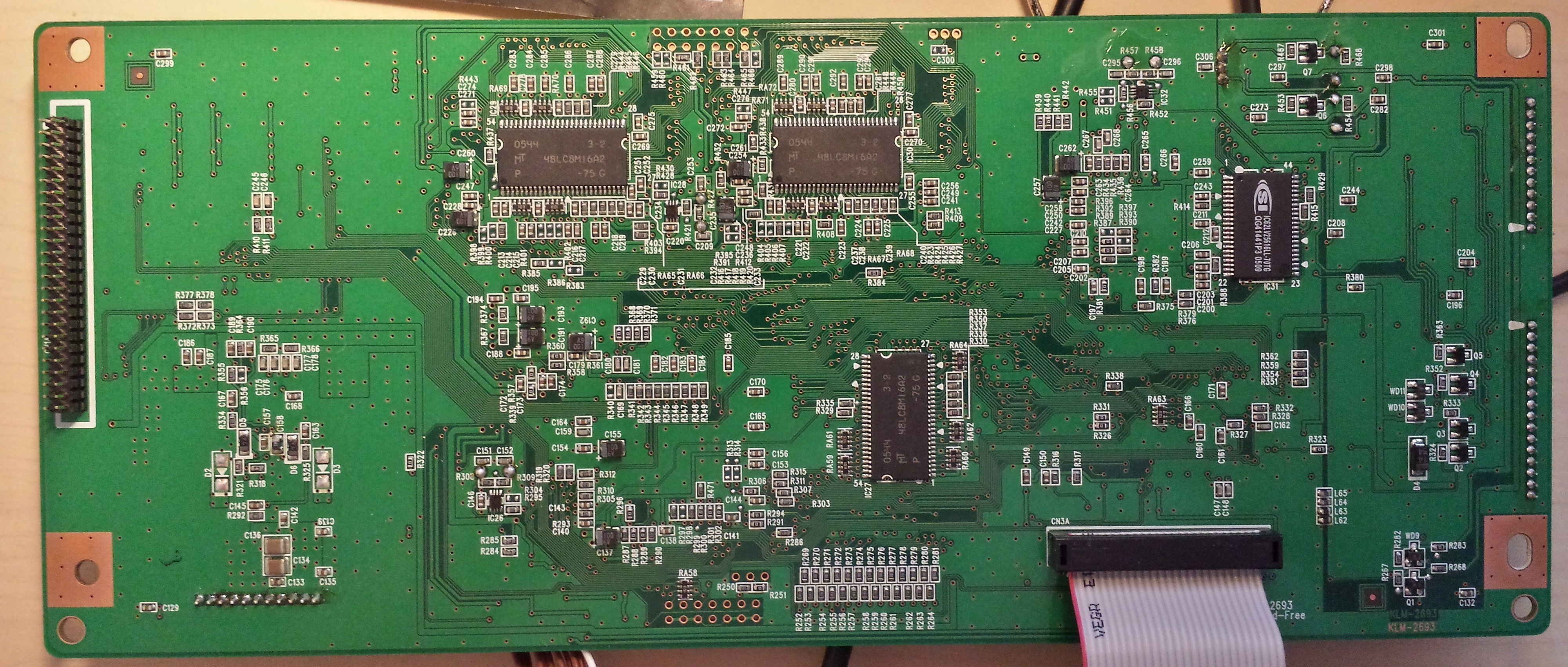
I was able to find Korg Radias service manual.Its has been posted on Korg forums.( link below - if this will help anybody)I obviously checked all the voltages and connectors. Everything seems to be exactly like service manual described. Looking at the CPU board schematics and CPU PCB itself i assumed that most suspicious parts are IC12 Flash memory , and IC27 SDRAM 128M.Looking for cold solder joints I checked their traces for data and address bus. ICs voltages also have been checked. Everything seems to be ok. My best bet for know are either corrupted flash and (or) sdram working with that flash.I already contacted Parts is Parts. Very nice people working there but unfortunately they have no electronics parts for my Radias at all (hence my later call to KorgUSA). I asked them if they can provide me programmed flash chip ( it has even part no in Korg parts catalog), whole CPU borad or even if they can program blank flash memory chip, which I was going to send them. I got no answer for this....
All the ICs are slodered on radias CPU board ( see links with PCB pictures)I already ordered SDRAM chip and will try to replace it soon but honestly I doubt if this will help.I have no access to working Radias CPU board or the one with non damaged flash. Therefore I cannot get copy of working flash. What I thought (since there is no other way visible on the horizon) is to order few blank flash chips (they are fairly cheap), desolder my existing flash from Radias, read it with eprom programmed and try to find area where chekcsum error is calculated. Fix that checksum (caculate it again and enter to bin code) program new flash chip, solder test scoket TSOP48 to CPU board and place there programmed flash chip.I know it sounds desperate but I dont see any other way for now.Do you thing this plan has any sens?
Can you advise me something based on your experience ?
Radias CPU board pictures:
http://obrazki.elektroda.pl/1692988900_1378904376.jpg
http://obrazki.elektroda.pl/9737250700_1378904379.jpg
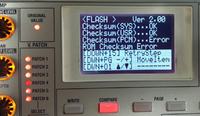
Radias (flash) test mode results:Chris