tube synth diy group photo

Yahoo Groups archive

tube synth diy

Archive for tubesynthdiy.

Index last updated: 2026-03-30 01:17 UTC

Thread

Hey i Bought a powersupply i wanted to see someones thoughts on the amps

Hey i Bought a powersupply i wanted to see someones thoughts on the amps

2007-04-19 by kidkrazy58
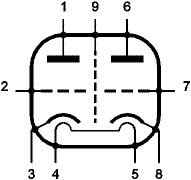
IT is variable from 1 to 3000 volts really acurate. its all regulated
and it uses two 8608 tubes. if some one could tell me what the
purpouse of the 2 tubes are that would be great. but the rest is just
solid state. It only goes to 20 m.amps after that it just starts
turing opn and off the high voltage out put. Is that high e nough in
the amps to be usefull for many tube projects?oh and i paid 25 dollars
for it

Re: [tubesynthdiy] Hey i Bought a powersupply i wanted to see someones thoughts on the amps

2007-04-19 by sasami@hotkey.net.au

the useful range is about 600 max, though in general you'll want to stay
below 300. For test/design work, 20ma should be enough for small assemblies.
Tubes "work on voltage" rather than or current.

Be careful not to kill yourself. Be VERY careful.

>IT is variable from 1 to 3000 volts really acurate. its all regulated
>and it uses two 8608 tubes. if some one could tell me what the
>purpouse of the 2 tubes are that would be great. but the rest is just
>solid state. It only goes to 20 m.amps after that it just starts
>turing opn and off the high voltage out put. Is that high e nough in
>the amps to be usefull for many tube projects?oh and i paid 25 dollars
>for it
>
>
>
>
>
>Yahoo! Groups Links
>
>
>
>
_______________________________________________________________________
Ken Stone sasami@...
Modular Synth PCBs for sale <http://www.cgs.synth.net/>
Australian Miniature Horses & Ponies <http://www.blaze.net.au/~sasami/>

Re: Hey i Bought a powersupply i wanted to see someones thoughts on the amps

2007-04-19 by kidkrazy58

yea, well i actuelly have been shooked by very very high voltages,
Like when i was useing my plasma generator. IT made 40,000 volts
before i burnt the transformer out. That thing shocked me i dont
know how many times. at least 20. ANd ive been shocked by the wall
outlet about 3 times. 120 and 240. and now i have a neon sign
transformer that goes up to 12,000 volts and 30 ma. by itself it
makes a 2 inch arch, Very nice.
Im really into high voltage expermints as well as tubes. I have
collected about 20 10kv peak volatage caps at 1.3 nanoferrets to
make a voltage multiplier. SO yes ive had alotta experience with
high voltage circuits.
WHat is a leathel amount of voltage and amps?
Oh and i was wondering can you use voltage multipliers to power tube
circuits. reason i ask is that i looked at a schematic that
originally was From piaa and it was a tube/solidstate preamp. it ran
a 12ax7 one for seach channel and they were voltage starvedd but
just to get t he 50 or volts to run them from the 12 volt heater and
ic suppy they used a 5 stage voltage muliplier.
so i wias wondering is that really a good idea to use voltage
multipliers when you dont have a proper transfomer
Thanks alot
--- In tubesynthdiy@yahoogroups.com, sasami@... wrote:
>
> the useful range is about 600 max, though in general you'll want
to stay
> below 300. For test/design work, 20ma should be enough for small
assemblies.
> Tubes "work on voltage" rather than or current.
>
> Be careful not to kill yourself. Be VERY careful.
>
> >IT is variable from 1 to 3000 volts really acurate. its all
regulated
> >and it uses two 8608 tubes. if some one could tell me what the
> >purpouse of the 2 tubes are that would be great. but the rest is
just
> >solid state. It only goes to 20 m.amps after that it just starts
> >turing opn and off the high voltage out put. Is that high e nough
in
> >the amps to be usefull for many tube projects?oh and i paid 25
dollars
> >for it
> >
> >
> >
> >
> >
> >Yahoo! Groups Links
> >
> >
> >
> >
>
_____________________________________________________________________
__
> Ken Stone sasami@...
> Modular Synth PCBs for sale <http://www.cgs.synth.net/>
> Australian Miniature Horses & Ponies
<http://www.blaze.net.au/~sasami/>
>

Re: [tubesynthdiy] Re: Hey i Bought a powersupply i wanted to see someones thoughts on the amps

2007-04-19 by sasami@hotkey.net.au

>WHat is a leathel amount of voltage and amps?

Voltage is irrelevant. It is the current across the heart that kills you,
and it is a tiny amount. I forget how much, but I think it was under 10 ma.

>Oh and i was wondering can you use voltage multipliers to power tube
>circuits.

You can, but if you don't have to, don't. It is a "last resort" method
because it is noisy and expensive.

Cheers,

Ken
_______________________________________________________________________
Ken Stone sasami@...
Modular Synth PCBs for sale <http://www.cgs.synth.net/>
Australian Miniature Horses & Ponies <http://www.blaze.net.au/~sasami/>

calculating bypass caps

2007-05-17 by Mark

Does anyone have any formulae or have any guidelines in determining
the size of a cathode bypass cap?? I am interested in both directly
and indirectly heated cathodes.

Thanks :)

Re: [tubesynthdiy] calculating bypass caps

2007-05-17 by sasami@hotkey.net.au

Just use what you see in other circuit diagrams - frequently 220uF. Do you
understand their purpose? They are there to give what is essentially a rock
solid above-ground DC reference. The only time the voltage across it should
change is while the capacitor is first charging. It charges until it is
sufficiently high above the grid voltage that the tube stops conduction,
thus biasing the tube.

Ken


>
>Does anyone have any formulae or have any guidelines in determining
>the size of a cathode bypass cap?? I am interested in both directly
>and indirectly heated cathodes.
>
>Thanks :)
>
>
>
>
>Yahoo! Groups Links
>
>
>
>
_______________________________________________________________________
Ken Stone sasami@...
Modular Synth PCBs for sale <http://www.cgs.synth.net/>
Australian Miniature Horses & Ponies <http://www.blaze.net.au/~sasami/>

Re: [tubesynthdiy] calculating bypass caps

2007-05-18 by Mark

Yes, cathode bypass caps often play a role in maintaining a steady
bias, and depending on the circuit, bypassing the cathode resistance
can also increase the gain of the tube by reducing negative feedback,
lower the output impedance, and may prevent oscillation. It charges
and discharges as the grid changes polarity. Depending on the
circuit, if the cap isn't large enough, it can reduce its low
frequency response.

Anyway, I would rather not copy the value another circuit without
knowing what I'm doing (or what the designer of the other circuit was
doing). The use and values of cathode bypass caps vary widely, even
for the same tube. I've found that doing the math, as opposed to
trial and error, often saves me time and money. Increasing a
capacitor increases is physical size, cost, and demand on the power
supply. I'm sure a way to calculate it exists, I just need to find
it.

On 5/18/07, sasami@... put forth:
>Just use what you see in other circuit diagrams - frequently 220uF. Do you
>understand their purpose? They are there to give what is essentially a rock
>solid above-ground DC reference. The only time the voltage across it should
>change is while the capacitor is first charging. It charges until it is
>sufficiently high above the grid voltage that the tube stops conduction,
>thus biasing the tube.
>
> >Does anyone have any formulae or have any guidelines in determining
> >the size of a cathode bypass cap?? I am interested in both directly
> >and indirectly heated cathodes.
> >
> >Thanks :)

Re: calculating bypass caps

2007-05-20 by bbluthang

wouldn't it be
C(Farads) = 1/(2.Pi.F.Xc)
pi = 3.14etc
F = min freq(Hz)
Xc = capacitive reactance(Ohm)
- this is the hard bit, maybe you would have to start calculating
thevenin resistance on the input cct to find the desired Xc.
I thought this page had a fair description -
http://members.tripod.com/~gabevee/mytubamp.html
tho its all for tube amps

a cheap and safe way to try out experimental tube circuits is Orcad
Pspice, the student version is free and plenty of websites have tube
spec files for Psice available.

which leads me to ponder when the 1st soft tube synth is coming out??

andrew


--- In tubesynthdiy@yahoogroups.com, Mark <yahoogroups@...> wrote:
>
>
> Yes, cathode bypass caps often play a role in maintaining a steady
> bias, and depending on the circuit, bypassing the cathode resistance
> can also increase the gain of the tube by reducing negative feedback,
> lower the output impedance, and may prevent oscillation. It charges
> and discharges as the grid changes polarity. Depending on the
> circuit, if the cap isn't large enough, it can reduce its low
> frequency response.
>
> Anyway, I would rather not copy the value another circuit without
> knowing what I'm doing (or what the designer of the other circuit was
> doing). The use and values of cathode bypass caps vary widely, even
> for the same tube. I've found that doing the math, as opposed to
> trial and error, often saves me time and money. Increasing a
> capacitor increases is physical size, cost, and demand on the power
> supply. I'm sure a way to calculate it exists, I just need to find
> it.
>
> On 5/18/07, sasami@... put forth:
> >Just use what you see in other circuit diagrams - frequently 220uF.
Do you
> >understand their purpose? They are there to give what is
essentially a rock
> >solid above-ground DC reference. The only time the voltage across
it should
> >change is while the capacitor is first charging. It charges until it is
> >sufficiently high above the grid voltage that the tube stops
conduction,
> >thus biasing the tube.
> >
> > >Does anyone have any formulae or have any guidelines in determining
> > >the size of a cathode bypass cap?? I am interested in both directly
> > >and indirectly heated cathodes.
> > >
> > >Thanks :)
>

CGS 65 tube VCA modifications and results

2008-05-17 by Mark

I recently completed construction and initial testing of the VCA
using a 1SH24B tube. I built it in MOTM-format using a panel and
bracket from Bridechamber.

The version I built is different than the original circuit. In order
to avoid damaging the PCB from excessive unsoldering, I did not build
a stock unmodified version for comparison purposes.

From what others had said, there were three issues: the output was
noisy, there was a "high-pass effect" or "loss of bass", and there
was a "thump" during the attack of the EG when used as a VCA. So I
modified the circuit in order to reduce noise and increase bandwidth.

LED's are very noisy. Since the cathode is in the signal path, I
eliminated the two signal diodes, the two LED's, and their resistors.
I connected a 1.2K 1/2W resistor between Pin 1 of the cathode-heater
and ground.

I was out of TL072's. In order to use a fast op-amp (which would not
be an LM358 or LT1013) to drive the grid capacitor that was better
suited for audio, I replaced it with an OP275. The OP275 requires
power bypassing to operate within specification, and the stock 100nF
bypass caps are too far away to be effective. Also, the stock 100nF
cap on the positive looks like it forms ~15kHz LPF on the tube
output. So I eliminated those caps, and underneath the PCB, added
two .1uF ceramic caps with heat shrink tubing going from ground, with
the capacitors as close as possible to the power pins on the socket.
The OP275 can drive capacitive loads, and works better as a
non-inverting amp if the parallel value of the gain resistors are
less than 2K. So eliminated the 47pF cap on the output, and replaced
it with a resistor lead. I did not add the gain resistor. While 330
Ohm is the minimum specified resistor for output protection, I
replaced it with 1K (outside the feedback path) to have the same
output impedance as MOTM.

The grid capacitor forms a high-pass filter with the (330K) grid
resistor in parallel with the grid resistance of the tube. The grid
resistance of the 1SH24B is specified as 100K. So the resulting
corner frequency with a 220nF cap would be 9.4Hz -- not high enough
to cause a problem, imho. However that specification is when the
cathode-heater is run off 1.2V, which is not what we are doing here,
so therefore the grid resistance is unknown. So I increased the two
220nF caps to 470nF (both of them so the tube would still sit level :)

At audio frequencies, the effective impedance of the plate is the
plate resistor (8K2) in parallel with the load resistor (100K).
Imho, coupling caps sound better driving lower impedances. So I
changed the plate resistor to 20K and the load resistor (connected to
pin 5 of the OP275) to 33K. 20K||33K = 12.5K yielding a bit more
gain than the stock circuit.

However, I do not think the "high-pass effect" noticed by others was
largely due to the coupling caps. I think it was due to cathode
depletion -- negative feedback that increases with lower frequencies.
So I added a cathode bypass capacitor. I could not figure out a way
to derive an appropriate value mathematically. So I used a 47uF
axial electrolytic. Which may be way larger than necessary, and also
might not sound as good as a film cap, YMMV. I connected it between
pin 2 of the tube (connected to the negative rail) and ground. Do
not connect it to the ground side of the cathode or the in-rush
current could burn out the heater.

I wired up the bias switch -- using properly shielded cable -- to two
settings: 330K towards the negative rail, and 1M towards ground.
They sound a bit different from each other, but more on that below.

I hooked it up and started testing it. I didn't notice any noise on
the output. While distortion increases the high frequency content, I
did not notice a "loss of bass". As one would expect, the output
does roll off at low frequencies eventually, but this seems to occur
below the audio range. While distortion increases with input level,
it does not reach the point where it squares up completely.

With the CV INIT trimmed, and no CV input, the output of pin 7 of the
LM358 is +6V with the gain control potted all the way down, and
-14.38V with the gain potted all the way up, the output of pin 1 is
-12.1V and 13.77V respectively. The Gain knob (I used a linear 50K
pot) has no effect within the last tick or so as it runs into the
rails. The output level seems fine.

With the stock 100nF cap installed, I did not notice a click or thump
when driving it with an MOTM-800 EG. So far, with a minimum attack,
it seems better than the MOTM-190 in that regard. However, there is
a noticeable peak or boost in output at the beginning of the
envelope. Which seems like a nice feature, and it it is easily
reduced by increasing the length of the attack. While the resulting
curve seems neither perfectly linear or exponential, it is easily
adjusted by ear. Although considering the range of the gain pot,
I'll try decreasing the CV input resistor to 50K. So besides that,
and given the distortion, it works fine as a "regular" VCA.

With a roughly 10Vpp source, distortion becomes obvious when the
input is more than half-way up (I used linear 50K pots for both audio
inputs). While the sound is quite different when using either
positive or negative feedback (and imho, changing Input 2 to a
reversing attenuator would be a nice mod), between the two bias
settings, the difference without feedback is subtle. There is also a
slight effect on the CV response between the two settings.

I'm still trying to figure out the best way to wire the bias switch.
I would like one setting to have the least distortion possible, and
another to have more distortion available.

With no signal, the voltage on the grid measures -14.66V connected to
the negative rail with a 330K resistor. With the signal grid
connected to ground with a 1M resistor, when first powered up when
already warm, it reads -13.50V then slowly climbs to -14.16V and
stays there. Switching between the two switches between -14.66V and
-14.16V.

I checked all my connections. My conclusion is that the grid is
capacitively coupled to the -15V cathode. Keep in mind that this
tube was designed to run the cathode near ground, and the grid biased
a bit below that.

With a signal, the negative voltage on the grid increases. If I
measure 3.15 VAC rms (about 9Vpp) on pin 1 of the OP275, with the
grid connected to the negative rail with a 330K resistor, the grid
measures -17.85 VDC. Which is roughly equal to 14.66 plus 3.15.
Well, anyway, at least the grid is negative to the cathode, which I
guess is kind of normal :)

Luckily, it doesn't become so negative it that it cuts off the plate
current. Still, I would like to figure out the optimal bias
settings. Although I was planning the resistor towards ground as the
clean setting, the slightly more negative (.5V) setting has less
distortion. So while there isn't much wiggle room, I'm going to try
reducing the 330K resistor for less distortion. Beyond that, my only
other idea is to make the cathode less negative. I'm also going to
try decreasing the 1M for more distortion.

If some of you who have this module could measure the cathode and
grid voltages that would be appreciated.


Thanks :)

Re: [tubesynthdiy] CGS 65 tube VCA modifications and results

2008-05-18 by sasami@hotkey.net.au

Interesting. Do you mind if I add this message to the VCA page as
constructors notes?

Ken


>I recently completed construction and initial testing of the VCA
>using a 1SH24B tube. I built it in MOTM-format using a panel and
>bracket from Bridechamber.
>
>The version I built is different than the original circuit. In order
>to avoid damaging the PCB from excessive unsoldering, I did not build
>a stock unmodified version for comparison purposes.
>
> From what others had said, there were three issues: the output was
>noisy, there was a "high-pass effect" or "loss of bass", and there
>was a "thump" during the attack of the EG when used as a VCA. So I
>modified the circuit in order to reduce noise and increase bandwidth.
>
>LED's are very noisy. Since the cathode is in the signal path, I
>eliminated the two signal diodes, the two LED's, and their resistors.
>I connected a 1.2K 1/2W resistor between Pin 1 of the cathode-heater
>and ground.
>
>I was out of TL072's. In order to use a fast op-amp (which would not
>be an LM358 or LT1013) to drive the grid capacitor that was better
>suited for audio, I replaced it with an OP275. The OP275 requires
>power bypassing to operate within specification, and the stock 100nF
>bypass caps are too far away to be effective. Also, the stock 100nF
>cap on the positive looks like it forms ~15kHz LPF on the tube
>output. So I eliminated those caps, and underneath the PCB, added
>two .1uF ceramic caps with heat shrink tubing going from ground, with
>the capacitors as close as possible to the power pins on the socket.
>The OP275 can drive capacitive loads, and works better as a
>non-inverting amp if the parallel value of the gain resistors are
>less than 2K. So eliminated the 47pF cap on the output, and replaced
>it with a resistor lead. I did not add the gain resistor. While 330
>Ohm is the minimum specified resistor for output protection, I
>replaced it with 1K (outside the feedback path) to have the same
>output impedance as MOTM.
>
>The grid capacitor forms a high-pass filter with the (330K) grid
>resistor in parallel with the grid resistance of the tube. The grid
>resistance of the 1SH24B is specified as 100K. So the resulting
>corner frequency with a 220nF cap would be 9.4Hz -- not high enough
>to cause a problem, imho. However that specification is when the
>cathode-heater is run off 1.2V, which is not what we are doing here,
>so therefore the grid resistance is unknown. So I increased the two
>220nF caps to 470nF (both of them so the tube would still sit level :)
>
>At audio frequencies, the effective impedance of the plate is the
>plate resistor (8K2) in parallel with the load resistor (100K).
>Imho, coupling caps sound better driving lower impedances. So I
>changed the plate resistor to 20K and the load resistor (connected to
>pin 5 of the OP275) to 33K. 20K||33K = 12.5K yielding a bit more
>gain than the stock circuit.
>
>However, I do not think the "high-pass effect" noticed by others was
>largely due to the coupling caps. I think it was due to cathode
>depletion -- negative feedback that increases with lower frequencies.
>So I added a cathode bypass capacitor. I could not figure out a way
>to derive an appropriate value mathematically. So I used a 47uF
>axial electrolytic. Which may be way larger than necessary, and also
>might not sound as good as a film cap, YMMV. I connected it between
>pin 2 of the tube (connected to the negative rail) and ground. Do
>not connect it to the ground side of the cathode or the in-rush
>current could burn out the heater.
>
>I wired up the bias switch -- using properly shielded cable -- to two
>settings: 330K towards the negative rail, and 1M towards ground.
>They sound a bit different from each other, but more on that below.
>
>I hooked it up and started testing it. I didn't notice any noise on
>the output. While distortion increases the high frequency content, I
>did not notice a "loss of bass". As one would expect, the output
>does roll off at low frequencies eventually, but this seems to occur
>below the audio range. While distortion increases with input level,
>it does not reach the point where it squares up completely.
>
>With the CV INIT trimmed, and no CV input, the output of pin 7 of the
>LM358 is +6V with the gain control potted all the way down, and
>-14.38V with the gain potted all the way up, the output of pin 1 is
>-12.1V and 13.77V respectively. The Gain knob (I used a linear 50K
>pot) has no effect within the last tick or so as it runs into the
>rails. The output level seems fine.
>
>With the stock 100nF cap installed, I did not notice a click or thump
>when driving it with an MOTM-800 EG. So far, with a minimum attack,
>it seems better than the MOTM-190 in that regard. However, there is
>a noticeable peak or boost in output at the beginning of the
>envelope. Which seems like a nice feature, and it it is easily
>reduced by increasing the length of the attack. While the resulting
>curve seems neither perfectly linear or exponential, it is easily
>adjusted by ear. Although considering the range of the gain pot,
>I'll try decreasing the CV input resistor to 50K. So besides that,
>and given the distortion, it works fine as a "regular" VCA.
>
>With a roughly 10Vpp source, distortion becomes obvious when the
>input is more than half-way up (I used linear 50K pots for both audio
>inputs). While the sound is quite different when using either
>positive or negative feedback (and imho, changing Input 2 to a
>reversing attenuator would be a nice mod), between the two bias
>settings, the difference without feedback is subtle. There is also a
>slight effect on the CV response between the two settings.
>
>I'm still trying to figure out the best way to wire the bias switch.
>I would like one setting to have the least distortion possible, and
>another to have more distortion available.
>
>With no signal, the voltage on the grid measures -14.66V connected to
>the negative rail with a 330K resistor. With the signal grid
>connected to ground with a 1M resistor, when first powered up when
>already warm, it reads -13.50V then slowly climbs to -14.16V and
>stays there. Switching between the two switches between -14.66V and
>-14.16V.
>
>I checked all my connections. My conclusion is that the grid is
>capacitively coupled to the -15V cathode. Keep in mind that this
>tube was designed to run the cathode near ground, and the grid biased
>a bit below that.
>
>With a signal, the negative voltage on the grid increases. If I
>measure 3.15 VAC rms (about 9Vpp) on pin 1 of the OP275, with the
>grid connected to the negative rail with a 330K resistor, the grid
>measures -17.85 VDC. Which is roughly equal to 14.66 plus 3.15.
>Well, anyway, at least the grid is negative to the cathode, which I
>guess is kind of normal :)
>
>Luckily, it doesn't become so negative it that it cuts off the plate
>current. Still, I would like to figure out the optimal bias
>settings. Although I was planning the resistor towards ground as the
>clean setting, the slightly more negative (.5V) setting has less
>distortion. So while there isn't much wiggle room, I'm going to try
>reducing the 330K resistor for less distortion. Beyond that, my only
>other idea is to make the cathode less negative. I'm also going to
>try decreasing the 1M for more distortion.
>
>If some of you who have this module could measure the cathode and
>grid voltages that would be appreciated.
>
>
>Thanks :)
>
>
>
>
>
>
>
>
>
>
>
>
>
>
>
>
>
>
>
>
>
>------------------------------------
>
>Yahoo! Groups Links
>
>
>
>
_______________________________________________________________________
Ken Stone sasami@...
Modular Synth PCBs for sale <http://www.cgs.synth.net/>
Australian Miniature Horses & Ponies <http://www.blaze.net.au/~sasami/>

Re: [tubesynthdiy] CGS 65 tube VCA modifications and results

2008-05-18 by Mark

On 5/18/08, sasami@... put forth:
>Interesting. Do you mind if I add this message to the VCA page as
>constructors notes?

Well, it's still a work in progress. If you like, I can write up
something for your website after I'm finished.

I'm still trying to figure out the correct bias settings, and I am
open to suggestions.

As far as my speculation about the need for a cathode bypass cap, if
someone has one without a bypass cap they could test it by sending a
signal in the low audio range, turning up the gain pot, and checking
the cathode for an AC voltage. If someone with a scope finds a
signal on the cathode out of phase with the input signal, then that
would demonstrate negative feedback.

Imho, determining the minimum cathode bypass cap would require
testing it as a VCA. It seems likely that rapid changes in voltage
on the control grid (eg. an envelope with a steep attack) would cause
a sudden demand for plate current enough to deplete the cathode,
which then bounces back causing an unwanted noise.