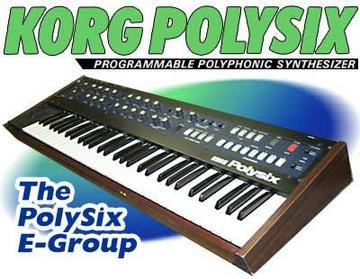
Discussion about the Korg PolySix synthesizer group photo

Yahoo Groups archive

Discussion about the Korg PolySix synthesizer

Archive for polysix.

Index last updated: 2026-03-30 01:17 UTC

Thread

Polysix 100/120V to 220/240V conversion - Swapping transformer?

Polysix 100/120V to 220/240V conversion - Swapping transformer?

2014-12-25 by stalinjohansen@yahoo.com
Hi. Got a Japanese 100V Polysix. I live in Europe where there's 220V.

Is it enough to change the current 100/120V transformer in the Polysix to this one, a 220/240V suggested by Kiwisix on their page?
M5118 - Powertran 18 + 18 80VA Toroidal Transformer - Altronics

The fuses etc. in the Polysix says they're all rated for 250V, so my guess is that changing the transformer is all that's needed. Anything else that will need to be changed as well?

Re: Polysix 100/120V to 220/240V conversion - Swapping transformer?

2014-12-29 by stalinjohansen@yahoo.com

Measured the AC-voltage coming out from the step-down converter, and it's 127V! (126.8V) That's no good.

Could someone please list the effects on a Polysix (or any synth/audio equipment for that matter) rated for 100V when the incoming voltage is +27V?

I've read that a transformer receiving excessive voltage will overheat, but will components literally die from this? What components are affected by long term use of +27V of excessive voltage?


Also measured the AC-output from the wall socket today. Its 235V. Should i get a 225VA or a 250VA transformer for the Polysix? Can't see that the local store sells any 240VA transformers.. only 225VA and 250VA in that VA-range.

[PolySix] Re: Polysix 100/120V to 220/240V conversion - Swapping transformer?

2014-12-29 by Malte Rogacki

Hello,

the first thing you should look at is the internal transformer and the
small PCB next to it.

If the service manual is to be believed there are different combinations.
It might well be that the internal transformer can be rewired for 120V.
This should probably handle 127V ok.

As far as the rating of the stepdown transformer goes: The 235V have
nothing to do with this. According to the manual the Polysix consumes 25W
of power. So the stepdown converter needs to handle this plus some margin.
The good news is that the power rating is uncritical once you are above the
requirements of the device: A transformer capable of delivering 100VA,
200VA or 500VA would be equally working (but would get significantly
bulkier).

I'm not 100% sure if you want to use a stepdown transformer or if you want
to exchange the internal transformer for a new one.

Re: [PolySix] Re: Polysix 100/120V to 220/240V conversion - Swapping transformer?

2014-12-29 by Johannes Hausensteiner

> Measured the AC-voltage coming out from the step-down converter, and
> it's 127V! (126.8V) That's no good.
This is indeed quite high (+27%)

> Could someone please list the effects on a Polysix (or any synth
> /audio equipment for that matter) rated for 100V when the incoming
> voltage is +27V?
Since it is a simple AC transformer it will transfer the primary voltage
faithfully to the secondary side. This means that the power supply
(KLM-376 in case of the Polysix) will get a voltage 27% above nominal.

> I've read that a transformer receiving excessive voltage will
> overheat, but will components literally die from this? What
> components are affected by long term use of +27V of excessive voltage?
The overvoltage will cause excessive heat mainly on the power
transistors and possibly on the transformer itself. This might lead to
a premature aging and failing of the power supply.

> Also measured the AC-output from the wall socket today. Its 235V.
This is perfectly OK and normal. The nominal voltage is 230V +10/-15%

> Should i get a 225VA or a 250VA transformer for the Polysix? Can't
> see that the local store sells any 240VA transformers.. only 225VA
> and 250VA in that VA-range.
This is a misunderstanding. The physical unit "VA" means "Volt Ampere",
Which is effectively Volts * Amperes, which denotes a power rating.
The type label of my Polysix reads 25W (which is in that case the same
as VA; although there is a subtle difference between "VA" and "W"...).
So the proposed 80VA transformer
(http://www.altronics.com.au/p/m5118-powertran-18-18-80va-toroidal-transformer/)
is way over-dimensioned. Even if you have additional circuitry like a
MIDI upgrade inside your Polysix you should be on the safe side with a
35 - 40VA type. The secondary AC voltage on my polysix reads ca. 19.4V
each output (the secondary has a center tap to generate +/-15V).
So 2x 18..20V transformer with ca 35..40VA is fine.
The proposed toroid type is superior in terms of stray inductance to
standard M- or EI- types. This might result in less (magnetic) induced
hum; but I would not expect too much of that.

BUT: According to the KLM-376 schematics the transformer has a second
tap on the primary to adapt for 100V (Japan) and 110/115V (e.g. U.S.).
This is very common to such transformers. So possibly all you have to do
is rewiring the AC mains wires and use the 120V setting. It says on the
schematics th orange wire should be used and the brown wire should be
left unconnected (actually there is a solder tap labeled "nc", which
stands for "not connected" on the KLM-425 filter PCB. But this can be
different in your unit.

I hope this helps!

Johannes


Am 29.12.2014 um 05:21 schrieb stalinjohansen@yahoo.com [PolySix]:
>
>
> Measured the AC-voltage coming out from the step-down converter, and
> it's 127V! (126.8V) That's no good.
>
> Could someone please list the effects on a Polysix (or any synth/audio
> equipment for that matter) rated for 100V when the incoming voltage is +27V?
>
> I've read that a transformer receiving excessive voltage will overheat,
> but will components literally die from this? What components are
> affected by long term use of +27V of excessive voltage?
>
>
>
>

Re: Polysix 100/120V to 220/240V conversion - Swapping transformer?

2014-12-29 by stalinjohansen@yahoo.com

To Malte and Johannes, thanks.

About potential damage to internal components because of long term excessive voltage: Anything I should check/inspect closer, relating to this? Any signs I should look/listen for?

I got this Polysix about a week ago, and have not used it that much (luckily). The previous owner/seller lives in the same country as me, and told me he had used the Polysix "alot". I have no idea of the voltage of his step down converter. (Just hope it wasn't as high as mine.) To me everything seems fine, (except from the grounding noise in the main output described in another post), but maybe there's something I should inspect closer?

Anyway, the plan is to asap install a new transformer into the Polysix, plus a 3 prong wire. This will allow the Polysix to be plugged directly into the wall, and also earth/ground the Polysix. Using a step down converter is not a long term option.

I know that swapping the locations of the brown and the orange wire will rate the Polysix for 120V, but these wires are soldered onto the KLM 372A (this is the old/first version of Polysix). And my soldering skills are really not up to this task.

So I'll just wait for the new transformer, contact the best tech in town and ask the tech to swap transformers and install the 3 prong wire and run a grounding wire to the chassis/casing.

About the transformer: Is it not important that the transformer is rated for receiving 240V? And will a 35VA or a 40VA transformer be able to work with 240V?

I know very little about this, especially about transformers, (but I am reading about them now and learning). The one I linked to in the first post is the one Kiwisix suggests for the Polysix.

I sent a question to the local transformers-dealer, asking if they had something similar to the one Kiwisix suggests. The dealer says that this transformer will do the job:

https://www1.elfa.se/data1/wwwroot/assets/datasheets/05612361.pdf

(link to spec-sheet in English)

Can anyone tell me if that transformer is good for use with the Polysix? Or what other specs I might be looking for? Don't want to buy anything overkill, but I'd like good margins so things don't get heated and stuff like that.