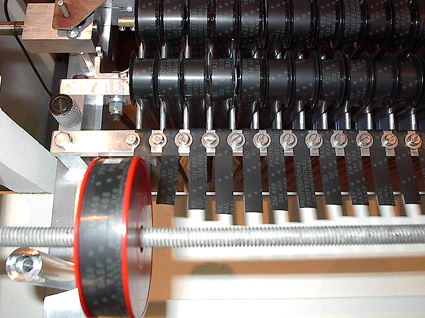
KER-CHUNK!    A HIT-MAKING KEYBOARD MADE OF 8-TRACK  CAR STEREOS?
MEET ROCK’S RAREST INSTRUMENT.    by Paul Collins
Dave Biro had a sound in his head, and it went sort  of like this:
Ahhhhh-AHHHHHH-Ahhhhhh
He’d been listening nonstop to a new 8-track, Tales from Topographic
Oceans; this was 1974, after all, when a Yes double album of four  side-long
songs could top the charts. Biro was a hopeful young musician in  Connecticut; he
’d already spent twelve hundred dollars on a Minimoog a few  months
earlier, only to find himself out of his day job now. But he still  listened to
that sound: phantom, hauntingly orchestral washes—and  yet not quite an actual
orchestra—sweeping like an undercurrent below the  impenetrable lyrics of
Tales.
He had to get that sound.
But how? It was coming from Rick Wakeman, prog rock’s wizard—the guy  even
wore a glittering silver cape onstage—and the keyboard Wakeman was  playing
cost thirty-five hundred dollars new. Biro didn’t have anything  near that,
and his unemployment checks weren’t going to last forever.
But he could get nineteen automotive 8-track decks from the junkyard  for
twenty dollars each—and an old piano from a friend, pulling the keys  out one
by one—and he could stay up thirty-six hours at a time in his  father’s
garage, working and working—recording, splicing, wiring,  cross-fading,
figuring out the action of the board, grinding the ivory off  the keys to glue in
electrical contacts…
“I had no idea what the hell I was doing,” he writes me. “No  plans… no
drawings… nothing. All I remember is that absolutely no one  thought it could
work at all.”
One month passed. Then another, and another still. Still he kept  working—
designing, improvising.
“Rubber bands came in very handy,” he recalls. “So did Radio Shack. I  was
a daily customer there.”
After working all night, he’d listen to Tales as the sun rose,  the track
selector on the Stereo 8 coming up to the next track. And then  the nineteen
other 8-tracks would start, and he’d press a key on his  skeletal piano
assembly, and then… and then…

KER-CHUNK!
The sound has been in your head too. Cue up David Bowie’s “Space  Oddity”
to the 1:10 mark—just as Ground Control announces liftoff.  There comes an
unearthly swell of… flutes? Cellos? It’s Rick Wakeman  again, this time on a
1969 Bowie session, and he’s playing the Mellotron:  the original analog
sampler, a piano cabinet rigged up with tape frames of  recorded orchestral
instruments. Press a key, and it plays back a specific  tape of, say, a middle
C# on a cello. The opening flute notes of  “Strawberry Fields Forever” are
a Mellotron; so are the strings in “The  Rain Song” and the choir in “The
Lamb Lies Down on Broadway.”
And, it so happens, the Mellotron is all over Tales from Topographic
Oceans.
“It’s the craziest instrument you could imagine,” Jean Michel Jarre  once
explained to the BBC. “Somebody thought to replace the piano string  with a
tape, and the hammer with a tape head.”
The Mellotron was never supposed to rock out: It was launched in  1963 as a
home entertainment console, a sort of hopped-up Lowry Organ.  Yank off its
dowdy wooden panels and you face an assemblage of dark brown  plastic tape
frames, plywood supports, and a dark green servo controller  board. Atop it
all spins a spinning silver flywheel with a telltale 400  kHz hum. Beneath
the keyboard assembly hang innumerable lengths of  recording tape, reaching
from the keyboard almost to the bottom of the  cabinet; they are separated
from mutual strangulation by opaque strips of  plastic. Press a key up top, and
one of the lengths of tapes starts to  disappear upward toward the keyboard
assembly; after eight seconds, it  reaches the top of the tape frame and
then—fffwwiiittt—a  spring-loaded pull drags the tape down again. Solo across
the keys, and  the little lengths of tape go up and down in succession. It’
s mesmerizing  to watch, beautiful to hear, and an utter pain in the ass to
maintain.
“There is not enough memory in any known computer to handle the answers  to
questions about what drove me up the wall with that instrument,”  Wakeman
once warned me. “Its tuning, a badly designed and underpowered  motor, plus
the fact that it broke down on every gig and traveled  appallingly would head
the list.”
And it was that instrument—a doddering, majestic, infuriating musical
Frankenstein—that a fan in Connecticut decided to conjure, golem-like,  from a
heap of cast-off machines best known for cutting off songs in the  middle of a
—

KER-CHUNK!
“The choir and strings are really frightening,” Wakeman boasted to
Keyboard magazine.
He wasn’t referring to a Mellotron. After he’d played a New Haven gig  in
October 1974—shiny cape and all—Wakeman was approached by an inventor.
Would he be interested in a machine that was cheaper, lighter, and easier  to
play than the Mellotron?
Behold: the Birotron.
It was an amazing sight. Dave Biro, upon hearing that he’d get to meet
Rick after the concert, had run up ten flights of stairs in the parking  garage
to his car, and dragged down a pile of automotive 8-track players  rigged
to the middle three octaves of an old piano. Biro had even recorded  his own
tapes by cracking open a bunch of 8-track cassettes and relooping  them with
his own samples. Why 8-tracks? Well, 8-track cartridges never  needed
rewinding. You could set them on an endless loop for notes with  infinite
sustain. All nineteen machines ran endlessly and at the ready in  a loop, and when
you pressed down a key, it engaged a playback head:
Ahhhhh-AHHHHHH-Ahhhhhh
The samples were a work of art themselves; they weren’t perfect yet,  but
Biro had recorded them off a friend’s Mellotron and then carefully  looped
each note into a continuous sound. That, it turns out, is  incredibly
difficult, because musical instruments aren’t really supposed  to do that. They have
an attack and a decay; they waver slightly in  between. But Biro had
painstakingly cross-faded and spliced, doubled it up  in stereo and patiently
sorted technical bugbears like phase cancellation,  and then—all this in his
father’s garage—he had something the world had  never heard before.
An endless cello note.
Wakeman plugged the Birotron into a small Fender amp and began playing  it,
sinking deeper and deeper into concentration. He asked a few questions
about Biro’s plans, played some more, and then turned to him.
“How would you like to make some money with this thing?” he asked.
It wasn’t just some guy’s home-brew machine now. It was the keyboard  of
the future. Wakeman set up shop near London in 1975 with a team  that
included business partner Peter Robinson and a mechanical engineer  with the
unlikely name of Roger Rogers.
Tangerine Dream signed on as one of their first customers, and Wakeman
toured with a prototype Birotron and recorded Yes’s 1978 hit single “Don’t
Kill the Whale” with it—you can hear the endlessly held choir notes  peeking
through the mix at the very end of the song. So the instrument had  some
glimmers of success: now Birotronics Inc. had to figure out how to
mass-produce it. The first order of business was fitting nineteen 8-tracks  tapes into
a reasonably small instrument. Instead of having nineteen  separate players
like Biro had done, they devised a single common rotating  bar that ran
across and ran all nineteen tapes at once. That seemed like a  swell idea: and
so, for that matter, was a control that created… swells.  Since the endlessly
looped tapes had no beginning or end, the attack and  decay of each note
was electronically controlled with—well, if you’re a  gearhead, they had
separate VCAs and preamps on every tape, and if you’re  not, they had some
pretty nifty dials on there.
They then booked recording sessions to create their own custom Birotron
sounds. Because an 8-track has eight separate tracks running parallel on  each
tape, each tape carried four different instruments’ sounds apiece for  two
different keys. Since 8-tracks could slip out of alignment and  sometimes
played ghosts from the next track over, Birotronics cleverly  assigned each
tape to two keys a fifth interval apart: that way, any cross  talk wouldn’t
sound too discordant.
All splendid innovations. There was just one problem: you’re not  supposed
to stand 8-tracks on their sides.
This fine point of 8-track product specs passed with little notice at  the
time. Instead, and suitably enough for a musician who later burned one  of
his Mellotrons, Wakeman’s company enthusiastically crash-tested a  number of
early models for durability—including, by one account, dropping  one from a
helicopter. (The verdict: not suitable for dropping from  helicopters.)
Other members of Yes still remember the Birotron, though without  fondness;
guitarist Steve Howe took revenge on the machine during one  recording
session by slipping a Seals & Crofts 8-track into the back  of the Birotron’s
tape set. Thus in mid-solo, instead of a diminished  seventh chord, Wakeman
would suddenly hear: We may never pass this way  aaaa-gaaaain, We may n……
And that would be an apt lyric, actually—because the Birotron was  doomed.
“Some nasty professor invented the chip,” is how Wakeman later  explained
it. Dogged by technical problems—largely self-inflicted by  Birotronics, and
not by Biro’s brilliant prototype—and running short on  money, the company
began to crumble by 1979. Then digital keyboards  arrived to pulverize
every mechanical keyboard of the genus  Mellotronics. Within a few years, the
extinction was complete.
By the end, some fifty thousand pounds of Rick Wakeman’s money—worth
upward of half a million dollars today—had disappeared into his 8-track  folly.
Nobody’s even sure how many Birotrons were made: Birotronics employee  Nic
Lewis says thirteen, Dave Biro claims seventeen, and Wakeman counts  thirty
or thirty-five. In fact, they may all be correct. Biro’s figure  includes
prototypes, while Wakeman’s number probably accounts for  Birotrons whose
parts were ordered but still unassembled when the business  went bust. Some
years ago, when I asked former Birotronics exec Peter  Robinson about his time
with the company, he laughed—“Quite frankly, for a  long time I blanked it
all out of my mind”—but he did recall what happened  to the missing
machines.
“I threw away the unbuilt ones in the early ’90s,” he admitted. “I  wouldn
’t see them making a comeback.”
So where did the surviving machines go?
“Oh, I haven’t a clue where they are,” Robinson answered. “I don’t even
know where Dave Biro is. The last time I saw him was in New York. In  1979.”


KER-CHUNK!
“Dave Biro?” an old friend of his asks, slightly incredulous.  “Is he
alive?”
“Very much so. I just got an email from him.”
I stare at my screen: Here is an old faded pic the local newspaper  took of
me and the prototype way back then.
Three decades have passed. Biro moved to a Florida trailer, not exactly
having reaped riches from his invention. Far from it: his own Birotron was
seized and discarded back when his house was repossessed. The whole  Birotron
affair sidetracked him a bit; as he puts it, “Inventor on  a resume is NOT
impressive.”
That he still has a Birotron at all is thanks to another Birotron  owner,
Dave Kean, the current owner of their old competitor, Mellotronics.  By 1991,
Kean had seen two Birotrons quietly resurface: Birotron #007  turned up in
Detroit, and Birotron #008 had lain neglected and  half-assembled at the
original British home of Mellotronics. Kean acquired  and restored both, and
then he and his wife drove Birotron #008 across the  country to Florida as a
surprise gift for Biro.
“We sat in his trailer,” Kean recalls, “and he showed us his pictures,
talked about the old days, and—I don’t know why I remember this—he served  us
orange Tang. The guy was as poor as a church mouse. And it just wasn’t
right, you know…. Dave had put so much work into that instrument. So I  went
out to the car, brought the Birotron in, and I put it on his kitchen  table.
There, this is yours. And there were tears in his eyes: it  had been so long
since he’d even seen one.”
It was no small present. Considering that it was featured in a hit  single
and a major-grossing tour, the Birotron can be fairly called the  rarest
rock instrument ever made. Only four are known to survive, and no  two exist in
the same country: there’s Dave Biro in Florida (#008), Dave  Kean in
Alberta (#007), former Birotron employee Nic Lewis in England  (#009, and parts
from #012 and #015), and Mellotron Studio owner Ryo  Sekine in Tokyo (#005).
Wakeman himself doesn’t even own one anymore.  Three of the four owners have
a direct business connection to the  instrument: Sekine is the only member
of the general public to own one.
The Birotron, once the future of keyboard technology, now has one
customer.
Curiously, its ancestor has made a comeback: the Mellotron is in  limited
production again and turns up in recordings by Radiohead and  Modest Mouse.
The Birotron, though, has only made two known reappearances  in twenty-five
years: first by Dave Kean on a now-rare CD, The Rime of  the Ancient Sampler,
and again in 1999. That time, producer Brian  Kehew—also known as one-half
of the band Moog Cookbook, and a coproducer  of Fiona Apple’s latest album—
was working on the track “Nickel Plated Man”  for Eleni Mandell’s album
Wishbone.
“The flute cartridge had a warble to it (wasn’t supposed to) that gave  it
an odd haunting feel,” he emails me. “Perfect for the song.”
Even when it was new, Kehew found, the Birotron had its troubles. It  was
Kehew who mixed a Rhino reissue of the 1978 Yes album  Tormato—by far the
Birotron’s most prominent outing—and hearing the  original mixes up close did
not inspire confidence in the instrument. The  decision to stand the
8-tracks on their sides has always haunted the  Birotron: the tapes wore unevenly
and were liable to fall out of alignment  with the tape heads. The resulting
sound was curiously distant.
“None of the Birotron sounds were that great,” Kehew attests. “Compared
to a Mellotron, a Birotron is rather thin.”
Even so, Kehew was impressed by the long notes and swells of sound the
instrument’s controls could produce—“a huge improvement,” he says, on
Mellotron technology. Without the Birotron’s master tapes and a way to  properly
fix a surviving Birotron, though, there’d be no knowing whether  it could
have sounded good.
But then, sometimes the past tosses up unexpected flotsam with the  tide.
Years ago, while in Holland on business, a tip-off led former  Birotronics
executive Peter Robinson face to face with his long-forgotten  past. “Someone
had a trunk full of Birotron stuff. I opened it up, and  damned if it wasn’t
the master tapes. They were all still there, good as  the day we recorded
them—and I have to say that they came out very nicely.  We had the London
Symphony Orchestra on there, and wonderful choir  recordings. And there they
were.”
I carried Peter’s anecdote in my head for a couple years before I made  a
chance comment caught by another restorer, Martin Smith of Streetly
Electronics, just outside Birmingham, England. He had a Birotron in the  shop, it
turned out, but the tapes on it were shot. Where, he asked, could  he find
Peter Robinson? Within days, Streetly had the masters, and the  first baby
steps had been taken toward a complete 8-track resurrection.  They sent a friend
to the local Oxfam thrift shop for “new” tape cases—“I  bought every last
8-track cartridge that they had,” he reports, adding  that the clerks
probably deemed him a complete nutter—and after cracking  open and emptying out
the old cartridges, Streetly tried restoring the  instrument’s old sounds.
“It was hard work and the resulting sound was less than rewarding,”  Smith
muses today. The machine had always been infamously noisy; its  nineteen
tapes running all at once were “clattering like a Singer machine  on acid”—
and despite being relatively small and supposedly portable, one  Streetly
regular reports the unit “weighed a fucking ton.”
And the master tapes, it turned out, were in a precarious state. Along
with being curious artifacts—you can hear musicians and choir members  screwing
up, or just farting around and giggling between takes—they happen  to be
quite fragile. They’re on old Ampex 456 tape, a revelation that  brings a sigh
from any recording engineer: Certain brands from the 1970s  have binding
agents that age poorly and gum up tape heads if replayed  years later. The
only cure is to literally bake the reels in an oven, and  you then get one or
maybe two passes through a dubbing deck before your  roasted tape sheds its
coating.
But the Birotron masters are slowly making their way into the world:
Streetly has even posted _a clip_
(http://mikedickson.org.uk/tron/right.htm#_birotronchoir)  on its website of a salvaged choir tape-set being  played. It’s
a gorgeous, haunting sound: and in it, freed of the flaws of  1970s
engineering and the damages of time, you can forget the glittering  capes, forget
the lost money, forget all the 8-track jokes. For a few  fleeting seconds, you
can hear the sound that filled Dave Biro’s head with  a dream.


**************Great deals on Dell’s most popular laptops – Starting at
$479 (http://pr.atwola
.com/promoclk/100126575x1220029082x1201385915/aol?redir=http:%2F%2Fad.doubleclick.net%2Fclk%3B213969145%3B35701480%3Bh)
Message
Re:Something for trondave
2009-04-16 by lsf5275@aol.com
Attachments
- No local attachments were found for this message.