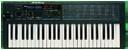
Korg Poly800/EX800 Users group photo

Yahoo Groups archive

Korg Poly800/EX800 Users

Archive for korgpolyex.

Index last updated: 2026-03-30 01:10 UTC

Thread

Modifying SLFO3/4 behavior

Modifying SLFO3/4 behavior

2014-05-16 by Michael Hawkins

I am thinking about moving the sustain pedal decay/sustain offset parameter from 78 to 87 (which is unused at the moment). That will free up 78 to be used as a phase setting for SLFO4. Then I can create the same starting phase position parameter control for SLFO4 the same as I just added to LFO1.

Does anyone have a problem with moving the extended parameter (P2) 78 to P2 87? It would be a problem only for backward compatibility of sysex patch dumps. And also, anyone that has created templates and gui plugins that uses the sustain pedal parameter at 78 would need to move it to 87.

Mike


Re: Modifying SLFO3/4 behavior

2014-05-18 by bperkins211@...

I think I'd probably find more use for the SLFO4 offset feature than the LFO1 offset.. just me I guess.
The LFO1 seems to be so quick most of the time that I hardly notice where in the phase it is starting..
It's the SLFO's phase startpoint that can drive me nuts.

I thought I might also add that I usually use SLFO3 for slow modulations.. any reason why the offset will only be for SLFO4?  Obviously, if I had a vote, I'd say apply it to SLFO3 :-)

Can't see why not use Extended Param. 78 for the SLFO offset.   I have as yet to use the pedal parameter.


Was the Orig. Parameters 57,58,67,68,77,78 ever used for anything?  Just curious.


thanks for the new feature, it should be really interesting to hear them in action.
I will try to update my custom GUI to accommodate these new features when I can get around to it. 

-Blaine

Re: [korgpolyex] Re: Modifying SLFO3/4 behavior

2014-05-19 by Michael Hawkins

If you use sawtooth, it's quite noticeable. Suggest you check out the latest code and see what I mean.

It is possible to improve it further but I won't do so unless people say it would be useful. The phase optionscould be changed from 1-4 to 1-35. Where 1-35 would correspond to 10,20, 30... 330,340,350 degrees. That would give very fine control over the phase starting position. I don't think it's necessary though.

I chose SLFO4 so that altering the parameter positions would be kept to a minimum.

Those parameters you mention  that are not in use were going to be for selecting EG3 or EG4 for control. But, I still haven't reverse engineered and worked out the mathematics of the EG software.

I am still tinkering with the idea of putting a new waveform tone generator into Poly. I think Poly is lacking a good sound generator. So with that in mind, some day, the parameters may have be reordered quite a bit. For now, they seem to work reasonably well.

Mike

On Sunday, May 18, 2014 6:15 PM, "bperkins211@... [korgpolyex]" <korgpolyex@yahoogroups.com> wrote:


I think I'd probably find more use for the SLFO4 offset feature than the LFO1 offset.. just me I guess.
The LFO1 seems to be so quick most of the time that I hardly notice where in the phase it is starting..
It's the SLFO's phase startpoint that can drive me nuts.

I thought I might also add that I usually use SLFO3 for slow modulations.. any reason why the offset will only be for SLFO4?  Obviously, if I had a vote, I'd say apply it to SLFO3 :-)

Can't see why not use Extended Param. 78 for the SLFO offset.   I have as yet to use the pedal parameter.


Was the Orig. Parameters 57,58,67,68,77,78 ever used for anything?  Just curious.


thanks for the new feature, it should be really interesting to hear them in action.
I will try to update my custom GUI to accommodate these new features when I can get around to it. 

-Blaine


Re: [korgpolyex] Re: Modifying SLFO3/4 behavior

2014-05-19 by bperkins211@...

I'm hoping to get around and update the new FW on my HAWK by this weekend to give it a go.

Thanks for all the clarification on what was going on with the parameter #'s.  

I've been studying up on how to program PICs to create simple Osc. waveforms.. there's many open source examples already.
the Electric Druid's waveform pic code could be altered to accept digital control vs. CV without too much trouble, I'd assume.

I'd think a nice simple mod would be to be able to distort the Poly's DCO's prior to the VCF and give it more grit to those blocky/ringy DCO's.

Re: [korgpolyex] Re: Modifying SLFO3/4 behavior

2014-05-19 by Michael Hawkins

My biggest hope for the DCO end of things was to make all voices clocks independent. At the moment, the MSM 5232 chip has two clock inputs. One for four voices and one for the other four. This means that the tonal quality of chords is severely limited by the locked in phase tone generation. Making them independent would allow detuning of all voices. If we can use a super cheap PIC, one for each voice, create some nice waveforms and have independent clocking then I would be very happy indeed.

Keep in mind that the existing master clock that goes into the tone generator is VCO controlled by joystick and modulation. We need to keep all of that intact.

I would like to keep the existing TG in place. And just insert the new TG into the mix(or not). That part is is not difficult when the HAWK is installed because it can be programmed to not turn on the existing TG voices at all (or not). We should also keep the same EG design that uses a VCA technique that plugs 0-5 volt into the MSM5232 to control each voice output level. So the design would require accepting a 0-5 volt signal for VCA control.

Mike

On Monday, May 19, 2014 11:56 AM, "bperkins211@... [korgpolyex]" <korgpolyex@yahoogroups.com> wrote:


I'm hoping to get around and update the new FW on my HAWK by this weekend to give it a go.

Thanks for all the clarification on what was going on with the parameter #'s.  

I've been studying up on how to program PICs to create simple Osc. waveforms.. there's many open source examples already.
the Electric Druid's waveform pic code could be altered to accept digital control vs. CV without too much trouble, I'd assume.

I'd think a nice simple mod would be to be able to distort the Poly's DCO's prior to the VCF and give it more grit to those blocky/ringy DCO's.


Re: [korgpolyex] Re: Modifying SLFO3/4 behavior

2014-05-22 by bperkins211@...

Keep in mind that the existing master clock that goes into the tone generator is VCO controlled by joystick and modulation. We need to keep all of that intact.

VCO?  Did you mean just VC?


We should also keep the same EG design that uses a VCA technique that plugs 0-5 volt into the MSM5232 to control each voice output level. So the design would require accepting a 0-5 volt signal for VCA control.


would you use new DAC's or extend some kind of S&H lines to send the v signal and use the existing DAC?


I'm checking into existing open source coded PICs as voice gen's and cannot seem to find that ONE to be even a little close to the requirements.  I do see the code to get 8bit waveforms to playback and how to make your own, vs. the typical saw/triangle etc waveforms.
Alot like a DW8000 or Kawai K3 is how they can sound, is my guess.

  The 16F pics are dirt cheap and would probably be the best to use for an affordable project that is 6-8voices.

output from the PIC seems to be either PWM for easy connection to a speaker or a filter system for 1 bit conversion.


There are a few ARM uC's used in open source projects.  And there's also a DX7 copy FM uC open project out there as well.   I believe all of them are 8bit waveform outputs.


I would have assumed a daughter board connection into the Poly's Filter IC would be a good "mix" connection for the voices, then relocate the filter IC to the new board.

Re: [korgpolyex] Re: Modifying SLFO3/4 behavior

2014-05-22 by John David Duncan

>
> I'm checking into existing open source coded PICs as voice gen's and
> cannot seem to find that ONE to be even a little close to the
> requirements. I do see the code to get 8bit waveforms to playback
> and how to make your own, vs. the typical saw/triangle etc waveforms.
> Alot like a DW8000 or Kawai K3 is how they can sound, is my guess.
>
> The 16F pics are dirt cheap and would probably be the best to use
> for an affordable project that is 6-8voices.
>
> output from the PIC seems to be either PWM for easy connection to a
> speaker or a filter system for 1 bit conversion.


FreeScale has some 16-bit microcontrollers with built-in RAM, built-in
flash, built-in EEPROM, built in A/D converters, etc., and they sell
them in small quantities for around $10 each. I don't know anything
about building circuits for them or programming them. I just found
them on the web site after I started out looking for DSPs (which are
more like $30 each in quantities of 100s).