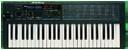
Okay, time to dive into this overly-complicated 5V regulator circuit. Yes,
it's a very good candidate for just unsoldering most of it and replacing it
with a 7805, but somehow that just seems like cheating....
1) It's important to note that we are dealing with two different "ground"
levels here. The ground from the wall wart supply is on the collector of Q1,
while the ground from the batteries (also the ground for the 5V output) is
on the emitter of Q1. If you can run it with batteries but not from an A/C
adapter, there is a good chance that Q1 is not switching on to allow current
through it. It's the negative return path for the power supply current.
2) The only thing between 6-11A and 6-10A is the power switch on the volume
knob, so they should both be 12 or 13 volts when the power is switched on,
using the negative terminal of the A/C adapter or collector of Q1 as a
ground reference. You should get 12 volts all the way over to the emitter of
Q3. On the collector of Q3 (also on 6-6A) is where the +5V should be, using
the collector of Q1 or 6-7A as the ground reference.
3) The thing that switches Q1 on is the 12 volts which needs to get through
D4 to the base of Q1. D4 is a 10 volt zener, so if you don't get at least 10
volts across it, it will be starved and Q1 will never switch on. If you've
got 10 volts across the zener, and 13 volts from 6-10A to the collector of
Q1, then it should turn on and you will only have about 1 volt across
collector to emitter of Q1 (collector is the negative side). If you've got
more like 13 volts from collector to emitter of Q1, then Q1 didn't turn on
and is most likely bad.
4) If you don't have 13V on 6-10A then you probably forgot to turn the synth
on.
5) Q18 is part of the -5V supply and it does get faily warm. The unregulated
13V is used to drive Q17 and Q18 which form an oscillator to convert it back
into AC. This AC signal is stepped down through the transformer into a
full-wave bridge rectifier (D8,9,10,11), then to a zener diode D7. If you
have -5V at 6-8A, then Q18 is probably okay. If not, maybe Q18 is switched
permanently on, or shorted inside. If you have an oscilloscope, try checking
across the transformer to see if the AC signal is there. If not, try the AC
range of your voltmeter across it.
Get some more voltage readings and we'll see where to go from there. If
you've got a diode checker on you meter, take a look at D2 and make sure it
looks good (Turn synth OFF first). Or just use the ohm-meter setting and
make sure it's almost nothing in one direction and really high in the other
(with the power switched off of course).
Don Backshall
_____
Show quoted textHide quoted text
From: korgpolyex@yahoogroups.com [mailto:korgpolyex@yahoogroups.com] On
Behalf Of backshall1 (dsl)
Sent: Monday, December 27, 2010 9:44 AM
To: korgpolyex@yahoogroups.com
Subject: RE: [korgpolyex] Re: korg poly 800 power problem
I think what Mike means here is that if you had batteries installed, and
wired the A/C adapter directly to the same circuit, the higher voltage would
feed back into the batteries, like an unregulated charger, and you can
definitely cause a fire trying to charge non-rechargeable batteries.

  _____
From: korgpolyex@yahoogroups.com [mailto:korgpolyex@yahoogroups.com] On
Behalf Of zoinky420
Sent: Monday, December 27, 2010 1:04 AM
To: korgpolyex@yahoogroups.com
Subject: [korgpolyex] Re: korg poly 800 power problem


--- In korgpolyex@yahoogroups.com <mailto:korgpolyex%40yahoogroups.com> ,
Michael Hawkins <korgpolyex800@...> wrote:
>
> To be frank, wiring a jack to the battery terminals if done incorrectly
could
> cause a battery explosion or fire.
>

Well a wall-wart is a more stable power source than batteries. What do you
mean by 'incorrectly'?