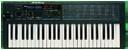
S&H random modulation generation.
2010-01-05 by Russ
"A high frequency sine wave sampled at low frequency will resemble a random number generator.
An infinitely high frequency sine wave sampled at infinitely low frequency would be a true random number generator. Except that since the sample rate is infinitely low, it would take an infinite amount of time to prove it.
;-)
Mike"
Isn't this why a lot of random number generators are called quasi random?
I know on my Moog MG1 if I pull up the random modulation and lopass it just right at certain speeds it is definitely a repeating pattern. I have read elsewhere that the random mod is a S&H circuit. (my aoplogies for bringing up a synth other than the Poly 800, both my polys get used a lot even with a moog and a DX in the studio).
I still plan on getting one of the hawk mods off of you Mike, I have just had a roller coaster of a year. 2010 looks to be better already though. I already fixed a DX27, a realtube preamp andI discovered a stash of vacuum tubes I forgot I had. Found some nice RCA 12ax7's that I cannot believe were just sitting there!
An infinitely high frequency sine wave sampled at infinitely low frequency would be a true random number generator. Except that since the sample rate is infinitely low, it would take an infinite amount of time to prove it.
;-)
Mike"
Isn't this why a lot of random number generators are called quasi random?
I know on my Moog MG1 if I pull up the random modulation and lopass it just right at certain speeds it is definitely a repeating pattern. I have read elsewhere that the random mod is a S&H circuit. (my aoplogies for bringing up a synth other than the Poly 800, both my polys get used a lot even with a moog and a DX in the studio).
I still plan on getting one of the hawk mods off of you Mike, I have just had a roller coaster of a year. 2010 looks to be better already though. I already fixed a DX27, a realtube preamp andI discovered a stash of vacuum tubes I forgot I had. Found some nice RCA 12ax7's that I cannot believe were just sitting there!