I'm no rocket scientist but I did stay at a Holiday Inn once. LOL

But seriously, your suggestion of a third oscillator is a good one.
The problem in the end is going to be two fold. First, how much time
do I/we intend to spend programming this thing and second, how many
CPU cycles can you squeeze out of an 8 bit microprocessor running at
3Mhz. That's right - 3 megahertz. Although we can add quite a few
digital pot's, the real time operations required to control them
requires a certain amount of CPU cycles - cycles that are running out
fast.

As it is right now, I've discovered that some of my code is already
big enough that it causes the envelope generators to slow down. I
don't think that's something that I'm worried about too much because
you can always speed things up again with a little tweak of the EG's
but I now know that there are distinct limitations as to what we're
going to be able to do. The more we add, the more likely we run out of
CPU.

The good news is that I got two Super LFO's working yesterday with
triangle, sawtooth, sine and stepped triangle (based on a waveform
lookup table). Plus, all of them can be inverted so that they first
sweep down instead of up. The frequency is adjustable from about 4hz
thru to a 20 second cycle. The plan is to apply these waveforms to the
LFO1 and or LFO2 frequency, depth and baseline. And also make them
available to the VCF cutoff and resonance levels. This is going to
take quite a bit of time to do though because the mathematics is a
little tricky and the CPU is pretty busy already. I have to write the
code as efficiently as I possibly can. And it's no easy task for this
amateur.

So at this point, I am probably going to try to get the SLFO's working
and later work on send the LFO's or EG3 to the moog slayer. But that
may be the last thing we can squeeze out of the real time code.

That's not to say that there are not a lot of other things to do. For
starters, I have got to get to work on the arpeggiator. Since the
arpeggiator is not nearly so CPU intensive as the real time sound
generation it should be no problem to make it quite sophisticated.

And then there are the many MIDI CC's that need to be added for all of
the parameters. That's also something that won't take many CPU cycles.

So there's still a lot to do and much fun to be had.

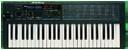
PS: I have seriously contemplated replacing the LED display with a
backlit LCD but I refuse to do it since it just wouldn't be the Poly
800 of the 1980's anymore.

Mike.


--- In korgpolyex@yahoogroups.com, Russ <russdaren@...> wrote:
>
> wow thats pretty impressive! What are you doing for a living? Rocket
Scientist? I mean really, you seem to have thought of everything!
> I am really interested in this digital pot/latching function
> especially if we can just wire it up as we see fit. Might make for
some interesting  hybridized 800s. Maybe add a 3rd osc? I am sure
there is a way to bridge it in there electronically. And if your gizmo
provides the means to make it controlable. Wow.
> Gosh you are going to add so many functions to the beasty it may
need a 4th LED display!
>
>
> ---------------------------------
> Be a better friend, newshound, and know-it-all with Yahoo! Mobile.
Try it now.
>
Message
Re:Moogslayer and the kit...
2008-02-07 by korgpolyex800
Attachments
- No local attachments were found for this message.