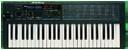
The MSM5232 produces the voices. The 8 voices are grouped into two
groups and the 16', 8', 4' and 2' outputs are provided for the two
groups of voices.

The Poly then has two sets of resister ladders that convert the
outputs into either sqaure wave (where each foot output is mixed
equally) or into a saw tooth (where the 16' is mixed twice as loud as
the 8' is mixed twice as loud as the 4' etc).

Ofcourse, the foot outputs for each group of four voices can be turned
on or off. But not per voice.

The two banks of four voices do have a separate clock input on the
chip. So it is conceivable that you could build a second master clock
and feed it to the second input. But that is too much work and too
expensive. And all you get is two portamento notes instead of one.

We have to keep in mind that this whole reengineering thing is not
designed to make a Poly 800 into a Matrix-12. LOL

However, I am looking to see if I can obtain additional NJM-2069's and
MSM5232's. Because it is not inconceivable that we could build
retrofit boards to provide dual or quad filters and dual or quad OSC's.

Right now though, I just wish I could get my hands on the datasheet
for the MSM5232.

Mike.

--- In korgpolyex@yahoogroups.com, "jure zitnik" <kokoon@...> wrote:
>
> yeah but i'm okay with that. i mean - if you want to turn the
poly-800 into
> a monosynth... you don't need to add any functionalities, just take the
> polyphony away. portamento is an added bonus but if we're talking
monophonic
> then portamento on the master OSC is perfectly okay.
>
> if we could detune each voice separately or to add envelopes so each
voice
> would have its own would be an awesome thing but i guess it's not
possible
> (judging from what you said)
>
> what about alternative waveform options? the way it is now tells me that
> there *are* some possibilities... does anyone know how the thing really
> works?
>
> jure
>
> On 10/18/06, korgpolyex800 <korgpolyex800@...> wrote:
> >
> >   Jure,
> >
> > Looking at the schematics.
> >
> > The joystick and modulation (from the LFO) are fed into the master
> > oscillator. The master OSC is fed to the first four voices and the
> > detuned oscillator goes into the second four voices. The detuning is
> > not an oscillator but rather is a divider/multiplier that takes the
> > master OSC as its input. The detune is just fine tuning around the
> > master OSC.
> >
> > The LFO and Joystick do the major sliding. In the EX800, you can send
> > pitch wheel (to replace the joystick). So there is a D to A converter
> > in there that provides the feed into the master OSC.
> >
> > So portamento could be done with a slide from one octave to the next
> > whereupon the TG would switch octaves while the analog OSC control
> > would reset back to zero and start the slide again on to the next
octave.
> >
> > Thinking about this though, since all of the voices ultimately take
> > their OSC from the master and since there is only one voltage control
> > input to the OSC. We are only going to be able to do single note
> > portamento.
> >
> > Oh well.
> >
> > Mike.
> >
> > --- In korgpolyex@yahoogroups.com <korgpolyex%40yahoogroups.com>,
> > "Alexander" <arf_hotdogdeity@>
> >
> > wrote:
> > >
> > > Mike, just bite the bullet and set it up with an Oberheim-style
> > > modulation matrix ;) (just kidding!)
> > >
> > > If the first bank of four is synced to the master clock any
slides you
> > > do to that are going to affect the second bank as well. I don't
think
> > > this is the case though. From the sound of the oscillators
they've got
> > > separate clocks. In double osc mode with the detune parameter set to
> > > 00 you can occasionally get changes in timbre where the two oscs are
> > > the same frequency but out of phase.
> > >
> > > --- In korgpolyex@yahoogroups.com <korgpolyex%40yahoogroups.com>,
> > "korgpolyex800" <korgpolyex800@>
> > > wrote:
> > > >
> > > > I think you're right.
> > > >
> > > > The first bank of four voices runs off of a master clock and the
> > > > second bank of four voices is detuned from the master.
> > > >
> > > > So unison mono should be able to be either Single (a single
voice) or
> > > > Double mode (two voices detuned from each other). Any more
than that
> > > > is redundant (unless we add a second filter - OK now we're
getting a
> > > > bit out of hand).
> > > >
> > > > Portamento is either mono (one voice only) or double (two
voices per
> > > > note) with up to four sliding notes. Or Poly (up to eight
> > > > simultaneously sliding notes).
> > > >
> > > > And wouldn't it be nice to be able to slide notes from high
side and
> > > > low side into one note - simultaneously. Or apply LFO to
either, one
> > > > inverted to the other.
> > > >
> > > > Wow! This could take a while.
> > > >
> > > > Mike.
> > > >
> > > >
> > > > --- In korgpolyex@yahoogroups.com <korgpolyex%40yahoogroups.com>,
> > "jure zitnik" <kokoon@> wrote:
> > > > >
> > > > > so you mean the non-unison mono mode would still trigger
separate
> > > voices
> > > > > succesively? so, for instance, vca release would take effect and
> > would
> > > > > result in polyphonic effect? personally i wouldn't like that and
> > would
> > > > > prefer mono to behave as a single-osc mono synth... unison
> > > wouldn't make
> > > > > much sense cause the oscillator is a dco and all of them
would be
> > > > constantly
> > > > > hard-synced (you'd notice nothing but increase in loudness?)
> > > > >
> > > > > cheers,
> > > > > jure
> > > > >
> > > > > On 10/16/06, patrioticduo < patrioticduo@> wrote:
> > > > > >
> > > > > > Two great questions with long winded answers.
> > > > > >
> > > > > > First, I think the MSM5232 might be able to do some primitive
> > > > > > frequency slides. I'm just not certain how fine grained
the slide
> > > > > > would be.
> > > > > >
> > > > > > In my searching on the Internet, all I could find on the
> > MSM5232 TG
> > > > > > was emulation C code written by a guy called Jarek Burczynski
> > > for the
> > > > > > MAME project. The MAME project is a freeware Arcade game
emulator.
> > > > > > Jared wrote the emulation for the MSM5232 chip because so many
> > > of the
> > > > > > old arcade games used this chip for sound generation. His code
> > > is not
> > > > > > commented nearly well enough for me to determine just exactly
> > > what the
> > > > > > chip can or cannot do. And to make matters worse, trying to
> > work out
> > > > > > what a chip does from emulation code is kind of backward. I've
> > > called
> > > > > > numerous arcade repairers looking for the datasheet. I've
> > tried OKI
> > > > > > themselves, who were helpful but ultimately failed to
provide a
> > > > > > datasheet. And I've called a couple of other old chip
> > distributors.
> > > > > > All attempts so far have failed.
> > > > > >
> > > > > > I still have some inquiries out there. So hopefully, I will
> > > still get
> > > > > > my hands on the datasheet. In the end though, if I have to
reverse
> > > > > > engineer the thing from scratch then so be it.
> > > > > >
> > > > > > Second, in my opinion mono node will operate in both unison
> > and non
> > > > > > unison modes. And mono mode will be designed to operate
> > closely with
> > > > > > the arpeggiator and the portmento functions. If you enable
> > > unison then
> > > > > > the arpeggiator and portmento functions (if also enabled)
> > operate on
> > > > > > all 8 voices simultaneously. If you enable mono mode without
> > unison
> > > > > > then arpeggiator would be activated per individual voice and
> > > > > > portamento would slide each voice independently as well.
> > > > > >
> > > > > > Right?
> > > > > >
> > > > > > Mike.
> > > > > >
> > > > > >
> > > > > >
> > > > >
> > > >
> > >
> >
> >
> >
>
Message
Re: Mike now uses KorgPolyEx800 as his handle and now has a relaunch
2006-10-18 by patrioticduo
Attachments
- No local attachments were found for this message.