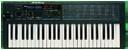
--- In korgpolyex@yahoogroups.com, Manu <g.manu@...> wrote:
>
> Hi,
>
> > I am considering adding some additional features to my Poly 800 and EX
> > 800 that will make them both much more useful in a studio environment.
>
> I don't have better scanned schematics, but.. Can I ask what type of
> extra features are those? :)
>
> Manu
>

Well it all depends on the architecture of the Poly 800. So we can
split the possible features into three groups - midi, front panel and
sound generation.

MIDI
Select local control on off.
Set keyboard transmit channel.
Select respond to MIDI note on off for All, Even, Odd notes only.
(Would allow two Poly's to listen on the same channel and effectively
double polyphony). (This is something I'm building independently on a
small Linux embedded controller)

Front Panel
Parameter Wheel - up or down repetition after holding down the
parameter buttons.
Replace sequencer with arpeggiator (you would enter the arpeggiator
sequence into sequencer memory but the sequence would play with the
current held note as the root).

Sound generation
DEG4 - create an additional DEG and assign 3 to VCF and 4 to Noise VCA.
Increase LFO oscillator range from current max to minimum of around
one cycle per 20 seconds.
LFO polarity change (at the moment it always starts by ramping up but
there are many times where I've wanted it to initially ramp down).

The parameter wheel might be the easiest to do of them all as it
appears that it could be done with some retrofit hardware only.

The MIDI implementation would probably be next easiest to do because
this would involve expanding the RAM and ROM, reverse engineering the
software, and then adding the new functions only. Ok so who said this
would be easy?

The sequencer also requires code reverse engineer and rewrite.

And all of the sound generation stuff depends on the hardware. From
the schematics I have, it looks like the VCA/VCF chip/s might not be
able to support an additional input from a fourth DEG. The same may
apply to the LFO. If the LFO is a real analog then it could be quite
difficult to engineer a wider range and make it software programmable.
But it also might be able to be tinkered with in hardware only which
is less desirable but workable.

Also, from the schematics I have, I cannot quite work out if the
entire address range of the CPU has been used to address the RAM,ROM
and hardware and that will likely be the limitation that makes or
breaks any possibility of doing any sort of code upgrade. So that's
why I'm looking for better schematics.

Cheers,

Mike
Message
Re: Feature upgrade but need high quality schematics
2006-03-19 by patrioticduo
Attachments
- No local attachments were found for this message.