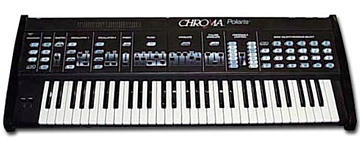
Reprogramming the Polaris -- wish list
2011-04-03 by rob_ocelot
I've noticed recently that a lot of the older CPU-controlled synths are getting upgrades in both software and hardware. Off the top of my head I can name the Roland Jupiter 4/Promars, Jupiter 6, JX-3p/MKS-30, JX-10/MKS-70, Sequential Pro-One, Korg DSS-1, and Polysix.
Would the Polaris benefit from a similar tune up? How easy/difficult would it be to disassemble the 80186 code using a standard Intel disassembler? Is there any documented Polaris code anywhere?
Debugging would be a hassle unless we could write a suitable Polaris emulator (ha!) or perhaps use a hardware EPROM emulator like the Southern Cross.
I'll just note for the record that I *love* the Polaris however it does have some characteristic functional quirks. Would removing or changing these things make it less of a Polaris?
As for what enhancements I'd like to see (both software and hardware) here's my list. Feel free to chime in:
*Slider 'snap' mode toggle:
Moving a slider after changing a patch causes the slider value to 'snap' to the value of the physical slider position which can be somewhat jarring in a live concert situation. One way around this would be to hold the slider value at the current patch value until the physical slider position sweeps though the value in the current patch. I can see merits in both approaches and would like to preserve of the original Polaris functionality if possible.
*Different glide/portamento modes:
Currently the only way to activate glide is via footswitch. It would be nice in some situations to activate it and keep it activated by a membrane panel button combination.
*Expander mode:
This would require a rewrite of how the Polaris allocates voices. Essentially you would hook another Polaris up via MIDI (or Chroma interface) and select expander mode which would grant 12 voice polyphony by selectively sending certain notes to the other Polaris and suppressing others that would normally be sent via MIDI OUT. May be of limited usefulness given that the Polaris already has a damn good voice stealing routine that is very good at hiding the 6 voice polyphony.
*Reverse pitch bend toggle:
Current pitch bend lever behavior is the opposite of what most synth makers have adopted (towards player = pitch down, away from player = pitch up). Reversing this may require hardware modification which makes retaining original functionality more complicated.
*Oscillator Mix:
The Polaris has both oscillators at 100% volume with no way to adjust their levels. Definitely a hardware mod.
*Full Resonance Sweep:
Currently the Polaris has 8 levels of filter resonance provided by a CEM3372. The 3372 however is capable of the entire spectrum of resonance values. Why this method was chosen is unclear but I suspect it might have to do with what is actually pleasing to the ear. As a comparison the Akai AX-60 uses a CEM3394 with the full resonance spectrum -- sweeping through the resonance is very aliased, harsh, and produces a lot of unpredictable (and some would say not pleasing) sounds (this might be an apples vs oranges comparison). Changing this
would require some pretty extensive hardware modification.
*Auxiliary Display:
Kind of a pie-in-the-sky idea but I thought I'd throw it out there. What I envision is an external LCD display with an onboard microcontroller that plugs into the Chroma interface. This would display currently edited parameter names and their values or things like MIDI channel selection that are currently displayed as LED flashes on the membrane panel. Likely not a feasable idea due
to power supply requirements (I don't think the Chroma interface would provide the needed power).
*Aftertouch Control:
Another pie-in-the-sky project. The Polaris MIDI spec responds to both key and channel pressure (channel aftertouch) and routes this information to pedal parameters. It would be an interesting experiment to replace the Polaris keybed with an aftertouch capable one. The easiest way to do this would be to keep the controller keyboard electronics intact and sacrifice the Polaris MIDI IN. If my
reading of the MIDI documentation is correct the Polaris is theoretically capable of receiving polyphonic aftertouch though I'm unsure if the sound engine is capable of dealing with the high volume of data poly aftertouch generates.
Would the Polaris benefit from a similar tune up? How easy/difficult would it be to disassemble the 80186 code using a standard Intel disassembler? Is there any documented Polaris code anywhere?
Debugging would be a hassle unless we could write a suitable Polaris emulator (ha!) or perhaps use a hardware EPROM emulator like the Southern Cross.
I'll just note for the record that I *love* the Polaris however it does have some characteristic functional quirks. Would removing or changing these things make it less of a Polaris?
As for what enhancements I'd like to see (both software and hardware) here's my list. Feel free to chime in:
*Slider 'snap' mode toggle:
Moving a slider after changing a patch causes the slider value to 'snap' to the value of the physical slider position which can be somewhat jarring in a live concert situation. One way around this would be to hold the slider value at the current patch value until the physical slider position sweeps though the value in the current patch. I can see merits in both approaches and would like to preserve of the original Polaris functionality if possible.
*Different glide/portamento modes:
Currently the only way to activate glide is via footswitch. It would be nice in some situations to activate it and keep it activated by a membrane panel button combination.
*Expander mode:
This would require a rewrite of how the Polaris allocates voices. Essentially you would hook another Polaris up via MIDI (or Chroma interface) and select expander mode which would grant 12 voice polyphony by selectively sending certain notes to the other Polaris and suppressing others that would normally be sent via MIDI OUT. May be of limited usefulness given that the Polaris already has a damn good voice stealing routine that is very good at hiding the 6 voice polyphony.
*Reverse pitch bend toggle:
Current pitch bend lever behavior is the opposite of what most synth makers have adopted (towards player = pitch down, away from player = pitch up). Reversing this may require hardware modification which makes retaining original functionality more complicated.
*Oscillator Mix:
The Polaris has both oscillators at 100% volume with no way to adjust their levels. Definitely a hardware mod.
*Full Resonance Sweep:
Currently the Polaris has 8 levels of filter resonance provided by a CEM3372. The 3372 however is capable of the entire spectrum of resonance values. Why this method was chosen is unclear but I suspect it might have to do with what is actually pleasing to the ear. As a comparison the Akai AX-60 uses a CEM3394 with the full resonance spectrum -- sweeping through the resonance is very aliased, harsh, and produces a lot of unpredictable (and some would say not pleasing) sounds (this might be an apples vs oranges comparison). Changing this
would require some pretty extensive hardware modification.
*Auxiliary Display:
Kind of a pie-in-the-sky idea but I thought I'd throw it out there. What I envision is an external LCD display with an onboard microcontroller that plugs into the Chroma interface. This would display currently edited parameter names and their values or things like MIDI channel selection that are currently displayed as LED flashes on the membrane panel. Likely not a feasable idea due
to power supply requirements (I don't think the Chroma interface would provide the needed power).
*Aftertouch Control:
Another pie-in-the-sky project. The Polaris MIDI spec responds to both key and channel pressure (channel aftertouch) and routes this information to pedal parameters. It would be an interesting experiment to replace the Polaris keybed with an aftertouch capable one. The easiest way to do this would be to keep the controller keyboard electronics intact and sacrifice the Polaris MIDI IN. If my
reading of the MIDI documentation is correct the Polaris is theoretically capable of receiving polyphonic aftertouch though I'm unsure if the sound engine is capable of dealing with the high volume of data poly aftertouch generates.
